Downloaded 20 times


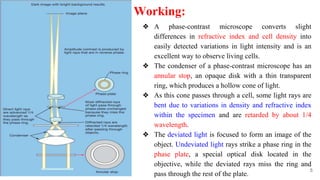
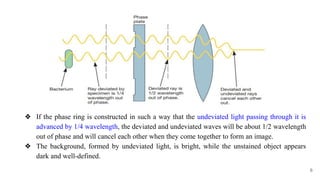


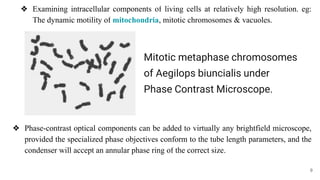


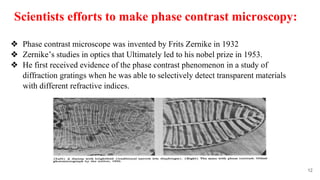


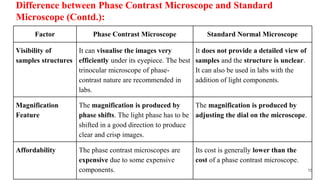


Phase contrast microscopy is a technique that was invented in 1934 by Dutch physicist Frits Zernike, for which he received the Nobel Prize in Physics in 1953. It allows for high-contrast imaging of transparent specimens like living cells without staining. In phase contrast microscopy, variations in the refractive index within a specimen cause some light rays to be retarded, producing an image with areas of different intensities. This converts subtle differences in a sample's density and refractive index into detectable variations in light intensity. Phase contrast microscopy is useful for observing living cells and intracellular structures in their natural state without needing to kill, fix, or stain the specimen. While it provides high resolution living images, it has limitations such as inability to view thick specimens clearly and


