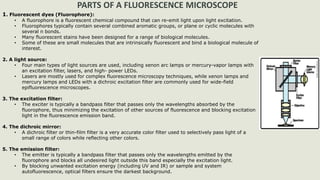
Fluorescence microscopy uses fluorescent dyes and filters to visualize structures that cannot be seen with regular light microscopy. It works by exciting fluorophores in the sample with high intensity light which causes them to emit light of a longer wavelength. This emitted light is then filtered and used to form an image. Fluorescence microscopy allows specific labeling and tracking of molecules and structures within cells. It is widely used today in life sciences research and other fields like histology, food chemistry, and mineralogy. While it provides high sensitivity and specificity, limitations include photobleaching and potential phototoxicity to cells from fluorescent excitation.