BUFFERS
PRESENTED BY, SALMAN KHAN
SAHIL DOGRA
ABHISHA
PRIYOSHA
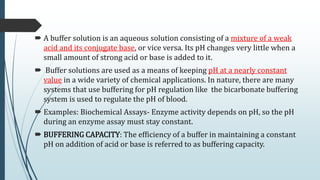
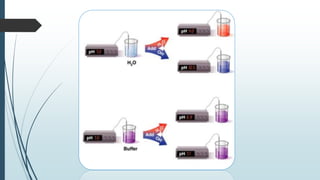
 A buffer solution is an aqueous solution consisting of a mixture of a weak
acid and its conjugate base, or vice versa. Its pH changes very little when a
small amount of strong acid or base is added to it.
 Buffer solutions are used as a means of keeping pH at a nearly constant
value in a wide variety of chemical applications. In nature, there are many
systems that use buffering for pH regulation like the bicarbonate buffering
system is used to regulate the pH of blood.
 Examples: Biochemical Assays- Enzyme activity depends on pH, so the pH
during an enzyme assay must stay constant.
 BUFFERING CAPACITY: The efficiency of a buffer in maintaining a constant
pH on addition of acid or base is referred to as buffering capacity.
NECESSITY OF A BUFFER
Sometimes it is necessary that a solution of a definite pH be prepared
and stored. The preservation of such a solution is even more difficult
than its preparation. If solution comes in contact with air, it will absorb
CO2 and becomes acidic. On the other hand, if solution is stored in a
glass bottle, alkaline impurities from the glass may alter its pH.
Due to these reasons, pharmaceutical solutions are buffered as the
buffer solutions are capable of maintaining pH at some fairly constant
value when even small amounts of acid or base are added.
PRINCIPLE
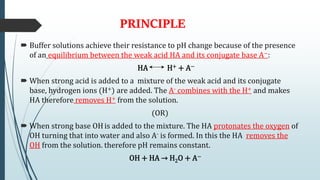
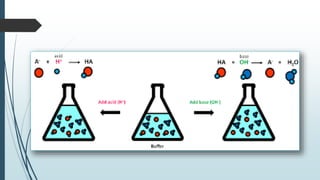
 Buffer solutions achieve their resistance to pH change because of the presence
of an equilibrium between the weak acid HA and its conjugate base A−:
HA H+ + A−
 When strong acid is added to a mixture of the weak acid and its conjugate
base, hydrogen ions (H+) are added. The A- combines with the H+ and makes
HA therefore removes H+ from the solution.
(OR)
 When strong base OHis added to the mixture. The HA protonates the oxygen of
OH turning that into water and also A- is formed. In this the HA removes the
OH from the solution. therefore pH remains constant.
OH + HA → H2O + A−
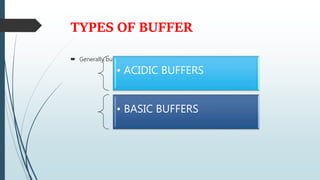
TYPES OF BUFFER
 Generally buffers are of two types:
• ACIDIC BUFFERS
• BASIC BUFFERS
ACIDIC BUFFERS
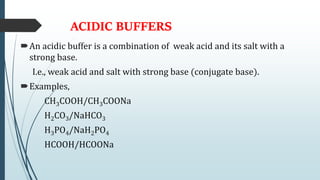
An acidic buffer is a combination of weak acid and its salt with a
strong base.
I.e., weak acid and salt with strong base (conjugate base).
Examples,
CH3COOH/CH3COONa
H2CO3/NaHCO3
H3PO4/NaH2PO4
HCOOH/HCOONa
Mechanism of Action of acidic buffers
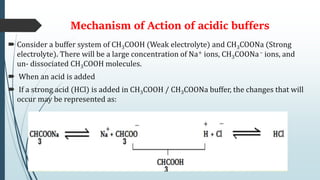
 Consider a buffer system of CH3COOH (Weak electrolyte) and CH3COONa (Strong
electrolyte). There will be a large concentration of Na+ ions, CH3COONa– ions, and
un- dissociated CH3COOH molecules.
 When an acid is added
 If a strong acid (HCl) is added in CH3COOH / CH3COONa buffer, the changes that will
occur may be represented as:
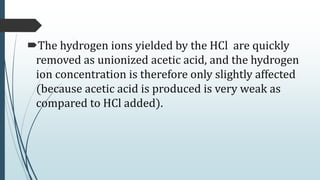
The hydrogen ions yielded by the HCl are quickly
removed as unionized acetic acid, and the hydrogen
ion concentration is therefore only slightly affected
(because acetic acid is produced is very weak as
compared to HCl added).
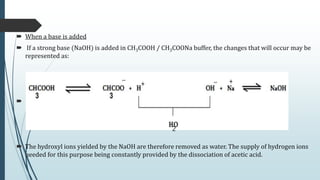
 When a base is added
 If a strong base (NaOH) is added in CH3COOH / CH3COONa buffer, the changes that will occur may be
represented as:

 The hydroxyl ions yielded by the NaOH are therefore removed as water. The supply of hydrogen ions
needed for this purpose being constantly provided by the dissociation of acetic acid.
2
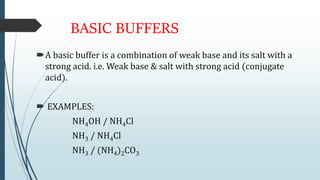
BASIC BUFFERS
A basic buffer is a combination of weak base and its salt with a
strong acid. i.e. Weak base & salt with strong acid (conjugate
acid).
 EXAMPLES:
NH4OH / NH4Cl
NH3 / NH4Cl
NH3 / (NH4)2CO3
Mechanism of Action of basic buffers
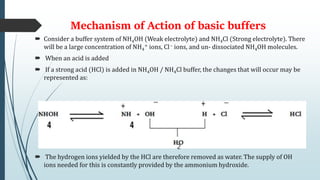
 Consider a buffer system of NH4OH (Weak electrolyte) and NH4Cl (Strong electrolyte). There
will be a large concentration of NH4
+ ions, Cl– ions, and un- dissociated NH4OH molecules.
 When an acid is added
 If a strong acid (HCl) is added in NH4OH / NH4Cl buffer, the changes that will occur may be
represented as:
 The hydrogen ions yielded by the HCl are therefore removed as water. The supply of OH
ions needed for this is constantly provided by the ammonium hydroxide.
2
 When a base is added
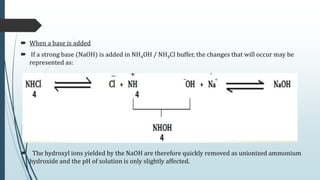
 If a strong base (NaOH) is added in NH4OH / NH4Cl buffer, the changes that will occur may be
represented as:
 The hydroxyl ions yielded by the NaOH are therefore quickly removed as unionized ammonium
hydroxide and the pH of solution is only slightly affected.
- +
Preparing a Buffer Solution
 In the first method, prepare a solution with an acid and its conjugate base by
dissolving the acid form of the buffer in about 60% of the volume of water required
to obtain the final solution volume. Once the pH is correct, dilute the solution to the
final desired volume.
 Alternatively, you can prepare solutions of both the acid form and base form of the
solution. Both solutions must contain the same buffer concentration as the
concentration of the buffer in the final solution. To get the final buffer, add one
solution to the other while monitoring the pH.
 In a third method, you can determine the exact amount of acid and conjugate base
needed to make a buffer of a certain pH, using the Henderson-Hassel Bach equation:
pH=pKa+log([A−]/[HA])
where pH is the concentration of [H+], pKa is the acid dissociation constant, and [
log{A-}] and [ log{HA}] are concentrations of the conjugate base and starting acid.
Common Buffers and Solutions
Carbonate- bicarbonate
Buffer
In a flask,
27.5ml of sodium carbonate
solution
22.5ml of bicarbonate solution.
Total volume is made upto
100ml with distilled water.
pH range – 9.2 to 10.6
Functions
 Commonly used for various immunoassay
applications and for many protein and
antibody conjugation procedures,
including sandwich ELISA, which require
experimental surface coatings.
 Carbonate-bicarbonate buffer is used
extensively in molecular and cell biology,
biochemistry, and in the medical field,
where it is the most commonly used small
intestine buffer.
 It has good buffering capacity and is easy
to prepare, with excellent shelf life.
Functions
Acetate buffer
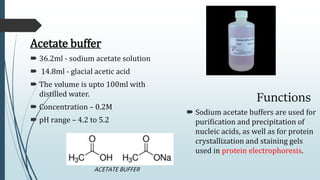
 36.2ml - sodium acetate solution
 14.8ml - glacial acetic acid
 The volume is upto 100ml with
distilled water.
 Concentration – 0.2M
 pH range – 4.2 to 5.2
 Sodium acetate buffers are used for
purification and precipitation of
nucleic acids, as well as for protein
crystallization and staining gels
used in protein electrophoresis.
ACETATE BUFFER
Function
PHOSPHATE BUFFER
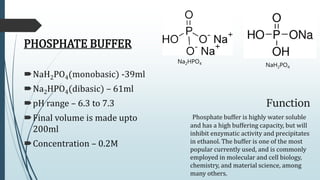
NaH2PO4(monobasic) -39ml
Na2HPO4(dibasic) – 61ml
pH range – 6.3 to 7.3
Final volume is made upto
200ml
Concentration – 0.2M
Phosphate buffer is highly water soluble
and has a high buffering capacity, but will
inhibit enzymatic activity and precipitates
in ethanol. The buffer is one of the most
popular currently used, and is commonly
employed in molecular and cell biology,
chemistry, and material science, among
many others.
Na2HPO4 NaH2PO4
Functions
TBE BUFFER
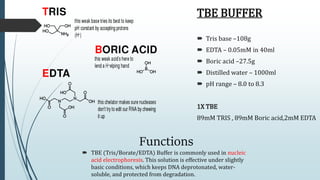
 Tris base –108g
 EDTA – 0.05mM in 40ml
 Boric acid –27.5g
 Distilled water – 1000ml
 pH range – 8.0 to 8.3
1X TBE
89mM TRIS , 89mM Boric acid,2mM EDTA
 TBE (Tris/Borate/EDTA) Buffer is commonly used in nucleic
acid electrophoresis. This solution is effective under slightly
basic conditions, which keeps DNA deprotonated, water-
soluble, and protected from degradation.
Functions
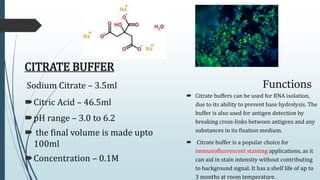
CITRATE BUFFER
Sodium Citrate – 3.5ml
Citric Acid – 46.5ml
pH range – 3.0 to 6.2
 the final volume is made upto
100ml
Concentration – 0.1M
 Citrate buffers can be used for RNA isolation,
due to its ability to prevent base hydrolysis. The
buffer is also used for antigen detection by
breaking cross-links between antigens and any
substances in its fixation medium.
 Citrate buffer is a popular choice for
immunofluorescent staining applications, as it
can aid in stain intensity without contributing
to background signal. It has a shelf life of up to
3 months at room temperature.
APPLICATIONS OF BUFFERS
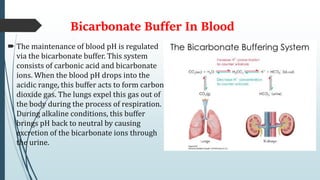
Bicarbonate Buffer In Blood
 The maintenance of blood pH is regulated
via the bicarbonate buffer. This system
consists of carbonic acid and bicarbonate
ions. When the blood pH drops into the
acidic range, this buffer acts to form carbon
dioxide gas. The lungs expel this gas out of
the body during the process of respiration.
During alkaline conditions, this buffer
brings pH back to neutral by causing
excretion of the bicarbonate ions through
the urine.
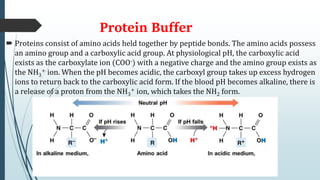
Protein Buffer
 Proteins consist of amino acids held together by peptide bonds. The amino acids possess
an amino group and a carboxylic acid group. At physiological pH, the carboxylic acid
exists as the carboxylate ion (COO-) with a negative charge and the amino group exists as
the NH3
+ ion. When the pH becomes acidic, the carboxyl group takes up excess hydrogen
ions to return back to the carboxylic acid form. If the blood pH becomes alkaline, there is
a release of a proton from the NH3
+ ion, which takes the NH2 form.
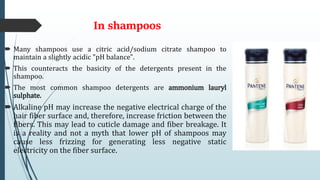
In shampoos
 Many shampoos use a citric acid/sodium citrate shampoo to
maintain a slightly acidic "pH balance".
 This counteracts the basicity of the detergents present in the
shampoo.
 The most common shampoo detergents are ammonium lauryl
sulphate.
 Alkaline pH may increase the negative electrical charge of the
hair fiber surface and, therefore, increase friction between the
fibers. This may lead to cuticle damage and fiber breakage. It
is a reality and not a myth that lower pH of shampoos may
cause less frizzing for generating less negative static
electricity on the fiber surface.
In The Textile Industry
 Dyes in textile industries play an important role in giving color to
different fabrics. Color strength of dyes is closely related to narrow pH
range which is maintained by using different buffer systems above or
below this range will affect the color imparting ability of different
dyes.
 For example, Monosodium phosphate (NaH2PO4) is commonly used to
maintain a low pH for acidic dyeing of textile fibers, whereas
Disodium phosphate(Na2HPO4) is used within a mild alkali range to
dye fabrics that are sensitive to extreme pH conditions.
In Food Industry
 Buffers are used in foods to maintain the acidity of the food in order
to preserve the flavor and appearance of food.
 These additives usually are weak acids or their respective salts
already naturally present in some foods.
 Potassium Citrate is a antioxidant and buffering agent that is found
in a number of food products like cheese, jam, biscuits etc.
 Calcium Citrate is an important acidity regulator that is often used in
carbonated drinks.
 Sodium Citrate is used principally in James and jellies. They are
added to food containing citric acid which creates the buffering
solution. The weak acid and its salt exist in equilibrium and allows
them to resist change in acidity by generating the H+ or reacting
with the H+ and maintaining the pH.
Carbonate Buffer In Nature
 In natural systems, there are many buffers. One that is
important in surface waters is the carbonic acid/bicarbonate
buffer.
 Calcium carbonate, [Ca][CO3] is a very common mineral.
Limestone is one familiar form of calcium carbonate. Acids in
acid rain promote the dissolution of calcium carbonate by
reacting with the carbonate anion.
 This produces a solution of bicarbonate. Because surface
waters are in equilibrium with atmospheric carbon dioxide
there is a constant concentration of carbonic acid, H2CO3, in
the water.
 The presence of limestone and other calcium carbonate rock
in lakes and streams helps to maintain a constant pH because
the minerals react with the excess acid.
THANK YOU

Buffers

  • 1.
    BUFFERS PRESENTED BY, SALMANKHAN SAHIL DOGRA ABHISHA PRIYOSHA
  • 2.
     A buffersolution is an aqueous solution consisting of a mixture of a weak acid and its conjugate base, or vice versa. Its pH changes very little when a small amount of strong acid or base is added to it.  Buffer solutions are used as a means of keeping pH at a nearly constant value in a wide variety of chemical applications. In nature, there are many systems that use buffering for pH regulation like the bicarbonate buffering system is used to regulate the pH of blood.  Examples: Biochemical Assays- Enzyme activity depends on pH, so the pH during an enzyme assay must stay constant.  BUFFERING CAPACITY: The efficiency of a buffer in maintaining a constant pH on addition of acid or base is referred to as buffering capacity.
  • 4.
    NECESSITY OF ABUFFER Sometimes it is necessary that a solution of a definite pH be prepared and stored. The preservation of such a solution is even more difficult than its preparation. If solution comes in contact with air, it will absorb CO2 and becomes acidic. On the other hand, if solution is stored in a glass bottle, alkaline impurities from the glass may alter its pH. Due to these reasons, pharmaceutical solutions are buffered as the buffer solutions are capable of maintaining pH at some fairly constant value when even small amounts of acid or base are added.
  • 5.
    PRINCIPLE  Buffer solutionsachieve their resistance to pH change because of the presence of an equilibrium between the weak acid HA and its conjugate base A−: HA H+ + A−  When strong acid is added to a mixture of the weak acid and its conjugate base, hydrogen ions (H+) are added. The A- combines with the H+ and makes HA therefore removes H+ from the solution. (OR)  When strong base OHis added to the mixture. The HA protonates the oxygen of OH turning that into water and also A- is formed. In this the HA removes the OH from the solution. therefore pH remains constant. OH + HA → H2O + A−
  • 7.
    TYPES OF BUFFER Generally buffers are of two types: • ACIDIC BUFFERS • BASIC BUFFERS
  • 8.
    ACIDIC BUFFERS An acidicbuffer is a combination of weak acid and its salt with a strong base. I.e., weak acid and salt with strong base (conjugate base). Examples, CH3COOH/CH3COONa H2CO3/NaHCO3 H3PO4/NaH2PO4 HCOOH/HCOONa
  • 9.
    Mechanism of Actionof acidic buffers  Consider a buffer system of CH3COOH (Weak electrolyte) and CH3COONa (Strong electrolyte). There will be a large concentration of Na+ ions, CH3COONa– ions, and un- dissociated CH3COOH molecules.  When an acid is added  If a strong acid (HCl) is added in CH3COOH / CH3COONa buffer, the changes that will occur may be represented as:
  • 10.
    The hydrogen ionsyielded by the HCl are quickly removed as unionized acetic acid, and the hydrogen ion concentration is therefore only slightly affected (because acetic acid is produced is very weak as compared to HCl added).
  • 11.
     When abase is added  If a strong base (NaOH) is added in CH3COOH / CH3COONa buffer, the changes that will occur may be represented as:   The hydroxyl ions yielded by the NaOH are therefore removed as water. The supply of hydrogen ions needed for this purpose being constantly provided by the dissociation of acetic acid. 2
  • 12.
    BASIC BUFFERS A basicbuffer is a combination of weak base and its salt with a strong acid. i.e. Weak base & salt with strong acid (conjugate acid).  EXAMPLES: NH4OH / NH4Cl NH3 / NH4Cl NH3 / (NH4)2CO3
  • 13.
    Mechanism of Actionof basic buffers  Consider a buffer system of NH4OH (Weak electrolyte) and NH4Cl (Strong electrolyte). There will be a large concentration of NH4 + ions, Cl– ions, and un- dissociated NH4OH molecules.  When an acid is added  If a strong acid (HCl) is added in NH4OH / NH4Cl buffer, the changes that will occur may be represented as:  The hydrogen ions yielded by the HCl are therefore removed as water. The supply of OH ions needed for this is constantly provided by the ammonium hydroxide. 2
  • 14.
     When abase is added  If a strong base (NaOH) is added in NH4OH / NH4Cl buffer, the changes that will occur may be represented as:  The hydroxyl ions yielded by the NaOH are therefore quickly removed as unionized ammonium hydroxide and the pH of solution is only slightly affected. - +
  • 15.
    Preparing a BufferSolution  In the first method, prepare a solution with an acid and its conjugate base by dissolving the acid form of the buffer in about 60% of the volume of water required to obtain the final solution volume. Once the pH is correct, dilute the solution to the final desired volume.  Alternatively, you can prepare solutions of both the acid form and base form of the solution. Both solutions must contain the same buffer concentration as the concentration of the buffer in the final solution. To get the final buffer, add one solution to the other while monitoring the pH.  In a third method, you can determine the exact amount of acid and conjugate base needed to make a buffer of a certain pH, using the Henderson-Hassel Bach equation: pH=pKa+log([A−]/[HA]) where pH is the concentration of [H+], pKa is the acid dissociation constant, and [ log{A-}] and [ log{HA}] are concentrations of the conjugate base and starting acid.
  • 16.
    Common Buffers andSolutions Carbonate- bicarbonate Buffer In a flask, 27.5ml of sodium carbonate solution 22.5ml of bicarbonate solution. Total volume is made upto 100ml with distilled water. pH range – 9.2 to 10.6 Functions  Commonly used for various immunoassay applications and for many protein and antibody conjugation procedures, including sandwich ELISA, which require experimental surface coatings.  Carbonate-bicarbonate buffer is used extensively in molecular and cell biology, biochemistry, and in the medical field, where it is the most commonly used small intestine buffer.  It has good buffering capacity and is easy to prepare, with excellent shelf life.
  • 17.
    Functions Acetate buffer  36.2ml- sodium acetate solution  14.8ml - glacial acetic acid  The volume is upto 100ml with distilled water.  Concentration – 0.2M  pH range – 4.2 to 5.2  Sodium acetate buffers are used for purification and precipitation of nucleic acids, as well as for protein crystallization and staining gels used in protein electrophoresis. ACETATE BUFFER
  • 18.
    Function PHOSPHATE BUFFER NaH2PO4(monobasic) -39ml Na2HPO4(dibasic)– 61ml pH range – 6.3 to 7.3 Final volume is made upto 200ml Concentration – 0.2M Phosphate buffer is highly water soluble and has a high buffering capacity, but will inhibit enzymatic activity and precipitates in ethanol. The buffer is one of the most popular currently used, and is commonly employed in molecular and cell biology, chemistry, and material science, among many others. Na2HPO4 NaH2PO4
  • 19.
    Functions TBE BUFFER  Trisbase –108g  EDTA – 0.05mM in 40ml  Boric acid –27.5g  Distilled water – 1000ml  pH range – 8.0 to 8.3 1X TBE 89mM TRIS , 89mM Boric acid,2mM EDTA  TBE (Tris/Borate/EDTA) Buffer is commonly used in nucleic acid electrophoresis. This solution is effective under slightly basic conditions, which keeps DNA deprotonated, water- soluble, and protected from degradation.
  • 20.
    Functions CITRATE BUFFER Sodium Citrate– 3.5ml Citric Acid – 46.5ml pH range – 3.0 to 6.2  the final volume is made upto 100ml Concentration – 0.1M  Citrate buffers can be used for RNA isolation, due to its ability to prevent base hydrolysis. The buffer is also used for antigen detection by breaking cross-links between antigens and any substances in its fixation medium.  Citrate buffer is a popular choice for immunofluorescent staining applications, as it can aid in stain intensity without contributing to background signal. It has a shelf life of up to 3 months at room temperature.
  • 21.
  • 22.
    Bicarbonate Buffer InBlood  The maintenance of blood pH is regulated via the bicarbonate buffer. This system consists of carbonic acid and bicarbonate ions. When the blood pH drops into the acidic range, this buffer acts to form carbon dioxide gas. The lungs expel this gas out of the body during the process of respiration. During alkaline conditions, this buffer brings pH back to neutral by causing excretion of the bicarbonate ions through the urine.
  • 23.
    Protein Buffer  Proteinsconsist of amino acids held together by peptide bonds. The amino acids possess an amino group and a carboxylic acid group. At physiological pH, the carboxylic acid exists as the carboxylate ion (COO-) with a negative charge and the amino group exists as the NH3 + ion. When the pH becomes acidic, the carboxyl group takes up excess hydrogen ions to return back to the carboxylic acid form. If the blood pH becomes alkaline, there is a release of a proton from the NH3 + ion, which takes the NH2 form.
  • 24.
    In shampoos  Manyshampoos use a citric acid/sodium citrate shampoo to maintain a slightly acidic "pH balance".  This counteracts the basicity of the detergents present in the shampoo.  The most common shampoo detergents are ammonium lauryl sulphate.  Alkaline pH may increase the negative electrical charge of the hair fiber surface and, therefore, increase friction between the fibers. This may lead to cuticle damage and fiber breakage. It is a reality and not a myth that lower pH of shampoos may cause less frizzing for generating less negative static electricity on the fiber surface.
  • 25.
    In The TextileIndustry  Dyes in textile industries play an important role in giving color to different fabrics. Color strength of dyes is closely related to narrow pH range which is maintained by using different buffer systems above or below this range will affect the color imparting ability of different dyes.  For example, Monosodium phosphate (NaH2PO4) is commonly used to maintain a low pH for acidic dyeing of textile fibers, whereas Disodium phosphate(Na2HPO4) is used within a mild alkali range to dye fabrics that are sensitive to extreme pH conditions.
  • 26.
    In Food Industry Buffers are used in foods to maintain the acidity of the food in order to preserve the flavor and appearance of food.  These additives usually are weak acids or their respective salts already naturally present in some foods.  Potassium Citrate is a antioxidant and buffering agent that is found in a number of food products like cheese, jam, biscuits etc.  Calcium Citrate is an important acidity regulator that is often used in carbonated drinks.  Sodium Citrate is used principally in James and jellies. They are added to food containing citric acid which creates the buffering solution. The weak acid and its salt exist in equilibrium and allows them to resist change in acidity by generating the H+ or reacting with the H+ and maintaining the pH.
  • 27.
    Carbonate Buffer InNature  In natural systems, there are many buffers. One that is important in surface waters is the carbonic acid/bicarbonate buffer.  Calcium carbonate, [Ca][CO3] is a very common mineral. Limestone is one familiar form of calcium carbonate. Acids in acid rain promote the dissolution of calcium carbonate by reacting with the carbonate anion.  This produces a solution of bicarbonate. Because surface waters are in equilibrium with atmospheric carbon dioxide there is a constant concentration of carbonic acid, H2CO3, in the water.  The presence of limestone and other calcium carbonate rock in lakes and streams helps to maintain a constant pH because the minerals react with the excess acid.
  • 28.