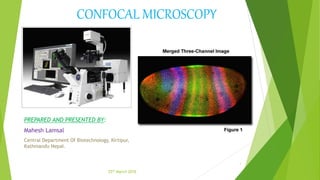
CONFOCAL MICROSCOPY
PREPARED AND PRESENTED BY:
Mahesh Lamsal
Central Department Of Biotechnology, Kirtipur,
Kathmandu Nepal.
1
25th March 2016
SLIDES INCLUDE
 Introduction
 History
 Instrumental design
 Principle
 Working mechanism
 Applications
 Advantages
 Limitations
 References
2
INTRODUCTION
Confocal microscopy : (having the same focus )
 An optical imaging technique for increasing optical resolution and contrast
of a micrograph.
 Radiations emitted from laser cause sample to fluoresce.
 Uses pinhole screen to produce high resolution images.
 Eliminates out of focus.
 So images have better contrast and are less hazy.
 A series of thin slices of the specimen are assembled to generate a 3-
dimensinal image.
 Is an updated version of fluorescence microscopy.
3
HISTORY
 Two investigators at Cambridge, Brad Amos and John
White attempted to look at the mitotic divisions in the
first few divisions in embryos of C. elegans.
 They were doing antitubulin immunofluorescence and
were trying to determine the cleavage planes of the
cells,
 but were frustrated in their attempt in that the majority
of the fluorescence they observed was out of focus.
 They looked at the technique called confocal
imaging which was first proposed by Nipkow and
pioneered by a postdoc at Harvard named Minsky.
 He made the first stage scanning confocal microscope in
1957.
 By illuminating single point at a time, Minsky avoided
most of the unwanted scattered light.
 For builiding the image, Minsky scanned the specimen by
moving the stage rather than light rays.
4
Marvin Minsky
INSTRUMENTAL DESIGN
5
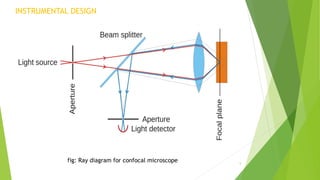
fig: Ray diagram for confocal microscope
6
fig: schematic diagram confocal microscope
PRINCIPLE
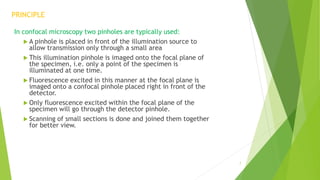
In confocal microscopy two pinholes are typically used:
 A pinhole is placed in front of the illumination source to
allow transmission only through a small area
 This illumination pinhole is imaged onto the focal plane of
the specimen, i.e. only a point of the specimen is
illuminated at one time.
 Fluorescence excited in this manner at the focal plane is
imaged onto a confocal pinhole placed right in front of the
detector.
 Only fluorescence excited within the focal plane of the
specimen will go through the detector pinhole.
 Scanning of small sections is done and joined them together
for better view.
7
WORKING MECHANISM
Confocal microscope incorporates 2 ideas:
1. Point-by-point illumination of the specimen.
2. Rejection of out of focus of light.
Light source of very high intensity is used—Zirconium arc lamp in Minsky’s
design & laser light source in modern design.
a)Laser provides intense blue excitation light.
b)The light reflects off a dichoric mirror, which directs it to an assembly of
vertically and horizontally scanning mirrors.
c)These motor driven mirrors scan the laser beam across the specimen.
d) The specimen is scanned by moving the stage back & forth in the vertical
& horizontal directions and optics are kept stationary.
8
Contd….
 Dye in the specimen is excited by the laser light & fluoresces.
 The fluorescent (green) light is descanned by the same mirrors that are
used to scan the excitation (blue) light from the laser beam
 then it passes through the dichoric mirror
 then it is focused on to pinhole.
 the light passing through the pinhole is measured by the detector such
as photomultiplier tube.
 For visualization, detector is attached to the computer, which builds up
the image at the rate of 0.1-1 second for single image
9
APPLICATIONS
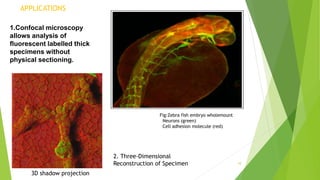
1.Confocal microscopy
allows analysis of
fluorescent labelled thick
specimens without
physical sectioning.
10
Fig:Zebra fish embryo wholemount
Neurons (green)
Cell adhesion molecule (red)
2. Three-Dimensional
Reconstruction of Specimen
3D shadow projection
11
Because the images are detected
by a computer rather than by eye,
it is possible to detect more color
differences.
3. More Colour Possibilities
APPLICATIONS
12
Fig:An Intestine Section
Fig: Kidney cells (fluorescence vs Confocal microscope
4. Improved Resolution
13
Fig: Colour coded image of actin filaments in a cancer cell
ADVANTAGES
 The specimen is everywhere illuminated axially, rather than at
different angles, thereby avoiding optical aberrations.
 Entire field of view is illuminated uniformly.
 The field of view can be made larger than that of the static objective
by controlling the amplitude of the stage movements.
 Image formed are of better resolution.
 Cells can be live or fixed.
 Serial optical sections can be collected.
 Taking a series of optical slices from different focus levels in the
specimen generates a 3D data set.
14
DRAWBACKS
 Resolution : It has inherent resolution limitation due to diffraction.
Maximum best resolution of confocal microscopy is typically about
200nm.
 Pin hole size : Strength of optical sectioning depends on the size of
the pinhole.
 Intensity of the incident light
 Fluorophores :
 a)The fluorophore should tag the correct part of the
specimen.
 b)Fluorophore should be sensitive enough for the given excitation
wave length.
 c)It should not significantly alter the dynamics of the organism in the
living specimen.
 Photobleaching: photochemical alteration of a dye or a fluorophore
molecule such that it permanently is unable to fluoresce 15
REFERENCES
 Pawley JB (editor) (2006). Handbook of Biological Confocal
Microscopy (3rd ed.). Berlin: Springer. ISBN 0-387-25921-X
 Confocal Microscopy - The Comprehensive Explanation
 www.microscopyu.com
 Marvin Minsky (1988). "Memoir on inventing the confocal scanning
microscope". Scanning10 (4): 128–138. doi:10.1002/sca.4950100403.
16
17

Confocal microscopy

  • 1.
    CONFOCAL MICROSCOPY PREPARED ANDPRESENTED BY: Mahesh Lamsal Central Department Of Biotechnology, Kirtipur, Kathmandu Nepal. 1 25th March 2016
  • 2.
    SLIDES INCLUDE  Introduction History  Instrumental design  Principle  Working mechanism  Applications  Advantages  Limitations  References 2
  • 3.
    INTRODUCTION Confocal microscopy :(having the same focus )  An optical imaging technique for increasing optical resolution and contrast of a micrograph.  Radiations emitted from laser cause sample to fluoresce.  Uses pinhole screen to produce high resolution images.  Eliminates out of focus.  So images have better contrast and are less hazy.  A series of thin slices of the specimen are assembled to generate a 3- dimensinal image.  Is an updated version of fluorescence microscopy. 3
  • 4.
    HISTORY  Two investigatorsat Cambridge, Brad Amos and John White attempted to look at the mitotic divisions in the first few divisions in embryos of C. elegans.  They were doing antitubulin immunofluorescence and were trying to determine the cleavage planes of the cells,  but were frustrated in their attempt in that the majority of the fluorescence they observed was out of focus.  They looked at the technique called confocal imaging which was first proposed by Nipkow and pioneered by a postdoc at Harvard named Minsky.  He made the first stage scanning confocal microscope in 1957.  By illuminating single point at a time, Minsky avoided most of the unwanted scattered light.  For builiding the image, Minsky scanned the specimen by moving the stage rather than light rays. 4 Marvin Minsky
  • 5.
    INSTRUMENTAL DESIGN 5 fig: Raydiagram for confocal microscope
  • 6.
    6 fig: schematic diagramconfocal microscope
  • 7.
    PRINCIPLE In confocal microscopytwo pinholes are typically used:  A pinhole is placed in front of the illumination source to allow transmission only through a small area  This illumination pinhole is imaged onto the focal plane of the specimen, i.e. only a point of the specimen is illuminated at one time.  Fluorescence excited in this manner at the focal plane is imaged onto a confocal pinhole placed right in front of the detector.  Only fluorescence excited within the focal plane of the specimen will go through the detector pinhole.  Scanning of small sections is done and joined them together for better view. 7
  • 8.
    WORKING MECHANISM Confocal microscopeincorporates 2 ideas: 1. Point-by-point illumination of the specimen. 2. Rejection of out of focus of light. Light source of very high intensity is used—Zirconium arc lamp in Minsky’s design & laser light source in modern design. a)Laser provides intense blue excitation light. b)The light reflects off a dichoric mirror, which directs it to an assembly of vertically and horizontally scanning mirrors. c)These motor driven mirrors scan the laser beam across the specimen. d) The specimen is scanned by moving the stage back & forth in the vertical & horizontal directions and optics are kept stationary. 8
  • 9.
    Contd….  Dye inthe specimen is excited by the laser light & fluoresces.  The fluorescent (green) light is descanned by the same mirrors that are used to scan the excitation (blue) light from the laser beam  then it passes through the dichoric mirror  then it is focused on to pinhole.  the light passing through the pinhole is measured by the detector such as photomultiplier tube.  For visualization, detector is attached to the computer, which builds up the image at the rate of 0.1-1 second for single image 9
  • 10.
    APPLICATIONS 1.Confocal microscopy allows analysisof fluorescent labelled thick specimens without physical sectioning. 10 Fig:Zebra fish embryo wholemount Neurons (green) Cell adhesion molecule (red) 2. Three-Dimensional Reconstruction of Specimen 3D shadow projection
  • 11.
    11 Because the imagesare detected by a computer rather than by eye, it is possible to detect more color differences. 3. More Colour Possibilities
  • 12.
    APPLICATIONS 12 Fig:An Intestine Section Fig:Kidney cells (fluorescence vs Confocal microscope 4. Improved Resolution
  • 13.
    13 Fig: Colour codedimage of actin filaments in a cancer cell
  • 14.
    ADVANTAGES  The specimenis everywhere illuminated axially, rather than at different angles, thereby avoiding optical aberrations.  Entire field of view is illuminated uniformly.  The field of view can be made larger than that of the static objective by controlling the amplitude of the stage movements.  Image formed are of better resolution.  Cells can be live or fixed.  Serial optical sections can be collected.  Taking a series of optical slices from different focus levels in the specimen generates a 3D data set. 14
  • 15.
    DRAWBACKS  Resolution :It has inherent resolution limitation due to diffraction. Maximum best resolution of confocal microscopy is typically about 200nm.  Pin hole size : Strength of optical sectioning depends on the size of the pinhole.  Intensity of the incident light  Fluorophores :  a)The fluorophore should tag the correct part of the specimen.  b)Fluorophore should be sensitive enough for the given excitation wave length.  c)It should not significantly alter the dynamics of the organism in the living specimen.  Photobleaching: photochemical alteration of a dye or a fluorophore molecule such that it permanently is unable to fluoresce 15
  • 16.
    REFERENCES  Pawley JB(editor) (2006). Handbook of Biological Confocal Microscopy (3rd ed.). Berlin: Springer. ISBN 0-387-25921-X  Confocal Microscopy - The Comprehensive Explanation  www.microscopyu.com  Marvin Minsky (1988). "Memoir on inventing the confocal scanning microscope". Scanning10 (4): 128–138. doi:10.1002/sca.4950100403. 16
  • 17.