Bright field Microscope
&
Dark field Microscope
Bright Field Microscope
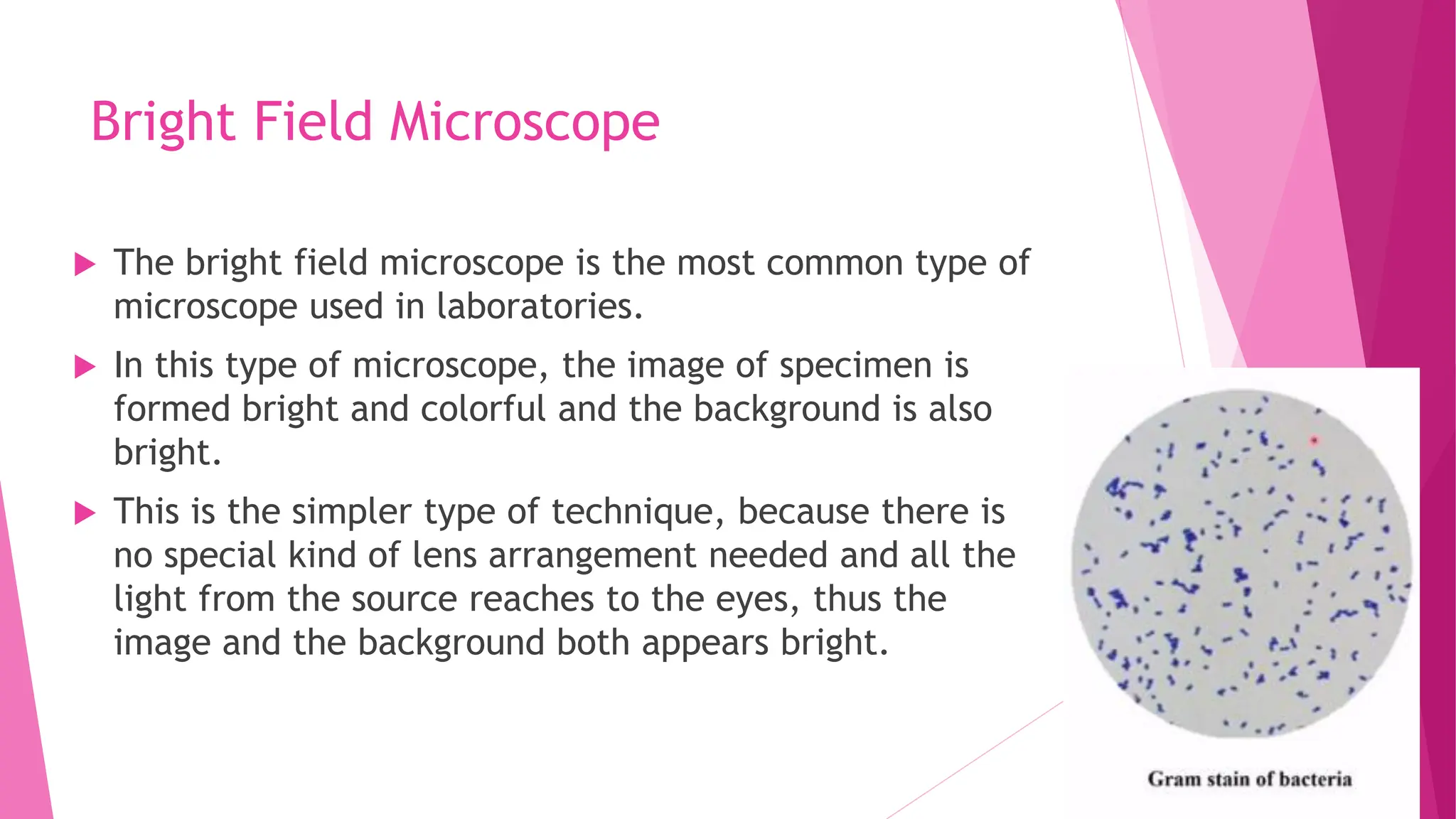
 The bright field microscope is the most common type of
microscope used in laboratories.
 In this type of microscope, the image of specimen is
formed bright and colorful and the background is also
bright.
 This is the simpler type of technique, because there is
no special kind of lens arrangement needed and all the
light from the source reaches to the eyes, thus the
image and the background both appears bright.
 But staining is required at the time of slide
preparation because ordinarily microorganisms
are colorless and do not absorb much light to
create contrast in the image.
 So the staining greatly increases the light
absorbing ability of specimen cells to create a
better contrast and color differentiation to
different cell organelles.
Principle of Bright field Microscope
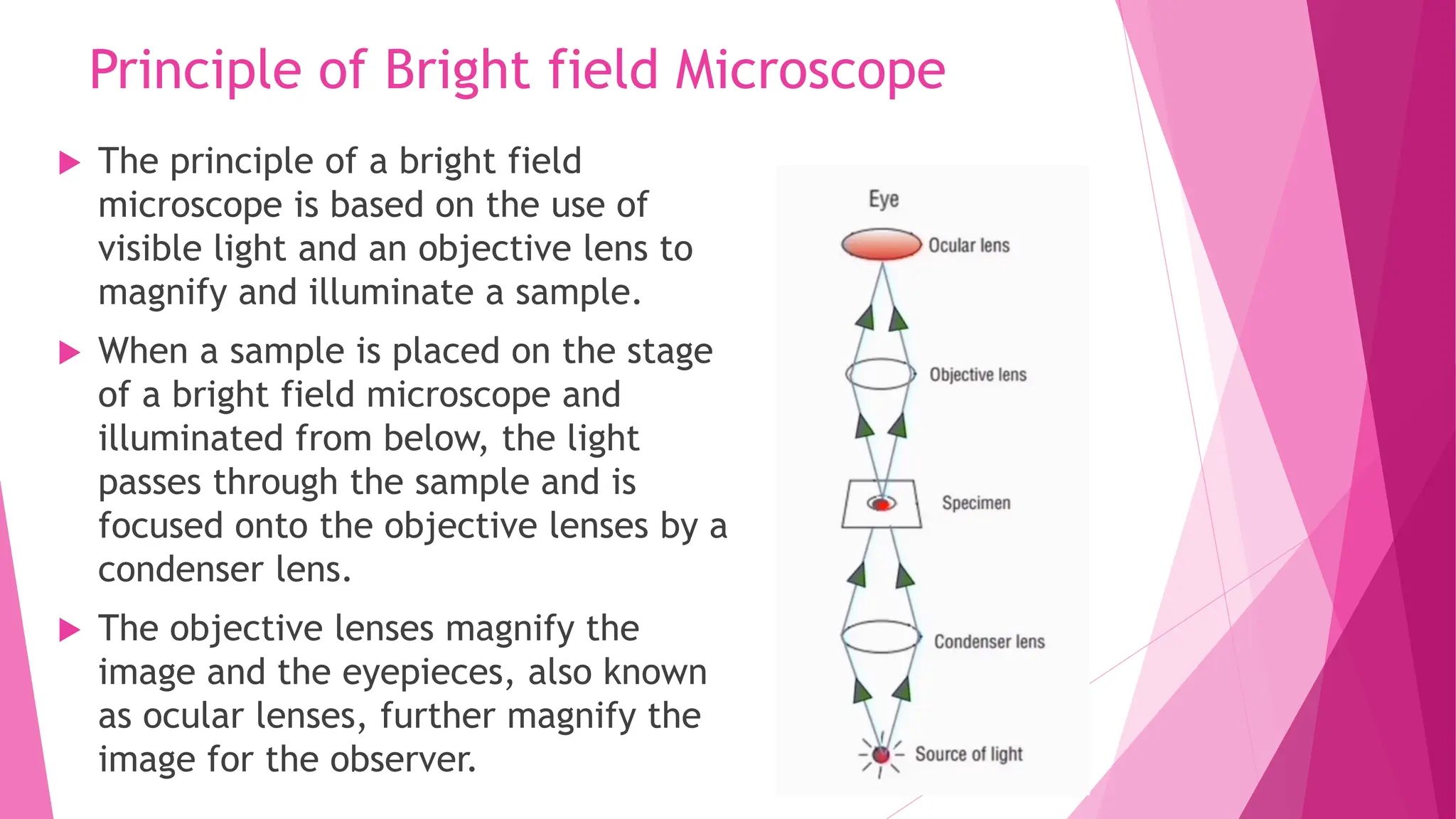
 The principle of a bright field
microscope is based on the use of
visible light and an objective lens to
magnify and illuminate a sample.
 When a sample is placed on the stage
of a bright field microscope and
illuminated from below, the light
passes through the sample and is
focused onto the objective lenses by a
condenser lens.
 The objective lenses magnify the
image and the eyepieces, also known
as ocular lenses, further magnify the
image for the observer.
Application of Bright field Microscope
1. Biology and medicine: Bright field microscopes are commonly used in
biology and medicine to observe cells, tissues, and other biological
samples. They are used to study the structure and function of cells,
tissues, and organisms, as well as to identify and classify different
types of cells or tissues.
2. Pharmaceutical industry: Bright field microscopes are used in the
pharmaceutical industry to analyzed the purity and quality of drugs.
They can be used to identify contaminants or impurities in drug
samples and to ensure that the drugs meet quality standards.
3. Food industry: Bright field microscopes are used in the food industry
to detect contaminants or defects in food products. They can be used
to inspect food products for bacteria, fungi, or other contaminants that
may pose a health risk.
Advantages of Bright field Microscope
 Bright-field microscopes are widely available and can be
found in many research and educational labs, making them a
convenient choice for many scientists and students.
 The brightness and contrast of the image can be easily
adjusted using the light source and condenser, making it easy
to optimize the image for different samples.
 The optics of the microscope do not alter the color of the
specimen.
Disadvantages of Bright field Microscope
 It cannot be used to view live specimens such as bacterial
cells. Only fixed specimens can be viewed under the bright
field microscope.
 It has low contrast hence most specimens must be stained
for them to be visualized.
 Staining may introduce unwanted details into the specimen
or contaminate the specimen.
 It is tedious to stain the specimen before visualizing it
under the bright field microscope.
 The microscope needs a strong light source for
magnification and sometimes the light source may produce
a lot of heat which may damage or kill the specimen.
Dark Field Microscope
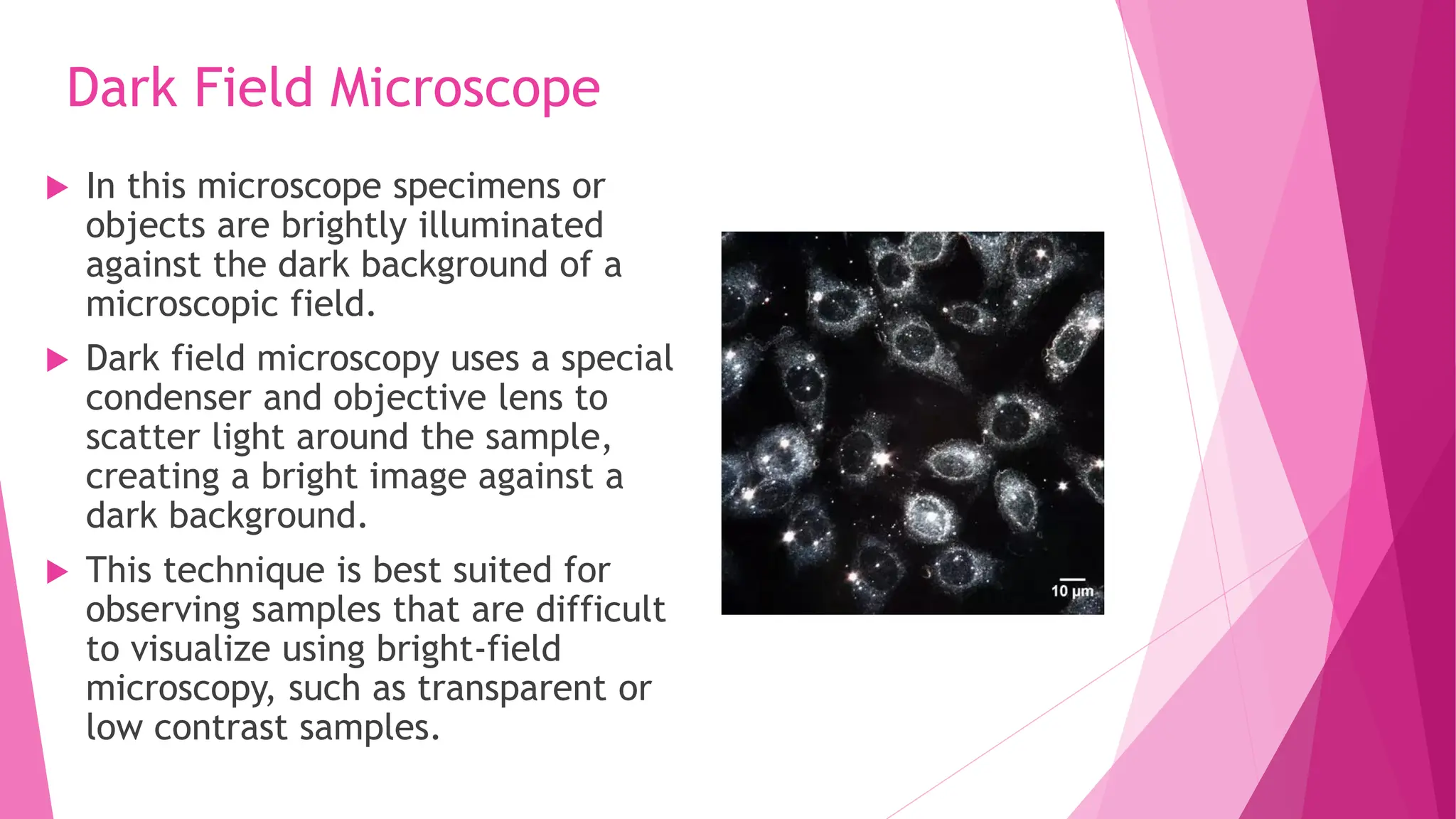
 In this microscope specimens or
objects are brightly illuminated
against the dark background of a
microscopic field.
 Dark field microscopy uses a special
condenser and objective lens to
scatter light around the sample,
creating a bright image against a
dark background.
 This technique is best suited for
observing samples that are difficult
to visualize using bright-field
microscopy, such as transparent or
low contrast samples.
Principle of Dark field Microscopy
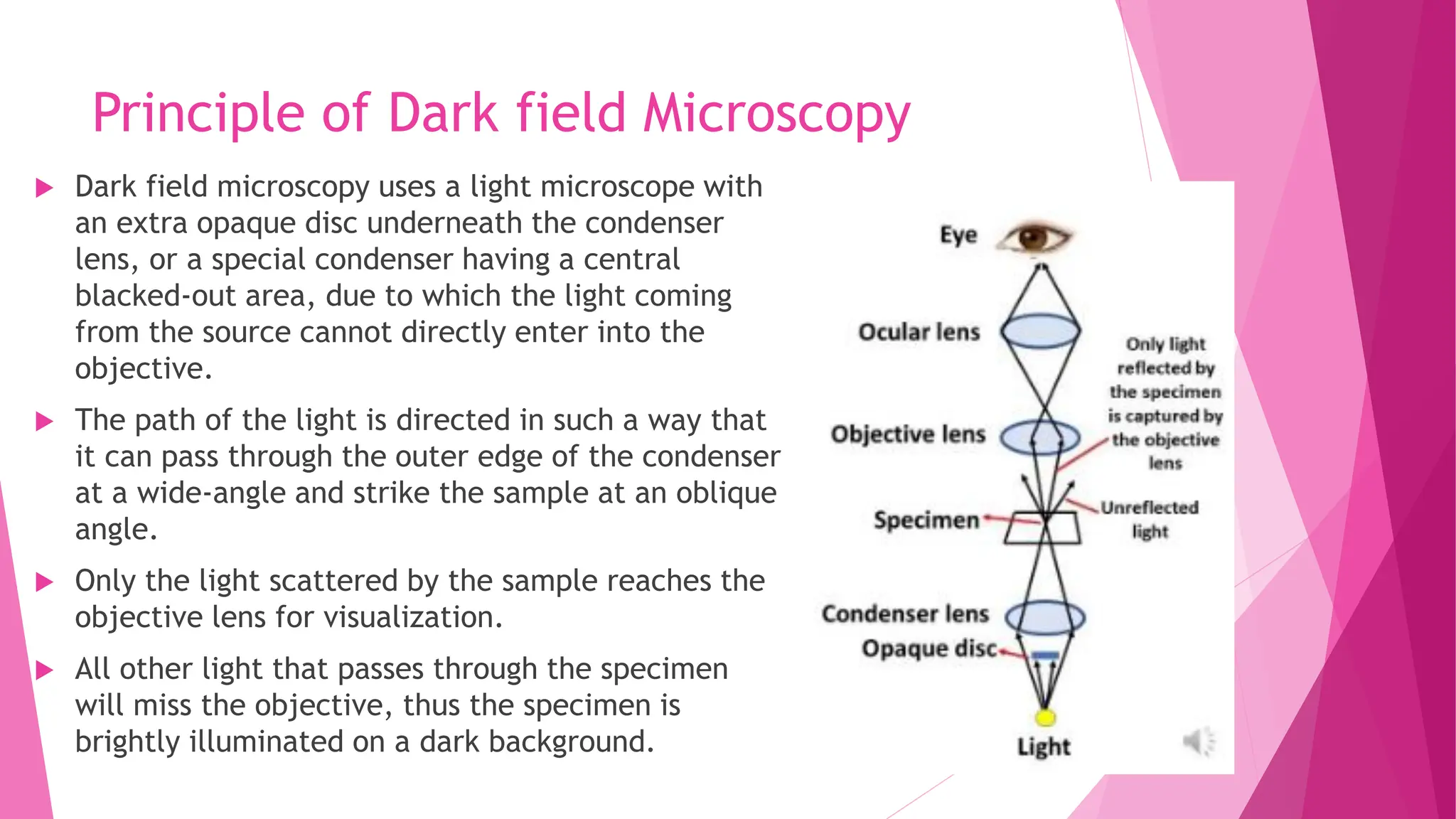
 Dark field microscopy uses a light microscope with
an extra opaque disc underneath the condenser
lens, or a special condenser having a central
blacked-out area, due to which the light coming
from the source cannot directly enter into the
objective.
 The path of the light is directed in such a way that
it can pass through the outer edge of the condenser
at a wide-angle and strike the sample at an oblique
angle.
 Only the light scattered by the sample reaches the
objective lens for visualization.
 All other light that passes through the specimen
will miss the objective, thus the specimen is
brightly illuminated on a dark background.
Application of Dark field Microscope
 We can observe the living and unstained cells by using a
dark field microscope.
 Considerable internal structure can be revealed by the
dark field microscope.
 It is useful to study the external structure of the specimen
in great detail.
 Observation of microbial motility; tufts of bacterial
flagella can often be seen in unstained cells by dark-field
microscopes.
 Observation of internal structure in larger eukaryotic
microorganisms such as algae, yeasts, etc.
Advantages of Dark-field Microscope
 No need to stain the specimen.
 Resolution by dark field microscopy is somewhat better
than bright-field microscopy.
 Improves image contrast without the use of stain, and
thus do not kill the cells.
 Direct detection of non-culturable bacteria present in
patient samples.
Limitations of Dark field Microscopes
 It is very sensitive to dust. A small amount of dust
will already light up on the dark background.
 The sample must be very strongly illuminated,
which can cause damage to the samples.
Dark field Microscope Images
Red blood cells as seen by darkfield
microscopy x 1000
Dark field image of a
microscopic water
mite larva
Radiolarians single cell
plankton live in the ocean and
form silica shells 400X
Darkfield microscopy

Bright field microscope and dark field microscope.pdf

  • 1.
  • 2.
    Bright Field Microscope The bright field microscope is the most common type of microscope used in laboratories.  In this type of microscope, the image of specimen is formed bright and colorful and the background is also bright.  This is the simpler type of technique, because there is no special kind of lens arrangement needed and all the light from the source reaches to the eyes, thus the image and the background both appears bright.
  • 3.
     But stainingis required at the time of slide preparation because ordinarily microorganisms are colorless and do not absorb much light to create contrast in the image.  So the staining greatly increases the light absorbing ability of specimen cells to create a better contrast and color differentiation to different cell organelles.
  • 4.
    Principle of Brightfield Microscope  The principle of a bright field microscope is based on the use of visible light and an objective lens to magnify and illuminate a sample.  When a sample is placed on the stage of a bright field microscope and illuminated from below, the light passes through the sample and is focused onto the objective lenses by a condenser lens.  The objective lenses magnify the image and the eyepieces, also known as ocular lenses, further magnify the image for the observer.
  • 5.
    Application of Brightfield Microscope 1. Biology and medicine: Bright field microscopes are commonly used in biology and medicine to observe cells, tissues, and other biological samples. They are used to study the structure and function of cells, tissues, and organisms, as well as to identify and classify different types of cells or tissues. 2. Pharmaceutical industry: Bright field microscopes are used in the pharmaceutical industry to analyzed the purity and quality of drugs. They can be used to identify contaminants or impurities in drug samples and to ensure that the drugs meet quality standards. 3. Food industry: Bright field microscopes are used in the food industry to detect contaminants or defects in food products. They can be used to inspect food products for bacteria, fungi, or other contaminants that may pose a health risk.
  • 6.
    Advantages of Brightfield Microscope  Bright-field microscopes are widely available and can be found in many research and educational labs, making them a convenient choice for many scientists and students.  The brightness and contrast of the image can be easily adjusted using the light source and condenser, making it easy to optimize the image for different samples.  The optics of the microscope do not alter the color of the specimen.
  • 7.
    Disadvantages of Brightfield Microscope  It cannot be used to view live specimens such as bacterial cells. Only fixed specimens can be viewed under the bright field microscope.  It has low contrast hence most specimens must be stained for them to be visualized.  Staining may introduce unwanted details into the specimen or contaminate the specimen.  It is tedious to stain the specimen before visualizing it under the bright field microscope.  The microscope needs a strong light source for magnification and sometimes the light source may produce a lot of heat which may damage or kill the specimen.
  • 9.
    Dark Field Microscope In this microscope specimens or objects are brightly illuminated against the dark background of a microscopic field.  Dark field microscopy uses a special condenser and objective lens to scatter light around the sample, creating a bright image against a dark background.  This technique is best suited for observing samples that are difficult to visualize using bright-field microscopy, such as transparent or low contrast samples.
  • 10.
    Principle of Darkfield Microscopy  Dark field microscopy uses a light microscope with an extra opaque disc underneath the condenser lens, or a special condenser having a central blacked-out area, due to which the light coming from the source cannot directly enter into the objective.  The path of the light is directed in such a way that it can pass through the outer edge of the condenser at a wide-angle and strike the sample at an oblique angle.  Only the light scattered by the sample reaches the objective lens for visualization.  All other light that passes through the specimen will miss the objective, thus the specimen is brightly illuminated on a dark background.
  • 11.
    Application of Darkfield Microscope  We can observe the living and unstained cells by using a dark field microscope.  Considerable internal structure can be revealed by the dark field microscope.  It is useful to study the external structure of the specimen in great detail.  Observation of microbial motility; tufts of bacterial flagella can often be seen in unstained cells by dark-field microscopes.  Observation of internal structure in larger eukaryotic microorganisms such as algae, yeasts, etc.
  • 12.
    Advantages of Dark-fieldMicroscope  No need to stain the specimen.  Resolution by dark field microscopy is somewhat better than bright-field microscopy.  Improves image contrast without the use of stain, and thus do not kill the cells.  Direct detection of non-culturable bacteria present in patient samples.
  • 13.
    Limitations of Darkfield Microscopes  It is very sensitive to dust. A small amount of dust will already light up on the dark background.  The sample must be very strongly illuminated, which can cause damage to the samples.
  • 14.
    Dark field MicroscopeImages Red blood cells as seen by darkfield microscopy x 1000 Dark field image of a microscopic water mite larva Radiolarians single cell plankton live in the ocean and form silica shells 400X Darkfield microscopy