Horizontal Gene Transfer With
Gene Mapping Presented by,
Anish chhillar
Anu Chaudhary
R Ajay Rajaram
Salman Khan
INTRODUCTION
● Gene transfer is defined as the movement of genetic information
between the organisms.
● There are two types of gene transfer methods. They are:
○ Vertical gene transfer - Transfer of genes from parents to offsprings.
○ Horizontal gene transfer - Transfer of genes between two independent
organisms.
● Horizontal gene transfer is common in prokaryotes.
● There are three types of horizontal gene transfer in prokaryotes. They
are:
○ Transformation
○ Transduction
○ Conjugation
TRANSFORMATION
● Transformation is the uptake of a naked DNA molecule or fragment from
the surrounding environment by a cell and the incorporation of this
molecule into the chromosome of the recipient.
● Transformation was discovered by Fred Griffith in 1928
● Frederick Griffith suggested that bacterial strains are capable of
transforming themselves by some factors, which he termed “transforming
principle”.
● Sixteen years later, Oswald Avery, Colin MacLeod and Maclyn M cCarty
demonstrated that transforming principle was the DNA, which provided
evidence that DNA is the genetic material of bacterial cell.
Griffith experiment
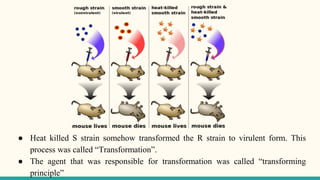
● Griffith worked on bacterium Diplococcus pneumonia which is
associated with certain types of pneumonia. This bacteria occurs in two
forms.
● The first form has smooth (s) cells which secrete a covering capsule
made-up of polysaccharide causing the colonies to be smooth and
shiny.This type of strain is virulent. It produces pneumonia in mice.
● The second type has rough (R) cells which lack the polysaccharide
capsule and colonies appear rough. This type is non virulent and it does
not cause pneumonia in mice.
● Heat killed S strain somehow transformed the R strain to virulent form. This
process was called “Transformation”.
● The agent that was responsible for transformation was called “transforming
principle”
Process of Transformation
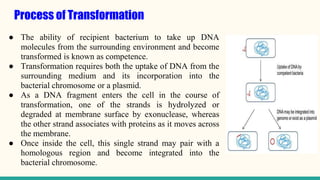
● The ability of recipient bacterium to take up DNA
molecules from the surrounding environment and become
transformed is known as competence.
● Transformation requires both the uptake of DNA from the
surrounding medium and its incorporation into the
bacterial chromosome or a plasmid.
● As a DNA fragment enters the cell in the course of
transformation, one of the strands is hydrolyzed or
degraded at membrane surface by exonuclease, whereas
the other strand associates with proteins as it moves across
the membrane.
● Once inside the cell, this single strand may pair with a
homologous region and become integrated into the
bacterial chromosome.
Gram positive vs gram negative
● The Gram positive bacterial cell binds dsDNA fragment and the uptake of
DNA into the cytoplasm is random and any portion of the donors may be
entered.
● In case of Gram negative bacteria, DNA uptake is associated with the
formation of small membranous structure called transformasomes which
protrude outside the cell. The transforming DNA is taken into these vesicles
where it is then internalized into the cell.
● DNA uptake in Gram negative bacteria is not random, DNA from only
closely related species can enter into the cytoplasm.
● DNA uptake requires the presence of specific sequence called Uptake
sequence, an 11 bp sequence repeated many times in gram neg bacteria
genome. DNA must have this sequence to be bound by a competent cell.
Types of Transformation
● Natural Transformation:
○ In this type of transformation, the bacteria takes up the naked DNA without the
outside help.
○ This bacterium are naturally competent, i.e. they can take up DNA from the
environment without any special treatment.
○ Natural Transformation is very rare.
● Artificial Transformation:
○ In this type of transformation, the bacterium are made competent by certain physical
or chemical treatments for the uptake of the naked DNA.
○ Various methods are used for increasing the competence which includes the treatment
with calcium chloride, electroporation, liposome etc.
Conjugation
● Conjugation is the process in which DNA is transferred from a bacteria donor cell to
recipient cell by cell-to-cell contact.
● Joshua Lederberg & Edward Tatum discovered the conjugation process in bacteria .
They experimented with two auxotrophic strains of E.coli K12 .
● Any bacterium harboring a self-transmissible plasmid is a potential donor(male
strains) , because it can transfer DNA to other bacteria.
● Bacteria that lack the self-transmissible plasmid are potential recipient .
● The F-type plasmids use a transfer system known as the Tra system.
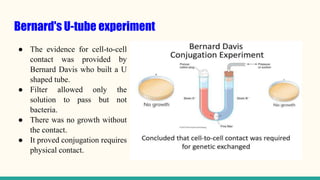
Bernard's U-tube experiment
● The evidence for cell-to-cell
contact was provided by
Bernard Davis who built a U
shaped tube.
● Filter allowed only the
solution to pass but not
bacteria.
● There was no growth without
the contact.
● It proved conjugation requires
physical contact.
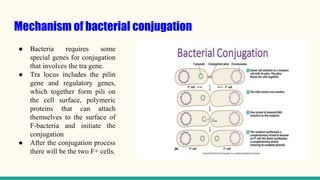
Mechanism of bacterial conjugation
● Bacteria requires some
special genes for conjugation
that involves the tra gene.
● Tra locus includes the pilin
gene and regulatory genes,
which together form pili on
the cell surface, polymeric
proteins that can attach
themselves to the surface of
F-bacteria and initiate the
conjugation
● After the conjugation process
there will be the two F+ cells.
Hfr conjugation
● When F-plasmid is integrated with chromosomal DNA then such bacteria is
known as high frequency recombination (Hfr) bacteria.
● In the cross (conjugation) between Hfr cell and F- cell, frequency of
recombination is very high but frequency of transfer of whole F-factor is
very low.
● Hfr cell acts as donor while F- cell acts as recipient.
● In this conjugation, chromosomal DNA is always almost transfer from donor
to recipient cell together with portion of F- factor. So, frequency of
recombination is high.
F’ conjugation
● Bacteria in which contains F-factor and a part of chromosomal
DNA integrated in it is known as F-prime bacteria.
● F’ cells are formed from Hfr cell during induction of F- factor
from chromosomal DNA in which F-factor carries a portion of
chromosomal DNA along with it.
● In the cross (conjugation) between F-prime (F’) cell and F- cell,
frequency of recombination is high as well as frequency of
transfer of whole F-factor is also high.
TRANSDUCTION
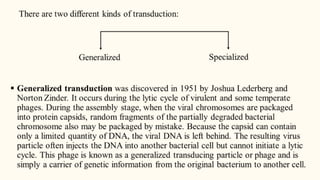
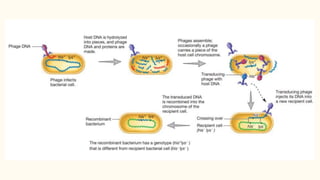
•Transduction is the transfer of bacterial genes by viruses. It is a frequent
mode of horizontal gene transfer in nature and is mediated by viruses.
•Viruses are unable to replicate autonomously. Instead, they infect and take
control of a host cell, forcing the host to make many copies of the virus.
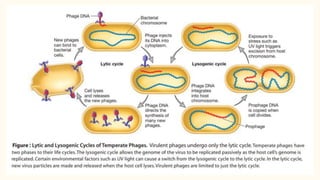
•Viruses that infect bacteria are called bacteriophages. Some phages are
replicated by their bacterial host immediately after entry. After the number
of replicated phages reaches a certain number, they cause the host to lyse,
so they can be released and infect new host cells. These phages are called
virulent bacteriophages and the process is called the lytic cycle.
•Other bacteriophages do not immediately kill their host. Many of these
viruses enter the host bacterium and, instead of replicating, insert their
genomes into the bacterial chromosome.
•Once inserted, the viral genome is called a prophage. The host bacterium
is unharmed by this, and the phage genome is passively replicated as the
host cell’s genome is replicated.
•These bacteriophages are called temperate bacteriophages and the
relationship between these viruses and their host is called lysogeny.
Bacteria that have been lysogenized are called lysogens.
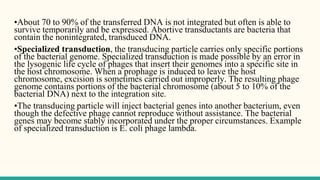
•About 70 to 90% of the transferred DNA is not integrated but often is able to
survive temporarily and be expressed. Abortive transductants are bacteria that
contain the nonintegrated, transduced DNA.
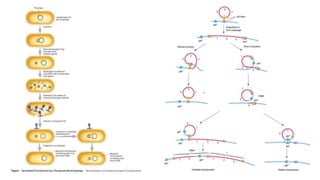
•Specialized transduction, the transducing particle carries only specific portions
of the bacterial genome. Specialized transduction is made possible by an error in
the lysogenic life cycle of phages that insert their genomes into a specific site in
the host chromosome. When a prophage is induced to leave the host
chromosome, excision is sometimes carried out improperly. The resulting phage
genome contains portions of the bacterial chromosome (about 5 to 10% of the
bacterial DNA) next to the integration site.
•The transducing particle will inject bacterial genes into another bacterium, even
though the defective phage cannot reproduce without assistance. The bacterial
genes may become stably incorporated under the proper circumstances. Example
of specialized transduction is E. coli phage lambda.
What is gene Mapping?
Genome mapping is the process of describing a
genome in terms of the relative locations of genes and
other DNA sequences.
In bacteria gene mapping can be performed using
Horizontal gene transfer mechanism.
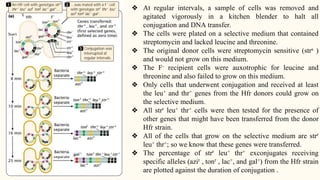
Mapping bacterial genes with interrupted conjugation
❖ Conjugation can be used to map bacterial genes by mixing Hfr
and F- cells that differ in genotype and interrupting conjugation
at regular intervals. The amount of time required for individual
genes to be transferred from the Hfr to the F- cells indicates the
relative positions of the genes on the bacterial chromosome.
❖ François Jacob and Elie Wollman, who first developed this
method of gene mapping.
● Donor Hfr cells - sensitive to the antibiotic
streptomycin (genotype strs); resistant to sodium
azide (azir) and infection by bacteriophage T1
(tonr); prototrophic to threonine (thr+) leucine
(leu+); and able to break down lactose (lac+) and
galactose (gal+).
● F- recipient cells that were resistant to
streptomycin (strr); sensitive to sodium azide
(azis) and to infection by bacteriophage T1 (tons);
auxotrophic for threonine (thr-) and leucine (leu-);
and unable to breakdown lactose (lac-) and
galactose (gal-)
Donor Hfr cells: Hfr strs thr+ leu+ azir tonr lac+ gal+
Recipient F cells: F strr thr- leu- azis tons lac- gal-
❖ At regular intervals, a sample of cells was removed and
agitated vigorously in a kitchen blender to halt all
conjugation and DNA transfer.
❖ The cells were plated on a selective medium that contained
streptomycin and lacked leucine and threonine.
❖ The original donor cells were streptomycin sensitive (strs )
and would not grow on this medium.
❖ The F- recipient cells were auxotrophic for leucine and
threonine and also failed to grow on this medium.
❖ Only cells that underwent conjugation and received at least
the leu+ and thr+ genes from the Hfr donors could grow on
the selective medium.
❖ All strr leu+ thr+ cells were then tested for the presence of
other genes that might have been transferred from the donor
Hfr strain.
❖ All of the cells that grow on the selective medium are strr
leu+ thr+; so we know that these genes were transferred.
❖ The percentage of strr leu+ thr+ exconjugates receiving
specific alleles (azir , tonr , lac+, and gal+) from the Hfr strain
are plotted against the duration of conjugation .
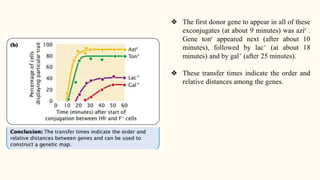
❖ The first donor gene to appear in all of these
exconjugates (at about 9 minutes) was azir .
Gene tonr appeared next (after about 10
minutes), followed by lac+ (at about 18
minutes) and by gal+ (after 25 minutes).
❖ These transfer times indicate the order and
relative distances among the genes.
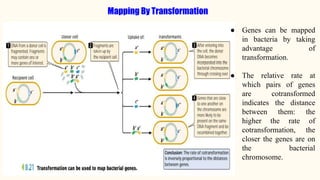
Mapping By Transformation
● Genes can be mapped
in bacteria by taking
advantage of
transformation.
● The relative rate at
which pairs of genes
are cotransformed
indicates the distance
between them: the
higher the rate of
cotransformation, the
closer the genes are on
the bacterial
chromosome.
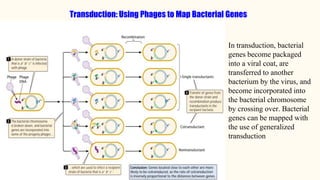
Transduction: Using Phages to Map Bacterial Genes
In transduction, bacterial
genes become packaged
into a viral coat, are
transferred to another
bacterium by the virus, and
become incorporated into
the bacterial chromosome
by crossing over. Bacterial
genes can be mapped with
the use of generalized
transduction
References
● Textbook-Genetics a conceptual approach-Benjamin A pierce.
● Textbook-Prescott, Harley, Klein’s Microbiology-7th Edition

Horizontal gene transfer with gene mapping

  • 1.
    Horizontal Gene TransferWith Gene Mapping Presented by, Anish chhillar Anu Chaudhary R Ajay Rajaram Salman Khan
  • 2.
    INTRODUCTION ● Gene transferis defined as the movement of genetic information between the organisms. ● There are two types of gene transfer methods. They are: ○ Vertical gene transfer - Transfer of genes from parents to offsprings. ○ Horizontal gene transfer - Transfer of genes between two independent organisms. ● Horizontal gene transfer is common in prokaryotes. ● There are three types of horizontal gene transfer in prokaryotes. They are: ○ Transformation ○ Transduction ○ Conjugation
  • 3.
    TRANSFORMATION ● Transformation isthe uptake of a naked DNA molecule or fragment from the surrounding environment by a cell and the incorporation of this molecule into the chromosome of the recipient. ● Transformation was discovered by Fred Griffith in 1928 ● Frederick Griffith suggested that bacterial strains are capable of transforming themselves by some factors, which he termed “transforming principle”. ● Sixteen years later, Oswald Avery, Colin MacLeod and Maclyn M cCarty demonstrated that transforming principle was the DNA, which provided evidence that DNA is the genetic material of bacterial cell.
  • 4.
    Griffith experiment ● Griffithworked on bacterium Diplococcus pneumonia which is associated with certain types of pneumonia. This bacteria occurs in two forms. ● The first form has smooth (s) cells which secrete a covering capsule made-up of polysaccharide causing the colonies to be smooth and shiny.This type of strain is virulent. It produces pneumonia in mice. ● The second type has rough (R) cells which lack the polysaccharide capsule and colonies appear rough. This type is non virulent and it does not cause pneumonia in mice.
  • 5.
    ● Heat killedS strain somehow transformed the R strain to virulent form. This process was called “Transformation”. ● The agent that was responsible for transformation was called “transforming principle”
  • 6.
    Process of Transformation ●The ability of recipient bacterium to take up DNA molecules from the surrounding environment and become transformed is known as competence. ● Transformation requires both the uptake of DNA from the surrounding medium and its incorporation into the bacterial chromosome or a plasmid. ● As a DNA fragment enters the cell in the course of transformation, one of the strands is hydrolyzed or degraded at membrane surface by exonuclease, whereas the other strand associates with proteins as it moves across the membrane. ● Once inside the cell, this single strand may pair with a homologous region and become integrated into the bacterial chromosome.
  • 7.
    Gram positive vsgram negative ● The Gram positive bacterial cell binds dsDNA fragment and the uptake of DNA into the cytoplasm is random and any portion of the donors may be entered. ● In case of Gram negative bacteria, DNA uptake is associated with the formation of small membranous structure called transformasomes which protrude outside the cell. The transforming DNA is taken into these vesicles where it is then internalized into the cell. ● DNA uptake in Gram negative bacteria is not random, DNA from only closely related species can enter into the cytoplasm. ● DNA uptake requires the presence of specific sequence called Uptake sequence, an 11 bp sequence repeated many times in gram neg bacteria genome. DNA must have this sequence to be bound by a competent cell.
  • 8.
    Types of Transformation ●Natural Transformation: ○ In this type of transformation, the bacteria takes up the naked DNA without the outside help. ○ This bacterium are naturally competent, i.e. they can take up DNA from the environment without any special treatment. ○ Natural Transformation is very rare. ● Artificial Transformation: ○ In this type of transformation, the bacterium are made competent by certain physical or chemical treatments for the uptake of the naked DNA. ○ Various methods are used for increasing the competence which includes the treatment with calcium chloride, electroporation, liposome etc.
  • 9.
    Conjugation ● Conjugation isthe process in which DNA is transferred from a bacteria donor cell to recipient cell by cell-to-cell contact. ● Joshua Lederberg & Edward Tatum discovered the conjugation process in bacteria . They experimented with two auxotrophic strains of E.coli K12 . ● Any bacterium harboring a self-transmissible plasmid is a potential donor(male strains) , because it can transfer DNA to other bacteria. ● Bacteria that lack the self-transmissible plasmid are potential recipient . ● The F-type plasmids use a transfer system known as the Tra system.
  • 10.
    Bernard's U-tube experiment ●The evidence for cell-to-cell contact was provided by Bernard Davis who built a U shaped tube. ● Filter allowed only the solution to pass but not bacteria. ● There was no growth without the contact. ● It proved conjugation requires physical contact.
  • 11.
    Mechanism of bacterialconjugation ● Bacteria requires some special genes for conjugation that involves the tra gene. ● Tra locus includes the pilin gene and regulatory genes, which together form pili on the cell surface, polymeric proteins that can attach themselves to the surface of F-bacteria and initiate the conjugation ● After the conjugation process there will be the two F+ cells.
  • 12.
    Hfr conjugation ● WhenF-plasmid is integrated with chromosomal DNA then such bacteria is known as high frequency recombination (Hfr) bacteria. ● In the cross (conjugation) between Hfr cell and F- cell, frequency of recombination is very high but frequency of transfer of whole F-factor is very low. ● Hfr cell acts as donor while F- cell acts as recipient. ● In this conjugation, chromosomal DNA is always almost transfer from donor to recipient cell together with portion of F- factor. So, frequency of recombination is high.
  • 13.
    F’ conjugation ● Bacteriain which contains F-factor and a part of chromosomal DNA integrated in it is known as F-prime bacteria. ● F’ cells are formed from Hfr cell during induction of F- factor from chromosomal DNA in which F-factor carries a portion of chromosomal DNA along with it. ● In the cross (conjugation) between F-prime (F’) cell and F- cell, frequency of recombination is high as well as frequency of transfer of whole F-factor is also high.
  • 14.
    TRANSDUCTION •Transduction is thetransfer of bacterial genes by viruses. It is a frequent mode of horizontal gene transfer in nature and is mediated by viruses. •Viruses are unable to replicate autonomously. Instead, they infect and take control of a host cell, forcing the host to make many copies of the virus. •Viruses that infect bacteria are called bacteriophages. Some phages are replicated by their bacterial host immediately after entry. After the number of replicated phages reaches a certain number, they cause the host to lyse, so they can be released and infect new host cells. These phages are called virulent bacteriophages and the process is called the lytic cycle.
  • 15.
    •Other bacteriophages donot immediately kill their host. Many of these viruses enter the host bacterium and, instead of replicating, insert their genomes into the bacterial chromosome. •Once inserted, the viral genome is called a prophage. The host bacterium is unharmed by this, and the phage genome is passively replicated as the host cell’s genome is replicated. •These bacteriophages are called temperate bacteriophages and the relationship between these viruses and their host is called lysogeny. Bacteria that have been lysogenized are called lysogens.
  • 19.
    •About 70 to90% of the transferred DNA is not integrated but often is able to survive temporarily and be expressed. Abortive transductants are bacteria that contain the nonintegrated, transduced DNA. •Specialized transduction, the transducing particle carries only specific portions of the bacterial genome. Specialized transduction is made possible by an error in the lysogenic life cycle of phages that insert their genomes into a specific site in the host chromosome. When a prophage is induced to leave the host chromosome, excision is sometimes carried out improperly. The resulting phage genome contains portions of the bacterial chromosome (about 5 to 10% of the bacterial DNA) next to the integration site. •The transducing particle will inject bacterial genes into another bacterium, even though the defective phage cannot reproduce without assistance. The bacterial genes may become stably incorporated under the proper circumstances. Example of specialized transduction is E. coli phage lambda.
  • 21.
    What is geneMapping? Genome mapping is the process of describing a genome in terms of the relative locations of genes and other DNA sequences. In bacteria gene mapping can be performed using Horizontal gene transfer mechanism.
  • 22.
    Mapping bacterial geneswith interrupted conjugation ❖ Conjugation can be used to map bacterial genes by mixing Hfr and F- cells that differ in genotype and interrupting conjugation at regular intervals. The amount of time required for individual genes to be transferred from the Hfr to the F- cells indicates the relative positions of the genes on the bacterial chromosome. ❖ François Jacob and Elie Wollman, who first developed this method of gene mapping.
  • 23.
    ● Donor Hfrcells - sensitive to the antibiotic streptomycin (genotype strs); resistant to sodium azide (azir) and infection by bacteriophage T1 (tonr); prototrophic to threonine (thr+) leucine (leu+); and able to break down lactose (lac+) and galactose (gal+). ● F- recipient cells that were resistant to streptomycin (strr); sensitive to sodium azide (azis) and to infection by bacteriophage T1 (tons); auxotrophic for threonine (thr-) and leucine (leu-); and unable to breakdown lactose (lac-) and galactose (gal-) Donor Hfr cells: Hfr strs thr+ leu+ azir tonr lac+ gal+ Recipient F cells: F strr thr- leu- azis tons lac- gal-
  • 24.
    ❖ At regularintervals, a sample of cells was removed and agitated vigorously in a kitchen blender to halt all conjugation and DNA transfer. ❖ The cells were plated on a selective medium that contained streptomycin and lacked leucine and threonine. ❖ The original donor cells were streptomycin sensitive (strs ) and would not grow on this medium. ❖ The F- recipient cells were auxotrophic for leucine and threonine and also failed to grow on this medium. ❖ Only cells that underwent conjugation and received at least the leu+ and thr+ genes from the Hfr donors could grow on the selective medium. ❖ All strr leu+ thr+ cells were then tested for the presence of other genes that might have been transferred from the donor Hfr strain. ❖ All of the cells that grow on the selective medium are strr leu+ thr+; so we know that these genes were transferred. ❖ The percentage of strr leu+ thr+ exconjugates receiving specific alleles (azir , tonr , lac+, and gal+) from the Hfr strain are plotted against the duration of conjugation .
  • 25.
    ❖ The firstdonor gene to appear in all of these exconjugates (at about 9 minutes) was azir . Gene tonr appeared next (after about 10 minutes), followed by lac+ (at about 18 minutes) and by gal+ (after 25 minutes). ❖ These transfer times indicate the order and relative distances among the genes.
  • 26.
    Mapping By Transformation ●Genes can be mapped in bacteria by taking advantage of transformation. ● The relative rate at which pairs of genes are cotransformed indicates the distance between them: the higher the rate of cotransformation, the closer the genes are on the bacterial chromosome.
  • 27.
    Transduction: Using Phagesto Map Bacterial Genes In transduction, bacterial genes become packaged into a viral coat, are transferred to another bacterium by the virus, and become incorporated into the bacterial chromosome by crossing over. Bacterial genes can be mapped with the use of generalized transduction
  • 28.
    References ● Textbook-Genetics aconceptual approach-Benjamin A pierce. ● Textbook-Prescott, Harley, Klein’s Microbiology-7th Edition