Downloaded 14 times
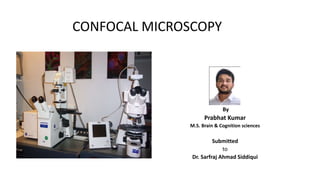


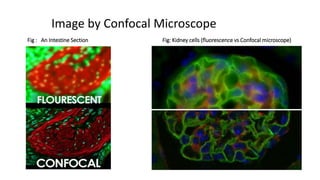


Confocal microscopy was invented by Marvin Minsky in 1957 and aims to improve resolution over traditional microscopy. It uses point illumination and a pinhole to exclude out-of-focus light and produce thin optical sections and high-contrast images. The key components are a laser light source, dichromatic mirror, pinholes, and photodetector. Confocal microscopy finds applications in cell biology and materials science by allowing optical sectioning and 3D reconstruction. It provides advantages like non-invasiveness, live cell imaging, and depth analysis, but has disadvantages such as photobleaching and loss of intensity.


