Normal distributionUnit 8 strand 1
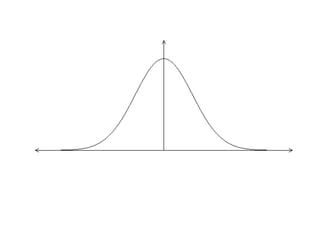
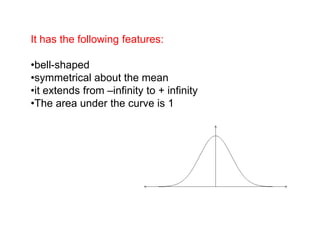
It has the following features:bell-shaped
symmetrical about the mean
it extends from –infinity to + infinity
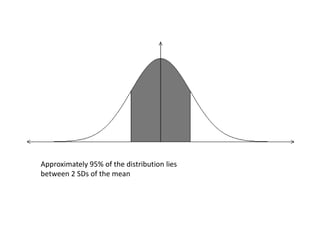
The area under the curve is 1Approximately 95% of the distribution lies between 2 SDs of the mean
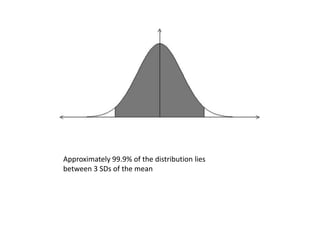
Approximately 99.9% of the distribution lies between 3 SDs of the mean
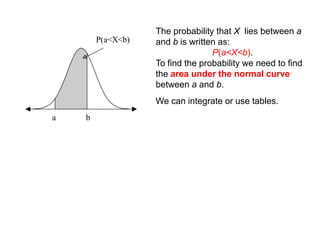
The probability that X  lies between a and b is written as:P(a<X<b).To find the probability we need to find the area under the normal curvebetween a and b.We can integrate or use tables.
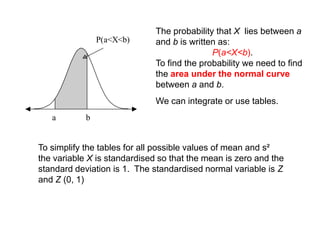
The probability that X  lies between a and b is written as:P(a<X<b).To find the probability we need to find the area under the normal curvebetween a and b.We can integrate or use tables.To simplify the tables for all possible values of mean and s² the variable X is standardised so that the mean is zero and the standard deviation is 1.  The standardised normal variable is Z and Z (0, 1)
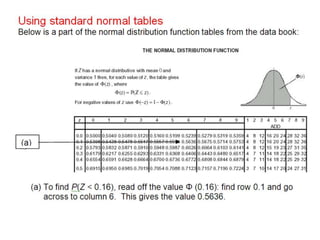
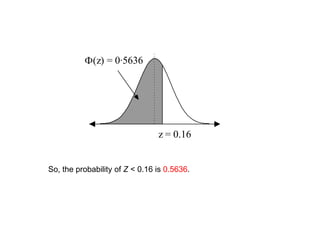
So, the probability of Z < 0.16 is 0.5636.
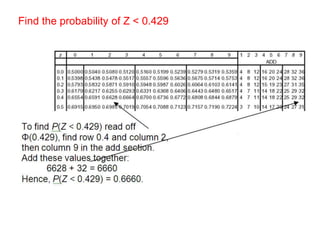
Find the probability of Z < 0.429
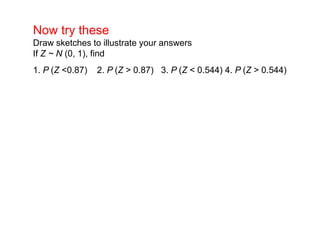
Now try theseDraw sketches to illustrate your answersIf Z ~N (0, 1), find1. P (Z <0.87) 	2. P (Z > 0.87) 	3. P (Z < 0.544)	4. P (Z > 0.544)
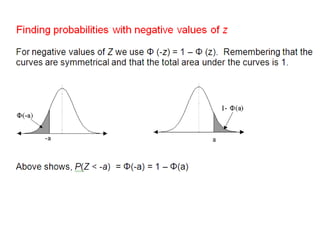
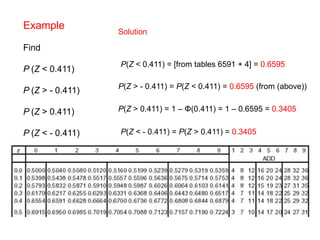
ExampleFind P (Z < 0.411) P (Z > - 0.411) P (Z > 0.411) P (Z < - 0.411)SolutionP(Z < 0.411) = [from tables 6591 + 4] = 0.6595P(Z > - 0.411) = P(Z < 0.411) = 0.6595 (from (above))P(Z > 0.411) = 1 – Φ(0.411) = 1 – 0.6595 = 0.3405P(Z < - 0.411) = P(Z > 0.411) = 0.3405
Now try these1. P (Z > - 0.314)	2. P (Z < - 0.314)	3. P (Z > 0.111)	4. P (Z > - 0.111)
What if we don’t have a distribution where the mean is 0 and the standard deviation is 1?
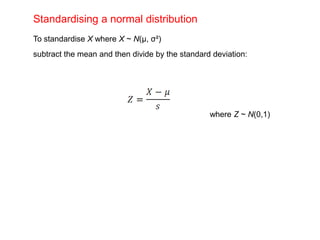
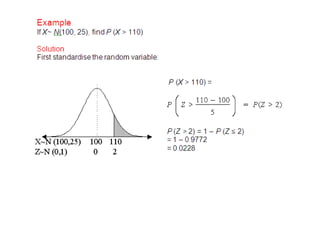
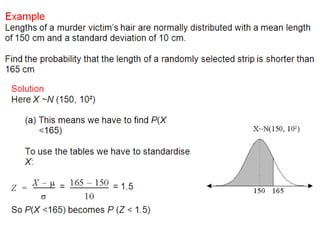
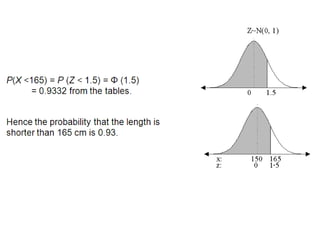
Standardising a normal distributionTo standardise X where X ~ N(μ, σ²)subtract the mean and then divide by the standard deviation:   where Z ~ N(0,1)

Normal distribution

  • 1.
  • 3.
    It has thefollowing features:bell-shaped
  • 4.
  • 5.
    it extends from–infinity to + infinity
  • 6.
    The area underthe curve is 1Approximately 95% of the distribution lies between 2 SDs of the mean
  • 7.
    Approximately 99.9% ofthe distribution lies between 3 SDs of the mean
  • 8.
    The probability thatX lies between a and b is written as:P(a<X<b).To find the probability we need to find the area under the normal curvebetween a and b.We can integrate or use tables.
  • 9.
    The probability thatX lies between a and b is written as:P(a<X<b).To find the probability we need to find the area under the normal curvebetween a and b.We can integrate or use tables.To simplify the tables for all possible values of mean and s² the variable X is standardised so that the mean is zero and the standard deviation is 1. The standardised normal variable is Z and Z (0, 1)
  • 11.
    So, the probabilityof Z < 0.16 is 0.5636.
  • 12.
  • 13.
    Now try theseDrawsketches to illustrate your answersIf Z ~N (0, 1), find1. P (Z <0.87) 2. P (Z > 0.87) 3. P (Z < 0.544) 4. P (Z > 0.544)
  • 16.
    ExampleFind P (Z< 0.411) P (Z > - 0.411) P (Z > 0.411) P (Z < - 0.411)SolutionP(Z < 0.411) = [from tables 6591 + 4] = 0.6595P(Z > - 0.411) = P(Z < 0.411) = 0.6595 (from (above))P(Z > 0.411) = 1 – Φ(0.411) = 1 – 0.6595 = 0.3405P(Z < - 0.411) = P(Z > 0.411) = 0.3405
  • 17.
    Now try these1.P (Z > - 0.314) 2. P (Z < - 0.314) 3. P (Z > 0.111) 4. P (Z > - 0.111)
  • 18.
    What if wedon’t have a distribution where the mean is 0 and the standard deviation is 1?
  • 19.
    Standardising a normaldistributionTo standardise X where X ~ N(μ, σ²)subtract the mean and then divide by the standard deviation: where Z ~ N(0,1)