B1.4 Interdedpendence and
Adaptations
Animal adaptations
BTEOTSSSBAT know how
animals adapt to different
environments
Summary
Organisms are well adapted to survive in their
normal environment. Population size depends
on a variety of factors including competition,
predation, disease and human influences.
Changes in the environment may affect the
distribution and behaviour of organisms.
Key words
Adaptation
Arctic
Biomass
Camouflage
Competitor
Desert
Habitat
Organism
Predator
Predation
Prey
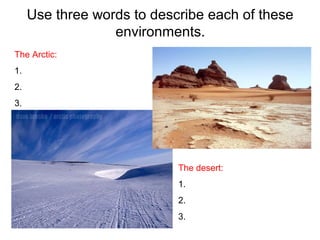
The desert:
1.
2.
3.
Use three words to describe each of these
environments.
The Arctic:
1.
2.
3.
Survival
To survive, organisms require a supply of materials
from their surroundings and from the other living
organisms there.
Organisms live, grow and reproduce in places
where, and at times when, conditions are suitable.
To do this they need to adapt to their environment.
The organisms that are best adapted to make use of
their resources in a habitat are more likely to survive
and increase in numbers
For example:
• To be able to obtain a certain food better.
• To make it more difficult for predators to
catch them.
• To survive in extreme climates, eg arctic or
deserts.
Adaptation
Adaptation is a special feature or behaviour that
makes an organism particularly suited to its
habitat.
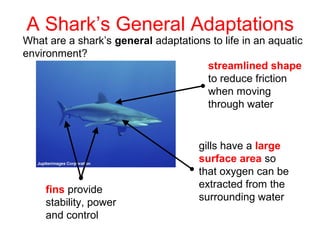
What are a shark’s general adaptations to life in an aquatic
environment?
A Shark’s General Adaptations
streamlined shape
to reduce friction
when moving
through water
gills have a large
surface area so
that oxygen can be
extracted from the
surrounding water
fins provide
stability, power
and control
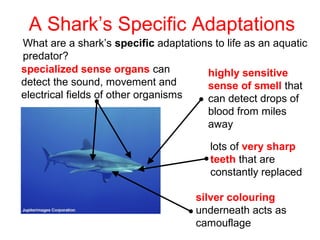
What are a shark’s specific adaptations to life as an aquatic
predator?
highly sensitive
sense of smell that
can detect drops of
blood from miles
away
lots of very sharp
teeth that are
constantly replaced
silver colouring
underneath acts as
camouflage
specialized sense organs can
detect the sound, movement and
electrical fields of other organisms
A Shark’s Specific Adaptations
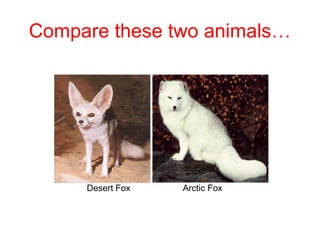
Compare these two animals…
Desert Fox Arctic Fox
Adaptations
• The two environments we saw before are
harsh environments for animals to survive
in so the animals have had to adapt to
survive.
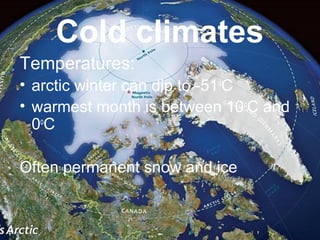
Cold climates
Temperatures:
• arctic winter can dip to -51o
C
• warmest month is between 10o
C and
0o
C
Often permanent snow and ice
Animals in Cold Climates
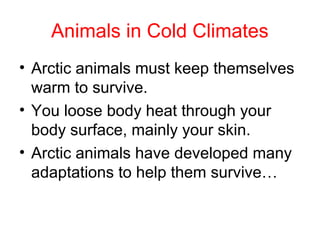
• Arctic animals must keep themselves
warm to survive.
• You loose body heat through your
body surface, mainly your skin.
• Arctic animals have developed many
adaptations to help them survive…
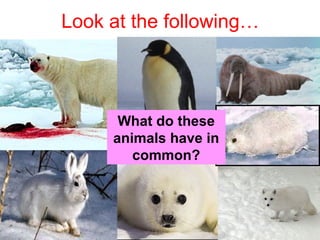
Look at the following…
What do these
animals have in
common?
Animals in Cold Climates
Common features:
• Thick oily fur coats
• Layer of blubber under the skin
• Colour – many change colour in
the summer
• Small ears
• Large feet
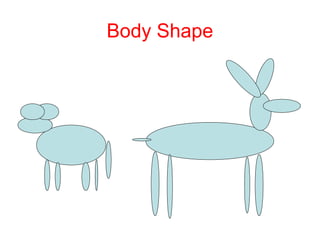
What about body shape?
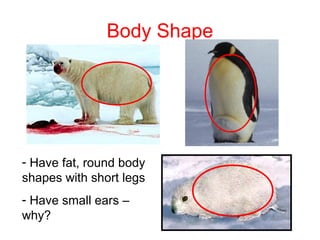
Body Shape
- Have fat, round body
shapes with short legs
- Have small ears –
why?
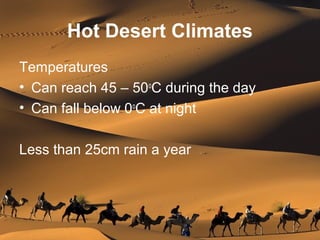
Hot Desert Climates
Temperatures
• Can reach 45 – 50o
C during the day
• Can fall below 0o
C at night
Less than 25cm rain a year
Animals in Dry Climates
• Animals in dry climates have to keep
themselves cool to survive.
• They also have to cope with a lack of
water.
• This means they are unable to lose heat
through sweating
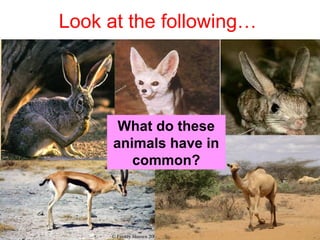
Look at the following…
What do these
animals have in
common?
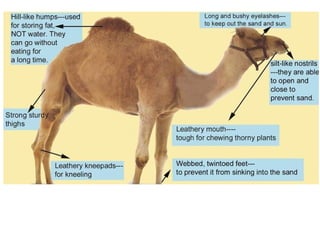
Animals in Dry Climates
Common features:
• Large thin ears
• Little body fat
• Thin, silky fur
• Long limbs to help spread heat
• They also often only come out at night.
Why?
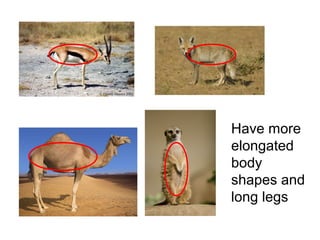
What about body shape?
Have more
elongated
body
shapes and
long legs
Body Shape
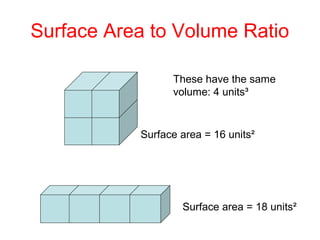
Surface Area to Volume Ratio
These have the same
volume: 4 unitsÂł
Surface area = 16 units²
Surface area = 18 units²
Surface Area to Volume Ratio
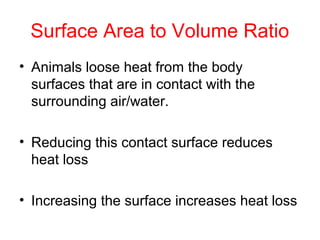
• Animals loose heat from the body
surfaces that are in contact with the
surrounding air/water.
• Reducing this contact surface reduces
heat loss
• Increasing the surface increases heat loss
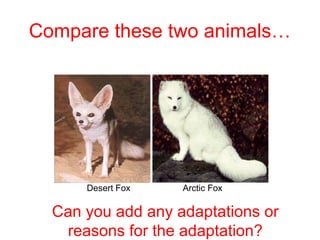
Compare these two animals…
Desert Fox Arctic Fox
Can you add any adaptations or
reasons for the adaptation?
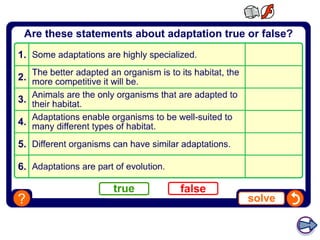
True or false?
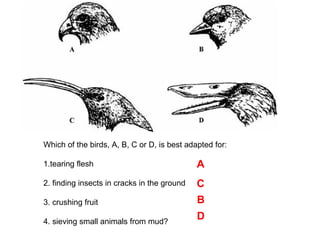
Which of the birds, A, B, C or D, is best adapted for:
1.tearing flesh
2. finding insects in cracks in the ground
3. crushing fruit
4. sieving small animals from mud?
A
C
B
D
Adaptation for survival
Animals have adaptations that help them survive
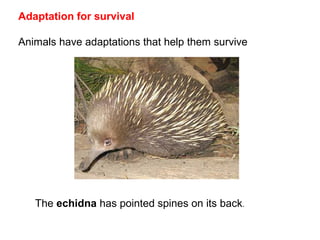
The echidna has pointed spines on its back.
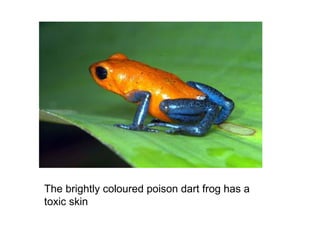
The brightly coloured poison dart frog has a
toxic skin
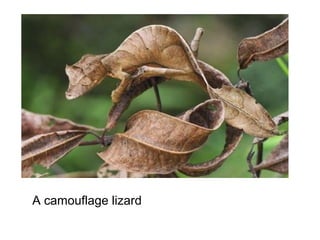
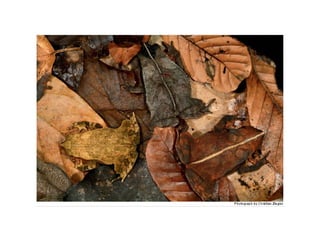
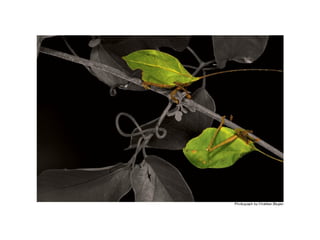
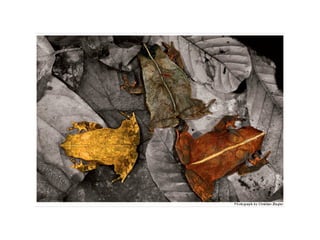
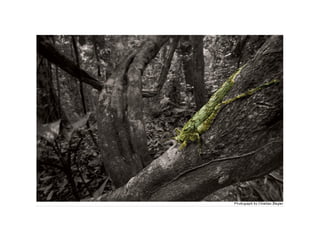
A camouflage lizard
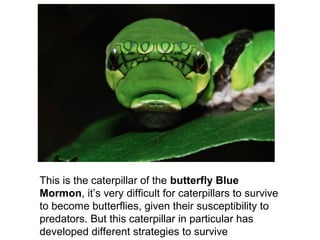
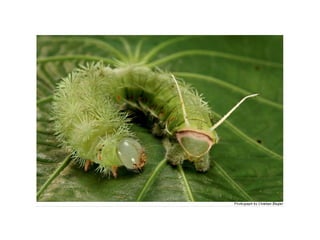
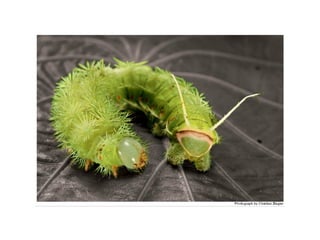
This is the caterpillar of the butterfly Blue
Mormon, it’s very difficult for caterpillars to survive
to become butterflies, given their susceptibility to
predators. But this caterpillar in particular has
developed different strategies to survive
Camouflage
B1.4 animals adaptations

B1.4 animals adaptations

  • 1.
  • 2.
    Animal adaptations BTEOTSSSBAT knowhow animals adapt to different environments
  • 3.
    Summary Organisms are welladapted to survive in their normal environment. Population size depends on a variety of factors including competition, predation, disease and human influences. Changes in the environment may affect the distribution and behaviour of organisms.
  • 4.
  • 5.
    The desert: 1. 2. 3. Use threewords to describe each of these environments. The Arctic: 1. 2. 3.
  • 6.
    Survival To survive, organismsrequire a supply of materials from their surroundings and from the other living organisms there. Organisms live, grow and reproduce in places where, and at times when, conditions are suitable. To do this they need to adapt to their environment.
  • 7.
    The organisms thatare best adapted to make use of their resources in a habitat are more likely to survive and increase in numbers For example: • To be able to obtain a certain food better. • To make it more difficult for predators to catch them. • To survive in extreme climates, eg arctic or deserts.
  • 8.
    Adaptation Adaptation is aspecial feature or behaviour that makes an organism particularly suited to its habitat.
  • 9.
    What are ashark’s general adaptations to life in an aquatic environment? A Shark’s General Adaptations streamlined shape to reduce friction when moving through water gills have a large surface area so that oxygen can be extracted from the surrounding water fins provide stability, power and control
  • 10.
    What are ashark’s specific adaptations to life as an aquatic predator? highly sensitive sense of smell that can detect drops of blood from miles away lots of very sharp teeth that are constantly replaced silver colouring underneath acts as camouflage specialized sense organs can detect the sound, movement and electrical fields of other organisms A Shark’s Specific Adaptations
  • 11.
    Compare these twoanimals… Desert Fox Arctic Fox
  • 12.
    Adaptations • The twoenvironments we saw before are harsh environments for animals to survive in so the animals have had to adapt to survive.
  • 13.
    Cold climates Temperatures: • arcticwinter can dip to -51o C • warmest month is between 10o C and 0o C Often permanent snow and ice
  • 14.
    Animals in ColdClimates • Arctic animals must keep themselves warm to survive. • You loose body heat through your body surface, mainly your skin. • Arctic animals have developed many adaptations to help them survive…
  • 15.
    Look at thefollowing… What do these animals have in common?
  • 16.
    Animals in ColdClimates Common features: • Thick oily fur coats • Layer of blubber under the skin • Colour – many change colour in the summer • Small ears • Large feet What about body shape?
  • 17.
    Body Shape - Havefat, round body shapes with short legs - Have small ears – why?
  • 18.
    Hot Desert Climates Temperatures •Can reach 45 – 50o C during the day • Can fall below 0o C at night Less than 25cm rain a year
  • 19.
    Animals in DryClimates • Animals in dry climates have to keep themselves cool to survive. • They also have to cope with a lack of water. • This means they are unable to lose heat through sweating
  • 20.
    Look at thefollowing… What do these animals have in common?
  • 21.
    Animals in DryClimates Common features: • Large thin ears • Little body fat • Thin, silky fur • Long limbs to help spread heat • They also often only come out at night. Why? What about body shape?
  • 23.
  • 24.
  • 25.
    Surface Area toVolume Ratio These have the same volume: 4 units³ Surface area = 16 units² Surface area = 18 units²
  • 26.
    Surface Area toVolume Ratio • Animals loose heat from the body surfaces that are in contact with the surrounding air/water. • Reducing this contact surface reduces heat loss • Increasing the surface increases heat loss
  • 27.
    Compare these twoanimals… Desert Fox Arctic Fox Can you add any adaptations or reasons for the adaptation?
  • 28.
  • 29.
    Which of thebirds, A, B, C or D, is best adapted for: 1.tearing flesh 2. finding insects in cracks in the ground 3. crushing fruit 4. sieving small animals from mud? A C B D
  • 30.
    Adaptation for survival Animalshave adaptations that help them survive The echidna has pointed spines on its back.
  • 31.
    The brightly colouredpoison dart frog has a toxic skin
  • 32.
  • 33.
    This is thecaterpillar of the butterfly Blue Mormon, it’s very difficult for caterpillars to survive to become butterflies, given their susceptibility to predators. But this caterpillar in particular has developed different strategies to survive
  • 34.

Editor's Notes

  • #10 Photo credit: © 2006 Jupiterimages Corporation
  • #11 Photo credit: © 2006 Jupiterimages Corporation Teacher notes A shark’s teeth are not fixed to its jaw but embedded directly into the flesh. Its teeth are constantly replaced as they fall out or are broken, so that a shark may get through thousands of teeth during its lifetime. The lower teeth are mainly used for holding prey, while the upper teeth are used for cutting. The shark’s specialized sense organs include: lateral lines – a row of fluid-filled sensory canals along each side of the shark. These can detect movement and changes in pressure from about 100m away. ampullae of Lorenzini – small pits in the shark’s snout that detect tiny electrical fields, such as those associated with muscle contraction of prey. auditory system – can detect the sound created by injured prey from over 1 mile away.
  • #29 Teacher notes This true-or-false activity could be used as a plenary or revision exercise on adaptation, or at the start of the lesson to gauge students’ existing knowledge of the subject matter. Coloured traffic light cards (red = false, yellow = don’t know, green = true) could be used to make this a whole-class exercise.
  • #45 http://ngm.nationalgeographic.com/2009/08/mimicry/ziegler-photography