Probability Model:
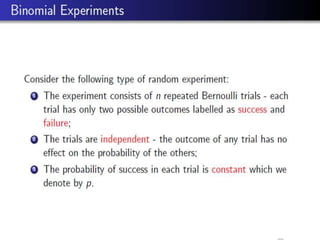
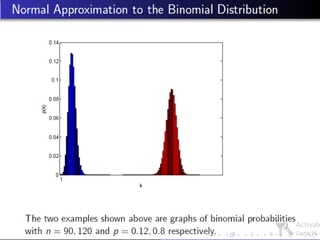
• Binomial
  Distribution…….
• Poison Distribution
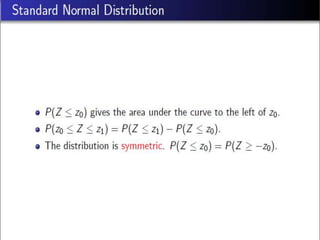
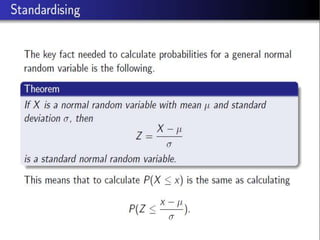
• Normal Distribution.
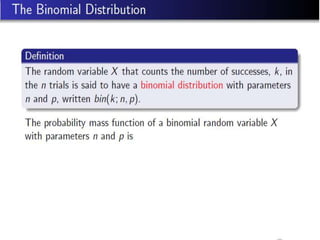
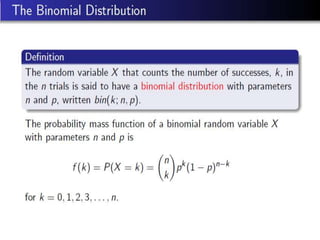
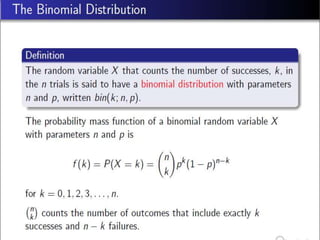
The Binomial Distribution…...
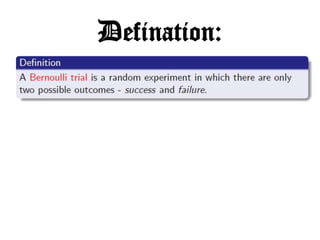
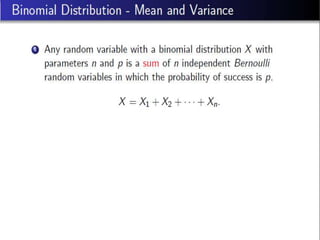
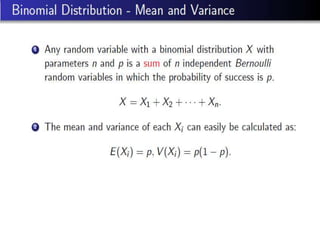
Defination:
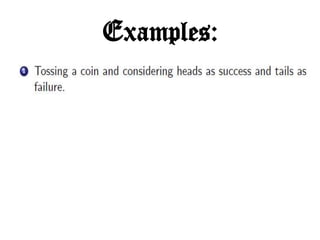
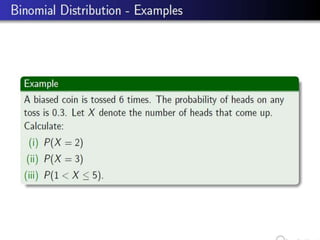
Examples:
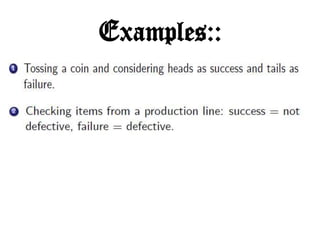
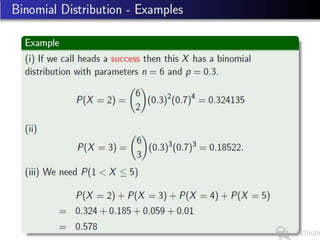
Examples::
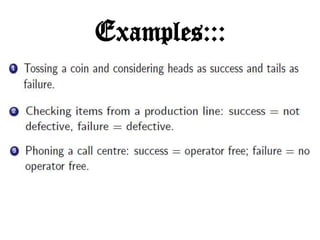
Examples:::
Probability Model:
• Binomial Distribution.
• Poison Distribution……
• Normal Distribution.
POISSON
DISTRIBUTION…….
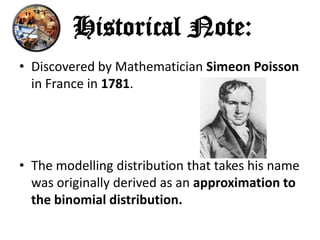
Historical Note:
• Discovered by Mathematician Simeon Poisson
  in France in 1781.


• The modelling distribution that takes his name
  was originally derived as an approximation to
  the binomial distribution.
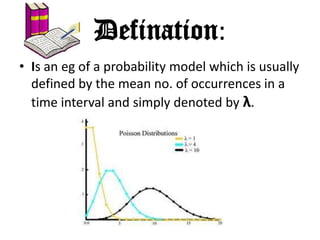
Defination:
• Is an eg of a probability model which is usually
  defined by the mean no. of occurrences in a
  time interval and simply denoted by λ.
Uses:
• Occurrences are independent.
• Occurrences are random.
• The probability of an occurrence is constant
  over time.
Sum of two Poisson
      distributions:
• If two independent random variables both
  have Poisson distributions with parameters λ
  and μ, then their sum also has a Poisson
  distribution and its parameter is λ + μ .
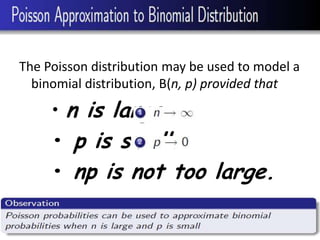
The Poisson distribution may be used to model a
  binomial distribution, B(n, p) provided that

     • n is large.
     • p is small.
     • np is not too large.
F o r m u l a:
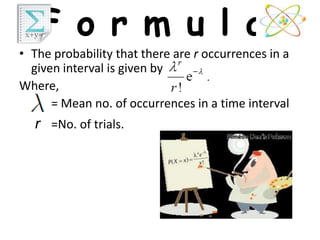
• The probability that there are r occurrences in a
  given interval is given by
Where,
      = Mean no. of occurrences in a time interval
  r =No. of trials.
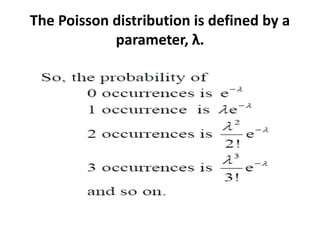
The Poisson distribution is defined by a
            parameter, λ.
Mean and Variance of Poisson
          Distribution
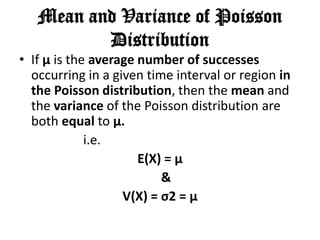
• If μ is the average number of successes
  occurring in a given time interval or region in
  the Poisson distribution, then the mean and
  the variance of the Poisson distribution are
  both equal to μ.
             i.e.
                      E(X) = μ
                          &
                   V(X) = σ2 = μ
Examples:
1. Number of telephone calls in a week.
2. Number of people arriving at a checkout in a
  day.
3. Number of industrial accidents per month in a
  manufacturing plant.
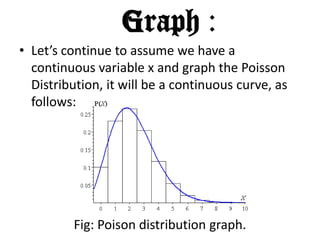
Graph :
• Let’s continue to assume we have a
  continuous variable x and graph the Poisson
  Distribution, it will be a continuous curve, as
  follows:


         Fig: Poison distribution graph.
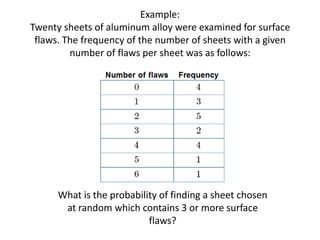
Example:
Twenty sheets of aluminum alloy were examined for surface
 flaws. The frequency of the number of sheets with a given
         number of flaws per sheet was as follows:


      What is the probability of finding a sheet chosen
       at random which contains 3 or more surface
                           flaws?
Generally,
• X = number of events, distributed
  independently in time, occurring in a fixed
  time interval.
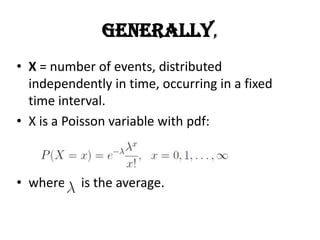
• X is a Poisson variable with pdf:


• where    is the average.
Application:
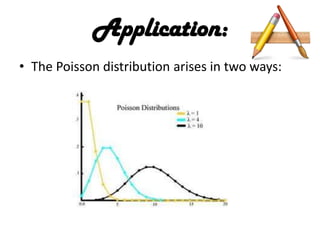
• The Poisson distribution arises in two ways:
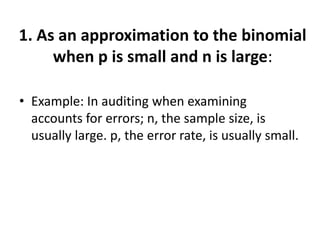
1. As an approximation to the binomial
     when p is small and n is large:

• Example: In auditing when examining
  accounts for errors; n, the sample size, is
  usually large. p, the error rate, is usually small.
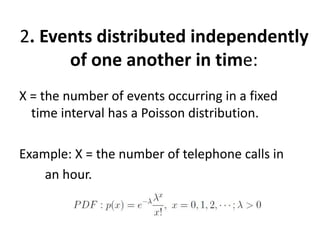
2. Events distributed independently
      of one another in time:
X = the number of events occurring in a fixed
  time interval has a Poisson distribution.

Example: X = the number of telephone calls in
    an hour.
Probability Model:
• Binomial Distribution.
• Poison Distribution
• Normal
  Distribution…….
The Normal Distribution…...
•The End
Thank You….

Poisson distribution

  • 2.
    Probability Model: • Binomial Distribution……. • Poison Distribution • Normal Distribution.
  • 3.
  • 4.
  • 5.
  • 6.
  • 7.
  • 21.
    Probability Model: • BinomialDistribution. • Poison Distribution…… • Normal Distribution.
  • 22.
  • 23.
    Historical Note: • Discoveredby Mathematician Simeon Poisson in France in 1781. • The modelling distribution that takes his name was originally derived as an approximation to the binomial distribution.
  • 24.
    Defination: • Is aneg of a probability model which is usually defined by the mean no. of occurrences in a time interval and simply denoted by λ.
  • 25.
    Uses: • Occurrences areindependent. • Occurrences are random. • The probability of an occurrence is constant over time.
  • 26.
    Sum of twoPoisson distributions: • If two independent random variables both have Poisson distributions with parameters λ and μ, then their sum also has a Poisson distribution and its parameter is λ + μ .
  • 27.
    The Poisson distributionmay be used to model a binomial distribution, B(n, p) provided that • n is large. • p is small. • np is not too large.
  • 28.
    F o rm u l a: • The probability that there are r occurrences in a given interval is given by Where, = Mean no. of occurrences in a time interval r =No. of trials.
  • 29.
    The Poisson distributionis defined by a parameter, λ.
  • 30.
    Mean and Varianceof Poisson Distribution • If μ is the average number of successes occurring in a given time interval or region in the Poisson distribution, then the mean and the variance of the Poisson distribution are both equal to μ. i.e. E(X) = μ & V(X) = σ2 = μ
  • 31.
    Examples: 1. Number oftelephone calls in a week. 2. Number of people arriving at a checkout in a day. 3. Number of industrial accidents per month in a manufacturing plant.
  • 32.
    Graph : • Let’scontinue to assume we have a continuous variable x and graph the Poisson Distribution, it will be a continuous curve, as follows: Fig: Poison distribution graph.
  • 33.
    Example: Twenty sheets ofaluminum alloy were examined for surface flaws. The frequency of the number of sheets with a given number of flaws per sheet was as follows: What is the probability of finding a sheet chosen at random which contains 3 or more surface flaws?
  • 34.
    Generally, • X =number of events, distributed independently in time, occurring in a fixed time interval. • X is a Poisson variable with pdf: • where is the average.
  • 35.
    Application: • The Poissondistribution arises in two ways:
  • 36.
    1. As anapproximation to the binomial when p is small and n is large: • Example: In auditing when examining accounts for errors; n, the sample size, is usually large. p, the error rate, is usually small.
  • 37.
    2. Events distributedindependently of one another in time: X = the number of events occurring in a fixed time interval has a Poisson distribution. Example: X = the number of telephone calls in an hour.
  • 39.
    Probability Model: • BinomialDistribution. • Poison Distribution • Normal Distribution…….
  • 40.
  • 53.
  • 54.