Speciation
BTEOTSSSBAT define speciation
Describe the evidence for evolution
Explain how speciation relates to natural
selection
Evolution in action
what evidence is there to support the theory of
evolution?
All
Most
Some
• Can you define the term “speciation”?
• Can you describe the evidence for evolution
in action?
• Can you explain evidence to
evolution in action in terms of natural
selection?
STARTER QUESTION
What is ‘natural selection’?
Summary
Changes in the environment of plants and animals may
cause them to die out. The fossil record shows that new
organisms arise, flourish, and after a time become
extinct. The record also shows changes that lead to the
formation of new species.
Key words
Species
Fossils
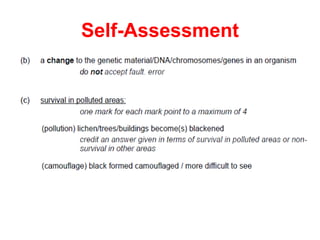
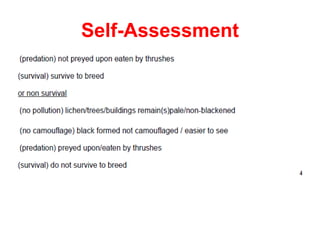
Organisms
Decay
Extinction
Predators
Speciation
Isolation
Genetic variation
Natural selection
Geographical isolation
Endemic
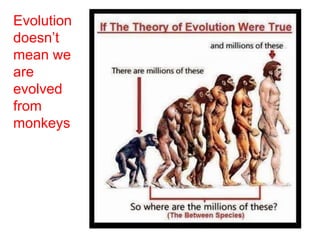
Evolution
doesn’t
mean we
are
evolved
from
monkeys
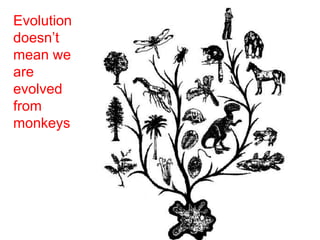
Evolution
doesn’t
mean we
are
evolved
from
monkeys
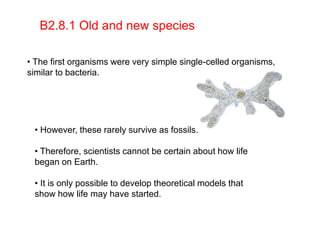
B2.8.1 Old and new species
• The first organisms were very simple single-celled organisms,
similar to bacteria.
• However, these rarely survive as fossils.
• Therefore, scientists cannot be certain about how life
began on Earth.
• It is only possible to develop theoretical models that
show how life may have started.
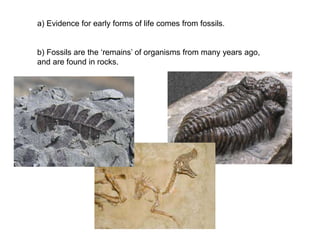
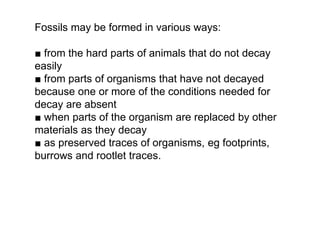
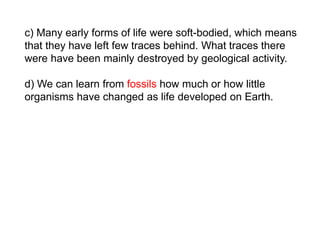
a) Evidence for early forms of life comes from fossils.
b) Fossils are the ‘remains’ of organisms from many years ago,
and are found in rocks.
■ from the hard parts of animals that do not decay
easily
■ from parts of organisms that have not decayed
because one or more of the conditions needed for
decay are absent
■ when parts of the organism are replaced by other
materials as they decay
■ as preserved traces of organisms, eg footprints,
burrows and rootlet traces.
Fossils may be formed in various ways:
c) Many early forms of life were soft-bodied, which means
that they have left few traces behind. What traces there
were have been mainly destroyed by geological activity.
d) We can learn from fossils how much or how little
organisms have changed as life developed on Earth.
■ changes to the environment over geological time
e) Extinction may be caused by:
■ new predators may arise
■ new diseases may arise
■ new, more successful, competitors may arise
■ a single catastrophic event, eg massive volcanic
eruptions or collisions with asteroids
■ through the cyclical nature of speciation.
• If the organisms cannot evolve quick enough
to become better adapted to the change they
may become extinct.
• If they do evolve, they are likely to develop
into new species.
Complete the sentences using the words below:
animal evidence fossils minerals plant
One important piece of …………. for how life has developed
on earth are …………… .
The most common type are formed when parts of the
……………. or …………..are replaced by ……….. as it
decays
A species is defined as a group of organisms that
are capable of breeding together to produce fertile
offspring.
What is a species?
A species is defined as a group of organisms that
are capable of breeding together to produce fertile
offspring.
What is a species?
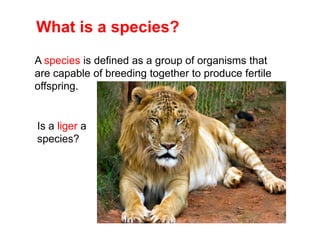
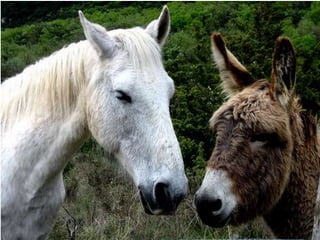
Is a liger a
species?
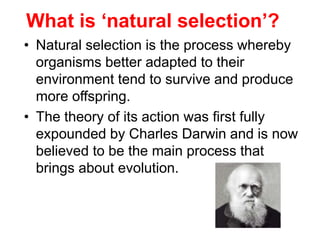
What is ‘natural selection’?
• Natural selection is the process whereby
organisms better adapted to their
environment tend to survive and produce
more offspring.
• The theory of its action was first fully
expounded by Charles Darwin and is now
believed to be the main process that
brings about evolution.
Natural selection can result in
the formation of new species…
• The formation of new species is know as
‘speciation’.
• Speciation can occur in a number of
ways…
This is evidence
for natural
selection in
action!
Formation of new species
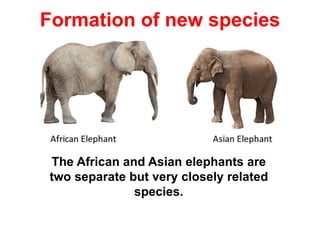
The African and Asian elephants are
two separate but very closely related
species.
Formation of new species
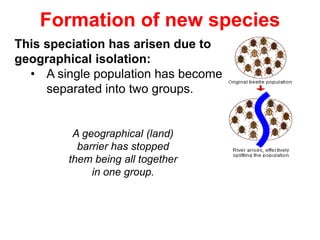
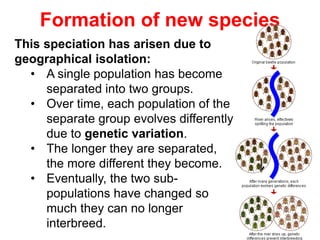
This speciation has arisen due to
geographical isolation:
• A single population has become
separated into two groups.
A geographical (land)
barrier has stopped
them being all together
in one group.
Formation of new species
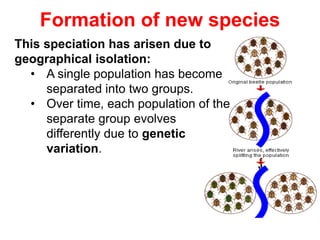
This speciation has arisen due to
geographical isolation:
• A single population has become
separated into two groups.
• Over time, each population of the
separate group evolves
differently due to genetic
variation.
Formation of new species
This speciation has arisen due to
geographical isolation:
• A single population has become
separated into two groups.
• Over time, each population of
the separate group evolves
differently due to genetic
variation.
• The longer they are separated,
the more different they become.
Formation of new species
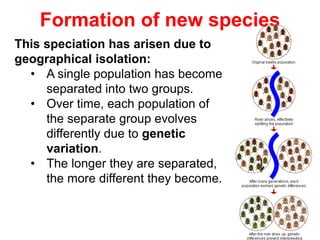
This speciation has arisen due to
geographical isolation:
• A single population has become
separated into two groups.
• Over time, each population of the
separate group evolves differently
due to genetic variation.
• The longer they are separated,
the more different they become.
• Eventually, the two sub-
populations have changed so
much they can no longer
interbreed.
Formation of new species
This speciation has arisen due to
geographical isolation:
• A single population has become
separated into two groups.
• Over time, each population of the
separate group evolves differently
due to genetic variation.
• The longer they are separated, the
more different they become.
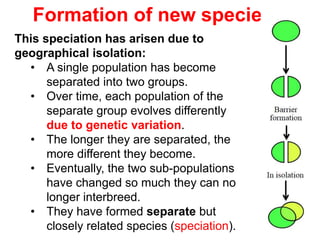
• Eventually, the two sub-populations
have changed so much they can no
longer interbreed.
• They have formed separate but
closely related species (speciation).
Natural selection in action:
The peppered moth
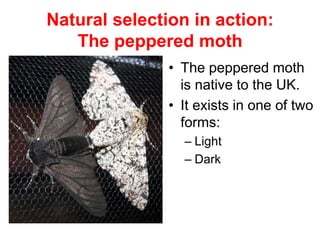
• The peppered moth
is native to the UK.
• It exists in one of two
forms:
– Light
– Dark
The Peppered Moth
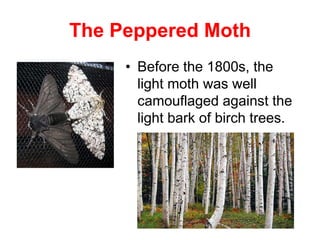
• Before the 1800s, the
light moth was well
camouflaged against the
light bark of birch trees.
The Peppered Moth
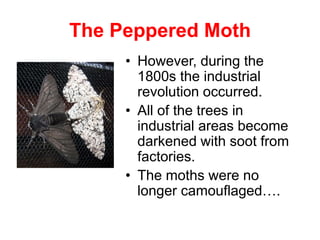
• However, during the
1800s the industrial
revolution occurred.
• All of the trees in
industrial areas become
darkened with soot from
factories.
• The moths were no
longer camouflaged….
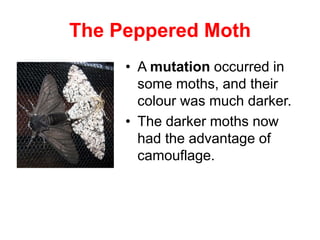
The Peppered Moth
• A mutation occurred in
some moths, and their
colour was much darker.
• The darker moths now
had the advantage of
camouflage.
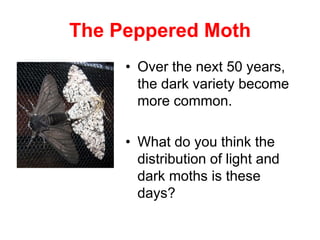
The Peppered Moth
• Over the next 50 years,
the dark variety become
more common.
• What do you think the
distribution of light and
dark moths is these
days?
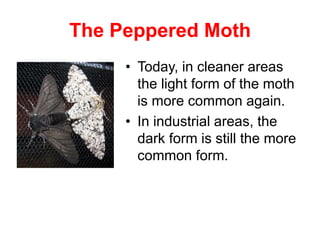
The Peppered Moth
• Today, in cleaner areas
the light form of the moth
is more common again.
• In industrial areas, the
dark form is still the more
common form.
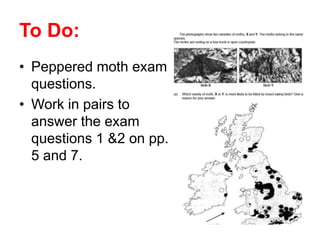
To Do:
• Peppered moth exam
questions.
• Work in pairs to
answer the exam
questions 1 &2 on pp.
5 and 7.
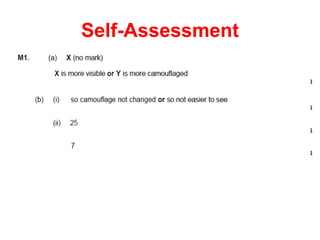
Self-Assessment
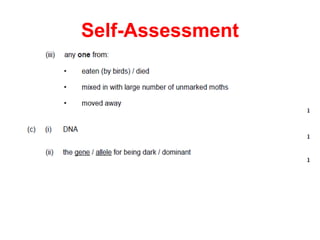
Self-Assessment
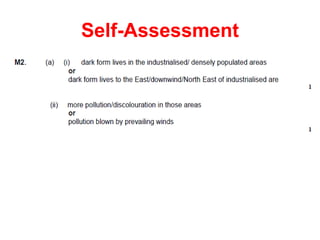
Self-Assessment
Self-Assessment
Self-Assessment

B2.8 speciation

  • 1.
    Speciation BTEOTSSSBAT define speciation Describethe evidence for evolution Explain how speciation relates to natural selection
  • 2.
    Evolution in action whatevidence is there to support the theory of evolution? All Most Some • Can you define the term “speciation”? • Can you describe the evidence for evolution in action? • Can you explain evidence to evolution in action in terms of natural selection? STARTER QUESTION What is ‘natural selection’?
  • 3.
    Summary Changes in theenvironment of plants and animals may cause them to die out. The fossil record shows that new organisms arise, flourish, and after a time become extinct. The record also shows changes that lead to the formation of new species.
  • 4.
  • 5.
  • 6.
  • 8.
    B2.8.1 Old andnew species • The first organisms were very simple single-celled organisms, similar to bacteria. • However, these rarely survive as fossils. • Therefore, scientists cannot be certain about how life began on Earth. • It is only possible to develop theoretical models that show how life may have started.
  • 9.
    a) Evidence forearly forms of life comes from fossils. b) Fossils are the ‘remains’ of organisms from many years ago, and are found in rocks.
  • 10.
    ■ from thehard parts of animals that do not decay easily ■ from parts of organisms that have not decayed because one or more of the conditions needed for decay are absent ■ when parts of the organism are replaced by other materials as they decay ■ as preserved traces of organisms, eg footprints, burrows and rootlet traces. Fossils may be formed in various ways:
  • 11.
    c) Many earlyforms of life were soft-bodied, which means that they have left few traces behind. What traces there were have been mainly destroyed by geological activity. d) We can learn from fossils how much or how little organisms have changed as life developed on Earth.
  • 12.
    ■ changes tothe environment over geological time e) Extinction may be caused by: ■ new predators may arise ■ new diseases may arise ■ new, more successful, competitors may arise ■ a single catastrophic event, eg massive volcanic eruptions or collisions with asteroids ■ through the cyclical nature of speciation.
  • 13.
    • If theorganisms cannot evolve quick enough to become better adapted to the change they may become extinct. • If they do evolve, they are likely to develop into new species.
  • 14.
    Complete the sentencesusing the words below: animal evidence fossils minerals plant One important piece of …………. for how life has developed on earth are …………… . The most common type are formed when parts of the ……………. or …………..are replaced by ……….. as it decays
  • 15.
    A species isdefined as a group of organisms that are capable of breeding together to produce fertile offspring. What is a species?
  • 16.
    A species isdefined as a group of organisms that are capable of breeding together to produce fertile offspring. What is a species? Is a liger a species?
  • 19.
    What is ‘naturalselection’? • Natural selection is the process whereby organisms better adapted to their environment tend to survive and produce more offspring. • The theory of its action was first fully expounded by Charles Darwin and is now believed to be the main process that brings about evolution.
  • 20.
    Natural selection canresult in the formation of new species… • The formation of new species is know as ‘speciation’. • Speciation can occur in a number of ways… This is evidence for natural selection in action!
  • 21.
    Formation of newspecies The African and Asian elephants are two separate but very closely related species.
  • 22.
    Formation of newspecies This speciation has arisen due to geographical isolation: • A single population has become separated into two groups. A geographical (land) barrier has stopped them being all together in one group.
  • 23.
    Formation of newspecies This speciation has arisen due to geographical isolation: • A single population has become separated into two groups. • Over time, each population of the separate group evolves differently due to genetic variation.
  • 24.
    Formation of newspecies This speciation has arisen due to geographical isolation: • A single population has become separated into two groups. • Over time, each population of the separate group evolves differently due to genetic variation. • The longer they are separated, the more different they become.
  • 25.
    Formation of newspecies This speciation has arisen due to geographical isolation: • A single population has become separated into two groups. • Over time, each population of the separate group evolves differently due to genetic variation. • The longer they are separated, the more different they become. • Eventually, the two sub- populations have changed so much they can no longer interbreed.
  • 26.
    Formation of newspecies This speciation has arisen due to geographical isolation: • A single population has become separated into two groups. • Over time, each population of the separate group evolves differently due to genetic variation. • The longer they are separated, the more different they become. • Eventually, the two sub-populations have changed so much they can no longer interbreed. • They have formed separate but closely related species (speciation).
  • 27.
    Natural selection inaction: The peppered moth • The peppered moth is native to the UK. • It exists in one of two forms: – Light – Dark
  • 28.
    The Peppered Moth •Before the 1800s, the light moth was well camouflaged against the light bark of birch trees.
  • 29.
    The Peppered Moth •However, during the 1800s the industrial revolution occurred. • All of the trees in industrial areas become darkened with soot from factories. • The moths were no longer camouflaged….
  • 30.
    The Peppered Moth •A mutation occurred in some moths, and their colour was much darker. • The darker moths now had the advantage of camouflage.
  • 31.
    The Peppered Moth •Over the next 50 years, the dark variety become more common. • What do you think the distribution of light and dark moths is these days?
  • 32.
    The Peppered Moth •Today, in cleaner areas the light form of the moth is more common again. • In industrial areas, the dark form is still the more common form.
  • 33.
    To Do: • Pepperedmoth exam questions. • Work in pairs to answer the exam questions 1 &2 on pp. 5 and 7.
  • 34.
  • 35.
  • 36.
  • 37.
  • 38.

Editor's Notes