NORMAL DISTRIBUTION
MEANING & FEATURES
NORMAL DISTRIBUTION
PROPERTIES ,EMPIRICAL
RULE & NORMAL EQUATION
NORMAL DISTRIBUTION
The normal distribution is a continuous
distribution of data that has the shape of a
symmetrical bell curve.
This distribution was developed by Dr. D. Moivre
in 1733.
This distribution was rediscovered by the German
mathematician ,Gauss in 1809 & again by the
french mathematician ,Pascal in 1812.
NORMAL DISTRIBUTION
It's also known as the Bell Curve , Normal
curve , Normal frequency distribution ,normal
probability curve, Normal curve of error,
Gauss curve.
It is also called the Gaussian Distribution,
after Karl F Gauss who created a mathematical
formula for the curve.
NORMAL DISTRIBUTION
Normal distribution is also called Gaussian
distribution or Gaussian law of error as this
theory describes the accidental error of
measurements.
EXAMPLE
Height is one simple example of something that
follows a normal distribution pattern: Most
people are of average height, the numbers of
people that are taller and shorter than average
are fairly equal and a very small (and still roughly
equivalent) number of people are either
extremely tall or extremely short.
EXAMPLE
For example, heights and weights of men and
women have this distribution.
Standardized test scores are normally
distributed.
Sometimes life spans of manufactured parts
or equipment form a normal distribution.
Features of normal distributions
Normal distributions are symmetric around their
mean.
The mean, median, and mode of a normal
distribution are equal.
The area under the normal curve is equal to 1.0.
Normal distributions are denser in the center and
less dense in the tails.
FEATURES OF NORMAL DISTRIBUTIONS
Normal distributions are defined by two
parameters, the mean (μ) and the standard
deviation (σ).
68% of the area of a normal distribution is within
one standard deviation of the mean.
Approximately 95% of the area of a normal
distribution is within two standard deviations of
the mean.
PROPERTIES OF THE NORMAL DISTRIBUTION
 Range of normal distribution is from negative infinity
to positive infinity. It means normal curve will never
touch x- axis.
 Normal distribution is without any type of skewness.
 The normal curve is asymptotic to the base line i.e. it
never touches the base line on both side of the curve
though the curve remains close to the base line on
either sides.
PROPERTIES OF THE NORMAL DISTRIBUTION
The Normal Distribution, Or Curve, Has A Bell
Shape And Is Symmetrical.
Mean = Median(M) = Mode(Z).' This Is
Because The Shape Of The Data Is
Symmetrical With One Peak.
Symbol Mu Represents A Population Mean,
And X Bar Represents A Sample Mean.
PROPERTIES OF THE NORMAL DISTRIBUTION
There is one maximum point of normal curve
which occur at mean.
 As it has only one maximum curve so it is
unimodal i.e. it has only one mode.
 In binomial and poisson distribution the
variable is discrete while in this it is continuous.
PROPERTIES OF THE NORMAL DISTRIBUTION
The total area of normal curve is 1. The area
to the left and the area to the right of the
curve is 0.5.
No portion of curve lies below x-axis so
probability can never be negative.
 The curve becomes parallel to x-axis which is
supposed to meet it at infinity.
PROPERTIES OF THE NORMAL DISTRIBUTION
 Here mean deviation = 4/5 standard deviation
The upper & lower quartiles remain at
equidistance
PROPERTIES OF THE NORMAL DISTRIBUTION
 Quartile deviation = 2/3 standard deviation
 Quartile deviation = 5/6 mean deviation
Quartile deviation : mean deviation : standard
deviation
 10 : 12 : 15
 4 standard deviation = 5 mean deviation = 6
quartile deviation
IMPORTANCE OF NORMAL DISTRIBUTION
 In case the sample size is large the normal
distribution serves as good approximation.
 Due to its mathematical properties it is more
popular and easy to calculate.
 It is used in statistical quality control in setting up
of control limits.
 The whole theory of sample tests t, f and chi-
square test is based on the normal distribution.
EMPIRICAL RULE OR THE 68-95-99.7 RULE
A normal distribution, most outcomes will be
within 3 standard deviations of the mean.
About 68% of the area under the curve falls
within 1 standard deviation of the mean.
About 95% of the area under the curve falls
within 2 standard deviations of the mean.
About 99.7% of the area under the curve falls
within 3 standard deviations of the mean.
NORMAL EQUATION
 The Normal Equation. The value of the random
variable Y is:
 Y = { 1/[ σ * sqrt (2π) ] } * e-(x - μ)2/2σ2
 where X is a normal random variable,
 μ is the mean,
 σ is the standard deviation,
 π is approximately 3.14159, and
 e is approximately 2.71828.
NORMAL EQUATION
The random variable X in the normal equation
is called the normal random variable.
The normal equation is the probability density
function for the normal distribution.
NORMAL CURVE
 The graph of the normal distribution depends on two
factors - the mean and the standard deviation.
 The mean of the distribution determines the location
of the centre of the graph .
 The standard deviation determines the height and
width of the graph.
 All normal distributions look like a symmetric, bell-
shaped curve .
NORMAL CURVE
When the standard deviation is small, the
curve is tall and narrow .
 when the standard deviation is big, the curve
is short and wide .
STANDARD NORMAL DISTRIBUTION
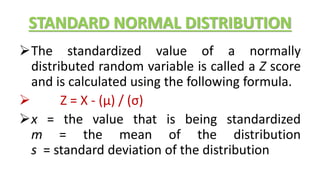
The standardized value of a normally
distributed random variable is called a Z score
and is calculated using the following formula.
 Z = X - (μ) / (σ)
x = the value that is being standardized
m = the mean of the distribution
s = standard deviation of the distribution
STANDARD NORMAL DISTRIBUTION
As the formula shows, a random variable is
standardized by subtracting the mean of the
distribution from the value being
standardized, and then dividing this difference
by the standard deviation of the distribution.
STANDARD NORMAL DISTRIBUTION
Once standardized, a normally distributed
random variable has a mean of zero and a
standard deviation of one.
As you can see from the notation to the right
of the curve, mz = 0 and sz = 1.
STANDARD NORMAL DISTRIBUTION
• To solve this problem, you would use the Z score
formula. Using the information from the example,
you know that
• x = 40
m = 20
s = 10
• Substitute these numbers into the formula and
solve.
STANDARD NORMAL DISTRIBUTION
• To see how a random variable is standardized, imagine you
have a random variable, x, that is normally distributed with
a mean of 20 and a standard deviation of 10. What would
be the standardized value (Z score) of 40? To solve this
problem, you would use the Z score formula. Using the
information from the example, you know that
• x = 40
m = 20
s = 10
• Substitute these numbers into the formula and solve.
STANDARD NORMAL DISTRIBUTION
• In this example, the standardized value (Z score) of 40 is 2.
• These Z scores are important because they tell you how far a value is from the
mean. When you standardize a random variable, its mean becomes zero and its
standard deviation becomes one; therefore,
• if the Z score of x is zero, then the value of x is equal to the mean.
if the Z score of x is one, then the value of x is one standard deviation above the
mean. If the Z score is –1, then the value of x is one standard deviation below the
mean.
If the Z score of x is two, then the value of x is two standard deviations above the
mean. If the Z score is –2, then the value of x is two standard deviations below the
mean.In the earlier example, the Z score of 40 was 2. This tells you that 40 is 2
standard deviations above the mean
STANDARD NORMAL DISTRIBUTION
 if the Z score of x is zero, then the value of x is equal to the mean.
if the Z score of x is one, then the value of x is one standard
deviation above the mean. If the Z score is –1, then the value of x is
one standard deviation below the mean.
If the Z score of x is two, then the value of x is two standard
deviations above the mean. If the Z score is –2, then the value
of x is two standard deviations below the mean.In the earlier
example, the Z score of 40 was 2. This tells you that 40 is 2 standard
deviations above the mean
STANDARD NORMAL DISTRIBUTION
If the Z score is –2, then the value of x is two
standard deviations below the mean.
This tells you that 40 is 2 standard deviations
above the mean .

Normal distribution

  • 1.
  • 2.
  • 3.
    NORMAL DISTRIBUTION The normaldistribution is a continuous distribution of data that has the shape of a symmetrical bell curve. This distribution was developed by Dr. D. Moivre in 1733. This distribution was rediscovered by the German mathematician ,Gauss in 1809 & again by the french mathematician ,Pascal in 1812.
  • 4.
    NORMAL DISTRIBUTION It's alsoknown as the Bell Curve , Normal curve , Normal frequency distribution ,normal probability curve, Normal curve of error, Gauss curve. It is also called the Gaussian Distribution, after Karl F Gauss who created a mathematical formula for the curve.
  • 5.
    NORMAL DISTRIBUTION Normal distributionis also called Gaussian distribution or Gaussian law of error as this theory describes the accidental error of measurements.
  • 6.
    EXAMPLE Height is onesimple example of something that follows a normal distribution pattern: Most people are of average height, the numbers of people that are taller and shorter than average are fairly equal and a very small (and still roughly equivalent) number of people are either extremely tall or extremely short.
  • 7.
    EXAMPLE For example, heightsand weights of men and women have this distribution. Standardized test scores are normally distributed. Sometimes life spans of manufactured parts or equipment form a normal distribution.
  • 8.
    Features of normaldistributions Normal distributions are symmetric around their mean. The mean, median, and mode of a normal distribution are equal. The area under the normal curve is equal to 1.0. Normal distributions are denser in the center and less dense in the tails.
  • 9.
    FEATURES OF NORMALDISTRIBUTIONS Normal distributions are defined by two parameters, the mean (μ) and the standard deviation (σ). 68% of the area of a normal distribution is within one standard deviation of the mean. Approximately 95% of the area of a normal distribution is within two standard deviations of the mean.
  • 10.
    PROPERTIES OF THENORMAL DISTRIBUTION  Range of normal distribution is from negative infinity to positive infinity. It means normal curve will never touch x- axis.  Normal distribution is without any type of skewness.  The normal curve is asymptotic to the base line i.e. it never touches the base line on both side of the curve though the curve remains close to the base line on either sides.
  • 11.
    PROPERTIES OF THENORMAL DISTRIBUTION The Normal Distribution, Or Curve, Has A Bell Shape And Is Symmetrical. Mean = Median(M) = Mode(Z).' This Is Because The Shape Of The Data Is Symmetrical With One Peak. Symbol Mu Represents A Population Mean, And X Bar Represents A Sample Mean.
  • 12.
    PROPERTIES OF THENORMAL DISTRIBUTION There is one maximum point of normal curve which occur at mean.  As it has only one maximum curve so it is unimodal i.e. it has only one mode.  In binomial and poisson distribution the variable is discrete while in this it is continuous.
  • 13.
    PROPERTIES OF THENORMAL DISTRIBUTION The total area of normal curve is 1. The area to the left and the area to the right of the curve is 0.5. No portion of curve lies below x-axis so probability can never be negative.  The curve becomes parallel to x-axis which is supposed to meet it at infinity.
  • 14.
    PROPERTIES OF THENORMAL DISTRIBUTION  Here mean deviation = 4/5 standard deviation The upper & lower quartiles remain at equidistance
  • 15.
    PROPERTIES OF THENORMAL DISTRIBUTION  Quartile deviation = 2/3 standard deviation  Quartile deviation = 5/6 mean deviation Quartile deviation : mean deviation : standard deviation  10 : 12 : 15  4 standard deviation = 5 mean deviation = 6 quartile deviation
  • 16.
    IMPORTANCE OF NORMALDISTRIBUTION  In case the sample size is large the normal distribution serves as good approximation.  Due to its mathematical properties it is more popular and easy to calculate.  It is used in statistical quality control in setting up of control limits.  The whole theory of sample tests t, f and chi- square test is based on the normal distribution.
  • 17.
    EMPIRICAL RULE ORTHE 68-95-99.7 RULE A normal distribution, most outcomes will be within 3 standard deviations of the mean. About 68% of the area under the curve falls within 1 standard deviation of the mean. About 95% of the area under the curve falls within 2 standard deviations of the mean. About 99.7% of the area under the curve falls within 3 standard deviations of the mean.
  • 18.
    NORMAL EQUATION  TheNormal Equation. The value of the random variable Y is:  Y = { 1/[ σ * sqrt (2π) ] } * e-(x - μ)2/2σ2  where X is a normal random variable,  μ is the mean,  σ is the standard deviation,  π is approximately 3.14159, and  e is approximately 2.71828.
  • 19.
    NORMAL EQUATION The randomvariable X in the normal equation is called the normal random variable. The normal equation is the probability density function for the normal distribution.
  • 20.
    NORMAL CURVE  Thegraph of the normal distribution depends on two factors - the mean and the standard deviation.  The mean of the distribution determines the location of the centre of the graph .  The standard deviation determines the height and width of the graph.  All normal distributions look like a symmetric, bell- shaped curve .
  • 21.
    NORMAL CURVE When thestandard deviation is small, the curve is tall and narrow .  when the standard deviation is big, the curve is short and wide .
  • 22.
    STANDARD NORMAL DISTRIBUTION Thestandardized value of a normally distributed random variable is called a Z score and is calculated using the following formula.  Z = X - (μ) / (σ) x = the value that is being standardized m = the mean of the distribution s = standard deviation of the distribution
  • 23.
    STANDARD NORMAL DISTRIBUTION Asthe formula shows, a random variable is standardized by subtracting the mean of the distribution from the value being standardized, and then dividing this difference by the standard deviation of the distribution.
  • 24.
    STANDARD NORMAL DISTRIBUTION Oncestandardized, a normally distributed random variable has a mean of zero and a standard deviation of one. As you can see from the notation to the right of the curve, mz = 0 and sz = 1.
  • 25.
    STANDARD NORMAL DISTRIBUTION •To solve this problem, you would use the Z score formula. Using the information from the example, you know that • x = 40 m = 20 s = 10 • Substitute these numbers into the formula and solve.
  • 26.
    STANDARD NORMAL DISTRIBUTION •To see how a random variable is standardized, imagine you have a random variable, x, that is normally distributed with a mean of 20 and a standard deviation of 10. What would be the standardized value (Z score) of 40? To solve this problem, you would use the Z score formula. Using the information from the example, you know that • x = 40 m = 20 s = 10 • Substitute these numbers into the formula and solve.
  • 27.
    STANDARD NORMAL DISTRIBUTION •In this example, the standardized value (Z score) of 40 is 2. • These Z scores are important because they tell you how far a value is from the mean. When you standardize a random variable, its mean becomes zero and its standard deviation becomes one; therefore, • if the Z score of x is zero, then the value of x is equal to the mean. if the Z score of x is one, then the value of x is one standard deviation above the mean. If the Z score is –1, then the value of x is one standard deviation below the mean. If the Z score of x is two, then the value of x is two standard deviations above the mean. If the Z score is –2, then the value of x is two standard deviations below the mean.In the earlier example, the Z score of 40 was 2. This tells you that 40 is 2 standard deviations above the mean
  • 28.
    STANDARD NORMAL DISTRIBUTION if the Z score of x is zero, then the value of x is equal to the mean. if the Z score of x is one, then the value of x is one standard deviation above the mean. If the Z score is –1, then the value of x is one standard deviation below the mean. If the Z score of x is two, then the value of x is two standard deviations above the mean. If the Z score is –2, then the value of x is two standard deviations below the mean.In the earlier example, the Z score of 40 was 2. This tells you that 40 is 2 standard deviations above the mean
  • 29.
    STANDARD NORMAL DISTRIBUTION Ifthe Z score is –2, then the value of x is two standard deviations below the mean. This tells you that 40 is 2 standard deviations above the mean .