C2.2 How do structures influence
the properties and uses of
substances?
Summary
Substances that have simple molecular, giant ionic
and giant covalent structures have very different
properties.
Ionic, covalent and metallic bonds are strong.
The forces between molecules are weaker, e.g. in
carbon dioxide and iodine.
Nanomaterials have new properties because of their
very small size (about the size of 10 atoms).
You should be able to:
 to relate the properties of substances to their uses
 to suggest the type of structure of a substance
given its properties
 to evaluate developments and applications of new
materials, e.g. Nanomaterials, smart materials.

Substances
Molecular
Giant
Ionic
Covalent
Metallic bonds
Nanomaterials
Structure
Intermolecular
Lattices
Delocalised
Fullerene
Graphite
Alloys
Polymers
Catalysts
Thermosoftening
Thermosetting
Nanoscience
Key words
Molecules
(a) Substances that consist of simple molecules are gases,
liquids or solids that have relatively low melting points and
boiling points.

Molecules
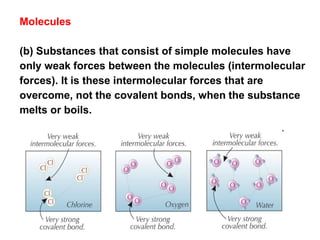
(b) Substances that consist of simple molecules have
only weak forces between the molecules (intermolecular
forces). It is these intermolecular forces that are
overcome, not the covalent bonds, when the substance
melts or boils.
Molecules
(c) Substances that consist of simple molecules do not
conduct electricity because the molecules do not have an
overall electric charge.
Ionic compounds
(a) Ionic compounds have regular structures (giant ionic
lattices) in which there are strong electrostatic forces in
all directions between oppositely charged ions. These
compounds have high melting points and high boiling
points.
Ionic compounds
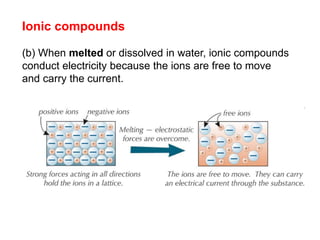
(b) When melted or dissolved in water, ionic compounds
conduct electricity because the ions are free to move
and carry the current.
Ionic compounds
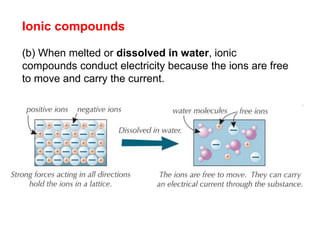
(b) When melted or dissolved in water, ionic
compounds conduct electricity because the ions are free
to move and carry the current.
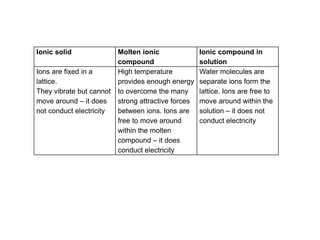
Ionic solid Molten ionic
compound
Ionic compound in
solution
Ions are fixed in a
lattice.
They vibrate but cannot
move around – it does
not conduct electricity
High temperature
provides enough energy
to overcome the many
strong attractive forces
between ions. Ions are
free to move around
within the molten
compound – it does
conduct electricity
Water molecules are
separate ions form the
lattice. Ions are free to
move around within the
solution – it does not
conduct electricity
Covalent structures
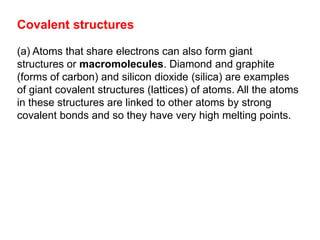
(a) Atoms that share electrons can also form giant
structures or macromolecules. Diamond and graphite
(forms of carbon) and silicon dioxide (silica) are examples
of giant covalent structures (lattices) of atoms. All the atoms
in these structures are linked to other atoms by strong
covalent bonds and so they have very high melting points.
Covalent structures
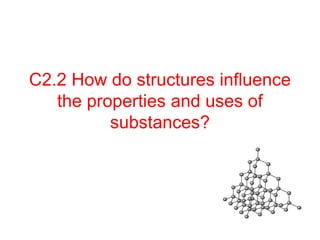
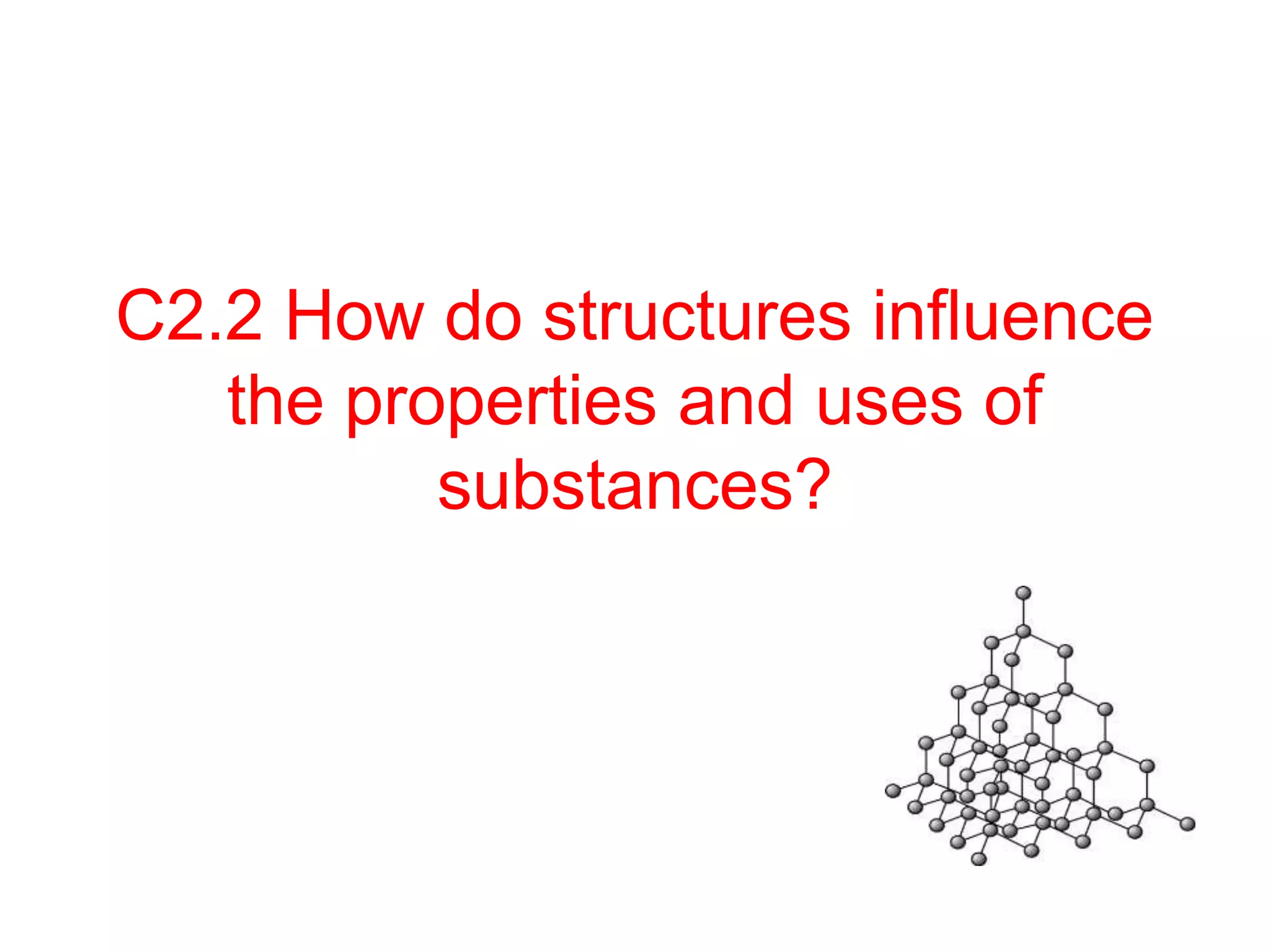
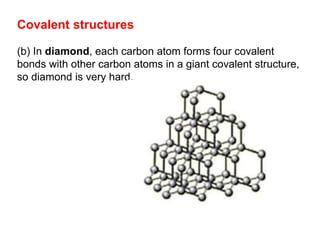
(b) In diamond, each carbon atom forms four covalent
bonds with other carbon atoms in a giant covalent structure,
so diamond is very hard.
Covalent structures
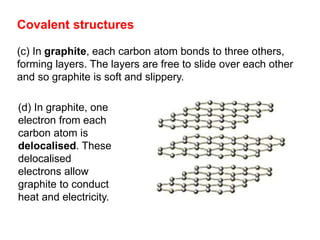
(c) In graphite, each carbon atom bonds to three others,
forming layers. The layers are free to slide over each other
and so graphite is soft and slippery.
(d) In graphite, one
electron from each
carbon atom is
delocalised. These
delocalised
electrons allow
graphite to conduct
heat and electricity.
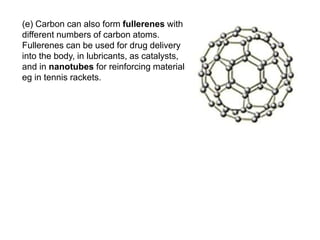
(e) Carbon can also form fullerenes with
different numbers of carbon atoms.
Fullerenes can be used for drug delivery
into the body, in lubricants, as catalysts,
and in nanotubes for reinforcing materials,
eg in tennis rackets.
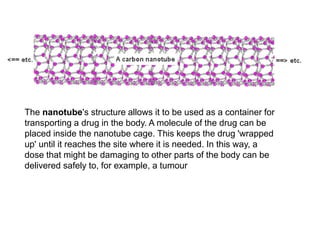
The nanotube's structure allows it to be used as a container for
transporting a drug in the body. A molecule of the drug can be
placed inside the nanotube cage. This keeps the drug 'wrapped
up' until it reaches the site where it is needed. In this way, a
dose that might be damaging to other parts of the body can be
delivered safely to, for example, a tumour
Metals
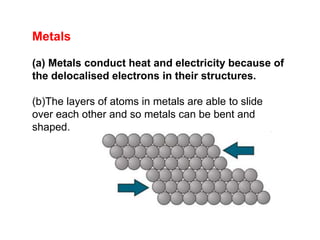
(a) Metals conduct heat and electricity because of
the delocalised electrons in their structures.
(b)The layers of atoms in metals are able to slide
over each other and so metals can be bent and
shaped.
Metals
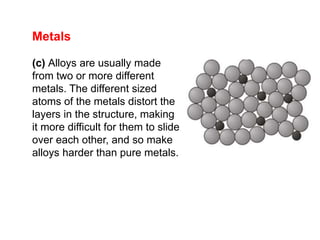
(c) Alloys are usually made
from two or more different
metals. The different sized
atoms of the metals distort the
layers in the structure, making
it more difficult for them to slide
over each other, and so make
alloys harder than pure metals.
(d) Shape memory alloys can return to their original
shape after being deformed.
http://www.youtube.com/watch?v=Y7jjqXh7bB4
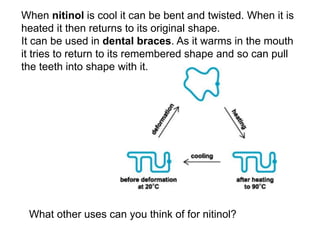
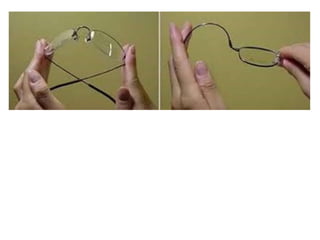
When nitinol is cool it can be bent and twisted. When it is
heated it then returns to its original shape.
It can be used in dental braces. As it warms in the mouth
it tries to return to its remembered shape and so can pull
the teeth into shape with it.
What other uses can you think of for nitinol?
When nitinol is cool it can be bent and twisted. When it is
heated it then returns to its original shape.
It can be used in dental braces. As it warms in the mouth
it tries to return to its remembered shape and so can pull
the teeth into shape with it.
Polymers
(a) The properties of polymers depend on what they
are made from and the conditions under which they
are made. For example, low density (LD) and high
density (HD) poly(ethene) are produced using different
catalysts and reaction conditions.
Polymers
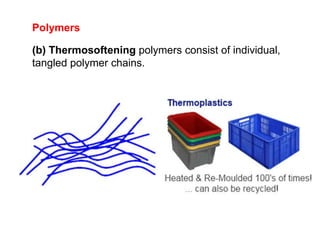
(b) Thermosoftening polymers consist of individual,
tangled polymer chains.
Polymers
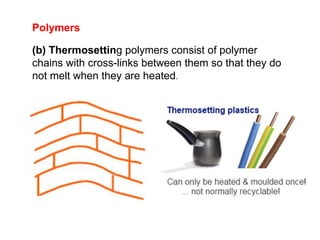
(b) Thermosetting polymers consist of polymer
chains with cross-links between them so that they do
not melt when they are heated.
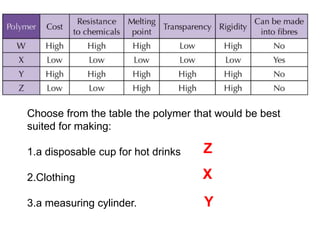
Choose from the table the polymer that would be best
suited for making:
1.a disposable cup for hot drinks
2.Clothing
3.a measuring cylinder.
Z
X
Y
Nanoscience
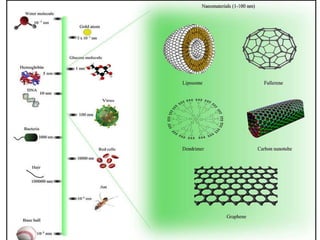
(a) Nanoscience refers to structures that are 1-100 nm in
size, of the order of a few hundred atoms.
Nanoscience
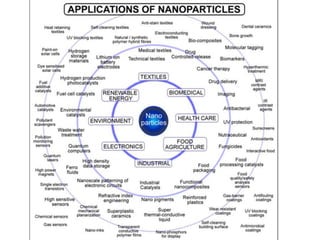
Such as:
• new computers,
• new catalysts,
• new coatings,
• highly selective sensors and
• stronger and lighter building materials.
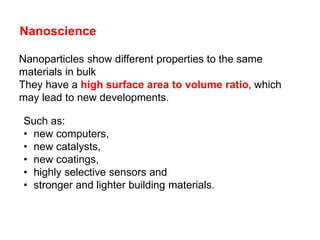
Nanoparticles show different properties to the same
materials in bulk
They have a high surface area to volume ratio, which
may lead to new developments.
Some nanoparticle have some strange properties –
this means we have to be careful that they don’t have
any unknown harmful properties.
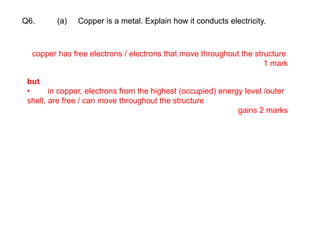
Q6. (a) Copper is a metal. Explain how it conducts electricity.
copper has free electrons / electrons that move throughout the structure
1 mark
but
• in copper, electrons from the highest (occupied) energy level /outer
shell, are free / can move throughout the structure
gains 2 marks
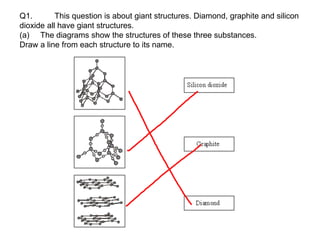
Q1. This question is about giant structures. Diamond, graphite and silicon
dioxide all have giant structures.
(a) The diagrams show the structures of these three substances.
Draw a line from each structure to its name.
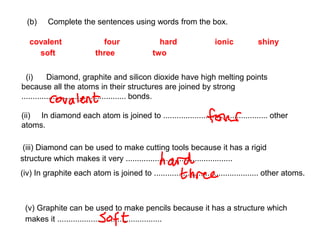
(b) Complete the sentences using words from the box.
covalent four hard ionic shiny
soft three two
(i) Diamond, graphite and silicon dioxide have high melting points
because all the atoms in their structures are joined by strong
............................................... bonds.
(ii) In diamond each atom is joined to ............................................... other
atoms.
(iii) Diamond can be used to make cutting tools because it has a rigid
structure which makes it very ................................................
(iv) In graphite each atom is joined to ............................................... other atoms.
(v) Graphite can be used to make pencils because it has a structure which
makes it ...............................................
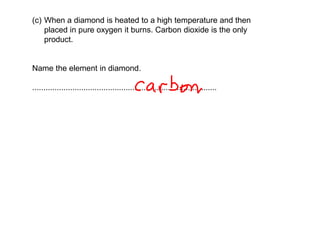
(c) When a diamond is heated to a high temperature and then
placed in pure oxygen it burns. Carbon dioxide is the only
product.
Name the element in diamond.
...................................................................................
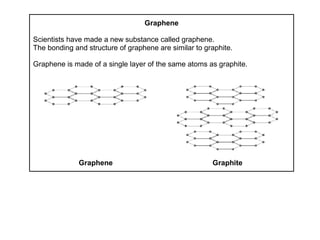
Graphene
Scientists have made a new substance called graphene.
The bonding and structure of graphene are similar to graphite.
Graphene is made of a single layer of the same atoms as graphite.
Graphene Graphite
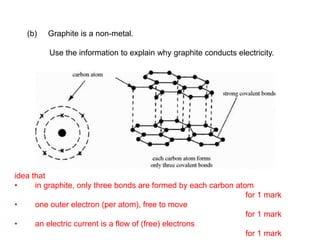
(b) Graphite is a non-metal.
Use the information to explain why graphite conducts electricity.
idea that
• in graphite, only three bonds are formed by each carbon atom
for 1 mark
• one outer electron (per atom), free to move
for 1 mark
• an electric current is a flow of (free) electrons
for 1 mark
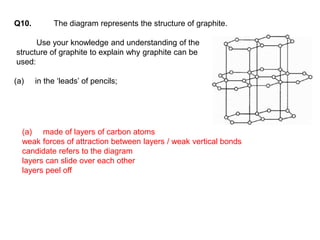
Q10. The diagram represents the structure of graphite.
Use your knowledge and understanding of the
structure of graphite to explain why graphite can be
used:
(a) in the ‘leads’ of pencils;
(a) made of layers of carbon atoms
weak forces of attraction between layers / weak vertical bonds
candidate refers to the diagram
layers can slide over each other
layers peel off
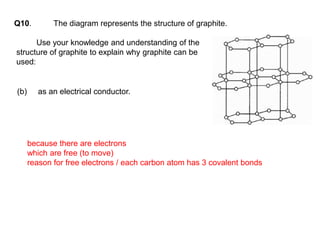
Q10. The diagram represents the structure of graphite.
Use your knowledge and understanding of the
structure of graphite to explain why graphite can be
used:
(b) as an electrical conductor.
because there are electrons
which are free (to move)
reason for free electrons / each carbon atom has 3 covalent bonds
C2.2 how structure influences

C2.2 how structure influences

  • 1.
    C2.2 How dostructures influence the properties and uses of substances?
  • 2.
    Summary Substances that havesimple molecular, giant ionic and giant covalent structures have very different properties. Ionic, covalent and metallic bonds are strong. The forces between molecules are weaker, e.g. in carbon dioxide and iodine. Nanomaterials have new properties because of their very small size (about the size of 10 atoms).
  • 3.
    You should beable to:  to relate the properties of substances to their uses  to suggest the type of structure of a substance given its properties  to evaluate developments and applications of new materials, e.g. Nanomaterials, smart materials.
  • 4.
  • 6.
    Molecules (a) Substances thatconsist of simple molecules are gases, liquids or solids that have relatively low melting points and boiling points.
  • 7.
    Molecules (b) Substances thatconsist of simple molecules have only weak forces between the molecules (intermolecular forces). It is these intermolecular forces that are overcome, not the covalent bonds, when the substance melts or boils.
  • 8.
    Molecules (c) Substances thatconsist of simple molecules do not conduct electricity because the molecules do not have an overall electric charge.
  • 9.
    Ionic compounds (a) Ioniccompounds have regular structures (giant ionic lattices) in which there are strong electrostatic forces in all directions between oppositely charged ions. These compounds have high melting points and high boiling points.
  • 10.
    Ionic compounds (b) Whenmelted or dissolved in water, ionic compounds conduct electricity because the ions are free to move and carry the current.
  • 11.
    Ionic compounds (b) Whenmelted or dissolved in water, ionic compounds conduct electricity because the ions are free to move and carry the current.
  • 12.
    Ionic solid Moltenionic compound Ionic compound in solution Ions are fixed in a lattice. They vibrate but cannot move around – it does not conduct electricity High temperature provides enough energy to overcome the many strong attractive forces between ions. Ions are free to move around within the molten compound – it does conduct electricity Water molecules are separate ions form the lattice. Ions are free to move around within the solution – it does not conduct electricity
  • 13.
    Covalent structures (a) Atomsthat share electrons can also form giant structures or macromolecules. Diamond and graphite (forms of carbon) and silicon dioxide (silica) are examples of giant covalent structures (lattices) of atoms. All the atoms in these structures are linked to other atoms by strong covalent bonds and so they have very high melting points.
  • 14.
    Covalent structures (b) Indiamond, each carbon atom forms four covalent bonds with other carbon atoms in a giant covalent structure, so diamond is very hard.
  • 15.
    Covalent structures (c) Ingraphite, each carbon atom bonds to three others, forming layers. The layers are free to slide over each other and so graphite is soft and slippery. (d) In graphite, one electron from each carbon atom is delocalised. These delocalised electrons allow graphite to conduct heat and electricity.
  • 16.
    (e) Carbon canalso form fullerenes with different numbers of carbon atoms. Fullerenes can be used for drug delivery into the body, in lubricants, as catalysts, and in nanotubes for reinforcing materials, eg in tennis rackets.
  • 17.
    The nanotube's structureallows it to be used as a container for transporting a drug in the body. A molecule of the drug can be placed inside the nanotube cage. This keeps the drug 'wrapped up' until it reaches the site where it is needed. In this way, a dose that might be damaging to other parts of the body can be delivered safely to, for example, a tumour
  • 18.
    Metals (a) Metals conductheat and electricity because of the delocalised electrons in their structures. (b)The layers of atoms in metals are able to slide over each other and so metals can be bent and shaped.
  • 19.
    Metals (c) Alloys areusually made from two or more different metals. The different sized atoms of the metals distort the layers in the structure, making it more difficult for them to slide over each other, and so make alloys harder than pure metals.
  • 20.
    (d) Shape memoryalloys can return to their original shape after being deformed. http://www.youtube.com/watch?v=Y7jjqXh7bB4 When nitinol is cool it can be bent and twisted. When it is heated it then returns to its original shape. It can be used in dental braces. As it warms in the mouth it tries to return to its remembered shape and so can pull the teeth into shape with it. What other uses can you think of for nitinol?
  • 21.
    What other usescan you think of for nitinol? When nitinol is cool it can be bent and twisted. When it is heated it then returns to its original shape. It can be used in dental braces. As it warms in the mouth it tries to return to its remembered shape and so can pull the teeth into shape with it.
  • 23.
    Polymers (a) The propertiesof polymers depend on what they are made from and the conditions under which they are made. For example, low density (LD) and high density (HD) poly(ethene) are produced using different catalysts and reaction conditions.
  • 24.
    Polymers (b) Thermosoftening polymersconsist of individual, tangled polymer chains.
  • 25.
    Polymers (b) Thermosetting polymersconsist of polymer chains with cross-links between them so that they do not melt when they are heated.
  • 26.
    Choose from thetable the polymer that would be best suited for making: 1.a disposable cup for hot drinks 2.Clothing 3.a measuring cylinder. Z X Y
  • 27.
    Nanoscience (a) Nanoscience refersto structures that are 1-100 nm in size, of the order of a few hundred atoms.
  • 29.
    Nanoscience Such as: • newcomputers, • new catalysts, • new coatings, • highly selective sensors and • stronger and lighter building materials. Nanoparticles show different properties to the same materials in bulk They have a high surface area to volume ratio, which may lead to new developments.
  • 31.
    Some nanoparticle havesome strange properties – this means we have to be careful that they don’t have any unknown harmful properties.
  • 32.
    Q6. (a) Copperis a metal. Explain how it conducts electricity. copper has free electrons / electrons that move throughout the structure 1 mark but • in copper, electrons from the highest (occupied) energy level /outer shell, are free / can move throughout the structure gains 2 marks
  • 33.
    Q1. This questionis about giant structures. Diamond, graphite and silicon dioxide all have giant structures. (a) The diagrams show the structures of these three substances. Draw a line from each structure to its name.
  • 34.
    (b) Complete thesentences using words from the box. covalent four hard ionic shiny soft three two (i) Diamond, graphite and silicon dioxide have high melting points because all the atoms in their structures are joined by strong ............................................... bonds. (ii) In diamond each atom is joined to ............................................... other atoms. (iii) Diamond can be used to make cutting tools because it has a rigid structure which makes it very ................................................ (iv) In graphite each atom is joined to ............................................... other atoms. (v) Graphite can be used to make pencils because it has a structure which makes it ...............................................
  • 35.
    (c) When adiamond is heated to a high temperature and then placed in pure oxygen it burns. Carbon dioxide is the only product. Name the element in diamond. ...................................................................................
  • 36.
    Graphene Scientists have madea new substance called graphene. The bonding and structure of graphene are similar to graphite. Graphene is made of a single layer of the same atoms as graphite. Graphene Graphite
  • 39.
    (b) Graphite isa non-metal. Use the information to explain why graphite conducts electricity. idea that • in graphite, only three bonds are formed by each carbon atom for 1 mark • one outer electron (per atom), free to move for 1 mark • an electric current is a flow of (free) electrons for 1 mark
  • 40.
    Q10. The diagramrepresents the structure of graphite. Use your knowledge and understanding of the structure of graphite to explain why graphite can be used: (a) in the ‘leads’ of pencils; (a) made of layers of carbon atoms weak forces of attraction between layers / weak vertical bonds candidate refers to the diagram layers can slide over each other layers peel off
  • 41.
    Q10. The diagramrepresents the structure of graphite. Use your knowledge and understanding of the structure of graphite to explain why graphite can be used: (b) as an electrical conductor. because there are electrons which are free (to move) reason for free electrons / each carbon atom has 3 covalent bonds