Statistics and Probability
Quarter 3: Normal Distribution
Ma’am Neomy Angela L. Tolentino
Virtual House Rules:
Be on time for the class. Make
sure to message the teacher if
you cannot log in on time.
MUTE yourself until you raise
your hand and your teacher
calls you.
STAY IN ONE PLACE and FACE
the camera.
Always do your BEST WORK.
Always be RESPECTFUL to your
teacher and classmates.
NO distractions.
Wear APPROPRIATE
CLOTHING.
Listen & follow DIRECTIONS.
Stay in a quiet place.
Statistics and Probability
Let’s have
a warm
up!
“
Statistics and Probability
What is a normal distribution?
A normal distribution (Gaussian distribution) is a
probability distribution that is symmetric about the
mean, showing that data near the mean are more
frequent in occurrence than data far from the mean.
“
Statistics and Probability
𝑓 𝑥 =
1
𝜎 2𝜋
𝑒
−
1
2
𝑥−𝜇
𝜎
2
f(x) = the height of the curve
particular values of x
X = any score in the
distribution
𝜎 = standard deviation of the
population
𝜇 = mean of the population
𝜋 = 3.1416
𝑒 = 2.7183
“
Statistics and Probability
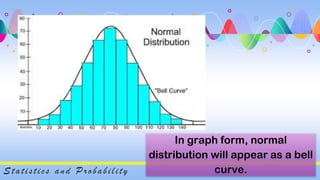
In graph form, normal
distribution will appear as a bell
curve.
Properties of the normal distribution:
Statistics and Probability
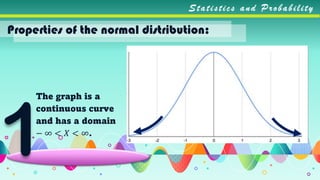
1
The graph is a
continuous curve
and has a domain
− ∞ < 𝑋 < ∞.
Properties of the normal distribution:
Statistics and Probability
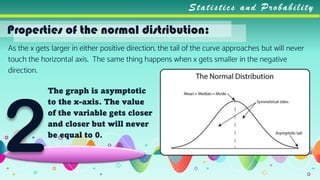
As the x gets larger in either positive direction, the tail of the curve approaches but will never
touch the horizontal axis. The same thing happens when x gets smaller in the negative
direction.
2
The graph is asymptotic
to the x-axis. The value
of the variable gets closer
and closer but will never
be equal to 0.
Properties of the normal distribution:
Statistics and Probability
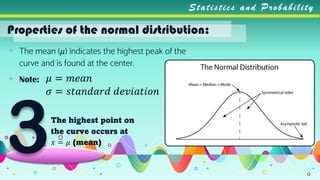
▹ The mean (𝜇) indicates the highest peak of the
curve and is found at the center.
▹ Note:
3The highest point on
the curve occurs at
𝑥 = 𝜇 (mean)
𝜇 = 𝑚𝑒𝑎𝑛
𝜎 = 𝑠𝑡𝑎𝑛𝑑𝑎𝑟𝑑 𝑑𝑒𝑣𝑖𝑎𝑡𝑖𝑜𝑛
Properties of the normal distribution:
Statistics and Probability
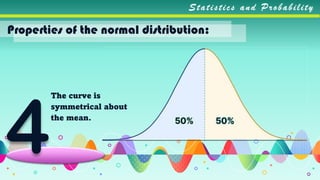
4
The curve is
symmetrical about
the mean.
Properties of the normal distribution:
Statistics and Probability
5
The total area in the
normal distribution
under the curve is
equal to 1.
100% or 1
Properties of the normal distribution:
Statistics and Probability
6
In general, the graph of
a normal distribution is
a bell-shaped curve
with two inflection
points, one on the left
and another on the
right. Inflection points
are the points that
mark the change in the
curve’s concavity
Properties of the normal distribution:
Statistics and Probability
7
Every normal
curve
corresponds
to the
“empirical
rule” (also
called the 68 –
95 – 99.7%
rule):
0.3413
or
34.13%
0.4772
or
47.72%
0.4987
or
49.87%
0.4987
or
49.87%
0.4772
or
47.72%
0.3413
or
34.13%
68.26%
95.44%
99.74%
Example #1:
Statistics and Probability
Suppose the
mean is 60 and
the standard
deviation is 5.
Sketch a normal
curve for the
distribution.
60
𝝁 =
5
𝝈 =
65 70
55
50
0 1 2
-1
-2
45
-3
75
3
5 5
Z scores
Statistics and Probability
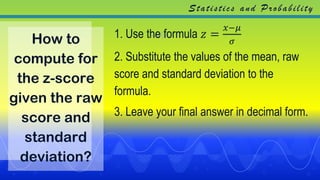
How to
compute for
the z-score
given the raw
score and
standard
deviation?
1. Use the formula 𝑧 =
𝑥−𝜇
𝜎
2. Substitute the values of the mean, raw
score and standard deviation to the
formula.
3. Leave your final answer in decimal form.
Example #1:
Statistics and Probability
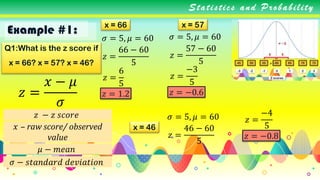
Q1:What is the z score if
x = 66? x = 57? x = 46?
𝑧 =
𝑥 − 𝜇
𝜎
𝜎 = 5, 𝜇 = 60
x = 66
𝑧 − 𝑧 𝑠𝑐𝑜𝑟𝑒
𝑥 – raw score/ observed
value
𝜇 − 𝑚𝑒𝑎𝑛
𝜎 − 𝑠𝑡𝑎𝑛𝑑𝑎𝑟𝑑 𝑑𝑒𝑣𝑖𝑎𝑡𝑖𝑜𝑛
𝑧 =
66 − 60
5
𝑧 =
6
5
𝑧 = 1.2
x = 57
𝜎 = 5, 𝜇 = 60
𝑧 =
57 − 60
5
𝑧 =
−3
5
𝑧 = −0.6
x = 46
𝜎 = 5, 𝜇 = 60
𝑧 =
46 − 60
5
𝑧 =
−4
5
𝑧 = −0.8
Example #2:
Statistics and Probability
Find for the z score of the following:
𝝈 = 𝟓
𝑧 =
50 − 40
5
𝑧 =
10
5
𝑧 = 2
𝒙 𝝈 𝝁
50 5 40
40 8 52
36 6 28
60 10 74
75 15 82
x = 50 𝝁 = 𝟒𝟎
𝒛 =
𝒙 − 𝝁
𝝈
𝝈 = 𝟖
x = 40 𝝁 = 𝟓𝟐
𝑧 =
40 − 52
8
𝑧 =
−12
8
= −
3
2
𝑧 = 1.5
𝑧 = 1.33
𝑧 = −1.4
𝑧 = −0.47
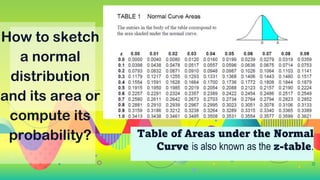
How to sketch
a normal
distribution
and its area or
compute its
probability? Table of Areas under the Normal
Curve is also known as the z-table.
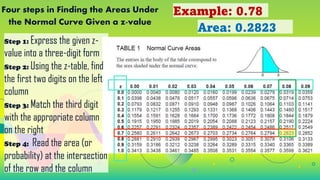
Four steps in Finding the Areas Under
the Normal Curve Given a z-value
Step 1: Express the given z-
value into a three-digit form
Step 2: Using the z-table, find
the first two digits on the left
column
Step 3: Match the third digit
with the appropriate column
on the right
Step 4: Read the area (or
probability) at the intersection
of the row and the column
Example: 0.78
Area: 0.2823
𝑧 = 1.2
Sketch the normal distribution of each
scores and indicate its area.
Area: 0.3849
60 65 70
55
50
45 75
1.2
65
38.49%
𝑧 = −0.6
Sketch the normal distribution of each
scores and indicate its area.
Area: 0.2257
60 65 70
55
50
45 75
-0.6
57
22.57%
𝑧 = −0.8
Sketch the normal distribution of each
scores and indicate its area.
Area: 0.2881
60 65 70
55
50
45 75
-0.8
46
28.81%
Place your answer in a 1 whole sheet of paper to be submitted on the day of
retrieval
Sketch the normal distribution of each z-scores and indicate its area.
𝑧 = 2 𝑧 = 1.5 𝑧 = 1.33 𝑧 = −1.4 𝑧 = −0.47
Assignment #1
Statistics and Probability
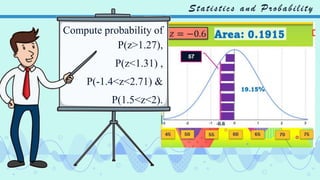
Compute probability of
P(z>1.27),
P(z<1.31) ,
P(-1.4<z<2.71) &
P(1.5<z<2).
Statistics and Probability
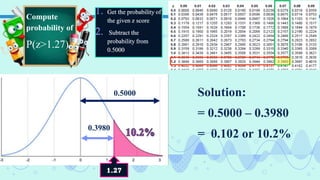
Compute
probability of
P(z>1.27)
1.27
1. Get the probability of
the given z score
2. Subtract the
probability from
0.5000
Statistics and Probability
Compute
probability of
P(z>1.27)
1.27
1. Get the probability of
the given z score
2. Subtract the
probability from
0.5000
0.3980
0.5000 Solution:
= 0.5000 – 0.3980
= 0.102 or 10.2%
Statistics and Probability
Compute
probability of
P(z<1.31)
1.31
1. Get the probability of
the given z score
2. Add the probability
of the z score to
0.5000
0.4049
0.5000
Solution:
= 0.5000 + 0.4049
= 0.9049 or 90.49%
Statistics and Probability
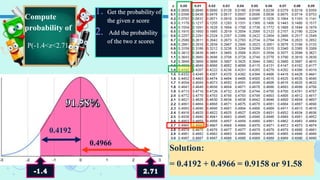
Compute
probability of
P(-1.4<z<2.71)
2.71
1. Get the probability of
the given z score
2. Add the probability
of the two z scores
0.4966
0.4192
-1.4
Solution:
= 0.4192 + 0.4966 = 0.9158 or 91.58
Statistics and Probability
Compute
probability of
P(1.5<z<2)
2
1. Get the probability of
the given z score
2. Subtract the
probability of the two
z scores
0.4772
0.4332
1.5
Solution:
= 0.4772 - 0.4332
= 0.044 or 4.4%
Statistics and Probability
Summary in computing the probability given:
a. Area less than +z
ex. P(z<1) = ADD
the area of the z
score to 0.5000
c. Area greater than
+z ex. P(z>1) =
SUBTRACT the
area of the z score
from 0.5000
b. Area greater than
-z ex. P(z>-1) = ADD
the area of the z
score to 0.5000
d. Area less than -z ex.
P(z<-1) = SUBTRACT
the area of the z score
from 0.5000
e. Area between –z and
+z ex. P(-1<z<-1) = ADD
the area of the two z
scores
e. Area between –z and –z / +z
and +z
ex. P(1<z<2) / P(-2<z<-1) =
SUBTRACT the area of the
two z scores
Place your answer in a 1 whole sheet of paper to be submitted on the day of
retrieval.
Compute for the probability of the following and sketch the graph.
P(z>2.13)
Assignment #2
P(-2.19<z<0.16) P(-1.74<z<-0.25) P(z<0.15)
Let’s have
an
activity!
Statistics and Probability
Thank you for listening!
Have a good day ahead
everyone!

Normal Distribution.pptx

  • 1.
    Statistics and Probability Quarter3: Normal Distribution Ma’am Neomy Angela L. Tolentino
  • 2.
    Virtual House Rules: Beon time for the class. Make sure to message the teacher if you cannot log in on time. MUTE yourself until you raise your hand and your teacher calls you. STAY IN ONE PLACE and FACE the camera. Always do your BEST WORK. Always be RESPECTFUL to your teacher and classmates. NO distractions. Wear APPROPRIATE CLOTHING. Listen & follow DIRECTIONS. Stay in a quiet place.
  • 3.
  • 4.
  • 5.
    “ Statistics and Probability Whatis a normal distribution? A normal distribution (Gaussian distribution) is a probability distribution that is symmetric about the mean, showing that data near the mean are more frequent in occurrence than data far from the mean.
  • 6.
    “ Statistics and Probability 𝑓𝑥 = 1 𝜎 2𝜋 𝑒 − 1 2 𝑥−𝜇 𝜎 2 f(x) = the height of the curve particular values of x X = any score in the distribution 𝜎 = standard deviation of the population 𝜇 = mean of the population 𝜋 = 3.1416 𝑒 = 2.7183
  • 7.
    “ Statistics and Probability Ingraph form, normal distribution will appear as a bell curve.
  • 8.
    Properties of thenormal distribution: Statistics and Probability 1 The graph is a continuous curve and has a domain − ∞ < 𝑋 < ∞.
  • 9.
    Properties of thenormal distribution: Statistics and Probability As the x gets larger in either positive direction, the tail of the curve approaches but will never touch the horizontal axis. The same thing happens when x gets smaller in the negative direction. 2 The graph is asymptotic to the x-axis. The value of the variable gets closer and closer but will never be equal to 0.
  • 10.
    Properties of thenormal distribution: Statistics and Probability ▹ The mean (𝜇) indicates the highest peak of the curve and is found at the center. ▹ Note: 3The highest point on the curve occurs at 𝑥 = 𝜇 (mean) 𝜇 = 𝑚𝑒𝑎𝑛 𝜎 = 𝑠𝑡𝑎𝑛𝑑𝑎𝑟𝑑 𝑑𝑒𝑣𝑖𝑎𝑡𝑖𝑜𝑛
  • 11.
    Properties of thenormal distribution: Statistics and Probability 4 The curve is symmetrical about the mean.
  • 12.
    Properties of thenormal distribution: Statistics and Probability 5 The total area in the normal distribution under the curve is equal to 1. 100% or 1
  • 13.
    Properties of thenormal distribution: Statistics and Probability 6 In general, the graph of a normal distribution is a bell-shaped curve with two inflection points, one on the left and another on the right. Inflection points are the points that mark the change in the curve’s concavity
  • 14.
    Properties of thenormal distribution: Statistics and Probability 7 Every normal curve corresponds to the “empirical rule” (also called the 68 – 95 – 99.7% rule): 0.3413 or 34.13% 0.4772 or 47.72% 0.4987 or 49.87% 0.4987 or 49.87% 0.4772 or 47.72% 0.3413 or 34.13% 68.26% 95.44% 99.74%
  • 15.
    Example #1: Statistics andProbability Suppose the mean is 60 and the standard deviation is 5. Sketch a normal curve for the distribution. 60 𝝁 = 5 𝝈 = 65 70 55 50 0 1 2 -1 -2 45 -3 75 3 5 5 Z scores
  • 16.
    Statistics and Probability Howto compute for the z-score given the raw score and standard deviation? 1. Use the formula 𝑧 = 𝑥−𝜇 𝜎 2. Substitute the values of the mean, raw score and standard deviation to the formula. 3. Leave your final answer in decimal form.
  • 17.
    Example #1: Statistics andProbability Q1:What is the z score if x = 66? x = 57? x = 46? 𝑧 = 𝑥 − 𝜇 𝜎 𝜎 = 5, 𝜇 = 60 x = 66 𝑧 − 𝑧 𝑠𝑐𝑜𝑟𝑒 𝑥 – raw score/ observed value 𝜇 − 𝑚𝑒𝑎𝑛 𝜎 − 𝑠𝑡𝑎𝑛𝑑𝑎𝑟𝑑 𝑑𝑒𝑣𝑖𝑎𝑡𝑖𝑜𝑛 𝑧 = 66 − 60 5 𝑧 = 6 5 𝑧 = 1.2 x = 57 𝜎 = 5, 𝜇 = 60 𝑧 = 57 − 60 5 𝑧 = −3 5 𝑧 = −0.6 x = 46 𝜎 = 5, 𝜇 = 60 𝑧 = 46 − 60 5 𝑧 = −4 5 𝑧 = −0.8
  • 18.
    Example #2: Statistics andProbability Find for the z score of the following: 𝝈 = 𝟓 𝑧 = 50 − 40 5 𝑧 = 10 5 𝑧 = 2 𝒙 𝝈 𝝁 50 5 40 40 8 52 36 6 28 60 10 74 75 15 82 x = 50 𝝁 = 𝟒𝟎 𝒛 = 𝒙 − 𝝁 𝝈 𝝈 = 𝟖 x = 40 𝝁 = 𝟓𝟐 𝑧 = 40 − 52 8 𝑧 = −12 8 = − 3 2 𝑧 = 1.5 𝑧 = 1.33 𝑧 = −1.4 𝑧 = −0.47
  • 19.
    How to sketch anormal distribution and its area or compute its probability? Table of Areas under the Normal Curve is also known as the z-table.
  • 20.
    Four steps inFinding the Areas Under the Normal Curve Given a z-value Step 1: Express the given z- value into a three-digit form Step 2: Using the z-table, find the first two digits on the left column Step 3: Match the third digit with the appropriate column on the right Step 4: Read the area (or probability) at the intersection of the row and the column Example: 0.78 Area: 0.2823
  • 21.
    𝑧 = 1.2 Sketchthe normal distribution of each scores and indicate its area. Area: 0.3849 60 65 70 55 50 45 75 1.2 65 38.49%
  • 22.
    𝑧 = −0.6 Sketchthe normal distribution of each scores and indicate its area. Area: 0.2257 60 65 70 55 50 45 75 -0.6 57 22.57%
  • 23.
    𝑧 = −0.8 Sketchthe normal distribution of each scores and indicate its area. Area: 0.2881 60 65 70 55 50 45 75 -0.8 46 28.81%
  • 24.
    Place your answerin a 1 whole sheet of paper to be submitted on the day of retrieval Sketch the normal distribution of each z-scores and indicate its area. 𝑧 = 2 𝑧 = 1.5 𝑧 = 1.33 𝑧 = −1.4 𝑧 = −0.47 Assignment #1
  • 25.
    Statistics and Probability Computeprobability of P(z>1.27), P(z<1.31) , P(-1.4<z<2.71) & P(1.5<z<2).
  • 26.
    Statistics and Probability Compute probabilityof P(z>1.27) 1.27 1. Get the probability of the given z score 2. Subtract the probability from 0.5000
  • 27.
    Statistics and Probability Compute probabilityof P(z>1.27) 1.27 1. Get the probability of the given z score 2. Subtract the probability from 0.5000 0.3980 0.5000 Solution: = 0.5000 – 0.3980 = 0.102 or 10.2%
  • 28.
    Statistics and Probability Compute probabilityof P(z<1.31) 1.31 1. Get the probability of the given z score 2. Add the probability of the z score to 0.5000 0.4049 0.5000 Solution: = 0.5000 + 0.4049 = 0.9049 or 90.49%
  • 29.
    Statistics and Probability Compute probabilityof P(-1.4<z<2.71) 2.71 1. Get the probability of the given z score 2. Add the probability of the two z scores 0.4966 0.4192 -1.4 Solution: = 0.4192 + 0.4966 = 0.9158 or 91.58
  • 30.
    Statistics and Probability Compute probabilityof P(1.5<z<2) 2 1. Get the probability of the given z score 2. Subtract the probability of the two z scores 0.4772 0.4332 1.5 Solution: = 0.4772 - 0.4332 = 0.044 or 4.4%
  • 31.
    Statistics and Probability Summaryin computing the probability given: a. Area less than +z ex. P(z<1) = ADD the area of the z score to 0.5000 c. Area greater than +z ex. P(z>1) = SUBTRACT the area of the z score from 0.5000 b. Area greater than -z ex. P(z>-1) = ADD the area of the z score to 0.5000 d. Area less than -z ex. P(z<-1) = SUBTRACT the area of the z score from 0.5000 e. Area between –z and +z ex. P(-1<z<-1) = ADD the area of the two z scores e. Area between –z and –z / +z and +z ex. P(1<z<2) / P(-2<z<-1) = SUBTRACT the area of the two z scores
  • 32.
    Place your answerin a 1 whole sheet of paper to be submitted on the day of retrieval. Compute for the probability of the following and sketch the graph. P(z>2.13) Assignment #2 P(-2.19<z<0.16) P(-1.74<z<-0.25) P(z<0.15)
  • 33.
  • 34.
    Statistics and Probability Thankyou for listening! Have a good day ahead everyone!