CONTINUOUS PROBABILITY
DISTRIBUTIONS
ENS185 2nd Semester
2
When computing probabilities for discrete
random variables, we usually substitute the
value of the random variable into a formula.
However, this is not the same for continuous
variables since they can take up infinite
values within an interval.
PROBABILITY DENSITY FUNCTION
Probability 3
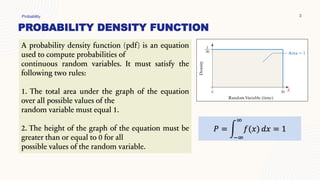
A probability density function (pdf) is an equation
used to compute probabilities of
continuous random variables. It must satisfy the
following two rules:
1. The total area under the graph of the equation
over all possible values of the
random variable must equal 1.
2. The height of the graph of the equation must be
greater than or equal to 0 for all
possible values of the random variable.
𝑃 = න
−∞
∞
𝑓(𝑥) 𝑑𝑥 = 1
PROBABILITY DENSITY FUNCTION
Probability 4
Unlike the case of discrete random variables, for a continuous random variable any
single outcome has probability zero of occurring. (ex. P(x=1)=0)
The probability that a random variable X takes a value in the interval [a,b] is
given by the function f(x)
𝑃 𝑎 ≤ 𝑋 ≤ 𝑏 = න
𝑎
𝑏
𝑓(𝑥) 𝑑𝑥
The area under the graph of a density
function over an interval represents the
probability of observing a value of the
random variable in that interval.
CONTINUOUS UNIFORM
DISTRIBUTION
UNIFORM PROBABILITY DISTRIBUTION
Probability 6
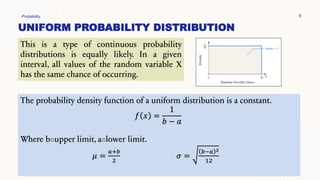
This is a type of continuous probability
distributions is equally likely. In a given
interval, all values of the random variable X
has the same chance of occurring.
The probability density function of a uniform distribution is a constant.
𝑓 𝑥 =
1
𝑏 − 𝑎
Where b=upper limit, a=lower limit.
𝜇 =
𝑎+𝑏
2
𝜎 =
𝑏−𝑎 2
12
EXAMPLE
Suppose that a large conference room for a
certain company can be reserved for no more
than 4 hours. However, the use of the conference
room is such that both long and short
conferences occur quite often. In fact, it can be
assumed that length X of a conference has a
uniform distribution on the interval [0, 4].
What is the probability density function?
What is the probability that any given conference
lasts at least 3 hours?
Presentation title 7
PROPERTIES OF THE
NORMAL PROBABILITY
DISTRIBUTION
NORMAL PROBABILITY DISTRIBUTION
Probability 9
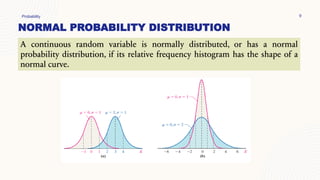
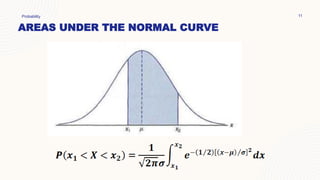
A continuous random variable is normally distributed, or has a normal
probability distribution, if its relative frequency histogram has the shape of a
normal curve.
PROPERTIES OF THE NORMAL CURVE
Probability 10
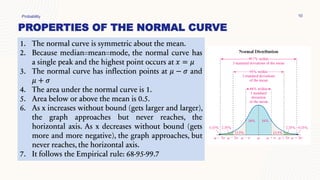
1. The normal curve is symmetric about the mean.
2. Because median=mean=mode, the normal curve has
a single peak and the highest point occurs at 𝑥 = 𝜇
3. The normal curve has inflection points at 𝜇 − 𝜎 and
𝜇 + 𝜎
4. The area under the normal curve is 1.
5. Area below or above the mean is 0.5.
6. As x increases without bound (gets larger and larger),
the graph approaches but never reaches, the
horizontal axis. As x decreases without bound (gets
more and more negative), the graph approaches, but
never reaches, the horizontal axis.
7. It follows the Empirical rule: 68-95-99.7
AREAS UNDER THE NORMAL CURVE
Probability 11
STANDARDIZING THE NORMAL CUVE
Probability 12
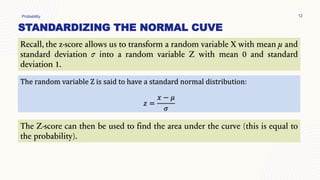
The random variable Z is said to have a standard normal distribution:
𝑧 =
𝑥 − 𝜇
𝜎
Recall, the z-score allows us to transform a random variable X with mean µ and
standard deviation σ into a random variable Z with mean 0 and standard
deviation 1.
The Z-score can then be used to find the area under the curve (this is equal to
the probability).
EXAMPLE
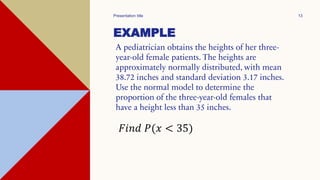
A pediatrician obtains the heights of her three-
year-old female patients. The heights are
approximately normally distributed, with mean
38.72 inches and standard deviation 3.17 inches.
Use the normal model to determine the
proportion of the three-year-old females that
have a height less than 35 inches.
Presentation title 13
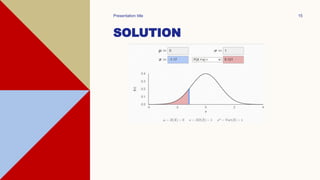
𝐹𝑖𝑛𝑑 𝑃(𝑥 < 35)
SOLUTION
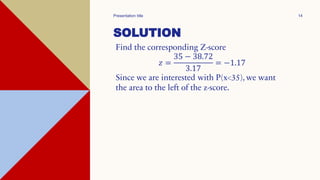
Find the corresponding Z-score
𝑧 =
35 − 38.72
3.17
= −1.17
Since we are interested with P(x<35), we want
the area to the left of the z-score.
Presentation title 14
SOLUTION
Presentation title 15
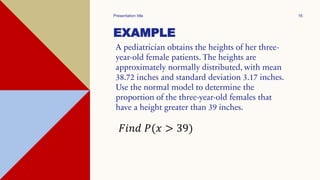
EXAMPLE
A pediatrician obtains the heights of her three-
year-old female patients. The heights are
approximately normally distributed, with mean
38.72 inches and standard deviation 3.17 inches.
Use the normal model to determine the
proportion of the three-year-old females that
have a height greater than 39 inches.
Presentation title 16
𝐹𝑖𝑛𝑑 𝑃(𝑥 > 39)
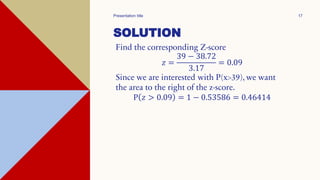
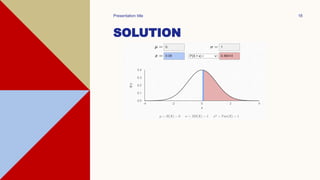
SOLUTION
Find the corresponding Z-score
𝑧 =
39 − 38.72
3.17
= 0.09
Since we are interested with P(x>39), we want
the area to the right of the z-score.
P 𝑧 > 0.09 = 1 − 0.53586 = 0.46414
Presentation title 17
SOLUTION
Presentation title 18
EXAMPLE
A pediatrician obtains the heights of her three-
year-old female patients. The heights are
approximately normally distributed, with mean
38.72 inches and standard deviation 3.17 inches.
Use the normal model to determine the
proportion of the three-year-old females that
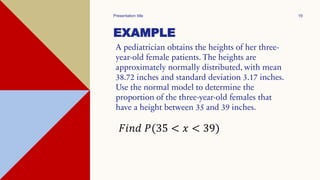
have a height between 35 and 39 inches.
Presentation title 19
𝐹𝑖𝑛𝑑 𝑃(35 < 𝑥 < 39)
EXAMPLE
The heights of a pediatrician’s three-year-old
females are approximately normally distributed,
with mean 38.72 inches and standard deviation
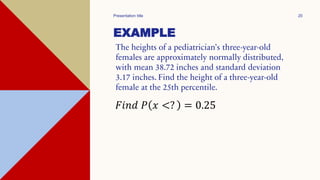
3.17 inches. Find the height of a three-year-old
female at the 25th percentile.
Presentation title 20
𝐹𝑖𝑛𝑑 𝑃 𝑥 <? = 0.25
EXAMPLE
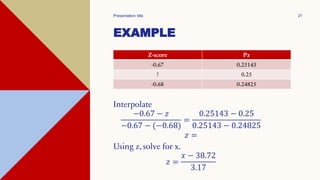
Z-score Pz
-0.67 0.25143
? 0.25
-0.68 0.24825
Presentation title 21
Interpolate
−0.67 − 𝑧
−0.67 − (−0.68)
=
0.25143 − 0.25
0.25143 − 0.24825
𝑧 =
Using z, solve for x.
𝑧 =
𝑥 − 38.72
3.17
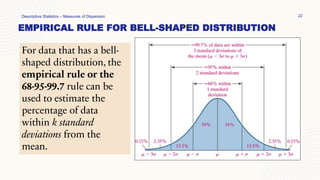
EMPIRICAL RULE FOR BELL-SHAPED DISTRIBUTION
Descriptive Statistics – Measures of Dispersion 22
For data that has a bell-
shaped distribution, the
empirical rule or the
68-95-99.7 rule can be
used to estimate the
percentage of data
within k standard
deviations from the
mean.
EXAMPLE
Descriptive Statistics 23
Given a bell-shaped distribution with a sample mean of
40 and a standard deviation of 10,
a) What is the percentage of observations that will have
a value between 20 and 60?
b) What is the percentage of observations that has a
value less than 10 and greater than 60?
Z-TABLE
Descriptive Statistics 24
a) Find P(z> 2.12)
b) Find P(z<-0.89)
c) Find P(0.12<z<1.88)
d) Find the z-score that bounds the top 9% of the
distribution.
e) Find the z-score that bounds the 25% of the lower tail
of the distribution.
ACTIVITY
Probability 25
The speeds of cars are measured using a radar unit, on a
motorway. The speeds are normally distributed with a mean
of 90 km/hr and a standard deviation of 10 km/hr.
a) What is the probability that a car selected at chance is
moving at more than 100 km/hr?
b) What is the minimum speed of the 5% fastest cars?
THE NORMAL
APPROXIMATION TO THE
BINOMIAL DISTRIBUTION
BINOMIAL PROBABILITY DISTRIBUTION
Probability 27
An experiment is said to be a binomial experiment if
1. The experiment is performed a fixed number of times (n trials).
Each experiment is called a trial.
2. The trials are independent.
3. For each trial, there are two mutually exclusive outcomes:
success (p) and failure (q=1-p).
4. The probability of success is the same for each trial.
Let X be the number of success in n trials.
28
For a fixed p, as the number of trials n in a
binomial experiment increases, the
probability distribution of the random
variable X becomes more nearly symmetric
and bell shaped.
As a rule of thumb, if 𝑛𝑝 1 − 𝑝 ≥ 10, the
probability distribution will be
approximately symmetric and bell-shaped.
NORMAL APPROXIMATION
Probability 29
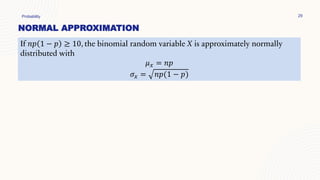
If 𝑛𝑝 1 − 𝑝 ≥ 10, the binomial random variable X is approximately normally
distributed with
𝜇𝑥 = 𝑛𝑝
𝜎𝑥 = 𝑛𝑝(1 − 𝑝)
Normal Probability 30
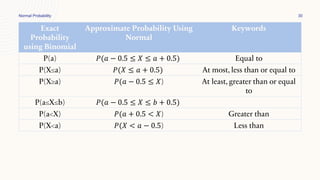
Exact
Probability
using Binomial
Approximate Probability Using
Normal
Keywords
P(a) 𝑃(𝑎 − 0.5 ≤ 𝑋 ≤ 𝑎 + 0.5) Equal to
P(X≤a) 𝑃(𝑋 ≤ 𝑎 + 0.5) At most, less than or equal to
P(X≥a) 𝑃(𝑎 − 0.5 ≤ 𝑋) At least, greater than or equal
to
P(a≤X≤b) 𝑃(𝑎 − 0.5 ≤ 𝑋 ≤ 𝑏 + 0.5)
P(a<X) 𝑃(𝑎 + 0.5 < 𝑋) Greater than
P(X<a) 𝑃(𝑋 < 𝑎 − 0.5) Less than
EXAMPLE
Probability 31
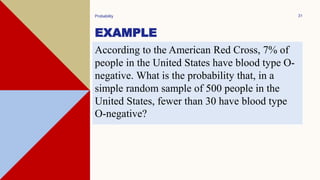
According to the American Red Cross, 7% of
people in the United States have blood type O-
negative. What is the probability that, in a
simple random sample of 500 people in the
United States, fewer than 30 have blood type
O-negative?
SOLUTION
Probability 32
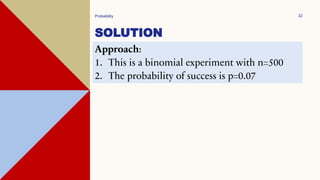
Approach:
1. This is a binomial experiment with n=500
2. The probability of success is p=0.07
SOLUTION
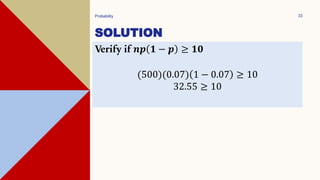
Probability 33
Verify if 𝒏𝒑 𝟏 − 𝒑 ≥ 𝟏𝟎
(500)(0.07) 1 − 0.07 ≥ 10
32.55 ≥ 10
SOLUTION
Probability 34
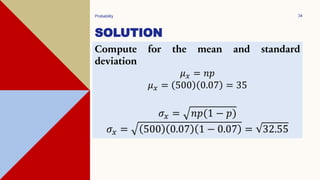
Compute for the mean and standard
deviation
𝜇𝑥 = 𝑛𝑝
𝜇𝑥 = 500 0.07 = 35
𝜎𝑥 = 𝑛𝑝(1 − 𝑝)
𝜎𝑥 = 500 0.07 1 − 0.07 = 32.55
SOLUTION
Probability 35
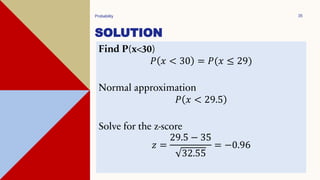
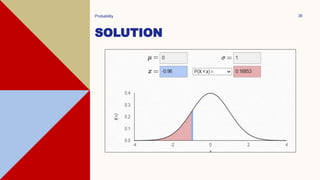
Find P(x<30)
𝑃 𝑥 < 30 = 𝑃(𝑥 ≤ 29)
Normal approximation
𝑃 𝑥 < 29.5
Solve for the z-score
𝑧 =
29.5 − 35
32.55
= −0.96
SOLUTION
Probability 36
EXAMPLE
Probability 37
What is the probability that, in a simple random
sample of 500 people in the United States, 20
have blood type O-negative?
ACTIVITY
Probability 38
A home-based baker was able to produce 200 cupcakes
within 8 hours of operation. In average, the cupcakes weigh
110 grams with a standard deviation 10 grams. To be
considered acceptable to the buyer, a cupcake should weigh
within 2 standard deviations from the mean. Historically, 5%
of the cupcakes do not pass the standard weight. To test for
consistency, you randomly sampled 15 cupcakes, what is the
probability that at most 7 will pass the standard weight?
GAMMA DISTRIBUTION
POISSON DISTRIBUTION
Probability 40
The Poisson probability distribution can be used to
compute probabilities of experiments in which the
random variable X counts the number of
occurrences (successes) of a particular event
within a specified interval (usually time or space).
Where λ (the Greek letter lambda) represents the
average number of occurrences of the event in some
interval length.
GAMMA DISTRIBUTION
Probability 41
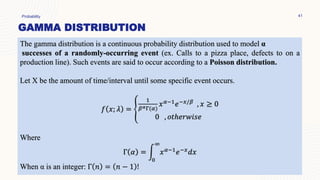
The gamma distribution is a continuous probability distribution used to model α
successes of a randomly-occurring event (ex. Calls to a pizza place, defects to on a
production line). Such events are said to occur according to a Poisson distribution.
Let X be the amount of time/interval until some specific event occurs.
𝑓 𝑥; 𝜆 = ቐ
1
𝛽𝛼Γ(𝛼)
𝑥𝛼−1𝑒−𝑥/𝛽 , 𝑥 ≥ 0
0 , 𝑜𝑡ℎ𝑒𝑟𝑤𝑖𝑠𝑒
Where
Γ 𝛼 = න
0
∞
𝑥𝛼−1𝑒−𝑥𝑑𝑥
When α is an integer: Γ 𝑛 = 𝑛 − 1 !
GAMMA DISTRIBUTION
Probability 42
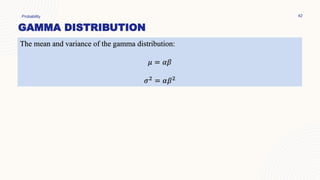
The mean and variance of the gamma distribution:
𝜇 = 𝛼𝛽
𝜎2
= 𝛼𝛽2
GAMMA DISTRIBUTION
Probability 43
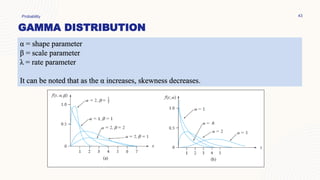
α = shape parameter
β = scale parameter
λ = rate parameter
It can be noted that as the α increases, skewness decreases.
EXAMPLE
Probability 44
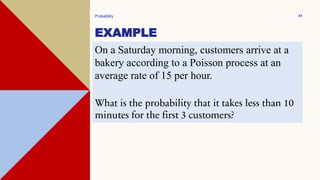
On a Saturday morning, customers arrive at a
bakery according to a Poisson process at an
average rate of 15 per hour.
What is the probability that it takes less than 10
minutes for the first 3 customers?
EXAMPLE
Probability 45
On a Saturday morning, customers arrive at a
bakery according to a Poisson process at an
average rate of 15 per hour.
What is the average amount of time that will
elapse before 3 customers arrive in the bakery?
EXAMPLE
Probability 46
On a Saturday morning, customers arrive at a
bakery according to a Poisson process at an
average rate of 15 per hour.
What is the probability that exactly 15 customers
arrive in an hour?
EXAMPLE
Probability 47
In a certain city, the daily consumption of
electric power, in millions of kilowatt-hours,
is a random variable X having a gamma
distribution with mean µ = 6 and variance σ2
= 12.
a. Find the values of α and β.
b. Find the probability that on any given day
the daily power consumption will exceed
12 million kilowatthours.
ACTIVITY
Probability 48
Suppose that when a transistor of a certain
type is subjected to an accelerated life test, the
lifetime X (in weeks) has a gamma
distribution with mean of 24 weeks and
standard deviation of 12 weeks.
a) What is the probability that a transistor
will last between 12 and 24 weeks?
b) What is the probability that a transistor
will last at most 24 weeks?
EXPONENTIAL
DISTRIBUTION
EXPONENTIAL DISTRIBUTION
Probability 50
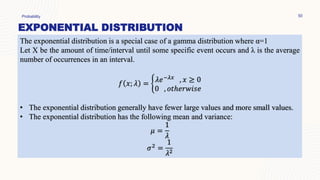
The exponential distribution is a special case of a gamma distribution where α=1
Let X be the amount of time/interval until some specific event occurs and λ is the average
number of occurrences in an interval.
𝑓 𝑥; 𝜆 = ቊ𝜆𝑒−𝜆𝑥 , 𝑥 ≥ 0
0 , 𝑜𝑡ℎ𝑒𝑟𝑤𝑖𝑠𝑒
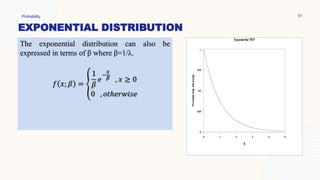
• The exponential distribution generally have fewer large values and more small values.
• The exponential distribution has the following mean and variance:
𝜇 =
1
𝜆
𝜎2
=
1
𝜆2
EXPONENTIAL DISTRIBUTION
Probability 51
The exponential distribution can also be
expressed in terms of β where β=1/λ.
𝑓 𝑥; 𝛽 = ൞
1
𝛽
𝑒
−
𝑥
𝛽 , 𝑥 ≥ 0
0 , 𝑜𝑡ℎ𝑒𝑟𝑤𝑖𝑠𝑒
EXAMPLE
Probability 52
Data collected at Toronto Pearson International
Airport suggests that an exponential
distribution with mean value 2.725 hours is a
good model for rainfall duration.
What is the probability that the duration of a
particular rainfall event at this location is
• at least 2 hours?
• At most 3 hours?
• Between 2 and 3 hours?
ACTIVITY
Probability 53
Let X denote the distance (m) that an animal
moves from its birth site to the first territorial
vacancy it encounters. Suppose that for banner-
tailed kangaroo rats, X has an exponential
distribution with parameter λ=0.01386.
a. What is the probability that the distance is at
most 100 m?
b. At most 200 m?
c. Between 100 and 200 m?
REFERENCE
Statistics: Informed Decisions
using Data with Integrated
Review by Michael Sullivan III
Chapter 5

Module 6 - Continuous Distribution_efcd52595b081d24a9bc3ca31b5f8d05.pdf

  • 1.
  • 2.
    2 When computing probabilitiesfor discrete random variables, we usually substitute the value of the random variable into a formula. However, this is not the same for continuous variables since they can take up infinite values within an interval.
  • 3.
    PROBABILITY DENSITY FUNCTION Probability3 A probability density function (pdf) is an equation used to compute probabilities of continuous random variables. It must satisfy the following two rules: 1. The total area under the graph of the equation over all possible values of the random variable must equal 1. 2. The height of the graph of the equation must be greater than or equal to 0 for all possible values of the random variable. 𝑃 = න −∞ ∞ 𝑓(𝑥) 𝑑𝑥 = 1
  • 4.
    PROBABILITY DENSITY FUNCTION Probability4 Unlike the case of discrete random variables, for a continuous random variable any single outcome has probability zero of occurring. (ex. P(x=1)=0) The probability that a random variable X takes a value in the interval [a,b] is given by the function f(x) 𝑃 𝑎 ≤ 𝑋 ≤ 𝑏 = න 𝑎 𝑏 𝑓(𝑥) 𝑑𝑥 The area under the graph of a density function over an interval represents the probability of observing a value of the random variable in that interval.
  • 5.
  • 6.
    UNIFORM PROBABILITY DISTRIBUTION Probability6 This is a type of continuous probability distributions is equally likely. In a given interval, all values of the random variable X has the same chance of occurring. The probability density function of a uniform distribution is a constant. 𝑓 𝑥 = 1 𝑏 − 𝑎 Where b=upper limit, a=lower limit. 𝜇 = 𝑎+𝑏 2 𝜎 = 𝑏−𝑎 2 12
  • 7.
    EXAMPLE Suppose that alarge conference room for a certain company can be reserved for no more than 4 hours. However, the use of the conference room is such that both long and short conferences occur quite often. In fact, it can be assumed that length X of a conference has a uniform distribution on the interval [0, 4]. What is the probability density function? What is the probability that any given conference lasts at least 3 hours? Presentation title 7
  • 8.
    PROPERTIES OF THE NORMALPROBABILITY DISTRIBUTION
  • 9.
    NORMAL PROBABILITY DISTRIBUTION Probability9 A continuous random variable is normally distributed, or has a normal probability distribution, if its relative frequency histogram has the shape of a normal curve.
  • 10.
    PROPERTIES OF THENORMAL CURVE Probability 10 1. The normal curve is symmetric about the mean. 2. Because median=mean=mode, the normal curve has a single peak and the highest point occurs at 𝑥 = 𝜇 3. The normal curve has inflection points at 𝜇 − 𝜎 and 𝜇 + 𝜎 4. The area under the normal curve is 1. 5. Area below or above the mean is 0.5. 6. As x increases without bound (gets larger and larger), the graph approaches but never reaches, the horizontal axis. As x decreases without bound (gets more and more negative), the graph approaches, but never reaches, the horizontal axis. 7. It follows the Empirical rule: 68-95-99.7
  • 11.
    AREAS UNDER THENORMAL CURVE Probability 11
  • 12.
    STANDARDIZING THE NORMALCUVE Probability 12 The random variable Z is said to have a standard normal distribution: 𝑧 = 𝑥 − 𝜇 𝜎 Recall, the z-score allows us to transform a random variable X with mean µ and standard deviation σ into a random variable Z with mean 0 and standard deviation 1. The Z-score can then be used to find the area under the curve (this is equal to the probability).
  • 13.
    EXAMPLE A pediatrician obtainsthe heights of her three- year-old female patients. The heights are approximately normally distributed, with mean 38.72 inches and standard deviation 3.17 inches. Use the normal model to determine the proportion of the three-year-old females that have a height less than 35 inches. Presentation title 13 𝐹𝑖𝑛𝑑 𝑃(𝑥 < 35)
  • 14.
    SOLUTION Find the correspondingZ-score 𝑧 = 35 − 38.72 3.17 = −1.17 Since we are interested with P(x<35), we want the area to the left of the z-score. Presentation title 14
  • 15.
  • 16.
    EXAMPLE A pediatrician obtainsthe heights of her three- year-old female patients. The heights are approximately normally distributed, with mean 38.72 inches and standard deviation 3.17 inches. Use the normal model to determine the proportion of the three-year-old females that have a height greater than 39 inches. Presentation title 16 𝐹𝑖𝑛𝑑 𝑃(𝑥 > 39)
  • 17.
    SOLUTION Find the correspondingZ-score 𝑧 = 39 − 38.72 3.17 = 0.09 Since we are interested with P(x>39), we want the area to the right of the z-score. P 𝑧 > 0.09 = 1 − 0.53586 = 0.46414 Presentation title 17
  • 18.
  • 19.
    EXAMPLE A pediatrician obtainsthe heights of her three- year-old female patients. The heights are approximately normally distributed, with mean 38.72 inches and standard deviation 3.17 inches. Use the normal model to determine the proportion of the three-year-old females that have a height between 35 and 39 inches. Presentation title 19 𝐹𝑖𝑛𝑑 𝑃(35 < 𝑥 < 39)
  • 20.
    EXAMPLE The heights ofa pediatrician’s three-year-old females are approximately normally distributed, with mean 38.72 inches and standard deviation 3.17 inches. Find the height of a three-year-old female at the 25th percentile. Presentation title 20 𝐹𝑖𝑛𝑑 𝑃 𝑥 <? = 0.25
  • 21.
    EXAMPLE Z-score Pz -0.67 0.25143 ?0.25 -0.68 0.24825 Presentation title 21 Interpolate −0.67 − 𝑧 −0.67 − (−0.68) = 0.25143 − 0.25 0.25143 − 0.24825 𝑧 = Using z, solve for x. 𝑧 = 𝑥 − 38.72 3.17
  • 22.
    EMPIRICAL RULE FORBELL-SHAPED DISTRIBUTION Descriptive Statistics – Measures of Dispersion 22 For data that has a bell- shaped distribution, the empirical rule or the 68-95-99.7 rule can be used to estimate the percentage of data within k standard deviations from the mean.
  • 23.
    EXAMPLE Descriptive Statistics 23 Givena bell-shaped distribution with a sample mean of 40 and a standard deviation of 10, a) What is the percentage of observations that will have a value between 20 and 60? b) What is the percentage of observations that has a value less than 10 and greater than 60?
  • 24.
    Z-TABLE Descriptive Statistics 24 a)Find P(z> 2.12) b) Find P(z<-0.89) c) Find P(0.12<z<1.88) d) Find the z-score that bounds the top 9% of the distribution. e) Find the z-score that bounds the 25% of the lower tail of the distribution.
  • 25.
    ACTIVITY Probability 25 The speedsof cars are measured using a radar unit, on a motorway. The speeds are normally distributed with a mean of 90 km/hr and a standard deviation of 10 km/hr. a) What is the probability that a car selected at chance is moving at more than 100 km/hr? b) What is the minimum speed of the 5% fastest cars?
  • 26.
    THE NORMAL APPROXIMATION TOTHE BINOMIAL DISTRIBUTION
  • 27.
    BINOMIAL PROBABILITY DISTRIBUTION Probability27 An experiment is said to be a binomial experiment if 1. The experiment is performed a fixed number of times (n trials). Each experiment is called a trial. 2. The trials are independent. 3. For each trial, there are two mutually exclusive outcomes: success (p) and failure (q=1-p). 4. The probability of success is the same for each trial. Let X be the number of success in n trials.
  • 28.
    28 For a fixedp, as the number of trials n in a binomial experiment increases, the probability distribution of the random variable X becomes more nearly symmetric and bell shaped. As a rule of thumb, if 𝑛𝑝 1 − 𝑝 ≥ 10, the probability distribution will be approximately symmetric and bell-shaped.
  • 29.
    NORMAL APPROXIMATION Probability 29 If𝑛𝑝 1 − 𝑝 ≥ 10, the binomial random variable X is approximately normally distributed with 𝜇𝑥 = 𝑛𝑝 𝜎𝑥 = 𝑛𝑝(1 − 𝑝)
  • 30.
    Normal Probability 30 Exact Probability usingBinomial Approximate Probability Using Normal Keywords P(a) 𝑃(𝑎 − 0.5 ≤ 𝑋 ≤ 𝑎 + 0.5) Equal to P(X≤a) 𝑃(𝑋 ≤ 𝑎 + 0.5) At most, less than or equal to P(X≥a) 𝑃(𝑎 − 0.5 ≤ 𝑋) At least, greater than or equal to P(a≤X≤b) 𝑃(𝑎 − 0.5 ≤ 𝑋 ≤ 𝑏 + 0.5) P(a<X) 𝑃(𝑎 + 0.5 < 𝑋) Greater than P(X<a) 𝑃(𝑋 < 𝑎 − 0.5) Less than
  • 31.
    EXAMPLE Probability 31 According tothe American Red Cross, 7% of people in the United States have blood type O- negative. What is the probability that, in a simple random sample of 500 people in the United States, fewer than 30 have blood type O-negative?
  • 32.
    SOLUTION Probability 32 Approach: 1. Thisis a binomial experiment with n=500 2. The probability of success is p=0.07
  • 33.
    SOLUTION Probability 33 Verify if𝒏𝒑 𝟏 − 𝒑 ≥ 𝟏𝟎 (500)(0.07) 1 − 0.07 ≥ 10 32.55 ≥ 10
  • 34.
    SOLUTION Probability 34 Compute forthe mean and standard deviation 𝜇𝑥 = 𝑛𝑝 𝜇𝑥 = 500 0.07 = 35 𝜎𝑥 = 𝑛𝑝(1 − 𝑝) 𝜎𝑥 = 500 0.07 1 − 0.07 = 32.55
  • 35.
    SOLUTION Probability 35 Find P(x<30) 𝑃𝑥 < 30 = 𝑃(𝑥 ≤ 29) Normal approximation 𝑃 𝑥 < 29.5 Solve for the z-score 𝑧 = 29.5 − 35 32.55 = −0.96
  • 36.
  • 37.
    EXAMPLE Probability 37 What isthe probability that, in a simple random sample of 500 people in the United States, 20 have blood type O-negative?
  • 38.
    ACTIVITY Probability 38 A home-basedbaker was able to produce 200 cupcakes within 8 hours of operation. In average, the cupcakes weigh 110 grams with a standard deviation 10 grams. To be considered acceptable to the buyer, a cupcake should weigh within 2 standard deviations from the mean. Historically, 5% of the cupcakes do not pass the standard weight. To test for consistency, you randomly sampled 15 cupcakes, what is the probability that at most 7 will pass the standard weight?
  • 39.
  • 40.
    POISSON DISTRIBUTION Probability 40 ThePoisson probability distribution can be used to compute probabilities of experiments in which the random variable X counts the number of occurrences (successes) of a particular event within a specified interval (usually time or space). Where λ (the Greek letter lambda) represents the average number of occurrences of the event in some interval length.
  • 41.
    GAMMA DISTRIBUTION Probability 41 Thegamma distribution is a continuous probability distribution used to model α successes of a randomly-occurring event (ex. Calls to a pizza place, defects to on a production line). Such events are said to occur according to a Poisson distribution. Let X be the amount of time/interval until some specific event occurs. 𝑓 𝑥; 𝜆 = ቐ 1 𝛽𝛼Γ(𝛼) 𝑥𝛼−1𝑒−𝑥/𝛽 , 𝑥 ≥ 0 0 , 𝑜𝑡ℎ𝑒𝑟𝑤𝑖𝑠𝑒 Where Γ 𝛼 = න 0 ∞ 𝑥𝛼−1𝑒−𝑥𝑑𝑥 When α is an integer: Γ 𝑛 = 𝑛 − 1 !
  • 42.
    GAMMA DISTRIBUTION Probability 42 Themean and variance of the gamma distribution: 𝜇 = 𝛼𝛽 𝜎2 = 𝛼𝛽2
  • 43.
    GAMMA DISTRIBUTION Probability 43 α= shape parameter β = scale parameter λ = rate parameter It can be noted that as the α increases, skewness decreases.
  • 44.
    EXAMPLE Probability 44 On aSaturday morning, customers arrive at a bakery according to a Poisson process at an average rate of 15 per hour. What is the probability that it takes less than 10 minutes for the first 3 customers?
  • 45.
    EXAMPLE Probability 45 On aSaturday morning, customers arrive at a bakery according to a Poisson process at an average rate of 15 per hour. What is the average amount of time that will elapse before 3 customers arrive in the bakery?
  • 46.
    EXAMPLE Probability 46 On aSaturday morning, customers arrive at a bakery according to a Poisson process at an average rate of 15 per hour. What is the probability that exactly 15 customers arrive in an hour?
  • 47.
    EXAMPLE Probability 47 In acertain city, the daily consumption of electric power, in millions of kilowatt-hours, is a random variable X having a gamma distribution with mean µ = 6 and variance σ2 = 12. a. Find the values of α and β. b. Find the probability that on any given day the daily power consumption will exceed 12 million kilowatthours.
  • 48.
    ACTIVITY Probability 48 Suppose thatwhen a transistor of a certain type is subjected to an accelerated life test, the lifetime X (in weeks) has a gamma distribution with mean of 24 weeks and standard deviation of 12 weeks. a) What is the probability that a transistor will last between 12 and 24 weeks? b) What is the probability that a transistor will last at most 24 weeks?
  • 49.
  • 50.
    EXPONENTIAL DISTRIBUTION Probability 50 Theexponential distribution is a special case of a gamma distribution where α=1 Let X be the amount of time/interval until some specific event occurs and λ is the average number of occurrences in an interval. 𝑓 𝑥; 𝜆 = ቊ𝜆𝑒−𝜆𝑥 , 𝑥 ≥ 0 0 , 𝑜𝑡ℎ𝑒𝑟𝑤𝑖𝑠𝑒 • The exponential distribution generally have fewer large values and more small values. • The exponential distribution has the following mean and variance: 𝜇 = 1 𝜆 𝜎2 = 1 𝜆2
  • 51.
    EXPONENTIAL DISTRIBUTION Probability 51 Theexponential distribution can also be expressed in terms of β where β=1/λ. 𝑓 𝑥; 𝛽 = ൞ 1 𝛽 𝑒 − 𝑥 𝛽 , 𝑥 ≥ 0 0 , 𝑜𝑡ℎ𝑒𝑟𝑤𝑖𝑠𝑒
  • 52.
    EXAMPLE Probability 52 Data collectedat Toronto Pearson International Airport suggests that an exponential distribution with mean value 2.725 hours is a good model for rainfall duration. What is the probability that the duration of a particular rainfall event at this location is • at least 2 hours? • At most 3 hours? • Between 2 and 3 hours?
  • 53.
    ACTIVITY Probability 53 Let Xdenote the distance (m) that an animal moves from its birth site to the first territorial vacancy it encounters. Suppose that for banner- tailed kangaroo rats, X has an exponential distribution with parameter λ=0.01386. a. What is the probability that the distance is at most 100 m? b. At most 200 m? c. Between 100 and 200 m?

  • 54.
    REFERENCE Statistics: Informed Decisions usingData with Integrated Review by Michael Sullivan III Chapter 5