Decision Making


www.humanikaconsulting.com
The Nature of
                              Decision Making


Making effective decisions, as well as recognizing when
a bad decision has been made and quickly responding to
mistakes, is a key ingredient in organizational
effectiveness.
Some experts believe that decision making is the most
basic and fundamental of all managerial activities.
Decision making is most closely linked with the Planning
function.
However, it is also part of Organizing, Leading and
Controlling.
• Decision making is the act of
  choosing one alternative from
  among a set of alternatives.


• We have to first decide that a
  decision has to be made and
  then secondly identify a set
  of feasible alternatives before
  we select one.
Decision-Making Process

• Decision-Making Process includes:

                 • recognizing and defining the
                   nature of a decision situation
                 • identifying alternatives
                 • choosing the ‘best’ [most
                   effective] alternative and
                 • putting it into practice.
Decision-Making Process. . .              (continued)


 Sometimes effective decisions must be
 made to:
              • Optimize some set of factors
                such as profits, sales, employee
                welfare and market share or
              • Minimize loss, expenses or
                employee turnover or
              • Select best method for going out
                of    business,      laying   off
                employees, or terminating a
                strategic alliance.
Decision-Making Process. . .                (continued)


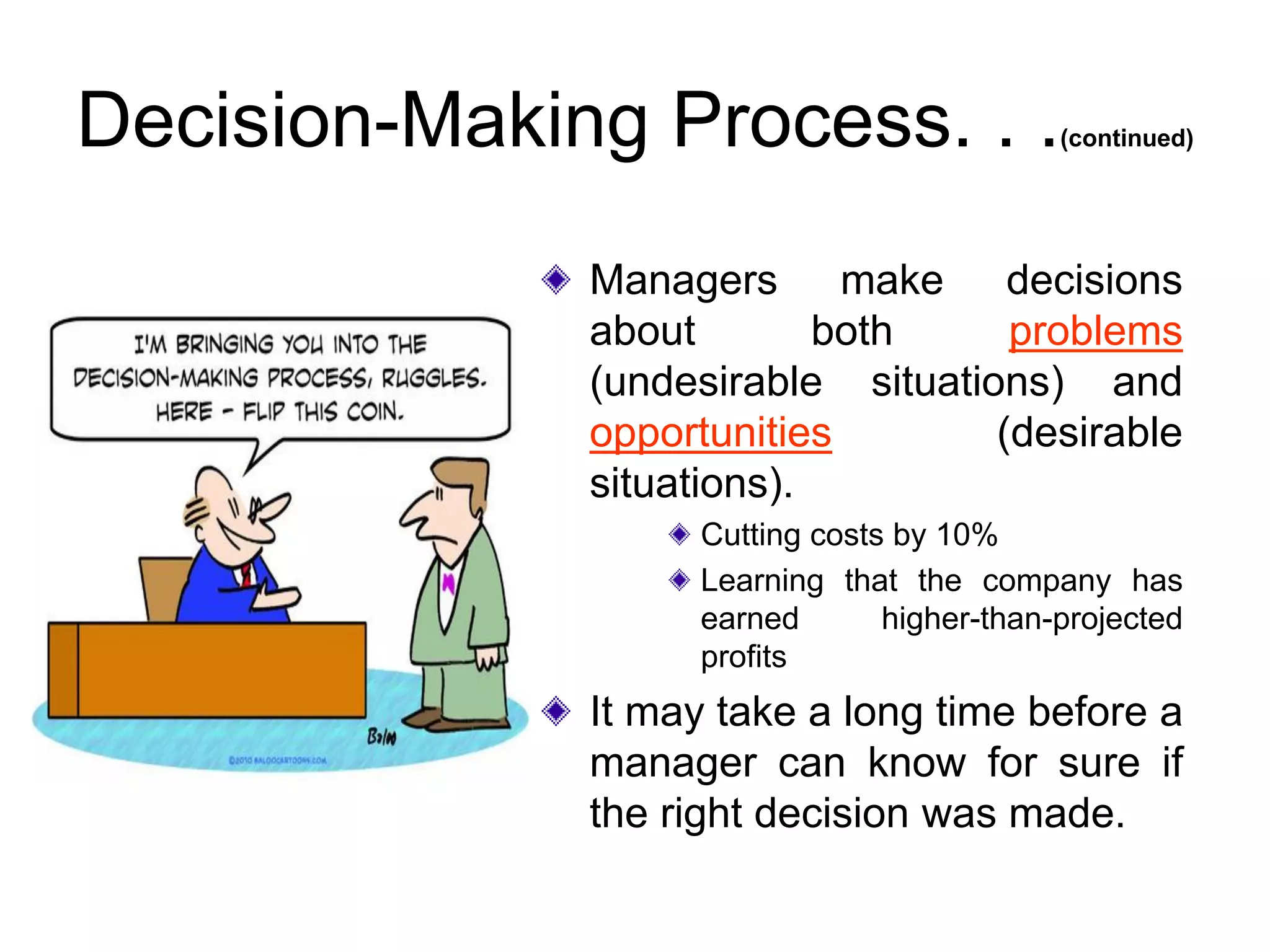
              Managers make decisions
              about        both     problems
              (undesirable situations) and
              opportunities        (desirable
              situations).
                   Cutting costs by 10%
                   Learning that the company has
                   earned       higher-than-projected
                   profits
              It may take a long time before a
              manager can know for sure if
              the right decision was made.
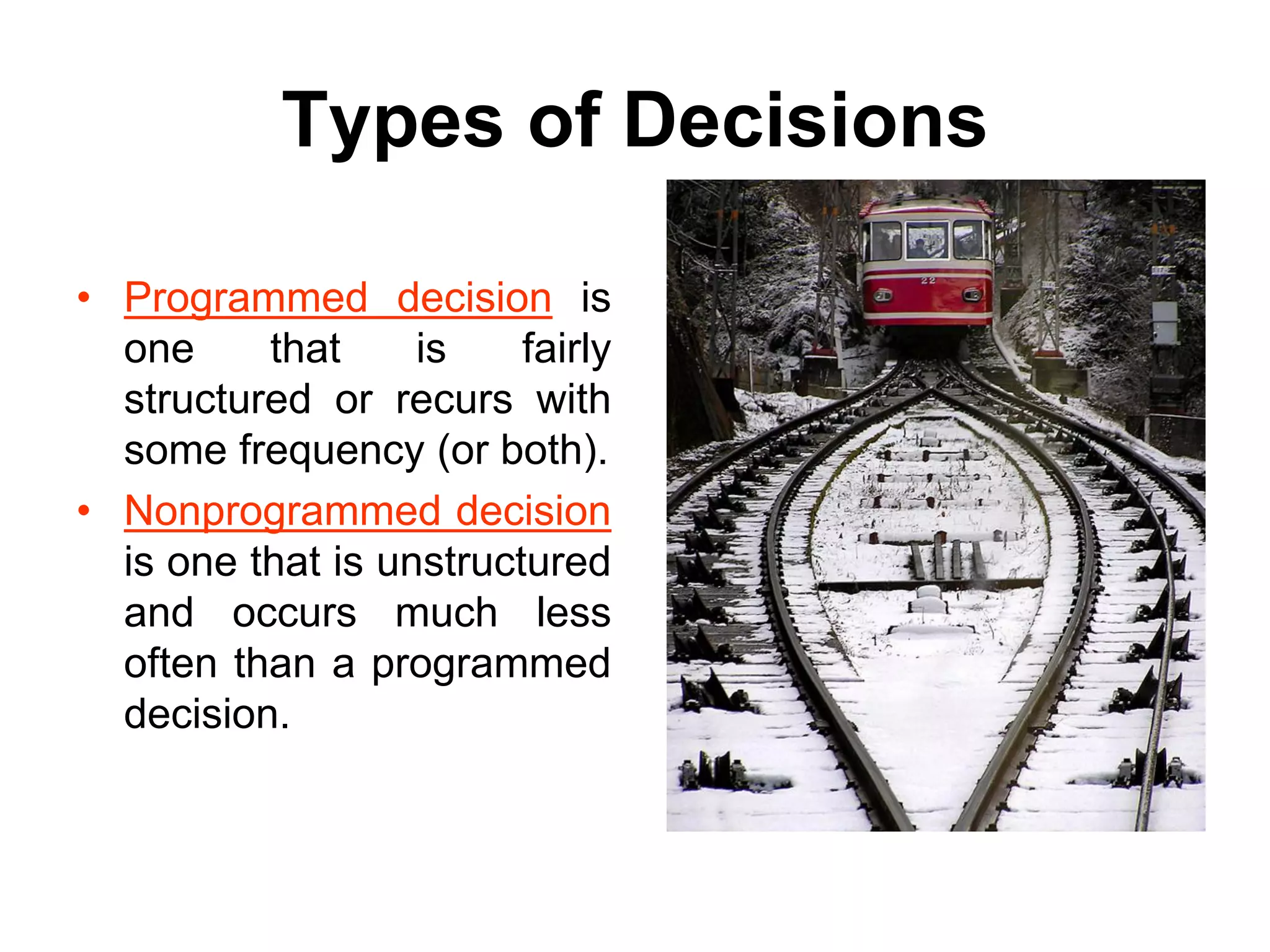
Types of Decisions

• Programmed decision is
  one     that     is    fairly
  structured or recurs with
  some frequency (or both).
• Nonprogrammed decision
  is one that is unstructured
  and occurs much less
  often than a programmed
  decision.
Programmed Decisions. .
 Many decisions regarding
 basic operating systems
 and     procedures     and
 standard     organizational
 transactions fall into this
 category.
   McDonald’s     employees    are
   trained to make the Big Mac
   according       to      specific
   procedures.
   Starbucks, and many other
   organizations, use programmed
   decisions to purchase new
   supplies [coffee beans, cups
   and napkins].
Nonprogrammed Decisions. ..
Most of the decisions made by
top managers involving strategy
and organization design are
nonprogrammed.
   Decisions about mergers, acquisitions
   and takeovers, new facilities, new
   products, labor contracts and legal
   issues are nonprogrammed decisions.
Managers          faced        with
nonprogrammed decisions must
treat each one as unique,
investing great amounts of time,
energy and resources into
exploring the situation from all
views.
Intuition and experience are
major factors in these decisions.
Decision-Making Conditions

• Decision Making Under
  Certainty


• Decision Making Under
  Risk

• Decision Making Under
  Uncertainty
Decision Making Under Certainty


A state of certainty exists when a decision maker knows,
with reasonable certainty, what the alternatives are and
what conditions are associated with each alternative.
Very few organizational decisions, however, are made
under these conditions.
The complex and turbulent environment in which
businesses exist rarely allows for such decisions.
Decision Making Under Risk
        A state of risk exists when a decision maker
        makes decisions under a condition in which
        the availability of each alternative and its
        potential payoffs and costs are all
        associated with probability estimate.
        Decisions such as these are based on past
        experiences, relevant information, the
        advice of others and one’s own judgment.
        Decision is ‘calculated’ on the basis of
        which alternative has the highest probability
        of working effectively. [union negotiations,
        Porsche’s SUV focus vs high-performance
        sports cars]
Decision Making Under Uncertainty

A state of uncertainty exists when a
decision maker does not know all of the
alternatives, the risks associated with
each, or the consequences each
alternative is likely to have.
Most of the major decision making in
today’s organizations is done under
these conditions.
To make effective decisions under
these conditions, managers must
secure as much relevant information as
possible and approach the situation
from a logical and rational view.
Intuition, judgment and experience
always play major roles in the decision-
making process under these conditions.
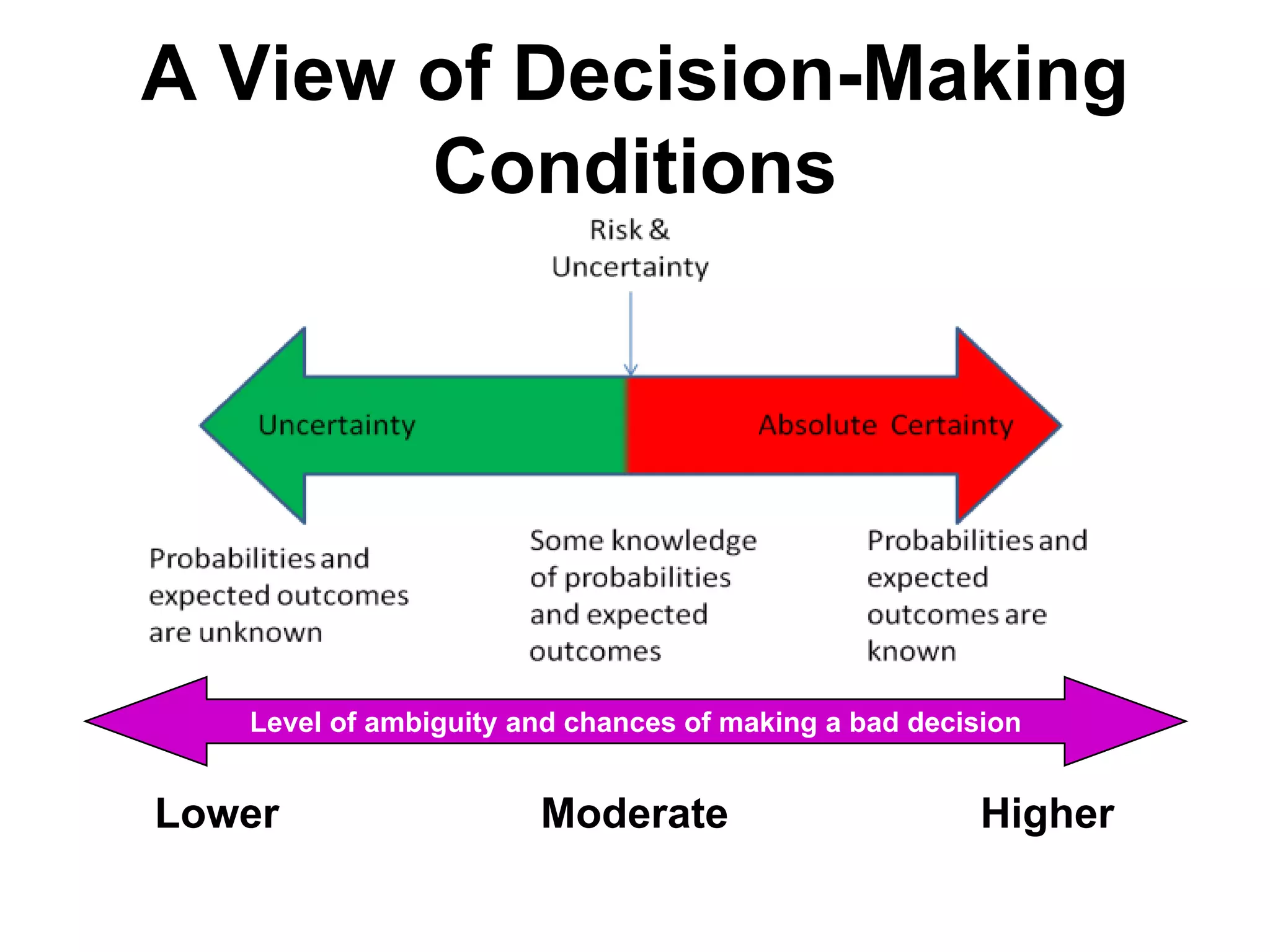
A View of Decision-Making
       Conditions


   Level of ambiguity and chances of making a bad decision


Lower                  Moderate                        Higher
Rational Perspectives
on Decision Making
                   Keys to Decision Making

                        Classical
                            Decision
                                  Model

                        Rational
                             Decision
                                 Making
Classical Decision Model
• An approach to decision making
  that tells managers how they
  should make decisions.
• Approach assumes that managers
  are logical and rational.
• Approach assumes that managers’
  decisions will be in the best
  interests of the organization.
• Conditions suggested in this
  approach rarely, if ever, exist.
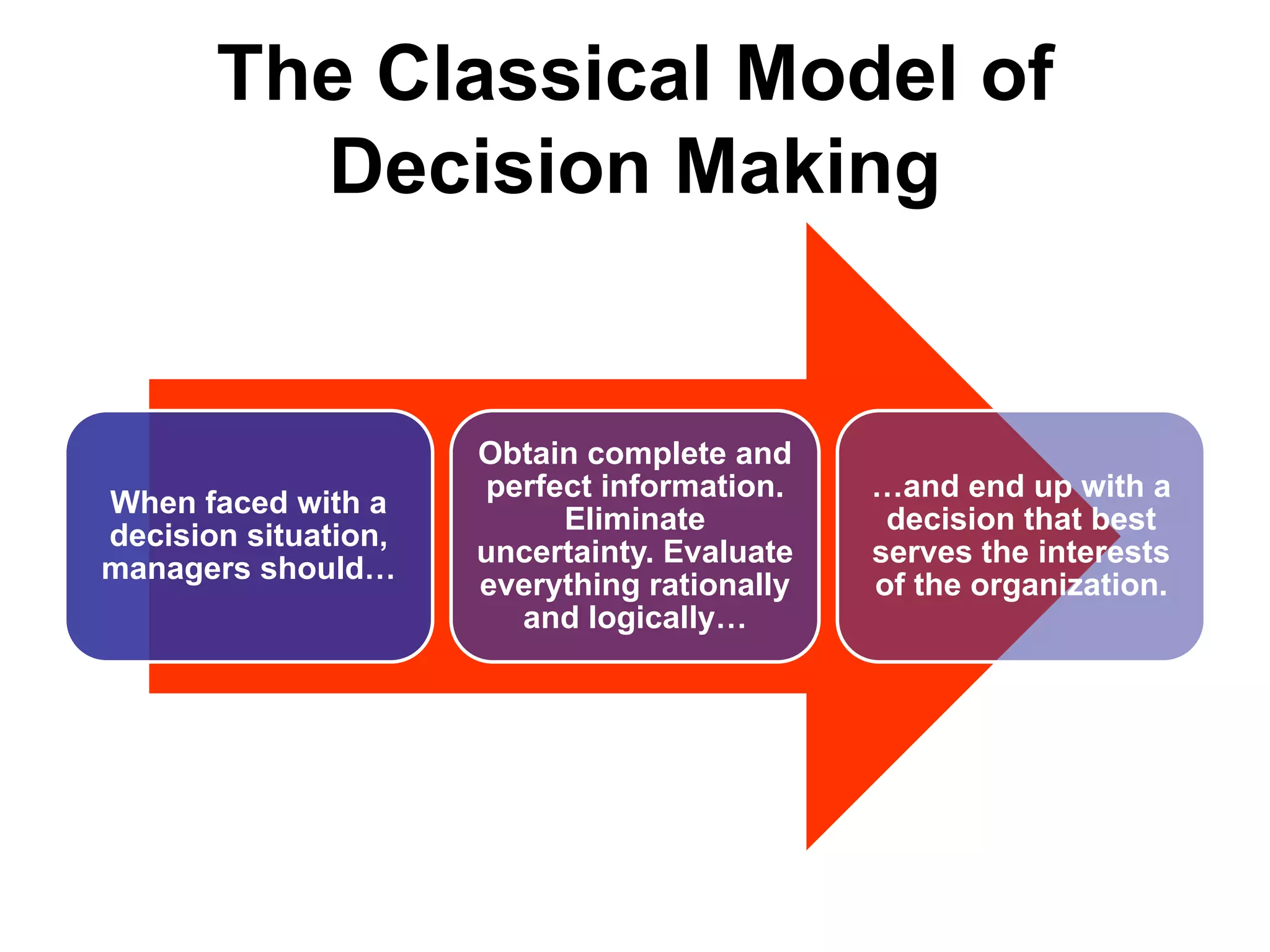
The Classical Model of
         Decision Making


                      Obtain complete and
                      perfect information.    …and end up with a
When faced with a
                           Eliminate           decision that best
decision situation,
                      uncertainty. Evaluate   serves the interests
managers should…
                      everything rationally   of the organization.
                        and logically…
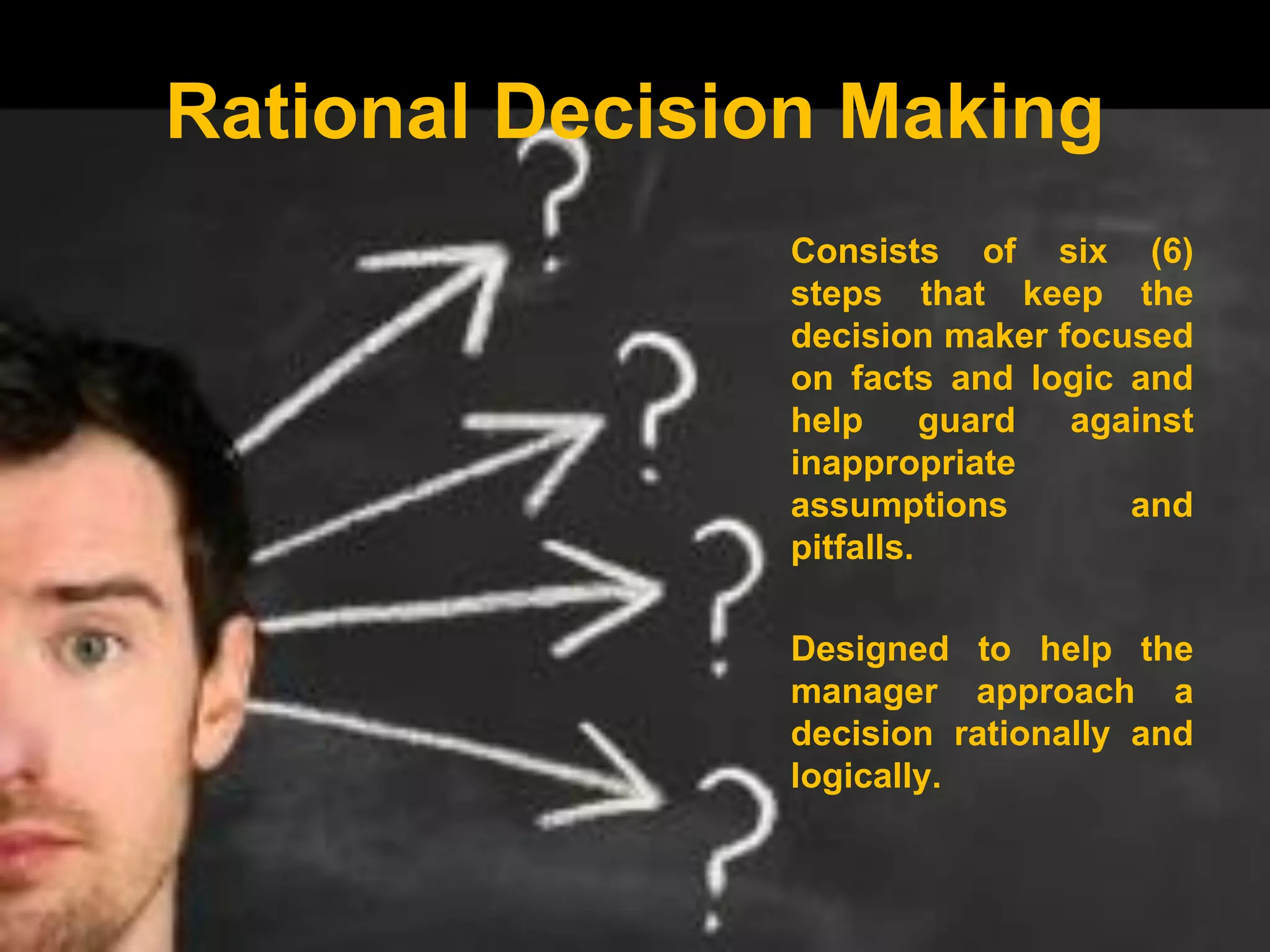
Rational Decision Making
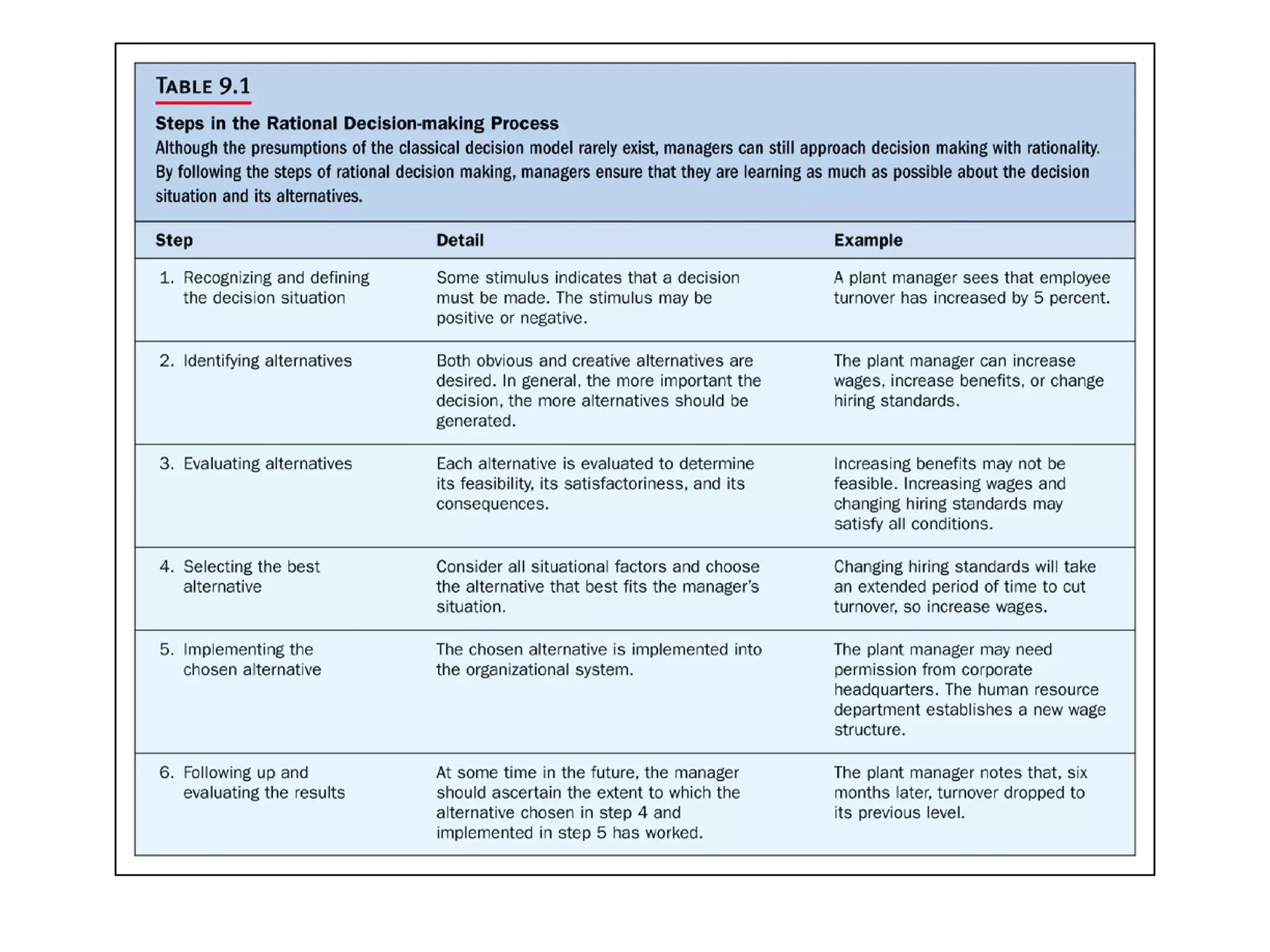
               Consists of six (6)
               steps that keep the
               decision maker focused
               on facts and logic and
               help      guard against
               inappropriate
               assumptions        and
               pitfalls.

               Designed to help the
               manager approach a
               decision rationally and
               logically.
Rational Decision Making. . .                   (continued)


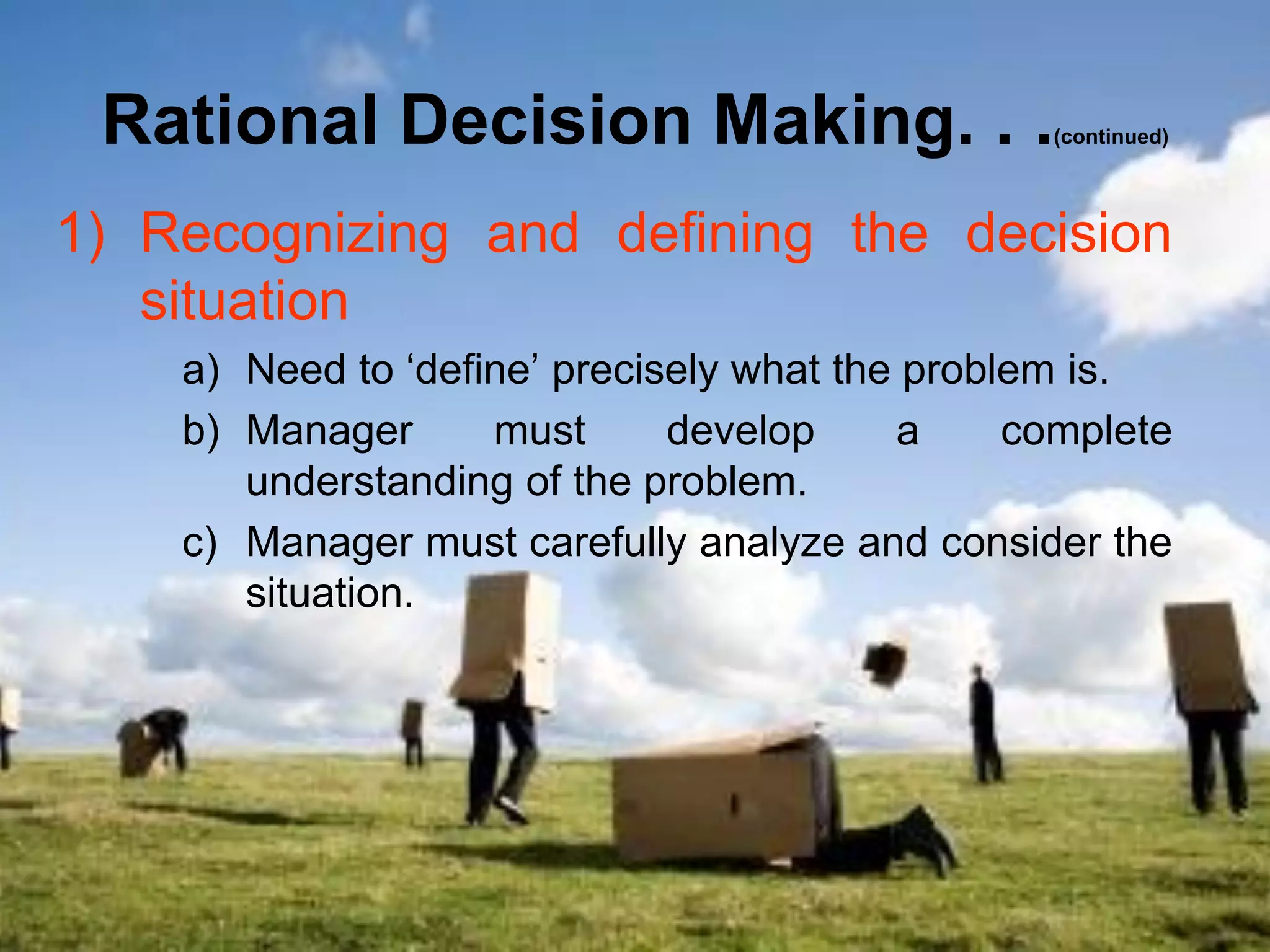
1) Recognizing and defining the decision
   situation
    a) Need to ‘define’ precisely what the problem is.
    b) Manager      must      develop     a     complete
       understanding of the problem.
    c) Manager must carefully analyze and consider the
       situation.
Rational Decision Making. . .                    (continued)


2) Identifying alternatives
     a) Managers must realize that their alternatives may
        be limited by legal, moral and ethical norms,
        authority constraints, available technology,
        economic considerations and unofficial social
        norms.
Rational Decision Making. . .                               (continued)


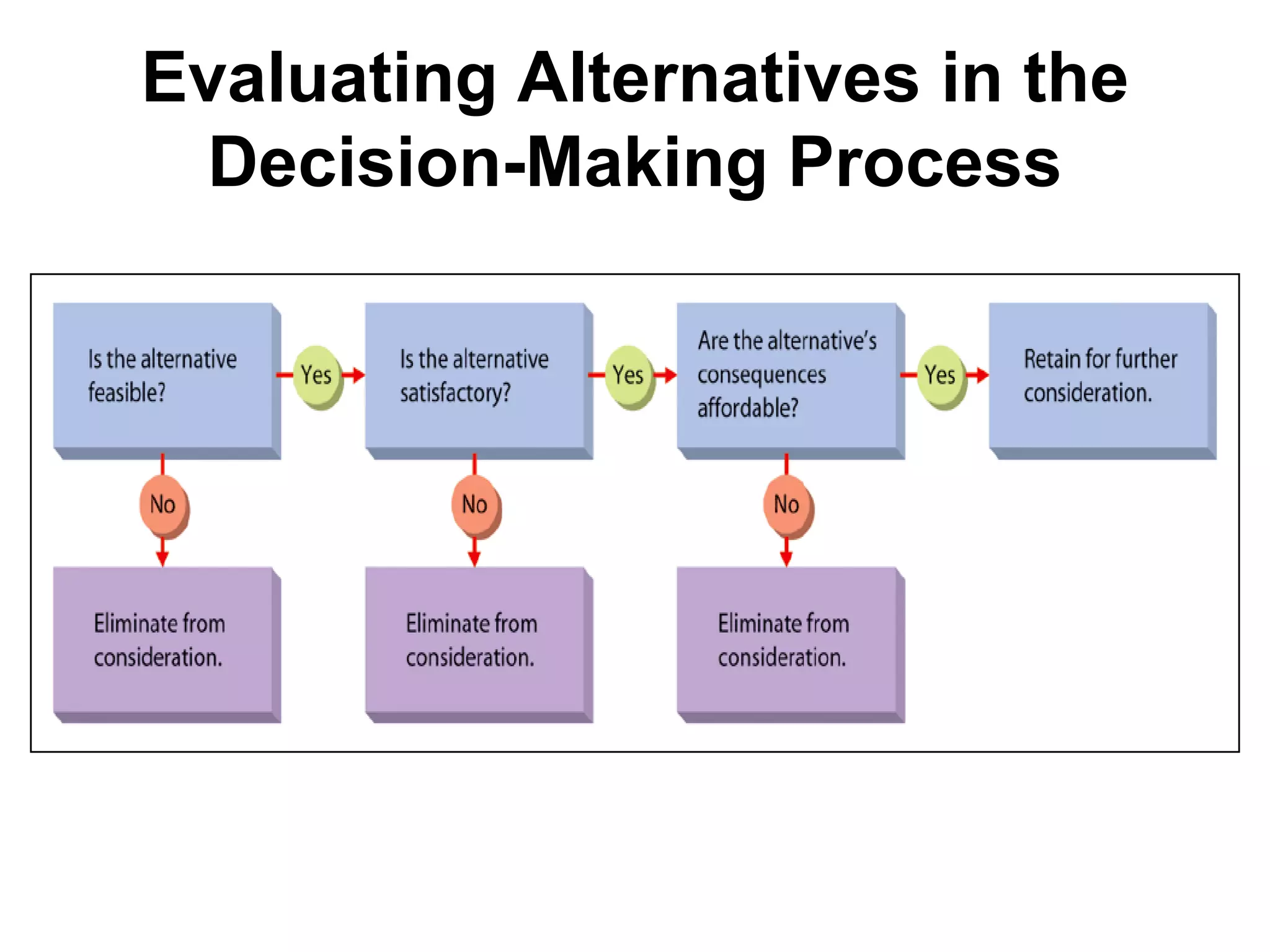
3)        Evaluating alternatives

     a)    Each alternative must pass successfully
           through three stages before it may be worthy of
           consideration as a solution.
             1. Feasibility – Is it financially possible? Is it
                  legally possible?       Are there limited
                  human, material and/or informational
                  resources available?
             2. Satisfactory – Does the alternative satisfy
                  the conditions of the decision situation?
                  [50% increase in sales]
             3. Affordability – How will this alternative
                  affect other parts of the organization?
                  What financial and non-financial costs are
                  associated?
     b)     The manager must put ‘price tags’ on the
            consequences of each alternative.
     c)     Even an alternative that is both feasible and
            satisfactory must be rejected if the
            consequences are too expensive for the total
            system.
Rational
Decision Making.
..
 (continued)


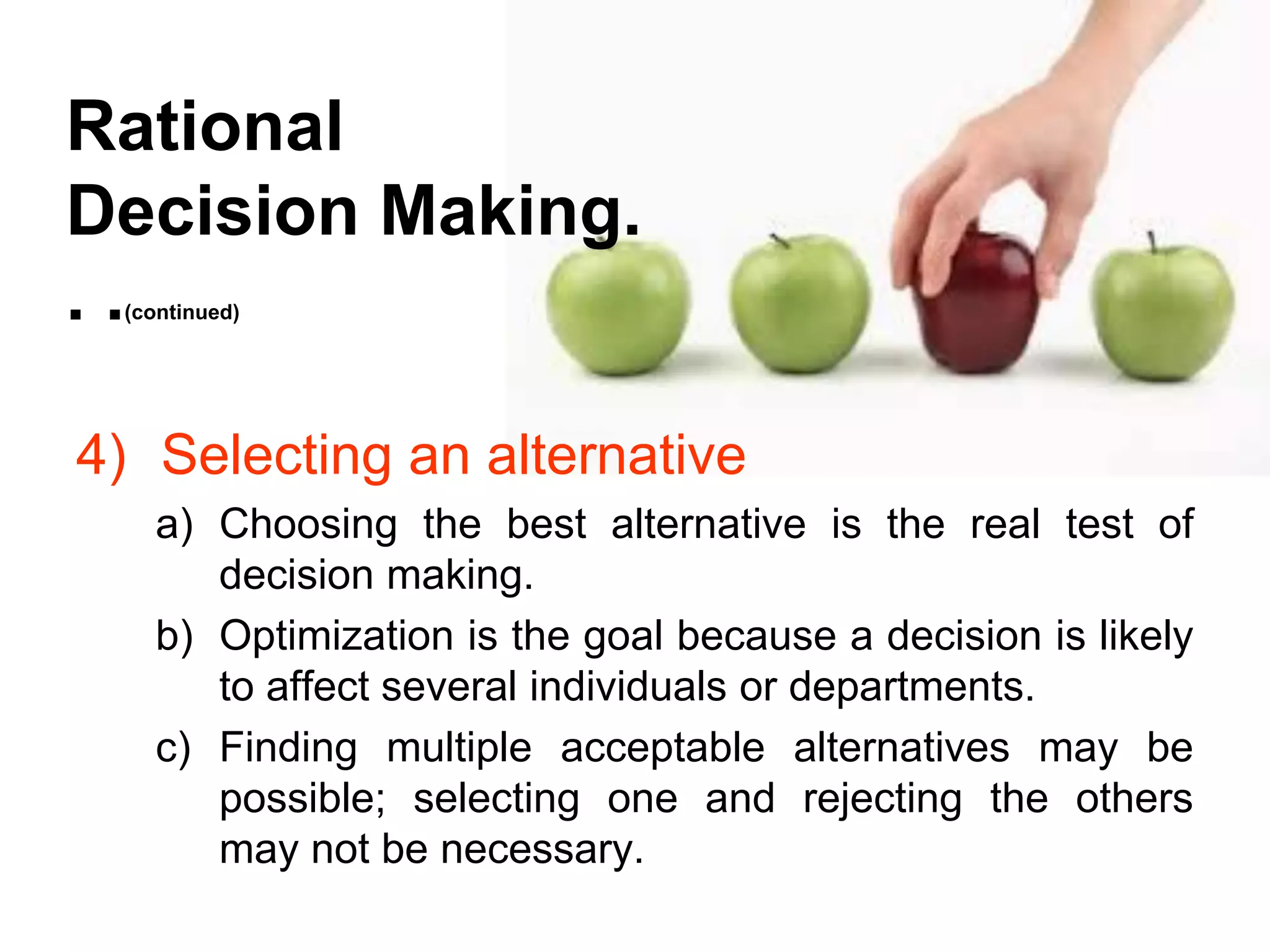
4) Selecting an alternative
   a) Choosing the best alternative is the real test of
      decision making.
   b) Optimization is the goal because a decision is likely
      to affect several individuals or departments.
   c) Finding multiple acceptable alternatives may be
      possible; selecting one and rejecting the others
      may not be necessary.
Rational Decision Making. . .               (continued)


        5)Implementing the chosen alternative
           a) Managers     must     consider   people’s
              resistance to change when implementing
              decisions.
           b) For some decisions, implementation is
              easy; for others, very difficult or time
              consuming.
           c) Operational plans are very useful in
              implementing alternatives.
           d) Managers must also recognize that even
              when all of the alternatives and their
              consequences have been evaluated as
              precisely as possible, unanticipated
              consequences are still likely.
Rational Decision Making. . .                          (continued)


6) Following up     a) Managers       must      evaluate      the
   and evaluating      effectiveness of their decisions – did the
                       chosen alternative serve its original
   the results         purpose?
                    b) If   the    implemented       alternative
                       appears not to be working, the
                       manager has several choices:
                        1. Another      previously     identified
                           alternative might be adopted or
                        2. Recognize that the situation was not
                           correctly defined and start the
                           process all over again or
                        3. Decide that the alternative has not
                           been given enough time to work or
                           should be implemented in a different
                           way.
Evaluating Alternatives in the
 Decision-Making Process
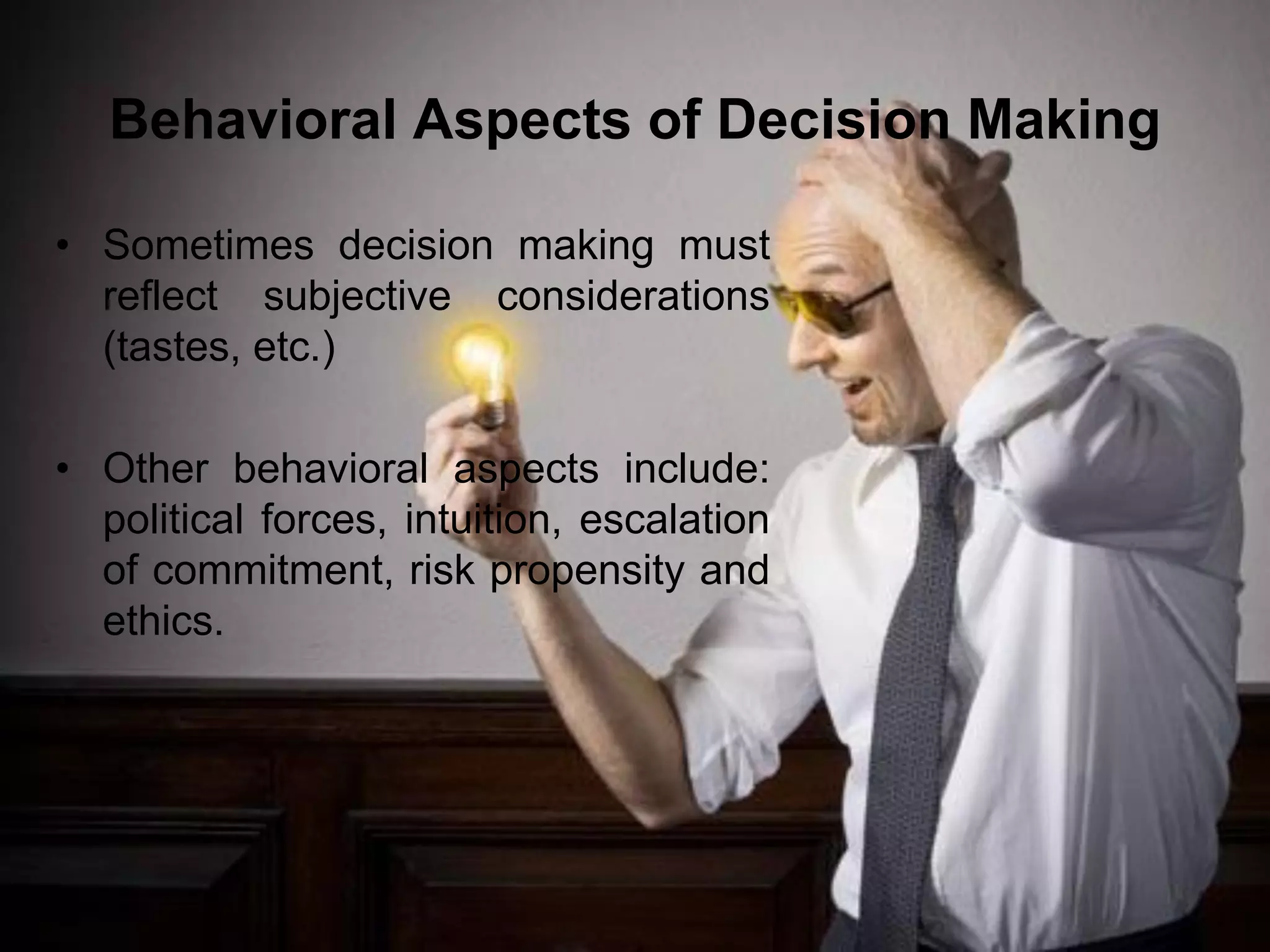
Behavioral Aspects of Decision Making

• Sometimes decision making must
  reflect subjective considerations
  (tastes, etc.)

• Other behavioral aspects include:
  political forces, intuition, escalation
  of commitment, risk propensity and
  ethics.
Behavioral Aspects. . .                  (continued)


        The Administrative Model of Decision Making
             Herbert A Simon, a Nobel Prize winner in
              Economics, developed the model to describe
              how decisions are often made rather than to
              prescribe how they should be made.
             Argues that decision makers have incomplete
              and imperfect information, are constrained by
              ‘bounded rationality’ and tend to ‘satisfice’
              when making decisions.
             Bounded rationality suggests that decision
              makers are limited by their values and
              unconscious reflexes, skills and habits.
              [American vs foreign automakers]
Behavioral Aspects. . .
             (continued)


    Satisficing is the tendency to
     search for alternatives only
     until one is found that meets
     some minimum standard of
     sufficiency.

    Rather than conducting an
     exhaustive search for the best
     possible alternative, decision
     makers tend to search only
     until they identify an alternative
     that meets some minimum
     standard of sufficiency.
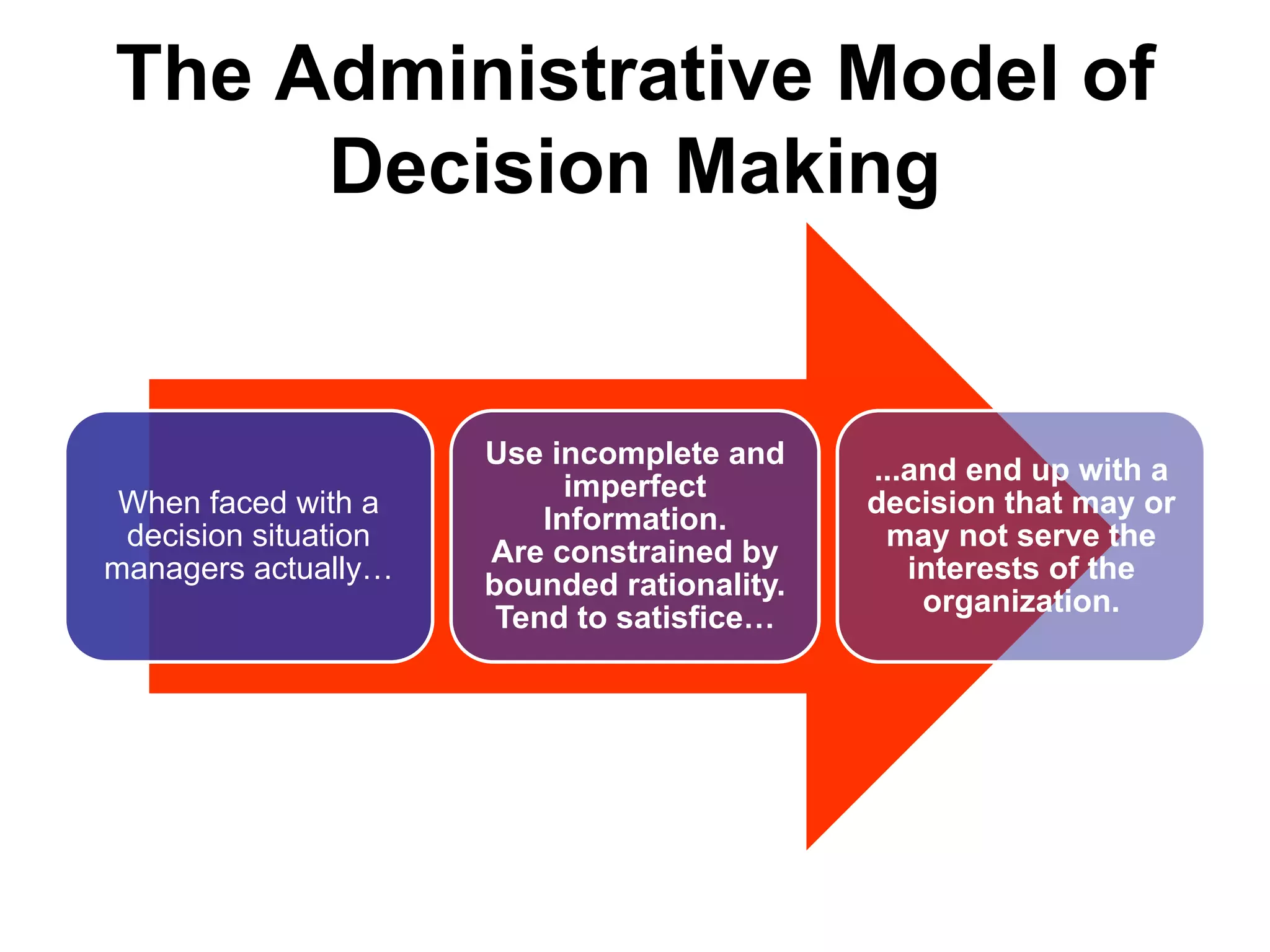
The Administrative Model of
     Decision Making


                      Use incomplete and
                                             ...and end up with a
                            imperfect
 When faced with a                           decision that may or
                          Information.
 decision situation                           may not serve the
                      Are constrained by
managers actually…                              interests of the
                      bounded rationality.
                                                 organization.
                       Tend to satisfice…
Behavioral
 Aspects. . .                (continued)


 The Classical and Administrative
  Models paint quite a different
  picture    of   decision     making.
  However, each may be used to
  better understand how managers
  make decisions.
 The Classical Model attempts to
  explain how managers can at least
  attempt to be more rational and
  logical in their approach to
  decisions.
 The Administrative Model can be
  used by managers to develop a
  better understanding of their
  inherent biases and limitations.
Behavioral Forces Influencing Decisions

                   Political Forces in Decision Making

                      Coalition - an informal alliance of
                      individuals or groups formed to
                      achieve      a      common        goal
                      [stockholders, directors, parliament
                      blocs, etc]
                      Impact of a coalition may be positive
                      or negative.
                      Managers must recognize when to
                      use coalitions, how to assess if they
                      are acting in the best interest of the
                      organization and how to control their
                      negative effects.
Behavioral Forces Influencing Decisions

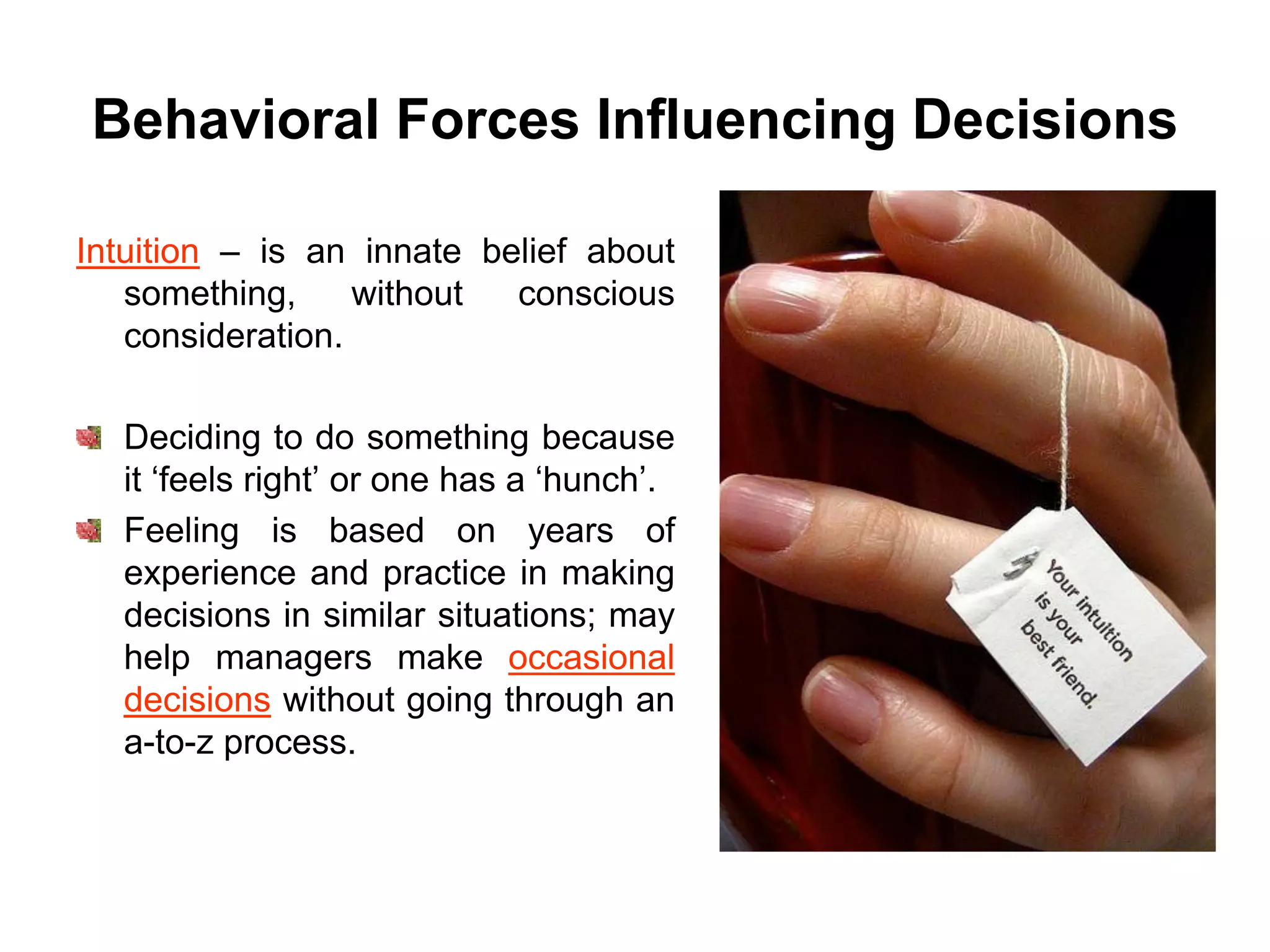
Intuition – is an innate belief about
   something,     without  conscious
   consideration.

  Deciding to do something because
  it ‘feels right’ or one has a ‘hunch’.
  Feeling is based on years of
  experience and practice in making
  decisions in similar situations; may
  help managers make occasional
  decisions without going through an
  a-to-z process.
Behavioral Forces Influencing Decisions

                Escalation of Commitment –
                  occurs when a decision maker
                  stays with a decision even
                  when it appears to be wrong.
                  [Pan Am holdings]
                  Decision makers must guard
                  against sticking too long with
                  an incorrect decision.
                  However, managers should
                  not ‘bail out’ of a seemingly
                  incorrect decision too soon.
Behavioral Forces Influencing Decisions


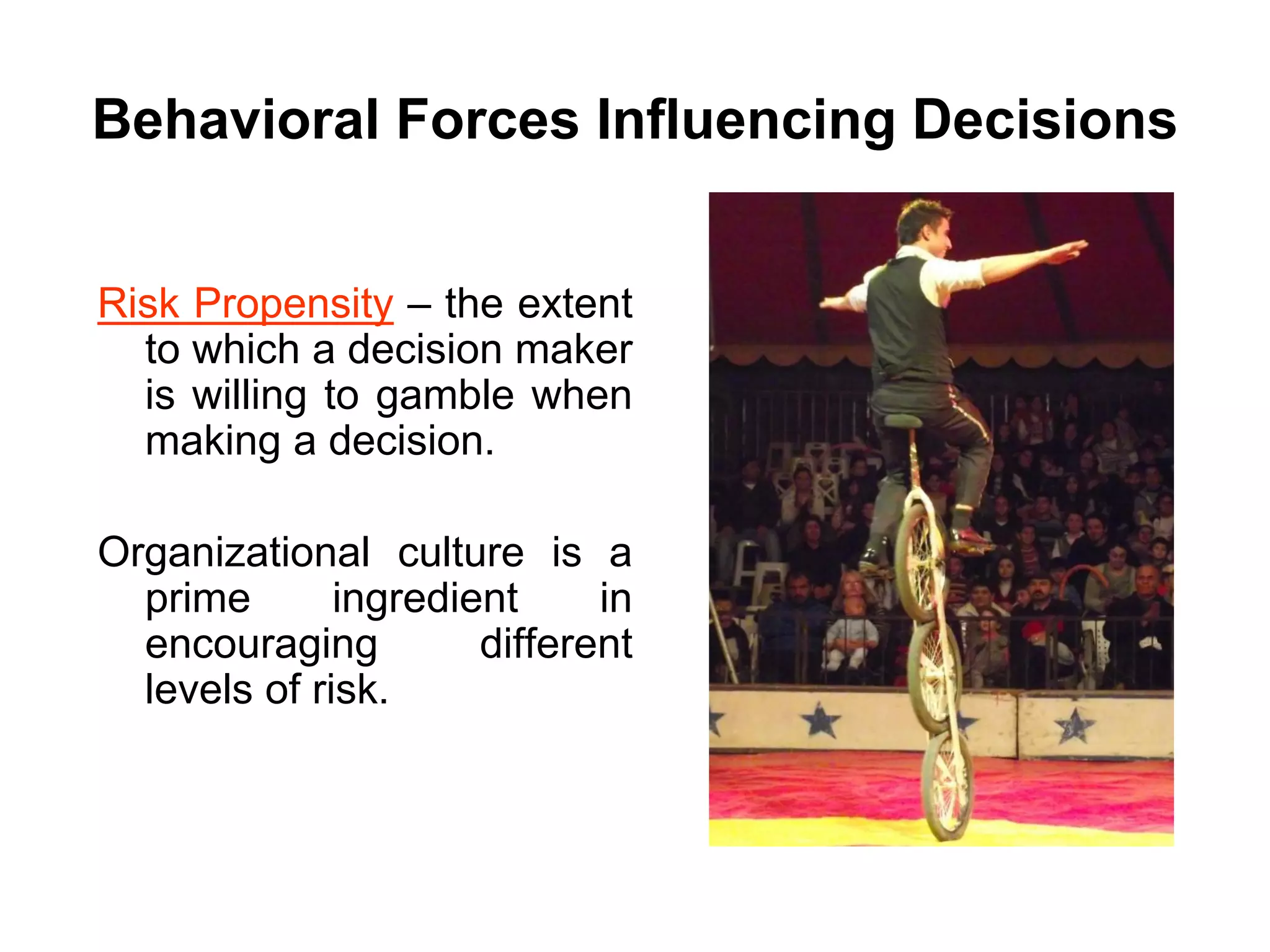
Risk Propensity – the extent
  to which a decision maker
  is willing to gamble when
  making a decision.

Organizational culture is a
  prime       ingredient     in
  encouraging         different
  levels of risk.
Behavioral Forces Influencing Decisions

                   Ethics
                   Managerial ethics involves a
                     wide variety of decisions:
                     Relationships of the firm to
                     its employees [closing a dept to
                     save money]

                     Relationships     of     the
                     employees to the firm
                     Relationships of the firm to
                     other economic agents
For Better 1ndONEsia

Decision making

  • 1.
  • 2.
    The Nature of Decision Making Making effective decisions, as well as recognizing when a bad decision has been made and quickly responding to mistakes, is a key ingredient in organizational effectiveness. Some experts believe that decision making is the most basic and fundamental of all managerial activities. Decision making is most closely linked with the Planning function. However, it is also part of Organizing, Leading and Controlling.
  • 3.
    • Decision makingis the act of choosing one alternative from among a set of alternatives. • We have to first decide that a decision has to be made and then secondly identify a set of feasible alternatives before we select one.
  • 4.
    Decision-Making Process • Decision-MakingProcess includes: • recognizing and defining the nature of a decision situation • identifying alternatives • choosing the ‘best’ [most effective] alternative and • putting it into practice.
  • 5.
    Decision-Making Process. .. (continued) Sometimes effective decisions must be made to: • Optimize some set of factors such as profits, sales, employee welfare and market share or • Minimize loss, expenses or employee turnover or • Select best method for going out of business, laying off employees, or terminating a strategic alliance.
  • 6.
    Decision-Making Process. .. (continued) Managers make decisions about both problems (undesirable situations) and opportunities (desirable situations). Cutting costs by 10% Learning that the company has earned higher-than-projected profits It may take a long time before a manager can know for sure if the right decision was made.
  • 7.
    Types of Decisions •Programmed decision is one that is fairly structured or recurs with some frequency (or both). • Nonprogrammed decision is one that is unstructured and occurs much less often than a programmed decision.
  • 8.
    Programmed Decisions. . Many decisions regarding basic operating systems and procedures and standard organizational transactions fall into this category. McDonald’s employees are trained to make the Big Mac according to specific procedures. Starbucks, and many other organizations, use programmed decisions to purchase new supplies [coffee beans, cups and napkins].
  • 9.
    Nonprogrammed Decisions. .. Mostof the decisions made by top managers involving strategy and organization design are nonprogrammed. Decisions about mergers, acquisitions and takeovers, new facilities, new products, labor contracts and legal issues are nonprogrammed decisions. Managers faced with nonprogrammed decisions must treat each one as unique, investing great amounts of time, energy and resources into exploring the situation from all views. Intuition and experience are major factors in these decisions.
  • 10.
    Decision-Making Conditions • DecisionMaking Under Certainty • Decision Making Under Risk • Decision Making Under Uncertainty
  • 11.
    Decision Making UnderCertainty A state of certainty exists when a decision maker knows, with reasonable certainty, what the alternatives are and what conditions are associated with each alternative. Very few organizational decisions, however, are made under these conditions. The complex and turbulent environment in which businesses exist rarely allows for such decisions.
  • 12.
    Decision Making UnderRisk A state of risk exists when a decision maker makes decisions under a condition in which the availability of each alternative and its potential payoffs and costs are all associated with probability estimate. Decisions such as these are based on past experiences, relevant information, the advice of others and one’s own judgment. Decision is ‘calculated’ on the basis of which alternative has the highest probability of working effectively. [union negotiations, Porsche’s SUV focus vs high-performance sports cars]
  • 13.
    Decision Making UnderUncertainty A state of uncertainty exists when a decision maker does not know all of the alternatives, the risks associated with each, or the consequences each alternative is likely to have. Most of the major decision making in today’s organizations is done under these conditions. To make effective decisions under these conditions, managers must secure as much relevant information as possible and approach the situation from a logical and rational view. Intuition, judgment and experience always play major roles in the decision- making process under these conditions.
  • 14.
    A View ofDecision-Making Conditions Level of ambiguity and chances of making a bad decision Lower Moderate Higher
  • 15.
    Rational Perspectives on DecisionMaking Keys to Decision Making Classical Decision Model Rational Decision Making
  • 16.
    Classical Decision Model •An approach to decision making that tells managers how they should make decisions. • Approach assumes that managers are logical and rational. • Approach assumes that managers’ decisions will be in the best interests of the organization. • Conditions suggested in this approach rarely, if ever, exist.
  • 17.
    The Classical Modelof Decision Making Obtain complete and perfect information. …and end up with a When faced with a Eliminate decision that best decision situation, uncertainty. Evaluate serves the interests managers should… everything rationally of the organization. and logically…
  • 18.
    Rational Decision Making Consists of six (6) steps that keep the decision maker focused on facts and logic and help guard against inappropriate assumptions and pitfalls. Designed to help the manager approach a decision rationally and logically.
  • 19.
    Rational Decision Making.. . (continued) 1) Recognizing and defining the decision situation a) Need to ‘define’ precisely what the problem is. b) Manager must develop a complete understanding of the problem. c) Manager must carefully analyze and consider the situation.
  • 20.
    Rational Decision Making.. . (continued) 2) Identifying alternatives a) Managers must realize that their alternatives may be limited by legal, moral and ethical norms, authority constraints, available technology, economic considerations and unofficial social norms.
  • 21.
    Rational Decision Making.. . (continued) 3) Evaluating alternatives a) Each alternative must pass successfully through three stages before it may be worthy of consideration as a solution. 1. Feasibility – Is it financially possible? Is it legally possible? Are there limited human, material and/or informational resources available? 2. Satisfactory – Does the alternative satisfy the conditions of the decision situation? [50% increase in sales] 3. Affordability – How will this alternative affect other parts of the organization? What financial and non-financial costs are associated? b) The manager must put ‘price tags’ on the consequences of each alternative. c) Even an alternative that is both feasible and satisfactory must be rejected if the consequences are too expensive for the total system.
  • 22.
    Rational Decision Making. .. (continued) 4)Selecting an alternative a) Choosing the best alternative is the real test of decision making. b) Optimization is the goal because a decision is likely to affect several individuals or departments. c) Finding multiple acceptable alternatives may be possible; selecting one and rejecting the others may not be necessary.
  • 23.
    Rational Decision Making.. . (continued) 5)Implementing the chosen alternative a) Managers must consider people’s resistance to change when implementing decisions. b) For some decisions, implementation is easy; for others, very difficult or time consuming. c) Operational plans are very useful in implementing alternatives. d) Managers must also recognize that even when all of the alternatives and their consequences have been evaluated as precisely as possible, unanticipated consequences are still likely.
  • 24.
    Rational Decision Making.. . (continued) 6) Following up a) Managers must evaluate the and evaluating effectiveness of their decisions – did the chosen alternative serve its original the results purpose? b) If the implemented alternative appears not to be working, the manager has several choices: 1. Another previously identified alternative might be adopted or 2. Recognize that the situation was not correctly defined and start the process all over again or 3. Decide that the alternative has not been given enough time to work or should be implemented in a different way.
  • 25.
    Evaluating Alternatives inthe Decision-Making Process
  • 27.
    Behavioral Aspects ofDecision Making • Sometimes decision making must reflect subjective considerations (tastes, etc.) • Other behavioral aspects include: political forces, intuition, escalation of commitment, risk propensity and ethics.
  • 28.
    Behavioral Aspects. .. (continued) The Administrative Model of Decision Making  Herbert A Simon, a Nobel Prize winner in Economics, developed the model to describe how decisions are often made rather than to prescribe how they should be made.  Argues that decision makers have incomplete and imperfect information, are constrained by ‘bounded rationality’ and tend to ‘satisfice’ when making decisions.  Bounded rationality suggests that decision makers are limited by their values and unconscious reflexes, skills and habits. [American vs foreign automakers]
  • 29.
    Behavioral Aspects. .. (continued) Satisficing is the tendency to search for alternatives only until one is found that meets some minimum standard of sufficiency. Rather than conducting an exhaustive search for the best possible alternative, decision makers tend to search only until they identify an alternative that meets some minimum standard of sufficiency.
  • 30.
    The Administrative Modelof Decision Making Use incomplete and ...and end up with a imperfect When faced with a decision that may or Information. decision situation may not serve the Are constrained by managers actually… interests of the bounded rationality. organization. Tend to satisfice…
  • 31.
    Behavioral Aspects. .. (continued)  The Classical and Administrative Models paint quite a different picture of decision making. However, each may be used to better understand how managers make decisions.  The Classical Model attempts to explain how managers can at least attempt to be more rational and logical in their approach to decisions.  The Administrative Model can be used by managers to develop a better understanding of their inherent biases and limitations.
  • 32.
    Behavioral Forces InfluencingDecisions Political Forces in Decision Making Coalition - an informal alliance of individuals or groups formed to achieve a common goal [stockholders, directors, parliament blocs, etc] Impact of a coalition may be positive or negative. Managers must recognize when to use coalitions, how to assess if they are acting in the best interest of the organization and how to control their negative effects.
  • 33.
    Behavioral Forces InfluencingDecisions Intuition – is an innate belief about something, without conscious consideration. Deciding to do something because it ‘feels right’ or one has a ‘hunch’. Feeling is based on years of experience and practice in making decisions in similar situations; may help managers make occasional decisions without going through an a-to-z process.
  • 34.
    Behavioral Forces InfluencingDecisions Escalation of Commitment – occurs when a decision maker stays with a decision even when it appears to be wrong. [Pan Am holdings] Decision makers must guard against sticking too long with an incorrect decision. However, managers should not ‘bail out’ of a seemingly incorrect decision too soon.
  • 35.
    Behavioral Forces InfluencingDecisions Risk Propensity – the extent to which a decision maker is willing to gamble when making a decision. Organizational culture is a prime ingredient in encouraging different levels of risk.
  • 36.
    Behavioral Forces InfluencingDecisions Ethics Managerial ethics involves a wide variety of decisions: Relationships of the firm to its employees [closing a dept to save money] Relationships of the employees to the firm Relationships of the firm to other economic agents
  • 37.