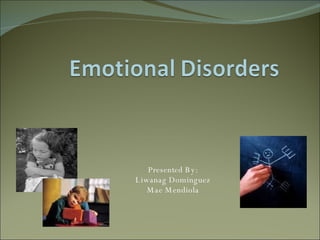
Presented By: Liwanag Dominguez Mae Mendiola
Introduction: Ice Breaker Music
Objectives By the end of this presentation the class will be able to: Explain that an unclear definition can influence how we identify and support students with emotional disorders. Identify academic and social characteristics of these students. Describe the causes of emotional disorders. Identify strategies for improving learning outcomes for these students. List strategies for improving post secondary outcome for these students.
Definition  DEFINITION OF EMOTIONAL DISTURBANCE Many terms are used to describe emotional, behavioral or mental disorders. Currently, students with such disorders are categorized as having a serious emotional disturbance, which is defined under the Individuals with Disabilities Education Act (IDEA), Public Law 101-476, as follows: Emotional disturbance   is defined as follows:  The term means a condition exhibiting one or more of the following characteristics over a long period of time and to a marked degree that adversely affects a child's educational performance:  (A) An inability to learn that cannot be explained by intellectual, sensory, or health factors.  (B) An inability to build or maintain satisfactory interpersonal relationships with peers and teachers. (C) Inappropriate types of behavior or feelings under normal circumstances. (D) A general pervasive mood of unhappiness or depression. (E) A tendency to develop physical symptoms or fears associated with personal or school problems.  (ii) The term includes schizophrenia. The term does not apply to children who are socially maladjusted, unless it is determined that they have an emotional disturbance.    [Code of Federal Regulations, Title 34, Section 300.7(c)(4)]
Challenges the Emotional Disorders Present  Although students with ED are among the most difficult ones to teach, it is imperative that all teachers understand not only the characteristics of these students but also how to meet their educational, social, and behavioral needs. Students with ED tend to develop anti-social behavior patterns, fail school, and commit delinquent acts before intervening.  These students experience less positive outcomes while in school than other students with and without disabilities. They continue to struggle when they leave school.
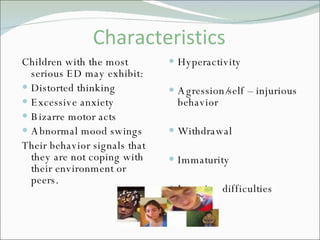
Characteristics Children with the most serious ED may exhibit: Distorted thinking Excessive anxiety Bizarre motor acts Abnormal mood swings  Their behavior signals that they are not coping with their environment or peers. Hyperactivity Agression/self – injurious behavior Withdrawal Immaturity Learning difficulties
Causes The causes of ED have not been adequately determined. Various factors such as heredity, brain disorder, diet, and family functioning. Research has not shown any of these factors to be the direct cause of behavior problems.
Assessment Early identification Pre-Referral:  Response to Intervention Identification Evaluation: Curriculum Based Measurement (CBM)
Teaching Strategies Guidelines for class with students with ED :   Display appropriate authority. Explain class goals on 1 st  day and routine to be followed. Discuss goals often with each student, develop a contract what student must do to achieve goal, relate goals to the group goals. Keep simple class rules, set as few as possible to obtain order. Clearly explain consequences of not following the rules, or regulations and the rewards for following them as well. Allow students to be involved in the consequence process, post in the room or allow them to take part in making them. Demonstrate consistency in enforcing rules and providing feedback.
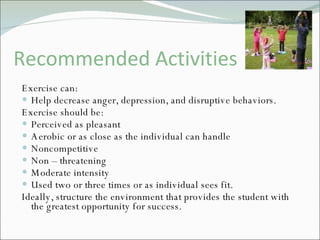
Recommended Activities Exercise can: Help decrease anger, depression, and disruptive behaviors. Exercise should be:  Perceived as pleasant Aerobic or as close as the individual can handle Noncompetitive Non – threatening Moderate intensity Used two or three times or as individual sees fit. Ideally, structure the environment that provides the student with the greatest opportunity for success.
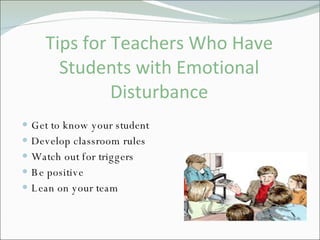
Tips for Teachers Who Have Students with Emotional Disturbance Get to know your student Develop classroom rules Watch out for triggers Be positive Lean on your team
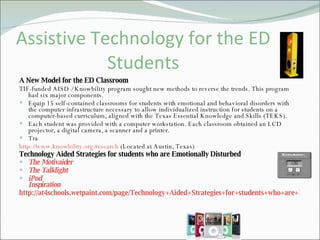
Assistive Technology for the ED Students A New Model for the ED Classroom TIF-funded AISD / Knowbility program sought new methods to reverse the trends. This program had six major components. Equip 15 self-contained classrooms for students with emotional and behavioral disorders with the computer infrastructure necessary to allow individualized instruction for students on a computer-based curriculum, aligned with the Texas Essential Knowledge and Skills (TEKS).  Each student was provided with a computer workstation. Each classroom obtained an LCD projector, a digital camera, a scanner and a printer. Tra http://www.knowbility.org/research  (Located at Austin, Texas) Technology Aided Strategies for students who are Emotionally Disturbed The Motivaider  The Talklight iPod Inspiration http://at4schools.wetpaint.com/page/Technology+Aided+Strategies+for+students+who+are+Emotionally+Disturbed
Other Considerations Families of children with emotional disturbances may need help in understanding their children's condition and in learning how to work effectively with them. Help is available from psychiatrists, psychologists or other mental health professionals in public or private mental health settings. Children should be provided services based on their individual needs, and all persons who are involved with these children should be aware of the care they are receiving.  It is important to coordinate all services between home, school, and therapeutic community with open communication.
Collaboration Families and Relatives School (Special Education and or Regular Classroom Teacher, Counselor, etc.) Community (Mental Health, Foster Care, etc.)
Organizations Nationally: American Academy of Child and Adolescent Psychiatry  ERIC Clearinghouse on Disabilities and Gifted Education   Federation of Families for Children's Mental Health  Locally: Guam Mental Health  GPSS SPED Program
GPSS SPED PROGRAM Location: Tiyan, Guam Program Coordinator: Gom Babauta Contact Number: 475 – 0558 Number of Social Workers: Eight
Information Related to ED students on GPSS Self-contain schools: P.C. Lujan Elem. School (Barrigada, Guam) Agueda Johnston Middle School Southern High School (Santa Rita, Guam)  A student must meet the criteria for the Federal Guidelines to be eligible for service.  Project I Famaguon-Ta under Guam Mental Health follow-up and work with the students who are having problems at home (Some students are receiving free medication).
Interview with a Special Education Teacher School: Upi Elementary (Yigo, Guam) Teacher: Mrs. Rose Castro Classroom: Special Education Student: Third grade male student Type of Instruction: Direct Instruction (Reading Mastery and Language for Learning for first and second instructional blocks). Timeframe is 3 ½ hours a day. The student cannot accept constructive criticism when a teacher is correcting him. He can be violent and throw objects in the classroom. He is not taking medication although it is recommended.
Resources Introduction to Special Education: Making a Difference Author: Deborah Deutsch Smith Sixth Edition http://www.knowbility.org/research http://at4schools.wetpaint.com/page/Technology+Aided http://www.knowbility.org/research http://www.learningabledkids.com/IEP_training/example_IEP_goals_for_reading.htm http://www.pecentral.org/adapted/factsheets/seriousemotionaldisturbance.htm
Conclusion It is definitely a challenge working with students who have an emotional disorder. But educators can have success with children who have emotional disturbances if they get support from co-workers and consistently implement behavioral strategies and classroom management techniques.
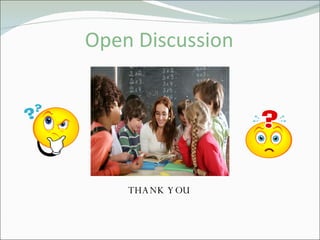
Open Discussion THANK YOU

Emotional Disorders Presentation

  • 1.
    Presented By: LiwanagDominguez Mae Mendiola
  • 2.
  • 3.
    Objectives By theend of this presentation the class will be able to: Explain that an unclear definition can influence how we identify and support students with emotional disorders. Identify academic and social characteristics of these students. Describe the causes of emotional disorders. Identify strategies for improving learning outcomes for these students. List strategies for improving post secondary outcome for these students.
  • 4.
    Definition DEFINITIONOF EMOTIONAL DISTURBANCE Many terms are used to describe emotional, behavioral or mental disorders. Currently, students with such disorders are categorized as having a serious emotional disturbance, which is defined under the Individuals with Disabilities Education Act (IDEA), Public Law 101-476, as follows: Emotional disturbance is defined as follows:  The term means a condition exhibiting one or more of the following characteristics over a long period of time and to a marked degree that adversely affects a child's educational performance: (A) An inability to learn that cannot be explained by intellectual, sensory, or health factors. (B) An inability to build or maintain satisfactory interpersonal relationships with peers and teachers. (C) Inappropriate types of behavior or feelings under normal circumstances. (D) A general pervasive mood of unhappiness or depression. (E) A tendency to develop physical symptoms or fears associated with personal or school problems.  (ii) The term includes schizophrenia. The term does not apply to children who are socially maladjusted, unless it is determined that they have an emotional disturbance.    [Code of Federal Regulations, Title 34, Section 300.7(c)(4)]
  • 5.
    Challenges the EmotionalDisorders Present Although students with ED are among the most difficult ones to teach, it is imperative that all teachers understand not only the characteristics of these students but also how to meet their educational, social, and behavioral needs. Students with ED tend to develop anti-social behavior patterns, fail school, and commit delinquent acts before intervening. These students experience less positive outcomes while in school than other students with and without disabilities. They continue to struggle when they leave school.
  • 6.
    Characteristics Children withthe most serious ED may exhibit: Distorted thinking Excessive anxiety Bizarre motor acts Abnormal mood swings Their behavior signals that they are not coping with their environment or peers. Hyperactivity Agression/self – injurious behavior Withdrawal Immaturity Learning difficulties
  • 7.
    Causes The causesof ED have not been adequately determined. Various factors such as heredity, brain disorder, diet, and family functioning. Research has not shown any of these factors to be the direct cause of behavior problems.
  • 8.
    Assessment Early identificationPre-Referral: Response to Intervention Identification Evaluation: Curriculum Based Measurement (CBM)
  • 9.
    Teaching Strategies Guidelinesfor class with students with ED : Display appropriate authority. Explain class goals on 1 st day and routine to be followed. Discuss goals often with each student, develop a contract what student must do to achieve goal, relate goals to the group goals. Keep simple class rules, set as few as possible to obtain order. Clearly explain consequences of not following the rules, or regulations and the rewards for following them as well. Allow students to be involved in the consequence process, post in the room or allow them to take part in making them. Demonstrate consistency in enforcing rules and providing feedback.
  • 10.
    Recommended Activities Exercisecan: Help decrease anger, depression, and disruptive behaviors. Exercise should be: Perceived as pleasant Aerobic or as close as the individual can handle Noncompetitive Non – threatening Moderate intensity Used two or three times or as individual sees fit. Ideally, structure the environment that provides the student with the greatest opportunity for success.
  • 11.
    Tips for TeachersWho Have Students with Emotional Disturbance Get to know your student Develop classroom rules Watch out for triggers Be positive Lean on your team
  • 12.
    Assistive Technology forthe ED Students A New Model for the ED Classroom TIF-funded AISD / Knowbility program sought new methods to reverse the trends. This program had six major components. Equip 15 self-contained classrooms for students with emotional and behavioral disorders with the computer infrastructure necessary to allow individualized instruction for students on a computer-based curriculum, aligned with the Texas Essential Knowledge and Skills (TEKS). Each student was provided with a computer workstation. Each classroom obtained an LCD projector, a digital camera, a scanner and a printer. Tra http://www.knowbility.org/research (Located at Austin, Texas) Technology Aided Strategies for students who are Emotionally Disturbed The Motivaider The Talklight iPod Inspiration http://at4schools.wetpaint.com/page/Technology+Aided+Strategies+for+students+who+are+Emotionally+Disturbed
  • 13.
    Other Considerations Familiesof children with emotional disturbances may need help in understanding their children's condition and in learning how to work effectively with them. Help is available from psychiatrists, psychologists or other mental health professionals in public or private mental health settings. Children should be provided services based on their individual needs, and all persons who are involved with these children should be aware of the care they are receiving. It is important to coordinate all services between home, school, and therapeutic community with open communication.
  • 14.
    Collaboration Families andRelatives School (Special Education and or Regular Classroom Teacher, Counselor, etc.) Community (Mental Health, Foster Care, etc.)
  • 15.
    Organizations Nationally: AmericanAcademy of Child and Adolescent Psychiatry ERIC Clearinghouse on Disabilities and Gifted Education Federation of Families for Children's Mental Health Locally: Guam Mental Health GPSS SPED Program
  • 16.
    GPSS SPED PROGRAMLocation: Tiyan, Guam Program Coordinator: Gom Babauta Contact Number: 475 – 0558 Number of Social Workers: Eight
  • 17.
    Information Related toED students on GPSS Self-contain schools: P.C. Lujan Elem. School (Barrigada, Guam) Agueda Johnston Middle School Southern High School (Santa Rita, Guam) A student must meet the criteria for the Federal Guidelines to be eligible for service. Project I Famaguon-Ta under Guam Mental Health follow-up and work with the students who are having problems at home (Some students are receiving free medication).
  • 18.
    Interview with aSpecial Education Teacher School: Upi Elementary (Yigo, Guam) Teacher: Mrs. Rose Castro Classroom: Special Education Student: Third grade male student Type of Instruction: Direct Instruction (Reading Mastery and Language for Learning for first and second instructional blocks). Timeframe is 3 ½ hours a day. The student cannot accept constructive criticism when a teacher is correcting him. He can be violent and throw objects in the classroom. He is not taking medication although it is recommended.
  • 19.
    Resources Introduction toSpecial Education: Making a Difference Author: Deborah Deutsch Smith Sixth Edition http://www.knowbility.org/research http://at4schools.wetpaint.com/page/Technology+Aided http://www.knowbility.org/research http://www.learningabledkids.com/IEP_training/example_IEP_goals_for_reading.htm http://www.pecentral.org/adapted/factsheets/seriousemotionaldisturbance.htm
  • 20.
    Conclusion It isdefinitely a challenge working with students who have an emotional disorder. But educators can have success with children who have emotional disturbances if they get support from co-workers and consistently implement behavioral strategies and classroom management techniques.
  • 21.