© Boardworks Ltd 2005
1 of 33
These icons indicate that teacher’s notes or useful web addresses are available in the Notes Page.
This icon indicates the slide contains activities created in Flash. These activities are not editable.
For more detailed instructions, see the Getting Started presentation.
© Boardworks Ltd 2005
1 of 33
AS-Level Maths:
Statistics 1
for Edexcel
S1.6 The normal
distribution
© Boardworks Ltd 2005
2 of 33
Contents
© Boardworks Ltd 2005
2 of 33
Introduction: Normal distribution
The standard normal distribution
More general normal distributions
Solving problems by working backwards.
© Boardworks Ltd 2005
3 of 33
Histogram showing the heights of 10000 males
0
200
400
600
800
1000
1200
1400
140 148 156 164 172 180 188 More
Height (cm)
Frequency
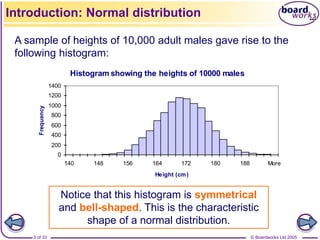
A sample of heights of 10,000 adult males gave rise to the
following histogram:
Notice that this histogram is symmetrical
and bell-shaped. This is the characteristic
shape of a normal distribution.
Introduction: Normal distribution
© Boardworks Ltd 2005
4 of 33
The normal distribution is an appropriate model for many
common continuous distributions, for example:
If we were to draw a
smooth curve through the
mid-points of the bars in
the histogram of these
heights, it would have the
following shape:
Introduction: Normal distribution
This is called the
normal curve.
The masses of new-born babies;
The IQs of school students;
The hand span of adult females;
The heights of plants growing in a field;
etc.
© Boardworks Ltd 2005
5 of 33
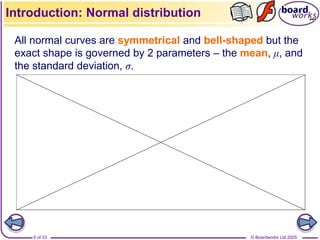
All normal curves are symmetrical and bell-shaped but the
exact shape is governed by 2 parameters – the mean, μ, and
the standard deviation, σ.
Introduction: Normal distribution
© Boardworks Ltd 2005
6 of 33
If X has a normal distribution with mean μ, and variance σ2,
we write
X ~ N[μ, σ2]
68% of the distribution lies within
1 standard deviation of the mean.
Introduction: Normal distribution
x
y
μ – σ μ + σ
© Boardworks Ltd 2005
7 of 33
95% of the distribution lies within 2
standard deviations of the mean.
Introduction: Normal distribution
x
y
If X has a normal distribution with mean μ, and variance σ2,
we write
X ~ N[μ, σ2]
μ – 2σ μ + 2σ
© Boardworks Ltd 2005
8 of 33
99.7% of the distribution lies within
3 standard deviations of the mean.
Introduction: Normal distribution
x
y
If X has a normal distribution with mean μ, and variance σ2,
we write
X ~ N[μ, σ2]
μ + 3σ
μ – 3σ
© Boardworks Ltd 2005
9 of 33
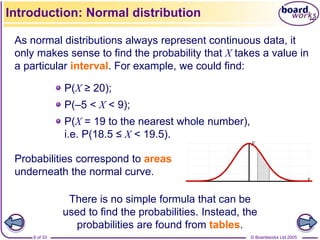
As normal distributions always represent continuous data, it
only makes sense to find the probability that X takes a value in
a particular interval. For example, we could find:
Introduction: Normal distribution
There is no simple formula that can be
used to find the probabilities. Instead, the
probabilities are found from tables.
Probabilities correspond to areas
underneath the normal curve.
P(X ≥ 20);
P(–5 < X < 9);
P(X = 19 to the nearest whole number),
i.e. P(18.5 ≤ X < 19.5).
x
y
© Boardworks Ltd 2005
10 of 33
Contents
© Boardworks Ltd 2005
10 of 33
Introduction: Normal distribution
The standard normal distribution
More general normal distributions
Solving problems by working backwards.
The standard normal distribution
© Boardworks Ltd 2005
11 of 33
The normal distribution with mean 0 and standard deviation 1
is called the standard normal distribution – it is denoted Z.
So, Z ~ N[0, 1].
Probabilities for this distribution are given in tables.
The standard normal distribution
-3 -2 -1 1 2 3
x
y
© Boardworks Ltd 2005
12 of 33
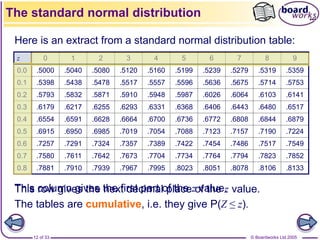
Here is an extract from a standard normal distribution table:
z 0 1 2 3 4 5 6 7 8 9
0.0 .5000 .5040 .5080 .5120 .5160 .5199 .5239 .5279 .5319 .5359
0.1 .5398 .5438 .5478 .5517 .5557 .5596 .5636 .5675 .5714 .5753
0.2 .5793 .5832 .5871 .5910 .5948 .5987 .6026 .6064 .6103 .6141
0.3 .6179 .6217 .6255 .6293 .6331 .6368 .6406 .6443 .6480 .6517
0.4 .6554 .6591 .6628 .6664 .6700 .6736 .6772 .6808 .6844 .6879
0.5 .6915 .6950 .6985 .7019 .7054 .7088 .7123 .7157 .7190 .7224
0.6 .7257 .7291 .7324 .7357 .7389 .7422 .7454 .7486 .7517 .7549
0.7 .7580 .7611 .7642 .7673 .7704 .7734 .7764 .7794 .7823 .7852
0.8 .7881 .7910 .7939 .7967 .7995 .8023 .8051 .8078 .8106 .8133
The tables are cumulative, i.e. they give P(Z ≤ z).
The standard normal distribution
This column gives the first part of the z value.
This row gives the next decimal place of the z value.
© Boardworks Ltd 2005
13 of 33
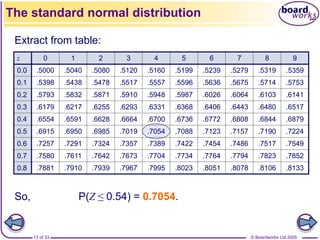
So, P(Z ≤ 0.54) = 0.7054.
The standard normal distribution
Extract from table:
z 0 1 2 3 4 5 6 7 8 9
0.0 .5000 .5040 .5080 .5120 .5160 .5199 .5239 .5279 .5319 .5359
0.1 .5398 .5438 .5478 .5517 .5557 .5596 .5636 .5675 .5714 .5753
0.2 .5793 .5832 .5871 .5910 .5948 .5987 .6026 .6064 .6103 .6141
0.3 .6179 .6217 .6255 .6293 .6331 .6368 .6406 .6443 .6480 .6517
0.4 .6554 .6591 .6628 .6664 .6700 .6736 .6772 .6808 .6844 .6879
0.5 .6915 .6950 .6985 .7019 .7054 .7088 .7123 .7157 .7190 .7224
0.6 .7257 .7291 .7324 .7357 .7389 .7422 .7454 .7486 .7517 .7549
0.7 .7580 .7611 .7642 .7673 .7704 .7734 .7764 .7794 .7823 .7852
0.8 .7881 .7910 .7939 .7967 .7995 .8023 .8051 .8078 .8106 .8133
© Boardworks Ltd 2005
14 of 33
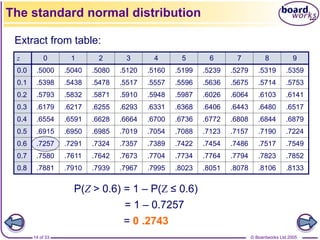
P(Z > 0.6) = 1 – P(Z ≤ 0.6)
= 1 – 0.7257
= 0 .2743
The standard normal distribution
Extract from table:
z 0 1 2 3 4 5 6 7 8 9
0.0 .5000 .5040 .5080 .5120 .5160 .5199 .5239 .5279 .5319 .5359
0.1 .5398 .5438 .5478 .5517 .5557 .5596 .5636 .5675 .5714 .5753
0.2 .5793 .5832 .5871 .5910 .5948 .5987 .6026 .6064 .6103 .6141
0.3 .6179 .6217 .6255 .6293 .6331 .6368 .6406 .6443 .6480 .6517
0.4 .6554 .6591 .6628 .6664 .6700 .6736 .6772 .6808 .6844 .6879
0.5 .6915 .6950 .6985 .7019 .7054 .7088 .7123 .7157 .7190 .7224
0.6 .7257 .7291 .7324 .7357 .7389 .7422 .7454 .7486 .7517 .7549
0.7 .7580 .7611 .7642 .7673 .7704 .7734 .7764 .7794 .7823 .7852
0.8 .7881 .7910 .7939 .7967 .7995 .8023 .8051 .8078 .8106 .8133
© Boardworks Ltd 2005
15 of 33
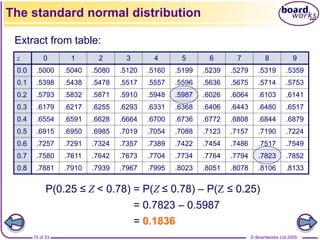
P(0.25 ≤ Z < 0.78) = P(Z ≤ 0.78) – P(Z ≤ 0.25)
= 0.7823 – 0.5987
= 0.1836
The standard normal distribution
Extract from table:
z 0 1 2 3 4 5 6 7 8 9
0.0 .5000 .5040 .5080 .5120 .5160 .5199 .5239 .5279 .5319 .5359
0.1 .5398 .5438 .5478 .5517 .5557 .5596 .5636 .5675 .5714 .5753
0.2 .5793 .5832 .5871 .5910 .5948 .5987 .6026 .6064 .6103 .6141
0.3 .6179 .6217 .6255 .6293 .6331 .6368 .6406 .6443 .6480 .6517
0.4 .6554 .6591 .6628 .6664 .6700 .6736 .6772 .6808 .6844 .6879
0.5 .6915 .6950 .6985 .7019 .7054 .7088 .7123 .7157 .7190 .7224
0.6 .7257 .7291 .7324 .7357 .7389 .7422 .7454 .7486 .7517 .7549
0.7 .7580 .7611 .7642 .7673 .7704 .7734 .7764 .7794 .7823 .7852
0.8 .7881 .7910 .7939 .7967 .7995 .8023 .8051 .8078 .8106 .8133
© Boardworks Ltd 2005
16 of 33
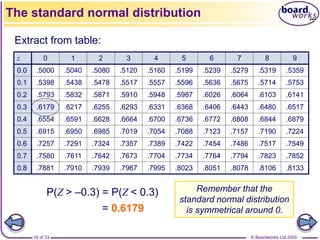
P(Z > –0.3) = P(Z < 0.3)
= 0.6179
The standard normal distribution
Extract from table:
z 0 1 2 3 4 5 6 7 8 9
0.0 .5000 .5040 .5080 .5120 .5160 .5199 .5239 .5279 .5319 .5359
0.1 .5398 .5438 .5478 .5517 .5557 .5596 .5636 .5675 .5714 .5753
0.2 .5793 .5832 .5871 .5910 .5948 .5987 .6026 .6064 .6103 .6141
0.3 .6179 .6217 .6255 .6293 .6331 .6368 .6406 .6443 .6480 .6517
0.4 .6554 .6591 .6628 .6664 .6700 .6736 .6772 .6808 .6844 .6879
0.5 .6915 .6950 .6985 .7019 .7054 .7088 .7123 .7157 .7190 .7224
0.6 .7257 .7291 .7324 .7357 .7389 .7422 .7454 .7486 .7517 .7549
0.7 .7580 .7611 .7642 .7673 .7704 .7734 .7764 .7794 .7823 .7852
0.8 .7881 .7910 .7939 .7967 .7995 .8023 .8051 .8078 .8106 .8133
Remember that the
standard normal distribution
is symmetrical around 0.
© Boardworks Ltd 2005
17 of 33
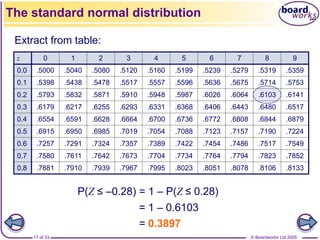
P(Z ≤ –0.28) = 1 – P(Z ≤ 0.28)
= 1 – 0.6103
= 0.3897
The standard normal distribution
Extract from table:
z 0 1 2 3 4 5 6 7 8 9
0.0 .5000 .5040 .5080 .5120 .5160 .5199 .5239 .5279 .5319 .5359
0.1 .5398 .5438 .5478 .5517 .5557 .5596 .5636 .5675 .5714 .5753
0.2 .5793 .5832 .5871 .5910 .5948 .5987 .6026 .6064 .6103 .6141
0.3 .6179 .6217 .6255 .6293 .6331 .6368 .6406 .6443 .6480 .6517
0.4 .6554 .6591 .6628 .6664 .6700 .6736 .6772 .6808 .6844 .6879
0.5 .6915 .6950 .6985 .7019 .7054 .7088 .7123 .7157 .7190 .7224
0.6 .7257 .7291 .7324 .7357 .7389 .7422 .7454 .7486 .7517 .7549
0.7 .7580 .7611 .7642 .7673 .7704 .7734 .7764 .7794 .7823 .7852
0.8 .7881 .7910 .7939 .7967 .7995 .8023 .8051 .8078 .8106 .8133
© Boardworks Ltd 2005
18 of 33
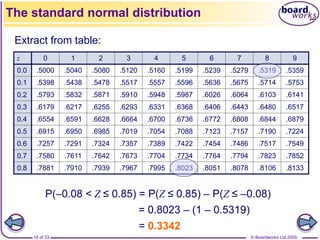
P(–0.08 < Z ≤ 0.85) = P(Z ≤ 0.85) – P(Z ≤ –0.08)
= 0.8023 – (1 – 0.5319)
= 0.3342
The standard normal distribution
Extract from table:
z 0 1 2 3 4 5 6 7 8 9
0.0 .5000 .5040 .5080 .5120 .5160 .5199 .5239 .5279 .5319 .5359
0.1 .5398 .5438 .5478 .5517 .5557 .5596 .5636 .5675 .5714 .5753
0.2 .5793 .5832 .5871 .5910 .5948 .5987 .6026 .6064 .6103 .6141
0.3 .6179 .6217 .6255 .6293 .6331 .6368 .6406 .6443 .6480 .6517
0.4 .6554 .6591 .6628 .6664 .6700 .6736 .6772 .6808 .6844 .6879
0.5 .6915 .6950 .6985 .7019 .7054 .7088 .7123 .7157 .7190 .7224
0.6 .7257 .7291 .7324 .7357 .7389 .7422 .7454 .7486 .7517 .7549
0.7 .7580 .7611 .7642 .7673 .7704 .7734 .7764 .7794 .7823 .7852
0.8 .7881 .7910 .7939 .7967 .7995 .8023 .8051 .8078 .8106 .8133
© Boardworks Ltd 2005
19 of 33
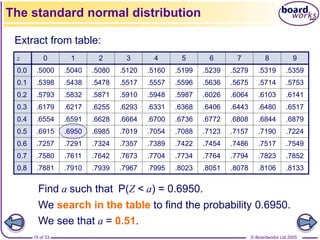
Find a such that P(Z < a) = 0.6950.
We search in the table to find the probability 0.6950.
We see that a = 0.51.
The standard normal distribution
Extract from table:
z 0 1 2 3 4 5 6 7 8 9
0.0 .5000 .5040 .5080 .5120 .5160 .5199 .5239 .5279 .5319 .5359
0.1 .5398 .5438 .5478 .5517 .5557 .5596 .5636 .5675 .5714 .5753
0.2 .5793 .5832 .5871 .5910 .5948 .5987 .6026 .6064 .6103 .6141
0.3 .6179 .6217 .6255 .6293 .6331 .6368 .6406 .6443 .6480 .6517
0.4 .6554 .6591 .6628 .6664 .6700 .6736 .6772 .6808 .6844 .6879
0.5 .6915 .6950 .6985 .7019 .7054 .7088 .7123 .7157 .7190 .7224
0.6 .7257 .7291 .7324 .7357 .7389 .7422 .7454 .7486 .7517 .7549
0.7 .7580 .7611 .7642 .7673 .7704 .7734 .7764 .7794 .7823 .7852
0.8 .7881 .7910 .7939 .7967 .7995 .8023 .8051 .8078 .8106 .8133
© Boardworks Ltd 2005
20 of 33
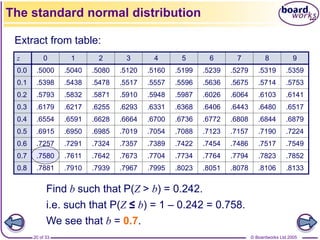
Find b such that P(Z > b) = 0.242.
i.e. such that P(Z ≤ b) = 1 – 0.242 = 0.758.
We see that b = 0.7.
The standard normal distribution
Extract from table:
z 0 1 2 3 4 5 6 7 8 9
0.0 .5000 .5040 .5080 .5120 .5160 .5199 .5239 .5279 .5319 .5359
0.1 .5398 .5438 .5478 .5517 .5557 .5596 .5636 .5675 .5714 .5753
0.2 .5793 .5832 .5871 .5910 .5948 .5987 .6026 .6064 .6103 .6141
0.3 .6179 .6217 .6255 .6293 .6331 .6368 .6406 .6443 .6480 .6517
0.4 .6554 .6591 .6628 .6664 .6700 .6736 .6772 .6808 .6844 .6879
0.5 .6915 .6950 .6985 .7019 .7054 .7088 .7123 .7157 .7190 .7224
0.6 .7257 .7291 .7324 .7357 .7389 .7422 .7454 .7486 .7517 .7549
0.7 .7580 .7611 .7642 .7673 .7704 .7734 .7764 .7794 .7823 .7852
0.8 .7881 .7910 .7939 .7967 .7995 .8023 .8051 .8078 .8106 .8133
© Boardworks Ltd 2005
21 of 33
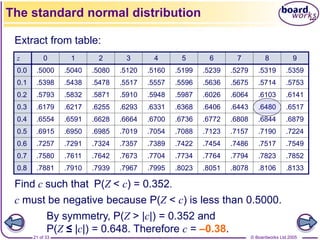
Find c such that P(Z < c) = 0.352.
c must be negative because P(Z < c) is less than 0.5000.
The standard normal distribution
Extract from table:
z 0 1 2 3 4 5 6 7 8 9
0.0 .5000 .5040 .5080 .5120 .5160 .5199 .5239 .5279 .5319 .5359
0.1 .5398 .5438 .5478 .5517 .5557 .5596 .5636 .5675 .5714 .5753
0.2 .5793 .5832 .5871 .5910 .5948 .5987 .6026 .6064 .6103 .6141
0.3 .6179 .6217 .6255 .6293 .6331 .6368 .6406 .6443 .6480 .6517
0.4 .6554 .6591 .6628 .6664 .6700 .6736 .6772 .6808 .6844 .6879
0.5 .6915 .6950 .6985 .7019 .7054 .7088 .7123 .7157 .7190 .7224
0.6 .7257 .7291 .7324 .7357 .7389 .7422 .7454 .7486 .7517 .7549
0.7 .7580 .7611 .7642 .7673 .7704 .7734 .7764 .7794 .7823 .7852
0.8 .7881 .7910 .7939 .7967 .7995 .8023 .8051 .8078 .8106 .8133
By symmetry, P(Z > |c|) = 0.352 and
P(Z ≤ |c|) = 0.648. Therefore c = –0.38.
© Boardworks Ltd 2005
22 of 33
Contents
© Boardworks Ltd 2005
22 of 33
Introduction: Normal distribution
The standard normal distribution
More general normal distributions
Solving problems by working backwards.
More general normal distributions
© Boardworks Ltd 2005
23 of 33
It would of course be impractical to publish tables of
probabilities for every possible normal distribution.
Fortunately, it is possible and easy to transform any
normal distribution to a standard normal:
If X ~ then ~ [ ].
N 0,1
X
Z




[ , ]
2
N  
Standardise
[ ]
N 0, 1
More general normal distributions
x
y
[ , ]
2
N  
-3 -2 -1 1 2 3
x
y
© Boardworks Ltd 2005
24 of 33
Example: If , find
a) P(X < 23);
b) P(X > 14);
c) P(16 < X < 24.8).
~ [ , ]
N 20 16
X
a) If σ2 = 16, then σ = 4.
( ) ( . )
P 23 P 0 75
X Z
  
More general normal distributions
x
y
x
y
20 23 0 0.75
Standardise
.
23 20
0 75
4


= 0.7734
© Boardworks Ltd 2005
25 of 33
b)
( ) ( . ) ( . )
P 14 P 1 5 P 1 5
X Z Z
     
More general normal distributions
Example: If , find
a) P(X < 23);
b) P(X > 14);
c) P(16 < X < 24.8).
~ [ , ]
N 20 16
X
x
y
x
y
14 20 –1.5 0
Standardise
.
14 20
1 5
4

 
= 0.9332
© Boardworks Ltd 2005
26 of 33
c)  
.
. ( . )
16 20 24 8 20
P 16 24 8 P P 1 1 2
4 4
X Z Z
 
 
        
 
 
P(Z < 1.2) = 0.8849
and P(Z < –1) = 1 – P(Z < 1) = 1 – 0.8413 = 0.1587.
So, P(–1 < Z < 1.2) = 0.8849 – 0.1587 = 0.7262
More general normal distributions
Example: If , find
a) P(X < 23);
b) P(X > 14);
c) P(16 < X < 24.8).
~ [ , ]
N 20 16
X
x
y
x
y
Standardise
16 20 24.8 -1 0 1.2
© Boardworks Ltd 2005
27 of 33
Let X be the random variable for the IQ of an individual.
X ~ N[100, 225].
So, we want P(X > 124) = P(Z > 1.6)
= 1 – P(Z ≤ 1.6) = 1 – 0.9452
More general normal distributions
Examination style question: IQs are normally distributed
with mean 100 and standard deviation 15. What proportion
of the population have an IQ of at least 124?
x
y
x
y
100 124 0 1.6
Standardise
.
124 100
1 6
15


= 0.0548
© Boardworks Ltd 2005
28 of 33
Contents
© Boardworks Ltd 2005
28 of 33
Introduction: Normal distribution
The standard normal distribution
More general normal distributions
Solving problems by working backwards.
Working backwards
© Boardworks Ltd 2005
29 of 33
x
y
To find x, we start by finding the standardised value z such
that P(Z < z) = 0.67.
From tables we see that z = 0.44.
We therefore need to find the value that standardises to
make 0.44 by rearranging the formula.
Example: If X ~ N[4, 0.25], find the value of
x if P(X < x) = 0.67.
Working backwards
x
y
4 x 0 0.44
Standardise
[ . ]
N 4, 0 25 [ ]
N 0, 1
.
.
.
4 0 44 0
4 22
5
x
x
  

© Boardworks Ltd 2005
30 of 33
x
y
x
y
Let X represent the marks in the examination. X ~ N[62, 256].
We need to find x such that P(X ≥ x) = 0.86.
We need to solve: . Therefore x = 44.72.
Example: Marks in an examination can be assumed to
follow a normal distribution with mean 62 and standard
deviation 16. The pass mark is to be chosen so that 86%
of candidates pass. Find the pass mark.
-1.08
.
62
1 08
16
x 
 
x
Working backwards
Standardise
So, the pass mark is 44.
© Boardworks Ltd 2005
31 of 33
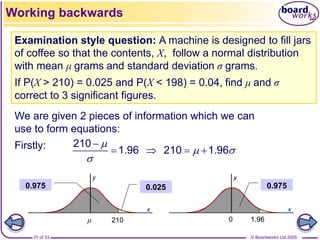
Examination style question: A machine is designed to fill jars
of coffee so that the contents, X, follow a normal distribution
with mean μ grams and standard deviation σ grams.
If P(X > 210) = 0.025 and P(X < 198) = 0.04, find μ and σ
correct to 3 significant figures.
μ 210
0.975
0 1.96
. .
210
1 96 210 1 96

 


   
0.025
Working backwards
We are given 2 pieces of information which we can
use to form equations:
Firstly:
0.975
© Boardworks Ltd 2005
32 of 33
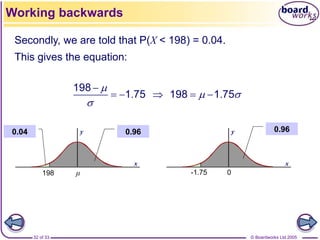
Secondly, we are told that P(X < 198) = 0.04.
This gives the equation:
198 μ
0.04
-1.75 0
. .
198
1 75 198 1 75

 


    
0.96
Working backwards
0.96
© Boardworks Ltd 2005
33 of 33
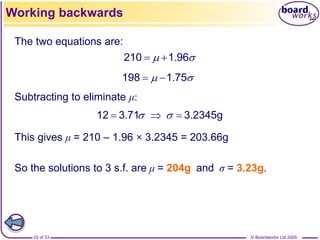
The two equations are:
.
198 1 75
 
 
.
210 1 96
 
 
Subtracting to eliminate μ:
. .
12 3 71 3 2345g
 
  
This gives μ = 210 – 1.96 × 3.2345 = 203.66g
So the solutions to 3 s.f. are μ = 204g and σ = 3.23g.
Working backwards

normal-distribution-2.ppt

  • 1.
    © Boardworks Ltd2005 1 of 33 These icons indicate that teacher’s notes or useful web addresses are available in the Notes Page. This icon indicates the slide contains activities created in Flash. These activities are not editable. For more detailed instructions, see the Getting Started presentation. © Boardworks Ltd 2005 1 of 33 AS-Level Maths: Statistics 1 for Edexcel S1.6 The normal distribution
  • 2.
    © Boardworks Ltd2005 2 of 33 Contents © Boardworks Ltd 2005 2 of 33 Introduction: Normal distribution Introduction: Normal distribution The standard normal distribution More general normal distributions Solving problems by working backwards.
  • 3.
    © Boardworks Ltd2005 3 of 33 Histogram showing the heights of 10000 males 0 200 400 600 800 1000 1200 1400 140 148 156 164 172 180 188 More Height (cm) Frequency A sample of heights of 10,000 adult males gave rise to the following histogram: Notice that this histogram is symmetrical and bell-shaped. This is the characteristic shape of a normal distribution. Introduction: Normal distribution
  • 4.
    © Boardworks Ltd2005 4 of 33 The normal distribution is an appropriate model for many common continuous distributions, for example: If we were to draw a smooth curve through the mid-points of the bars in the histogram of these heights, it would have the following shape: Introduction: Normal distribution This is called the normal curve. The masses of new-born babies; The IQs of school students; The hand span of adult females; The heights of plants growing in a field; etc.
  • 5.
    © Boardworks Ltd2005 5 of 33 All normal curves are symmetrical and bell-shaped but the exact shape is governed by 2 parameters – the mean, μ, and the standard deviation, σ. Introduction: Normal distribution
  • 6.
    © Boardworks Ltd2005 6 of 33 If X has a normal distribution with mean μ, and variance σ2, we write X ~ N[μ, σ2] 68% of the distribution lies within 1 standard deviation of the mean. Introduction: Normal distribution x y μ – σ μ + σ
  • 7.
    © Boardworks Ltd2005 7 of 33 95% of the distribution lies within 2 standard deviations of the mean. Introduction: Normal distribution x y If X has a normal distribution with mean μ, and variance σ2, we write X ~ N[μ, σ2] μ – 2σ μ + 2σ
  • 8.
    © Boardworks Ltd2005 8 of 33 99.7% of the distribution lies within 3 standard deviations of the mean. Introduction: Normal distribution x y If X has a normal distribution with mean μ, and variance σ2, we write X ~ N[μ, σ2] μ + 3σ μ – 3σ
  • 9.
    © Boardworks Ltd2005 9 of 33 As normal distributions always represent continuous data, it only makes sense to find the probability that X takes a value in a particular interval. For example, we could find: Introduction: Normal distribution There is no simple formula that can be used to find the probabilities. Instead, the probabilities are found from tables. Probabilities correspond to areas underneath the normal curve. P(X ≥ 20); P(–5 < X < 9); P(X = 19 to the nearest whole number), i.e. P(18.5 ≤ X < 19.5). x y
  • 10.
    © Boardworks Ltd2005 10 of 33 Contents © Boardworks Ltd 2005 10 of 33 Introduction: Normal distribution The standard normal distribution More general normal distributions Solving problems by working backwards. The standard normal distribution
  • 11.
    © Boardworks Ltd2005 11 of 33 The normal distribution with mean 0 and standard deviation 1 is called the standard normal distribution – it is denoted Z. So, Z ~ N[0, 1]. Probabilities for this distribution are given in tables. The standard normal distribution -3 -2 -1 1 2 3 x y
  • 12.
    © Boardworks Ltd2005 12 of 33 Here is an extract from a standard normal distribution table: z 0 1 2 3 4 5 6 7 8 9 0.0 .5000 .5040 .5080 .5120 .5160 .5199 .5239 .5279 .5319 .5359 0.1 .5398 .5438 .5478 .5517 .5557 .5596 .5636 .5675 .5714 .5753 0.2 .5793 .5832 .5871 .5910 .5948 .5987 .6026 .6064 .6103 .6141 0.3 .6179 .6217 .6255 .6293 .6331 .6368 .6406 .6443 .6480 .6517 0.4 .6554 .6591 .6628 .6664 .6700 .6736 .6772 .6808 .6844 .6879 0.5 .6915 .6950 .6985 .7019 .7054 .7088 .7123 .7157 .7190 .7224 0.6 .7257 .7291 .7324 .7357 .7389 .7422 .7454 .7486 .7517 .7549 0.7 .7580 .7611 .7642 .7673 .7704 .7734 .7764 .7794 .7823 .7852 0.8 .7881 .7910 .7939 .7967 .7995 .8023 .8051 .8078 .8106 .8133 The tables are cumulative, i.e. they give P(Z ≤ z). The standard normal distribution This column gives the first part of the z value. This row gives the next decimal place of the z value.
  • 13.
    © Boardworks Ltd2005 13 of 33 So, P(Z ≤ 0.54) = 0.7054. The standard normal distribution Extract from table: z 0 1 2 3 4 5 6 7 8 9 0.0 .5000 .5040 .5080 .5120 .5160 .5199 .5239 .5279 .5319 .5359 0.1 .5398 .5438 .5478 .5517 .5557 .5596 .5636 .5675 .5714 .5753 0.2 .5793 .5832 .5871 .5910 .5948 .5987 .6026 .6064 .6103 .6141 0.3 .6179 .6217 .6255 .6293 .6331 .6368 .6406 .6443 .6480 .6517 0.4 .6554 .6591 .6628 .6664 .6700 .6736 .6772 .6808 .6844 .6879 0.5 .6915 .6950 .6985 .7019 .7054 .7088 .7123 .7157 .7190 .7224 0.6 .7257 .7291 .7324 .7357 .7389 .7422 .7454 .7486 .7517 .7549 0.7 .7580 .7611 .7642 .7673 .7704 .7734 .7764 .7794 .7823 .7852 0.8 .7881 .7910 .7939 .7967 .7995 .8023 .8051 .8078 .8106 .8133
  • 14.
    © Boardworks Ltd2005 14 of 33 P(Z > 0.6) = 1 – P(Z ≤ 0.6) = 1 – 0.7257 = 0 .2743 The standard normal distribution Extract from table: z 0 1 2 3 4 5 6 7 8 9 0.0 .5000 .5040 .5080 .5120 .5160 .5199 .5239 .5279 .5319 .5359 0.1 .5398 .5438 .5478 .5517 .5557 .5596 .5636 .5675 .5714 .5753 0.2 .5793 .5832 .5871 .5910 .5948 .5987 .6026 .6064 .6103 .6141 0.3 .6179 .6217 .6255 .6293 .6331 .6368 .6406 .6443 .6480 .6517 0.4 .6554 .6591 .6628 .6664 .6700 .6736 .6772 .6808 .6844 .6879 0.5 .6915 .6950 .6985 .7019 .7054 .7088 .7123 .7157 .7190 .7224 0.6 .7257 .7291 .7324 .7357 .7389 .7422 .7454 .7486 .7517 .7549 0.7 .7580 .7611 .7642 .7673 .7704 .7734 .7764 .7794 .7823 .7852 0.8 .7881 .7910 .7939 .7967 .7995 .8023 .8051 .8078 .8106 .8133
  • 15.
    © Boardworks Ltd2005 15 of 33 P(0.25 ≤ Z < 0.78) = P(Z ≤ 0.78) – P(Z ≤ 0.25) = 0.7823 – 0.5987 = 0.1836 The standard normal distribution Extract from table: z 0 1 2 3 4 5 6 7 8 9 0.0 .5000 .5040 .5080 .5120 .5160 .5199 .5239 .5279 .5319 .5359 0.1 .5398 .5438 .5478 .5517 .5557 .5596 .5636 .5675 .5714 .5753 0.2 .5793 .5832 .5871 .5910 .5948 .5987 .6026 .6064 .6103 .6141 0.3 .6179 .6217 .6255 .6293 .6331 .6368 .6406 .6443 .6480 .6517 0.4 .6554 .6591 .6628 .6664 .6700 .6736 .6772 .6808 .6844 .6879 0.5 .6915 .6950 .6985 .7019 .7054 .7088 .7123 .7157 .7190 .7224 0.6 .7257 .7291 .7324 .7357 .7389 .7422 .7454 .7486 .7517 .7549 0.7 .7580 .7611 .7642 .7673 .7704 .7734 .7764 .7794 .7823 .7852 0.8 .7881 .7910 .7939 .7967 .7995 .8023 .8051 .8078 .8106 .8133
  • 16.
    © Boardworks Ltd2005 16 of 33 P(Z > –0.3) = P(Z < 0.3) = 0.6179 The standard normal distribution Extract from table: z 0 1 2 3 4 5 6 7 8 9 0.0 .5000 .5040 .5080 .5120 .5160 .5199 .5239 .5279 .5319 .5359 0.1 .5398 .5438 .5478 .5517 .5557 .5596 .5636 .5675 .5714 .5753 0.2 .5793 .5832 .5871 .5910 .5948 .5987 .6026 .6064 .6103 .6141 0.3 .6179 .6217 .6255 .6293 .6331 .6368 .6406 .6443 .6480 .6517 0.4 .6554 .6591 .6628 .6664 .6700 .6736 .6772 .6808 .6844 .6879 0.5 .6915 .6950 .6985 .7019 .7054 .7088 .7123 .7157 .7190 .7224 0.6 .7257 .7291 .7324 .7357 .7389 .7422 .7454 .7486 .7517 .7549 0.7 .7580 .7611 .7642 .7673 .7704 .7734 .7764 .7794 .7823 .7852 0.8 .7881 .7910 .7939 .7967 .7995 .8023 .8051 .8078 .8106 .8133 Remember that the standard normal distribution is symmetrical around 0.
  • 17.
    © Boardworks Ltd2005 17 of 33 P(Z ≤ –0.28) = 1 – P(Z ≤ 0.28) = 1 – 0.6103 = 0.3897 The standard normal distribution Extract from table: z 0 1 2 3 4 5 6 7 8 9 0.0 .5000 .5040 .5080 .5120 .5160 .5199 .5239 .5279 .5319 .5359 0.1 .5398 .5438 .5478 .5517 .5557 .5596 .5636 .5675 .5714 .5753 0.2 .5793 .5832 .5871 .5910 .5948 .5987 .6026 .6064 .6103 .6141 0.3 .6179 .6217 .6255 .6293 .6331 .6368 .6406 .6443 .6480 .6517 0.4 .6554 .6591 .6628 .6664 .6700 .6736 .6772 .6808 .6844 .6879 0.5 .6915 .6950 .6985 .7019 .7054 .7088 .7123 .7157 .7190 .7224 0.6 .7257 .7291 .7324 .7357 .7389 .7422 .7454 .7486 .7517 .7549 0.7 .7580 .7611 .7642 .7673 .7704 .7734 .7764 .7794 .7823 .7852 0.8 .7881 .7910 .7939 .7967 .7995 .8023 .8051 .8078 .8106 .8133
  • 18.
    © Boardworks Ltd2005 18 of 33 P(–0.08 < Z ≤ 0.85) = P(Z ≤ 0.85) – P(Z ≤ –0.08) = 0.8023 – (1 – 0.5319) = 0.3342 The standard normal distribution Extract from table: z 0 1 2 3 4 5 6 7 8 9 0.0 .5000 .5040 .5080 .5120 .5160 .5199 .5239 .5279 .5319 .5359 0.1 .5398 .5438 .5478 .5517 .5557 .5596 .5636 .5675 .5714 .5753 0.2 .5793 .5832 .5871 .5910 .5948 .5987 .6026 .6064 .6103 .6141 0.3 .6179 .6217 .6255 .6293 .6331 .6368 .6406 .6443 .6480 .6517 0.4 .6554 .6591 .6628 .6664 .6700 .6736 .6772 .6808 .6844 .6879 0.5 .6915 .6950 .6985 .7019 .7054 .7088 .7123 .7157 .7190 .7224 0.6 .7257 .7291 .7324 .7357 .7389 .7422 .7454 .7486 .7517 .7549 0.7 .7580 .7611 .7642 .7673 .7704 .7734 .7764 .7794 .7823 .7852 0.8 .7881 .7910 .7939 .7967 .7995 .8023 .8051 .8078 .8106 .8133
  • 19.
    © Boardworks Ltd2005 19 of 33 Find a such that P(Z < a) = 0.6950. We search in the table to find the probability 0.6950. We see that a = 0.51. The standard normal distribution Extract from table: z 0 1 2 3 4 5 6 7 8 9 0.0 .5000 .5040 .5080 .5120 .5160 .5199 .5239 .5279 .5319 .5359 0.1 .5398 .5438 .5478 .5517 .5557 .5596 .5636 .5675 .5714 .5753 0.2 .5793 .5832 .5871 .5910 .5948 .5987 .6026 .6064 .6103 .6141 0.3 .6179 .6217 .6255 .6293 .6331 .6368 .6406 .6443 .6480 .6517 0.4 .6554 .6591 .6628 .6664 .6700 .6736 .6772 .6808 .6844 .6879 0.5 .6915 .6950 .6985 .7019 .7054 .7088 .7123 .7157 .7190 .7224 0.6 .7257 .7291 .7324 .7357 .7389 .7422 .7454 .7486 .7517 .7549 0.7 .7580 .7611 .7642 .7673 .7704 .7734 .7764 .7794 .7823 .7852 0.8 .7881 .7910 .7939 .7967 .7995 .8023 .8051 .8078 .8106 .8133
  • 20.
    © Boardworks Ltd2005 20 of 33 Find b such that P(Z > b) = 0.242. i.e. such that P(Z ≤ b) = 1 – 0.242 = 0.758. We see that b = 0.7. The standard normal distribution Extract from table: z 0 1 2 3 4 5 6 7 8 9 0.0 .5000 .5040 .5080 .5120 .5160 .5199 .5239 .5279 .5319 .5359 0.1 .5398 .5438 .5478 .5517 .5557 .5596 .5636 .5675 .5714 .5753 0.2 .5793 .5832 .5871 .5910 .5948 .5987 .6026 .6064 .6103 .6141 0.3 .6179 .6217 .6255 .6293 .6331 .6368 .6406 .6443 .6480 .6517 0.4 .6554 .6591 .6628 .6664 .6700 .6736 .6772 .6808 .6844 .6879 0.5 .6915 .6950 .6985 .7019 .7054 .7088 .7123 .7157 .7190 .7224 0.6 .7257 .7291 .7324 .7357 .7389 .7422 .7454 .7486 .7517 .7549 0.7 .7580 .7611 .7642 .7673 .7704 .7734 .7764 .7794 .7823 .7852 0.8 .7881 .7910 .7939 .7967 .7995 .8023 .8051 .8078 .8106 .8133
  • 21.
    © Boardworks Ltd2005 21 of 33 Find c such that P(Z < c) = 0.352. c must be negative because P(Z < c) is less than 0.5000. The standard normal distribution Extract from table: z 0 1 2 3 4 5 6 7 8 9 0.0 .5000 .5040 .5080 .5120 .5160 .5199 .5239 .5279 .5319 .5359 0.1 .5398 .5438 .5478 .5517 .5557 .5596 .5636 .5675 .5714 .5753 0.2 .5793 .5832 .5871 .5910 .5948 .5987 .6026 .6064 .6103 .6141 0.3 .6179 .6217 .6255 .6293 .6331 .6368 .6406 .6443 .6480 .6517 0.4 .6554 .6591 .6628 .6664 .6700 .6736 .6772 .6808 .6844 .6879 0.5 .6915 .6950 .6985 .7019 .7054 .7088 .7123 .7157 .7190 .7224 0.6 .7257 .7291 .7324 .7357 .7389 .7422 .7454 .7486 .7517 .7549 0.7 .7580 .7611 .7642 .7673 .7704 .7734 .7764 .7794 .7823 .7852 0.8 .7881 .7910 .7939 .7967 .7995 .8023 .8051 .8078 .8106 .8133 By symmetry, P(Z > |c|) = 0.352 and P(Z ≤ |c|) = 0.648. Therefore c = –0.38.
  • 22.
    © Boardworks Ltd2005 22 of 33 Contents © Boardworks Ltd 2005 22 of 33 Introduction: Normal distribution The standard normal distribution More general normal distributions Solving problems by working backwards. More general normal distributions
  • 23.
    © Boardworks Ltd2005 23 of 33 It would of course be impractical to publish tables of probabilities for every possible normal distribution. Fortunately, it is possible and easy to transform any normal distribution to a standard normal: If X ~ then ~ [ ]. N 0,1 X Z     [ , ] 2 N   Standardise [ ] N 0, 1 More general normal distributions x y [ , ] 2 N   -3 -2 -1 1 2 3 x y
  • 24.
    © Boardworks Ltd2005 24 of 33 Example: If , find a) P(X < 23); b) P(X > 14); c) P(16 < X < 24.8). ~ [ , ] N 20 16 X a) If σ2 = 16, then σ = 4. ( ) ( . ) P 23 P 0 75 X Z    More general normal distributions x y x y 20 23 0 0.75 Standardise . 23 20 0 75 4   = 0.7734
  • 25.
    © Boardworks Ltd2005 25 of 33 b) ( ) ( . ) ( . ) P 14 P 1 5 P 1 5 X Z Z       More general normal distributions Example: If , find a) P(X < 23); b) P(X > 14); c) P(16 < X < 24.8). ~ [ , ] N 20 16 X x y x y 14 20 –1.5 0 Standardise . 14 20 1 5 4    = 0.9332
  • 26.
    © Boardworks Ltd2005 26 of 33 c)   . . ( . ) 16 20 24 8 20 P 16 24 8 P P 1 1 2 4 4 X Z Z                  P(Z < 1.2) = 0.8849 and P(Z < –1) = 1 – P(Z < 1) = 1 – 0.8413 = 0.1587. So, P(–1 < Z < 1.2) = 0.8849 – 0.1587 = 0.7262 More general normal distributions Example: If , find a) P(X < 23); b) P(X > 14); c) P(16 < X < 24.8). ~ [ , ] N 20 16 X x y x y Standardise 16 20 24.8 -1 0 1.2
  • 27.
    © Boardworks Ltd2005 27 of 33 Let X be the random variable for the IQ of an individual. X ~ N[100, 225]. So, we want P(X > 124) = P(Z > 1.6) = 1 – P(Z ≤ 1.6) = 1 – 0.9452 More general normal distributions Examination style question: IQs are normally distributed with mean 100 and standard deviation 15. What proportion of the population have an IQ of at least 124? x y x y 100 124 0 1.6 Standardise . 124 100 1 6 15   = 0.0548
  • 28.
    © Boardworks Ltd2005 28 of 33 Contents © Boardworks Ltd 2005 28 of 33 Introduction: Normal distribution The standard normal distribution More general normal distributions Solving problems by working backwards. Working backwards
  • 29.
    © Boardworks Ltd2005 29 of 33 x y To find x, we start by finding the standardised value z such that P(Z < z) = 0.67. From tables we see that z = 0.44. We therefore need to find the value that standardises to make 0.44 by rearranging the formula. Example: If X ~ N[4, 0.25], find the value of x if P(X < x) = 0.67. Working backwards x y 4 x 0 0.44 Standardise [ . ] N 4, 0 25 [ ] N 0, 1 . . . 4 0 44 0 4 22 5 x x    
  • 30.
    © Boardworks Ltd2005 30 of 33 x y x y Let X represent the marks in the examination. X ~ N[62, 256]. We need to find x such that P(X ≥ x) = 0.86. We need to solve: . Therefore x = 44.72. Example: Marks in an examination can be assumed to follow a normal distribution with mean 62 and standard deviation 16. The pass mark is to be chosen so that 86% of candidates pass. Find the pass mark. -1.08 . 62 1 08 16 x    x Working backwards Standardise So, the pass mark is 44.
  • 31.
    © Boardworks Ltd2005 31 of 33 Examination style question: A machine is designed to fill jars of coffee so that the contents, X, follow a normal distribution with mean μ grams and standard deviation σ grams. If P(X > 210) = 0.025 and P(X < 198) = 0.04, find μ and σ correct to 3 significant figures. μ 210 0.975 0 1.96 . . 210 1 96 210 1 96          0.025 Working backwards We are given 2 pieces of information which we can use to form equations: Firstly: 0.975
  • 32.
    © Boardworks Ltd2005 32 of 33 Secondly, we are told that P(X < 198) = 0.04. This gives the equation: 198 μ 0.04 -1.75 0 . . 198 1 75 198 1 75           0.96 Working backwards 0.96
  • 33.
    © Boardworks Ltd2005 33 of 33 The two equations are: . 198 1 75     . 210 1 96     Subtracting to eliminate μ: . . 12 3 71 3 2345g      This gives μ = 210 – 1.96 × 3.2345 = 203.66g So the solutions to 3 s.f. are μ = 204g and σ = 3.23g. Working backwards