NEOVASCULA
R GLAUCOMA
TERMINOLOGY
• In 1906, Coats described new vessel
formation on the iris in eyes with central
retinal vein occlusion
• This neovascularization of the iris is
commonly known as Rubeosis iridis
• Rubeosis iridis is frequently associated with a
severe form of glaucoma, which has been given
different names on the basis of various clinical
features:
• Hemorrhagic glaucoma, referring to the
hyphema that is present in some cases
• Congestive glaucoma, describing the frequently
acute nature of the condition and
• Thrombotic glaucoma, implying an underlying
vascular thrombotic cause.
• However the term rubeotic glaucoma or
neovascular glaucoma, was proposed by
Weiss and colleagues is the term found most
often in the current literature
• Neovascular glaucoma is an important entity
because it often causes great morbidity and
visual loss.
FACTORS PREDISPOSING TO
RUBEOSIS IRIDIS
• Diabetic retinopathy and
central retinal vein occlusion (CRVO)
are the primary pathologic processes
involved in the development of ocular
neovascularization .
• 36% of all cases of NVG arise from CRVO, 32%
from proliferative diabetic retinopathy, and
13% from carotid artery occlusive disease
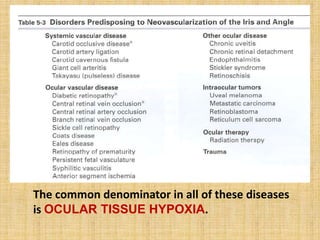
The common denominator in all of these diseases
is OCULAR TISSUE HYPOXIA.
Diabetic Retinopathy
• Approximately one third of patients with
rubeosis iridis have diabetic retinopathy
• Neovascular glaucoma is usually seen in eyes
with proliferative diabetic retinopathy, but
it can be seen in eyes with nonproliferative
retinopathy if there are large areas of
capillary nonperfusion
• Lens and vitreous may act as mechanical
barriers to the forward movement of
angiogenic factors elaborated by the retina.
The vitreous may also serve as an
endogenous inhibitor of angiogenic stimuli.
. After pars plana vitrectomy for diabetic
retinopathy, the reported incidence of NVI
ranges from 25% to 42%, whereas that for
NVG ranges from 10% to 23% , with most of
these cases developing during the first 6
months after surgery
In these cases, NVI and NVG occur more
often in aphakic eyes
Postoperative neovascular glaucoma is also
more common when rubeosis iridis is present
before vitrectomy
• An unrepaired retinal detachment after
vitrectomy for diabetic retinopathy is also a
risk factor for postoperative rubeosis iridis.
The acute onset or exacerbation of rubeosis
iridis after diabetic vitrectomy can indicate
the presence of a peripheral traction retinal
detachment .
• A completely attached retina and
aggressive anterior or peripheral
photocoagulation therapy are the most
important factors in controlling or preventing
neovascular glaucoma after vitrectomy for
proliferative diabetic retinopathy
• Intraocular silicone oil also reduces the
incidence of anterior segment
neovascularization, possibly by acting as a
diffusion or convection barrier to the
posterior movement of oxygen from the
anterior chamber or the anterior movement
of an angiogenesis factor
Intracapsular cataract surgery alone in eyes
with diabetic retinopathy has been
associated with an increased incidence of
postoperative NVI and NVG
• The incidence is similar with extracapsular
extraction and a primary capsulotomy.
• Leaving the posterior capsule intact
appears to reduce the likelihood of this
complication, although a subsequent laser
capsulotomy in patients with diabetes may
lead to NVG
Retinal Vascular Occlusive
Disorders
• Central retinal vein occlusion accounted for 1/3 of
all cases of NVI in one series
• Approximately 50% of eyes develop NVG
following ischaemic central retinal vein occlusion.
• Extensive peripheral retinal capillary non-
perfusion on fluorescein angiography is the most
valuable predictor of the risk of subsequent NVG
• Glaucoma typically occurs 3 months after the
occlusion (‘100-day glaucoma’) but intervals from
4 weeks to 2 years have been documented
• Older patients with central retinal vein
occlusions often have associated
glaucoma or elevated IOP.
• The presence of pre-existing POAG increases
the risk of NVG after central retinal vein
occlusion
• Adequate treatment of the pre-existing
glaucoma does not prevent the onset of
neovascularization.
• Furthermore, pre-existing open-angle
glaucoma may make any subsequent
neovascular glaucoma more refractory to
treatment.
• Eyes with ischemic central retinal vein
occlusions should receive panretinal
photocoagulation (or cryoablation if no laser
is available) to reduce the incidence of
neovascular glaucoma.
• Careful follow-up is mandated even in those
with the non-ischemic type because of the
observation that one-third of eyes with
central retinal vein occlusion and good
perfusion at the onset show signs of ischemia
by 3 years
Extraocular Vascular Disorders
• Carotid artery obstructive disease is probably
the third most common cause of neovascular
glaucoma, accounting for 13% of all cases
• Carotid artery obstruction does not cause
neovascular glaucoma in all cases because
there is usually sufficient collateral flow to
prevent widespread retinal ischemia.
• Neovascular glaucoma associated with carotid
artery disease often has a confusing presentation
and a variable course.
• If anterior segment ischemia is severe, the
vessels on the iris may be less visible, and the IOP
may be normal or even low despite extensive
neovascular closure of the angle.
• These eyes often suffer wide swings in IOP,
depending on the perfusion to the ciliary body.
• Patients who undergo surgery to relieve or bypass
carotid artery obstruction may experience a
dramatic rise in IOP when the ciliary body blood
supply improves and aqueous humor formation
increases.
• Panretinal photocoagulation may be less
successful in eliminating iris
neovascularization in patients with carotid
artery obstruction because the anterior
segment of these eyes is also ischemic and is
not affected by retinal ablation techniques
THEORIES OF
NEOVASCULOGENESIS
• RETINAL HYPOXIA
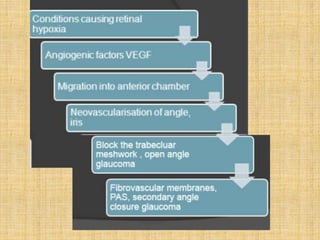
• The pathogenesis of neovascular glaucoma is
that retinal ischemia liberates angiogenic
factors that diffuse forward and induce new
vessel formation on the iris and in the angle
• Inflammation and hypoxia often coexist in the
microenvironment leading to new vessel
formation.
• Inflammatory mediators are now known to play
a role in new vessel formation and remodeling,
along with their role in inflammation
ANGIOGENESIS FACTORS
• Human retinas and other vascular ocular tissues
have angiogenic activity related to a key
angiogenic peptide, vascular endothelial growth
factor (VEGF)
• Several cell types in the retina synthesize VEGF,
but under conditions of retinal ischemia, Müller
cells appear to be the primary source.
• Four VEGF isoforms (VEGF121, VEGF165, VEGF189,
and VEGF206) have been identified, which are
generated by alternative mRNA splicing from the
same gene
• VEGF165 is the most abundant form in the
majority of tissues.
• VEGF is a potent angiogenic stimulator,
promoting several steps of angiogenesis,
including proliferation, migration, proteolytic
activity, and capillary tube formation, thus
playing a crucial role in both normal and
pathologic angiogenesis.
• It is also known as a vascular permeability factor
on the basis of its ability to induce vascular
hyperpermeability and endothelial cell
proliferation as well as migration
• Vasoproliferative factors have been detected
in increased amounts in the eyes of both
animal models and patients with neovascular
glaucoma.
• It is found in concentrations 40–100 times
normal in the aqueous humor of patients
with neovascular glaucoma
• And most recently is the impressive
regression of new vessels induced by
molecular-specific antiangiogenic factors,
such as bevacizumab.
VASOINHIBITORY FACTORS
• It has been postulated that ocular tissues
may produce substances that inhibit
neovascularization.
• The vitreous and lens are possible sources of
these vasoinhibitory factors which could
explain why vitrectomy or lensectomy
increases the risk for rubeosis iridis in eyes
with diabetic retinopathy.
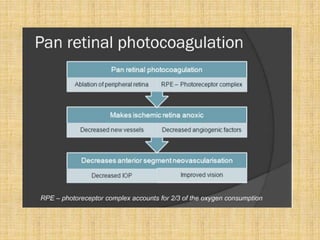
• Retinal pigment epithelial cells release an
inhibitor of neovascularization
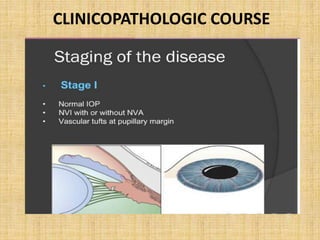
CLINICOPATHOLOGIC COURSE
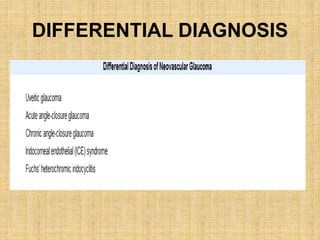
DIFFERENTIAL DIAGNOSIS
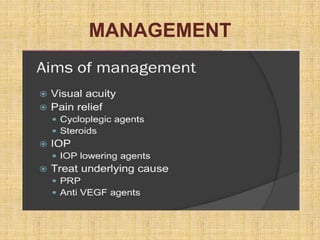
MANAGEMENT
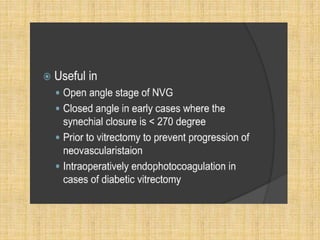
SURGICAL MANAGEMENT
Neovascular glaucoma

Neovascular glaucoma

  • 1.
  • 2.
    TERMINOLOGY • In 1906,Coats described new vessel formation on the iris in eyes with central retinal vein occlusion • This neovascularization of the iris is commonly known as Rubeosis iridis
  • 3.
    • Rubeosis iridisis frequently associated with a severe form of glaucoma, which has been given different names on the basis of various clinical features: • Hemorrhagic glaucoma, referring to the hyphema that is present in some cases • Congestive glaucoma, describing the frequently acute nature of the condition and • Thrombotic glaucoma, implying an underlying vascular thrombotic cause.
  • 4.
    • However theterm rubeotic glaucoma or neovascular glaucoma, was proposed by Weiss and colleagues is the term found most often in the current literature • Neovascular glaucoma is an important entity because it often causes great morbidity and visual loss.
  • 5.
    FACTORS PREDISPOSING TO RUBEOSISIRIDIS • Diabetic retinopathy and central retinal vein occlusion (CRVO) are the primary pathologic processes involved in the development of ocular neovascularization . • 36% of all cases of NVG arise from CRVO, 32% from proliferative diabetic retinopathy, and 13% from carotid artery occlusive disease
  • 6.
    The common denominatorin all of these diseases is OCULAR TISSUE HYPOXIA.
  • 7.
    Diabetic Retinopathy • Approximatelyone third of patients with rubeosis iridis have diabetic retinopathy • Neovascular glaucoma is usually seen in eyes with proliferative diabetic retinopathy, but it can be seen in eyes with nonproliferative retinopathy if there are large areas of capillary nonperfusion • Lens and vitreous may act as mechanical barriers to the forward movement of angiogenic factors elaborated by the retina. The vitreous may also serve as an endogenous inhibitor of angiogenic stimuli.
  • 8.
    . After parsplana vitrectomy for diabetic retinopathy, the reported incidence of NVI ranges from 25% to 42%, whereas that for NVG ranges from 10% to 23% , with most of these cases developing during the first 6 months after surgery In these cases, NVI and NVG occur more often in aphakic eyes Postoperative neovascular glaucoma is also more common when rubeosis iridis is present before vitrectomy
  • 9.
    • An unrepairedretinal detachment after vitrectomy for diabetic retinopathy is also a risk factor for postoperative rubeosis iridis. The acute onset or exacerbation of rubeosis iridis after diabetic vitrectomy can indicate the presence of a peripheral traction retinal detachment . • A completely attached retina and aggressive anterior or peripheral photocoagulation therapy are the most important factors in controlling or preventing neovascular glaucoma after vitrectomy for proliferative diabetic retinopathy
  • 10.
    • Intraocular siliconeoil also reduces the incidence of anterior segment neovascularization, possibly by acting as a diffusion or convection barrier to the posterior movement of oxygen from the anterior chamber or the anterior movement of an angiogenesis factor
  • 11.
    Intracapsular cataract surgeryalone in eyes with diabetic retinopathy has been associated with an increased incidence of postoperative NVI and NVG • The incidence is similar with extracapsular extraction and a primary capsulotomy. • Leaving the posterior capsule intact appears to reduce the likelihood of this complication, although a subsequent laser capsulotomy in patients with diabetes may lead to NVG
  • 12.
    Retinal Vascular Occlusive Disorders •Central retinal vein occlusion accounted for 1/3 of all cases of NVI in one series • Approximately 50% of eyes develop NVG following ischaemic central retinal vein occlusion. • Extensive peripheral retinal capillary non- perfusion on fluorescein angiography is the most valuable predictor of the risk of subsequent NVG • Glaucoma typically occurs 3 months after the occlusion (‘100-day glaucoma’) but intervals from 4 weeks to 2 years have been documented
  • 13.
    • Older patientswith central retinal vein occlusions often have associated glaucoma or elevated IOP. • The presence of pre-existing POAG increases the risk of NVG after central retinal vein occlusion • Adequate treatment of the pre-existing glaucoma does not prevent the onset of neovascularization. • Furthermore, pre-existing open-angle glaucoma may make any subsequent neovascular glaucoma more refractory to treatment.
  • 14.
    • Eyes withischemic central retinal vein occlusions should receive panretinal photocoagulation (or cryoablation if no laser is available) to reduce the incidence of neovascular glaucoma. • Careful follow-up is mandated even in those with the non-ischemic type because of the observation that one-third of eyes with central retinal vein occlusion and good perfusion at the onset show signs of ischemia by 3 years
  • 15.
    Extraocular Vascular Disorders •Carotid artery obstructive disease is probably the third most common cause of neovascular glaucoma, accounting for 13% of all cases • Carotid artery obstruction does not cause neovascular glaucoma in all cases because there is usually sufficient collateral flow to prevent widespread retinal ischemia.
  • 16.
    • Neovascular glaucomaassociated with carotid artery disease often has a confusing presentation and a variable course. • If anterior segment ischemia is severe, the vessels on the iris may be less visible, and the IOP may be normal or even low despite extensive neovascular closure of the angle. • These eyes often suffer wide swings in IOP, depending on the perfusion to the ciliary body. • Patients who undergo surgery to relieve or bypass carotid artery obstruction may experience a dramatic rise in IOP when the ciliary body blood supply improves and aqueous humor formation increases.
  • 17.
    • Panretinal photocoagulationmay be less successful in eliminating iris neovascularization in patients with carotid artery obstruction because the anterior segment of these eyes is also ischemic and is not affected by retinal ablation techniques
  • 18.
    THEORIES OF NEOVASCULOGENESIS • RETINALHYPOXIA • The pathogenesis of neovascular glaucoma is that retinal ischemia liberates angiogenic factors that diffuse forward and induce new vessel formation on the iris and in the angle • Inflammation and hypoxia often coexist in the microenvironment leading to new vessel formation. • Inflammatory mediators are now known to play a role in new vessel formation and remodeling, along with their role in inflammation
  • 19.
    ANGIOGENESIS FACTORS • Humanretinas and other vascular ocular tissues have angiogenic activity related to a key angiogenic peptide, vascular endothelial growth factor (VEGF) • Several cell types in the retina synthesize VEGF, but under conditions of retinal ischemia, Müller cells appear to be the primary source. • Four VEGF isoforms (VEGF121, VEGF165, VEGF189, and VEGF206) have been identified, which are generated by alternative mRNA splicing from the same gene • VEGF165 is the most abundant form in the majority of tissues.
  • 20.
    • VEGF isa potent angiogenic stimulator, promoting several steps of angiogenesis, including proliferation, migration, proteolytic activity, and capillary tube formation, thus playing a crucial role in both normal and pathologic angiogenesis. • It is also known as a vascular permeability factor on the basis of its ability to induce vascular hyperpermeability and endothelial cell proliferation as well as migration
  • 21.
    • Vasoproliferative factorshave been detected in increased amounts in the eyes of both animal models and patients with neovascular glaucoma. • It is found in concentrations 40–100 times normal in the aqueous humor of patients with neovascular glaucoma • And most recently is the impressive regression of new vessels induced by molecular-specific antiangiogenic factors, such as bevacizumab.
  • 22.
    VASOINHIBITORY FACTORS • Ithas been postulated that ocular tissues may produce substances that inhibit neovascularization. • The vitreous and lens are possible sources of these vasoinhibitory factors which could explain why vitrectomy or lensectomy increases the risk for rubeosis iridis in eyes with diabetic retinopathy. • Retinal pigment epithelial cells release an inhibitor of neovascularization
  • 24.
  • 29.
  • 31.
  • 39.