

CONGENITAL GLAUCOMA
DR SIVATEJA CHALLA
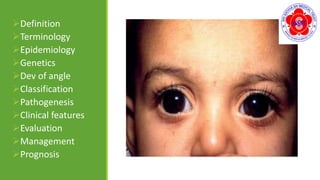
Definition
Terminology
Epidemiology
Genetics
Dev of angle
Classification
Pathogenesis
Clinical features
Evaluation
Management
Prognosis
DEFINITION
Glaucoma associated with developmental anomalies of eye present
at birth
Includes
1. Isolated congenital glaucoma
2. Glaucoma's asso with development anomalies either systemic or ocular
WHAT TO LABEL???
A. Isolated congenital glaucoma
B. Infantile glaucoma
C. Juvenile glaucoma
Isolated congenital glaucoma
1. Isolated mal development of the trabecular meshwork
2. No other developmental ocular anomalies or ocular diseases that can raise IOP.
3. Recognized with in first month
Infantile glaucoma
1. Synonymous with congenital glaucoma.
2. 1 month to 3 years
Juvenile glaucoma
1. Primary glaucoma occurring later in child hood or early adulthood
2. 3 years to 35 years
Three years of age is generally taken as the division between infantile and
juvenile glaucoma.
After this age the eye no longer expands in response to raised intraocular
pressure.
 Juvenile glaucoma doesn’t have corneal enlargement or Haab striae
EPIDEMIOLOGY
1. 1 in 10000 births
2. 50% isolated congenital
3. 60% diagnosed by 6 months and 80% by 1 year
4. 65% affected are males
5. 70% bilateral involvement
GENETICS
ISOLATED CONGENITAL GLAUCOMAS
1. Most are sporadic
2. 10% familial, usually AR pattern with incomplete or variable penetrance
3. Genes  CYP1B1, LTBP2
JUVENILE OPEN-ANGLE GLAUCOMA
1. Autosomal dominant inheritance
2. Genes TIGR and MYOC
DEVELOPMENT OF ANGLE
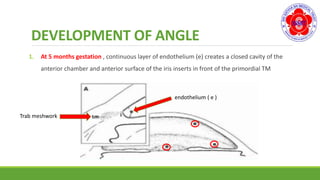
1. At 5 months gestation , continuous layer of endothelium (e) creates a closed cavity of the
anterior chamber and anterior surface of the iris inserts in front of the primordial TM
endothelium ( e )
Trab meshwork
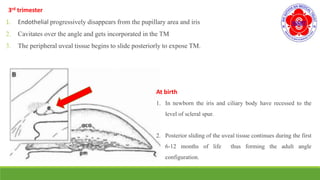
3rd trimester
1. Endothelial progressively disappears from the pupillary area and iris
2. Cavitates over the angle and gets incorporated in the TM
3. The peripheral uveal tissue begins to slide posteriorly to expose TM.
At birth
1. In newborn the iris and ciliary body have recessed to the
level of scleral spur.
2. Posterior sliding of the uveal tissue continues during the first
6-12 months of life thus forming the adult angle
configuration.
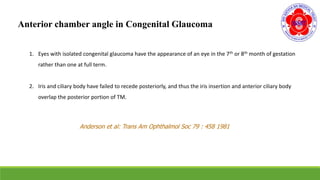
Anterior chamber angle in Congenital Glaucoma
1. Eyes with isolated congenital glaucoma have the appearance of an eye in the 7th or 8th month of gestation
rather than one at full term.
2. Iris and ciliary body have failed to recede posteriorly, and thus the iris insertion and anterior ciliary body
overlap the posterior portion of TM.
Anderson et al: Trans Am Ophthalmol Soc 79 : 458 1981
CLASSIFICATION
1. Shaffer-Weiss classification of congenital glaucoma.
2. Hoskins’s anatomic classification of Developmental glaucoma.
a) clinically identifiable anatomic defects of the eye were chosen as the basis.
b) identification of the anatomic defect helps in determining appropriate therapy and assessing
prognostic factors.
Shaffer-Weiss classification
1.Isolated congenital glaucoma (infantile glaucoma) 2.Glaucomas associated with congenital anomalies
1. Aniridia
2. Sturge-Weber syndrome
3. Neurofibromatosis
4. Marfan syndrome
5. Pierre Robin syndrome
6. Homocystinuria
7. Goniodysgenesis
8. Lowe’s syndrome
9. Microcornea
10. Microspherophakia , PHPV
3.Acquired glaucomas in infants
1. Retrolental fibroplasia
2. Tumors- retinoblastoma, juvenile xanthogranuloma
3. Inflammation
4. Trauma
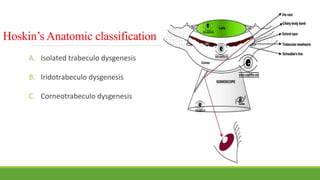
Hoskin’s Anatomic classification
A. Isolated trabeculo dysgenesis
B. Iridotrabeculo dysgenesis
C. Corneotrabeculo dysgenesis
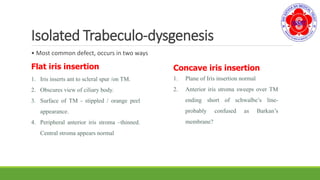
Isolated Trabeculo-dysgenesis
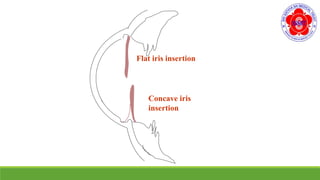
• Most common defect, occurs in two ways
Concave iris insertion
1. Plane of Iris insertion normal
2. Anterior iris stroma sweeps over TM
ending short of schwalbe’s line-
probably confused as Barkan’s
membrane?
Flat iris insertion
1. Iris inserts ant to scleral spur /on TM.
2. Obscures view of ciliary body.
3. Surface of TM - stippled / orange peel
appearance.
4. Peripheral anterior iris stroma –thinned.
Central stroma appears normal
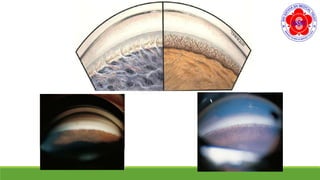
Flat iris insertion
Concave iris
insertion
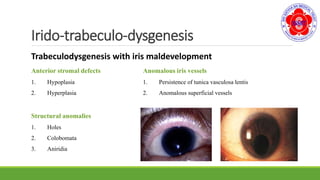
Irido-trabeculo-dysgenesis
Trabeculodysgenesis with iris maldevelopment
Anterior stromal defects
1. Hypoplasia
2. Hyperplasia
Anomalous iris vessels
1. Persistence of tunica vasculosa lentis
2. Anomalous superficial vessels
Structural anomalies
1. Holes
2. Colobomata
3. Aniridia
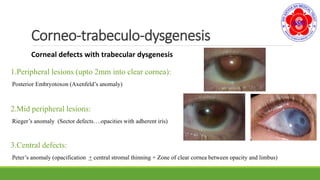
Corneo-trabeculo-dysgenesis
Corneal defects with trabecular dysgenesis
1.Peripheral lesions (upto 2mm into clear cornea):
Posterior Embryotoxon (Axenfeld’s anomaly)
2.Mid peripheral lesions:
Rieger’s anomaly (Sector defects….opacities with adherent iris)
3.Central defects:
Peter’s anomaly (opacification + central stromal thinning + Zone of clear cornea between opacity and limbus)
PATHOGENESIS
Barkan (1955)  imperforate membrane, barkan's membrane
 no such membrane on histology or electron microscopy
Allen & colleugues  faulty cleavage of mesodermal tissue.
Maumeene theory  abnormal iris insertion causes obstruction
Andersons theory  excessive collagen matrix deposition in T.M,
 prevents CB & IRIS to sliding back
Kaiser theory  faulty migration or differentiation of neural crest cells
CLINICAL FEATURES
Classic Triad ……symptoms
1. Epiphora
2. Photophobia
3. Blepharospasm
Other symptoms are
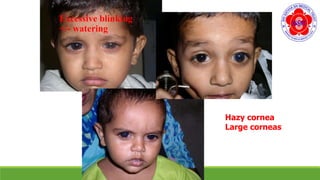
cloudy cornea , red eye, enlarged cornea or eye , irritability , poor vision and pain
In older children, astigmatism, progressive axial myopia cause symptomatic decreased VA and
refractive amblyopia.
Excessive blinking
+/- watering
Hazy cornea
Large corneas
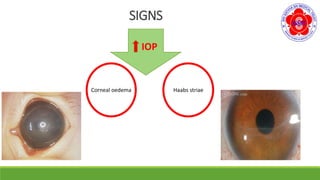
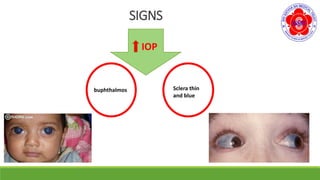
SIGNS
IOP
Corneal oedema Haabs striae
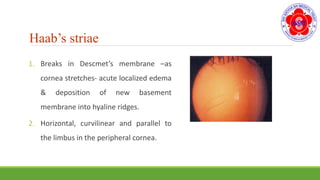
1. Breaks in Descmet’s membrane –as
cornea stretches- acute localized edema
& deposition of new basement
membrane into hyaline ridges.
2. Horizontal, curvilinear and parallel to
the limbus in the peripheral cornea.
Haab’s striae
SIGNS
IOP
buphthalmos Sclera thin
and blue
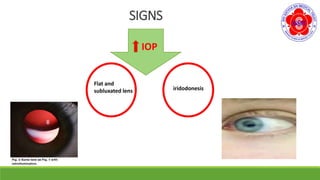
SIGNS
IOP
Flat and
subluxated lens iridodonesis
1. Anterior chamber becomes deep
2. Optic nerve cupping
◦ Develop early and rapidly
◦ Reversal of cupping with IOP reduction
EVALUATION
Examination in clinic
Observe
1. Cornea Size and Clarity
2. degree of tearing/photophobia
3. Any discharge /swelling –sac area
4. Iris/pupil Hypoplasia/corectopia and Aniridia
EVALUATION UNDER GA
1. Tonometry ( After Induction And Before Intubation )
2. External Examination
3. Anterior Segment Examination
4. Corneal Diameter Measurement
5. Gonioscopy
6. Fundus Examination
7. CCT
8. Ultrasound (Axial Length Measurement / B Scan )
9. Optic Nerve Photography
10. Refraction
TONOMETRY
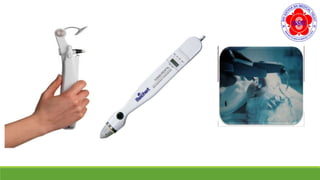
1. IOP should be measured using Perkin’s hand-held applanation tonometer or
tonopen
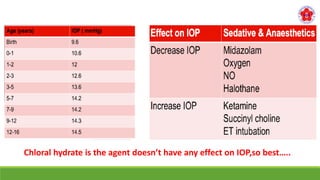
2. Most anesthetic agents reduce IOP
3. Should be measured early during earliest possible moments after anesthesia
induction, before intubation.
4. Asymmetric IOP more suggestive of abnormality than B/L borderline IOP
Chloral hydrate is the agent doesn’t have any effect on IOP,so best…..
EXTERNAL EXAMINATION
1. Exclude other causes of epiphora, photophobia and blepharospasm
2. Most common cause of epiphora in newborn and infant – congenital NLDO
3. Others ; conjucntivitis (infectious, chemical)
corneal epithelial defect/ abrasion
keratitis
inflammed ant segmant (uveitis, trauma)
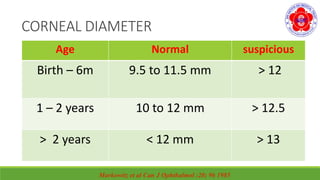
CORNEAL DIAMETER
Age Normal suspicious
Birth – 6m 9.5 to 11.5 mm > 12
1 – 2 years 10 to 12 mm > 12.5
> 2 years < 12 mm > 13
Markowitz et al Can J Ophthalmol :20; 96 1985
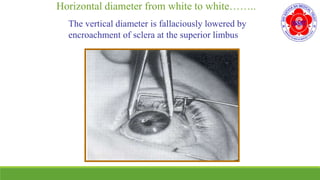
Horizontal diameter from white to white……..
The vertical diameter is fallaciously lowered by
encroachment of sclera at the superior limbus
Also Document
Corneal edema/ clouding, breaks in Descemet’s membrane (Haab’s striae)
Other causes of corneal clouding
Sclerocornea
Tears in D membrane
Ulcers
Metabolic disease
Peters anomaly
Endothelial dystrophies
Dystrophy e.g congenital hereditary stromal dystrophy
GONIOSCOPY
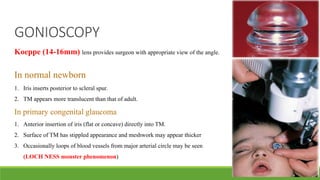
Koeppe (14-16mm) lens provides surgeon with appropriate view of the angle.
In normal newborn
1. Iris inserts posterior to scleral spur.
2. TM appears more translucent than that of adult.
In primary congenital glaucoma
1. Anterior insertion of iris (flat or concave) directly into TM.
2. Surface of TM has stippled appearance and meshwork may appear thicker
3. Occasionally loops of blood vessels from major arterial circle may be seen
(LOCH NESS monster phenomenon)
FUNDOSCOPY
1. C:D ratio >0.3 and asymmetry are suggestive evidence of glaucoma.
2. The infant glaucomatous cup is more often round , steep walled central &
surrounded by uniform pink NRR. Tends to enlarge circumferentially with
progression of glaucoma.
3. Cupping is reversible
MANAGEMENT
I. Parent counselling.
II. A complete general physical examination by a pediatrician
III. Treatment
Parent counselling
1. What is glaucoma ?
2. Need for surgery , multiple surgery.
3. Need for life time follow up
4. Combination of problems
◦ IOP
◦ Amblyopia management
◦ Refractive correction
◦ Keratoplasty
5. Counsel regarding choice of profession
Treatment
MEDICAL
Congenital glaucoma is a surgical disease.
Indications
1. reduce IOP temporarily
2. clear cornea to facilitate goniotomy
3. achieve post op IOP control till aquequacy of surgical procedure
4. Cases where surgery poses high risk
DRUGS
 Topical beta blockers 1st line
S/E bronchospasm, bradycardia, hypotension
 2nd line are topical CAI
 Others  Miotics, PGA, Alpha agonists
 The a2-adrenergic agonist brimonidine crosses the blood-brain barrier
and therefore has significant effects on the central nervous system
apnea, hypotension, bradycardia, hypotonia, hypothermia, and somnolence
 C/I in children younger than 3 years.
SURGICAL
Multiple surgical interventions are often required.
Goal of surgery
◦ Normalize and permanently control IOP off drugs
◦ Clear the cornea
◦ Prevent progression of disc cupping &corneal diameters
◦ Preserve visual field and ocular integrity
◦ To stimulate development of binocular stereoscopic vision
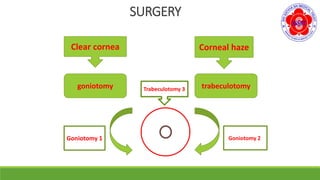
Surgical options
I. Goniotomy
II. Trabeculotomy
III. Trabeculectomy + antimetabolites
IV. Trabeculotomy with trabeculectomy
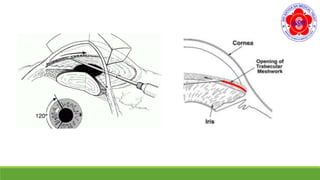
Goniotomy
Clear cornea is prerequisite.
Preoperative gonioscopic evaluation is essential.
Success rate 80 – 90% if performed in 1-12 months age
Requisites  barkans lens and knife
Procedure  involves entering the AC with sharp goniotomy knife and making an opening
incision through the abnormally developed TM
 120 DEGRESS can be treated in single sitting
Post op  antibiotics, miotics
ADVANTAGES
1. Direct visualisations allows prescice
location
2. Less traumatic
3. Safe
4. Rapid
5. Can be repeated
6. Doesn’t injure conjunctiva
7. No bleb related complications
DISADVANTAGES
1. Lens have to be used to visualise angle
2. Not possible in cloudy corneas
3. Require surgical experience
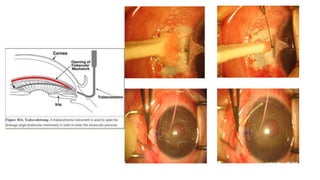
Trabeculotomy
Indications
 Cloudy cornea
 After 2 goniotomies
 Can be combined with trabeculectomy
Success 73-100%
Procedure
 External incision
 Identify schemms canal
 Break through TM to increase aqueous flow, 120-140 degrees can be done
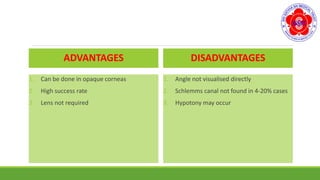
ADVANTAGES
1. Can be done in opaque corneas
2. High success rate
3. Lens not required
DISADVANTAGES
1. Angle not visualised directly
2. Schlemms canal not found in 4-20% cases
3. Hypotony may occur
Trabeculectomy
1. Lower success rates as compared to adults
2. Problems in children with PCG.
◦ Stretched and thinned out limbus.
◦ Distorted anatomy.
◦ A thick and active tenon capsule.
◦ Exuberant scar tissue due to rapid wound healing.
◦ Large buphthalmic eye with thin sclera and low scleral rigidity.
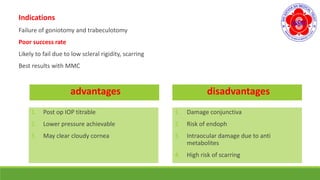
Indications
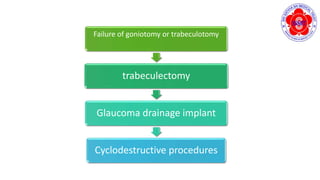
Failure of goniotomy and trabeculotomy
Poor success rate
Likely to fail due to low scleral rigidity, scarring
Best results with MMC
advantages
1. Post op IOP titrable
2. Lower pressure achievable
3. May clear cloudy cornea
disadvantages
1. Damage conjunctiva
2. Risk of endoph
3. Intraocular damage due to anti
metabolites
4. High risk of scarring
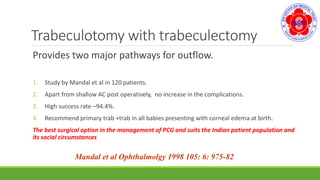
Trabeculotomy with trabeculectomy
Provides two major pathways for outflow.
1. Study by Mandal et al in 120 patients.
2. Apart from shallow AC post operatively, no increase in the complications.
3. High success rate –94.4%.
4. Recommend primary trab +trab in all babies presenting with corneal edema at birth.
The best surgical option in the management of PCG and suits the Indian patient population and
its social circumstances
Mandal et al Ophthalmolgy 1998 105: 6: 975-82
SURGERY
Clear cornea Corneal haze
goniotomy trabeculotomy
Goniotomy 1 Goniotomy 2
Trabeculotomy 3
Failure of goniotomy or trabeculotomy
trabeculectomy
Glaucoma drainage implant
Cyclodestructive procedures
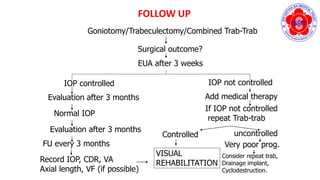
Goniotomy/Trabeculectomy/Combined Trab-Trab
Surgical outcome?
EUA after 3 weeks
IOP controlled
Evaluation after 3 months
Normal IOP
Evaluation after 3 months
FU every 3 months
Record IOP, CDR, VA
Axial length, VF (if possible)
IOP not controlled
Add medical therapy
If IOP not controlled
repeat Trab-trab
Controlled
VISUAL
REHABILITATION
uncontrolled
Very poor prog.
Consider repeat trab,
Drainage implant,
Cyclodestruction.
FOLLOW UP
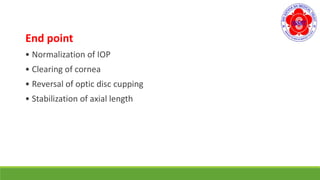
End point
• Normalization of IOP
• Clearing of cornea
• Reversal of optic disc cupping
• Stabilization of axial length
PROGNOSIS
Best results with isolated trabeculodysgenesis
Best when onset is between 1st and 24th month of life
CONCLUSIONS
Early diagnosis and prompt treatment can preserve vision
Responsibility of surgeon does not stop with the surgery.
Visual rehabilitation is equally important as IOP control.
An attempt should be made to familiarize the parents with the protracted course of
the illness.
THANK YOU

Congenital glaucomas

  • 1.
  • 2.
  • 3.
    DEFINITION Glaucoma associated withdevelopmental anomalies of eye present at birth Includes 1. Isolated congenital glaucoma 2. Glaucoma's asso with development anomalies either systemic or ocular
  • 4.
    WHAT TO LABEL??? A.Isolated congenital glaucoma B. Infantile glaucoma C. Juvenile glaucoma
  • 5.
    Isolated congenital glaucoma 1.Isolated mal development of the trabecular meshwork 2. No other developmental ocular anomalies or ocular diseases that can raise IOP. 3. Recognized with in first month Infantile glaucoma 1. Synonymous with congenital glaucoma. 2. 1 month to 3 years Juvenile glaucoma 1. Primary glaucoma occurring later in child hood or early adulthood 2. 3 years to 35 years
  • 6.
    Three years ofage is generally taken as the division between infantile and juvenile glaucoma. After this age the eye no longer expands in response to raised intraocular pressure.  Juvenile glaucoma doesn’t have corneal enlargement or Haab striae
  • 7.
    EPIDEMIOLOGY 1. 1 in10000 births 2. 50% isolated congenital 3. 60% diagnosed by 6 months and 80% by 1 year 4. 65% affected are males 5. 70% bilateral involvement
  • 8.
    GENETICS ISOLATED CONGENITAL GLAUCOMAS 1.Most are sporadic 2. 10% familial, usually AR pattern with incomplete or variable penetrance 3. Genes  CYP1B1, LTBP2 JUVENILE OPEN-ANGLE GLAUCOMA 1. Autosomal dominant inheritance 2. Genes TIGR and MYOC
  • 9.
    DEVELOPMENT OF ANGLE 1.At 5 months gestation , continuous layer of endothelium (e) creates a closed cavity of the anterior chamber and anterior surface of the iris inserts in front of the primordial TM endothelium ( e ) Trab meshwork
  • 10.
    3rd trimester 1. Endothelialprogressively disappears from the pupillary area and iris 2. Cavitates over the angle and gets incorporated in the TM 3. The peripheral uveal tissue begins to slide posteriorly to expose TM. At birth 1. In newborn the iris and ciliary body have recessed to the level of scleral spur. 2. Posterior sliding of the uveal tissue continues during the first 6-12 months of life thus forming the adult angle configuration.
  • 11.
    Anterior chamber anglein Congenital Glaucoma 1. Eyes with isolated congenital glaucoma have the appearance of an eye in the 7th or 8th month of gestation rather than one at full term. 2. Iris and ciliary body have failed to recede posteriorly, and thus the iris insertion and anterior ciliary body overlap the posterior portion of TM. Anderson et al: Trans Am Ophthalmol Soc 79 : 458 1981
  • 12.
    CLASSIFICATION 1. Shaffer-Weiss classificationof congenital glaucoma. 2. Hoskins’s anatomic classification of Developmental glaucoma. a) clinically identifiable anatomic defects of the eye were chosen as the basis. b) identification of the anatomic defect helps in determining appropriate therapy and assessing prognostic factors.
  • 13.
    Shaffer-Weiss classification 1.Isolated congenitalglaucoma (infantile glaucoma) 2.Glaucomas associated with congenital anomalies 1. Aniridia 2. Sturge-Weber syndrome 3. Neurofibromatosis 4. Marfan syndrome 5. Pierre Robin syndrome 6. Homocystinuria 7. Goniodysgenesis 8. Lowe’s syndrome 9. Microcornea 10. Microspherophakia , PHPV 3.Acquired glaucomas in infants 1. Retrolental fibroplasia 2. Tumors- retinoblastoma, juvenile xanthogranuloma 3. Inflammation 4. Trauma
  • 14.
    Hoskin’s Anatomic classification A.Isolated trabeculo dysgenesis B. Iridotrabeculo dysgenesis C. Corneotrabeculo dysgenesis
  • 15.
    Isolated Trabeculo-dysgenesis • Mostcommon defect, occurs in two ways Concave iris insertion 1. Plane of Iris insertion normal 2. Anterior iris stroma sweeps over TM ending short of schwalbe’s line- probably confused as Barkan’s membrane? Flat iris insertion 1. Iris inserts ant to scleral spur /on TM. 2. Obscures view of ciliary body. 3. Surface of TM - stippled / orange peel appearance. 4. Peripheral anterior iris stroma –thinned. Central stroma appears normal
  • 17.
  • 18.
    Irido-trabeculo-dysgenesis Trabeculodysgenesis with irismaldevelopment Anterior stromal defects 1. Hypoplasia 2. Hyperplasia Anomalous iris vessels 1. Persistence of tunica vasculosa lentis 2. Anomalous superficial vessels Structural anomalies 1. Holes 2. Colobomata 3. Aniridia
  • 19.
    Corneo-trabeculo-dysgenesis Corneal defects withtrabecular dysgenesis 1.Peripheral lesions (upto 2mm into clear cornea): Posterior Embryotoxon (Axenfeld’s anomaly) 2.Mid peripheral lesions: Rieger’s anomaly (Sector defects….opacities with adherent iris) 3.Central defects: Peter’s anomaly (opacification + central stromal thinning + Zone of clear cornea between opacity and limbus)
  • 20.
    PATHOGENESIS Barkan (1955) imperforate membrane, barkan's membrane  no such membrane on histology or electron microscopy Allen & colleugues  faulty cleavage of mesodermal tissue. Maumeene theory  abnormal iris insertion causes obstruction Andersons theory  excessive collagen matrix deposition in T.M,  prevents CB & IRIS to sliding back Kaiser theory  faulty migration or differentiation of neural crest cells
  • 21.
    CLINICAL FEATURES Classic Triad……symptoms 1. Epiphora 2. Photophobia 3. Blepharospasm Other symptoms are cloudy cornea , red eye, enlarged cornea or eye , irritability , poor vision and pain In older children, astigmatism, progressive axial myopia cause symptomatic decreased VA and refractive amblyopia.
  • 22.
  • 23.
  • 24.
    1. Breaks inDescmet’s membrane –as cornea stretches- acute localized edema & deposition of new basement membrane into hyaline ridges. 2. Horizontal, curvilinear and parallel to the limbus in the peripheral cornea. Haab’s striae
  • 25.
  • 26.
  • 27.
    1. Anterior chamberbecomes deep 2. Optic nerve cupping ◦ Develop early and rapidly ◦ Reversal of cupping with IOP reduction
  • 28.
    EVALUATION Examination in clinic Observe 1.Cornea Size and Clarity 2. degree of tearing/photophobia 3. Any discharge /swelling –sac area 4. Iris/pupil Hypoplasia/corectopia and Aniridia
  • 29.
    EVALUATION UNDER GA 1.Tonometry ( After Induction And Before Intubation ) 2. External Examination 3. Anterior Segment Examination 4. Corneal Diameter Measurement 5. Gonioscopy 6. Fundus Examination 7. CCT 8. Ultrasound (Axial Length Measurement / B Scan ) 9. Optic Nerve Photography 10. Refraction
  • 30.
    TONOMETRY 1. IOP shouldbe measured using Perkin’s hand-held applanation tonometer or tonopen 2. Most anesthetic agents reduce IOP 3. Should be measured early during earliest possible moments after anesthesia induction, before intubation. 4. Asymmetric IOP more suggestive of abnormality than B/L borderline IOP
  • 32.
    Chloral hydrate isthe agent doesn’t have any effect on IOP,so best…..
  • 33.
    EXTERNAL EXAMINATION 1. Excludeother causes of epiphora, photophobia and blepharospasm 2. Most common cause of epiphora in newborn and infant – congenital NLDO 3. Others ; conjucntivitis (infectious, chemical) corneal epithelial defect/ abrasion keratitis inflammed ant segmant (uveitis, trauma)
  • 34.
    CORNEAL DIAMETER Age Normalsuspicious Birth – 6m 9.5 to 11.5 mm > 12 1 – 2 years 10 to 12 mm > 12.5 > 2 years < 12 mm > 13 Markowitz et al Can J Ophthalmol :20; 96 1985
  • 35.
    Horizontal diameter fromwhite to white…….. The vertical diameter is fallaciously lowered by encroachment of sclera at the superior limbus
  • 36.
    Also Document Corneal edema/clouding, breaks in Descemet’s membrane (Haab’s striae) Other causes of corneal clouding Sclerocornea Tears in D membrane Ulcers Metabolic disease Peters anomaly Endothelial dystrophies Dystrophy e.g congenital hereditary stromal dystrophy
  • 37.
    GONIOSCOPY Koeppe (14-16mm) lensprovides surgeon with appropriate view of the angle. In normal newborn 1. Iris inserts posterior to scleral spur. 2. TM appears more translucent than that of adult. In primary congenital glaucoma 1. Anterior insertion of iris (flat or concave) directly into TM. 2. Surface of TM has stippled appearance and meshwork may appear thicker 3. Occasionally loops of blood vessels from major arterial circle may be seen (LOCH NESS monster phenomenon)
  • 38.
    FUNDOSCOPY 1. C:D ratio>0.3 and asymmetry are suggestive evidence of glaucoma. 2. The infant glaucomatous cup is more often round , steep walled central & surrounded by uniform pink NRR. Tends to enlarge circumferentially with progression of glaucoma. 3. Cupping is reversible
  • 39.
    MANAGEMENT I. Parent counselling. II.A complete general physical examination by a pediatrician III. Treatment
  • 40.
    Parent counselling 1. Whatis glaucoma ? 2. Need for surgery , multiple surgery. 3. Need for life time follow up 4. Combination of problems ◦ IOP ◦ Amblyopia management ◦ Refractive correction ◦ Keratoplasty 5. Counsel regarding choice of profession
  • 41.
    Treatment MEDICAL Congenital glaucoma isa surgical disease. Indications 1. reduce IOP temporarily 2. clear cornea to facilitate goniotomy 3. achieve post op IOP control till aquequacy of surgical procedure 4. Cases where surgery poses high risk
  • 42.
    DRUGS  Topical betablockers 1st line S/E bronchospasm, bradycardia, hypotension  2nd line are topical CAI  Others  Miotics, PGA, Alpha agonists  The a2-adrenergic agonist brimonidine crosses the blood-brain barrier and therefore has significant effects on the central nervous system apnea, hypotension, bradycardia, hypotonia, hypothermia, and somnolence  C/I in children younger than 3 years.
  • 43.
    SURGICAL Multiple surgical interventionsare often required. Goal of surgery ◦ Normalize and permanently control IOP off drugs ◦ Clear the cornea ◦ Prevent progression of disc cupping &corneal diameters ◦ Preserve visual field and ocular integrity ◦ To stimulate development of binocular stereoscopic vision
  • 44.
    Surgical options I. Goniotomy II.Trabeculotomy III. Trabeculectomy + antimetabolites IV. Trabeculotomy with trabeculectomy
  • 45.
    Goniotomy Clear cornea isprerequisite. Preoperative gonioscopic evaluation is essential. Success rate 80 – 90% if performed in 1-12 months age Requisites  barkans lens and knife Procedure  involves entering the AC with sharp goniotomy knife and making an opening incision through the abnormally developed TM  120 DEGRESS can be treated in single sitting Post op  antibiotics, miotics
  • 47.
    ADVANTAGES 1. Direct visualisationsallows prescice location 2. Less traumatic 3. Safe 4. Rapid 5. Can be repeated 6. Doesn’t injure conjunctiva 7. No bleb related complications DISADVANTAGES 1. Lens have to be used to visualise angle 2. Not possible in cloudy corneas 3. Require surgical experience
  • 48.
    Trabeculotomy Indications  Cloudy cornea After 2 goniotomies  Can be combined with trabeculectomy Success 73-100% Procedure  External incision  Identify schemms canal  Break through TM to increase aqueous flow, 120-140 degrees can be done
  • 50.
    ADVANTAGES 1. Can bedone in opaque corneas 2. High success rate 3. Lens not required DISADVANTAGES 1. Angle not visualised directly 2. Schlemms canal not found in 4-20% cases 3. Hypotony may occur
  • 51.
    Trabeculectomy 1. Lower successrates as compared to adults 2. Problems in children with PCG. ◦ Stretched and thinned out limbus. ◦ Distorted anatomy. ◦ A thick and active tenon capsule. ◦ Exuberant scar tissue due to rapid wound healing. ◦ Large buphthalmic eye with thin sclera and low scleral rigidity.
  • 52.
    Indications Failure of goniotomyand trabeculotomy Poor success rate Likely to fail due to low scleral rigidity, scarring Best results with MMC advantages 1. Post op IOP titrable 2. Lower pressure achievable 3. May clear cloudy cornea disadvantages 1. Damage conjunctiva 2. Risk of endoph 3. Intraocular damage due to anti metabolites 4. High risk of scarring
  • 53.
    Trabeculotomy with trabeculectomy Providestwo major pathways for outflow. 1. Study by Mandal et al in 120 patients. 2. Apart from shallow AC post operatively, no increase in the complications. 3. High success rate –94.4%. 4. Recommend primary trab +trab in all babies presenting with corneal edema at birth. The best surgical option in the management of PCG and suits the Indian patient population and its social circumstances Mandal et al Ophthalmolgy 1998 105: 6: 975-82
  • 54.
    SURGERY Clear cornea Cornealhaze goniotomy trabeculotomy Goniotomy 1 Goniotomy 2 Trabeculotomy 3
  • 55.
    Failure of goniotomyor trabeculotomy trabeculectomy Glaucoma drainage implant Cyclodestructive procedures
  • 56.
    Goniotomy/Trabeculectomy/Combined Trab-Trab Surgical outcome? EUAafter 3 weeks IOP controlled Evaluation after 3 months Normal IOP Evaluation after 3 months FU every 3 months Record IOP, CDR, VA Axial length, VF (if possible) IOP not controlled Add medical therapy If IOP not controlled repeat Trab-trab Controlled VISUAL REHABILITATION uncontrolled Very poor prog. Consider repeat trab, Drainage implant, Cyclodestruction. FOLLOW UP
  • 57.
    End point • Normalizationof IOP • Clearing of cornea • Reversal of optic disc cupping • Stabilization of axial length
  • 58.
    PROGNOSIS Best results withisolated trabeculodysgenesis Best when onset is between 1st and 24th month of life
  • 59.
    CONCLUSIONS Early diagnosis andprompt treatment can preserve vision Responsibility of surgeon does not stop with the surgery. Visual rehabilitation is equally important as IOP control. An attempt should be made to familiarize the parents with the protracted course of the illness.
  • 60.