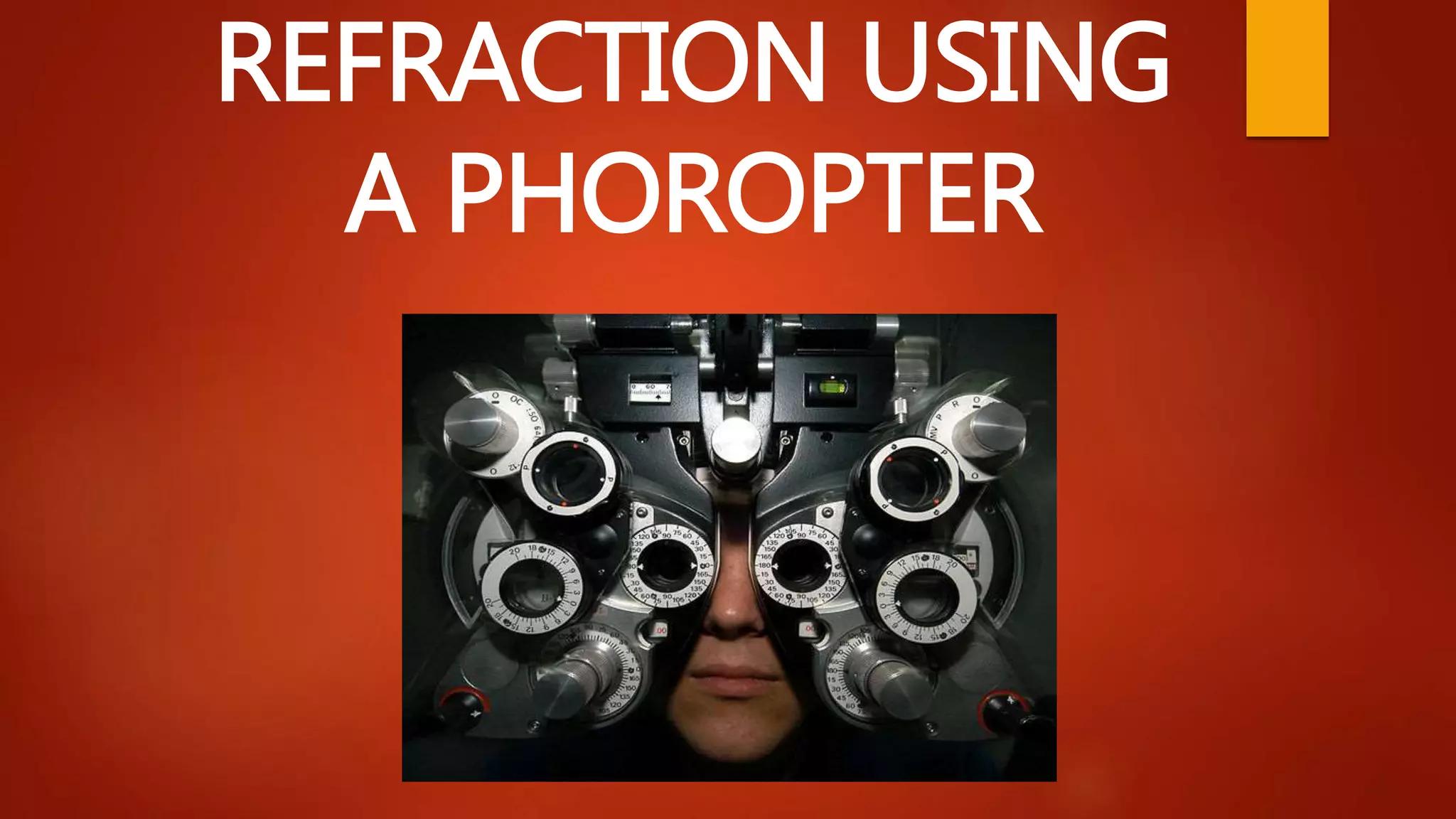
REFRACTION USING
A PHOROPTER
A phoropter is a common name for an
ophthalmic testing device, also called a
refractor. It is commonly used by eye care
professionals during an eye examination,
and contains different lenses used for
refraction, to measure an individual's
refractive error and determine his or her
eyeglass prescription.
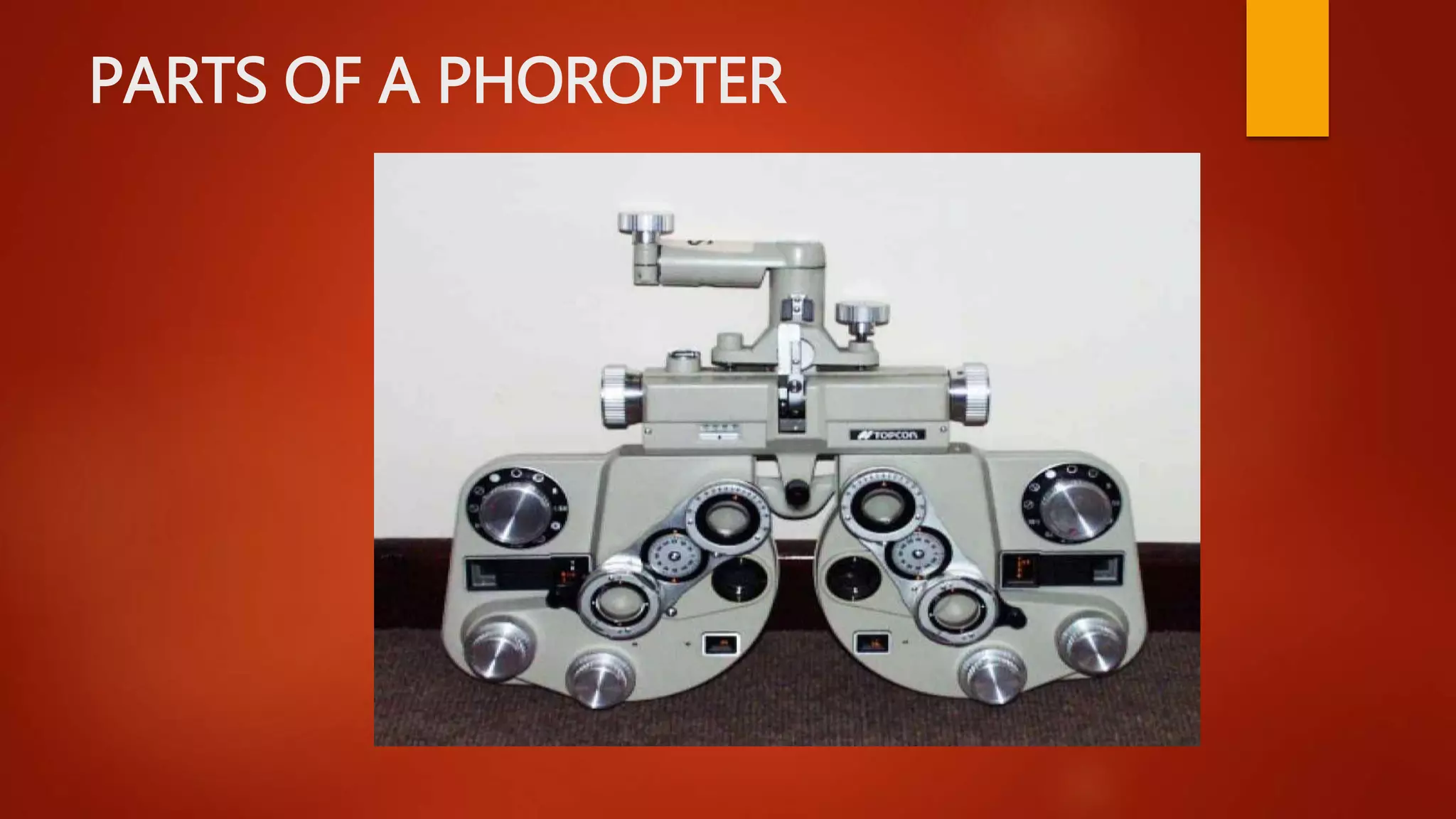
PARTS OF A PHOROPTER
PRELIMINARY STEPS OF REFRACTION:
1. Place the patient in a comfortable sitting position behind
the phoropter.
2. Adjust the IPD to centre the patients eyes on the lenses
3. Level the instrument to perfectly horizontal position.
4. Adjust the back vertex distance to 12mm.
5. Starting point of refraction is determined by objective
refraction in any of these ways:
a. Retinoscopy
b. Auto refractometer readings
c. Glasses power
STEPS OF SUBJECTIVE REFRACTION
PROPER
1. To test baseline visual acuity.
2. Establishing spherical power.
3. Cylindrical axis refinement.
4. Cylindrical power refinement.
5. Spherical power refinement.
6. Binocular balancing.
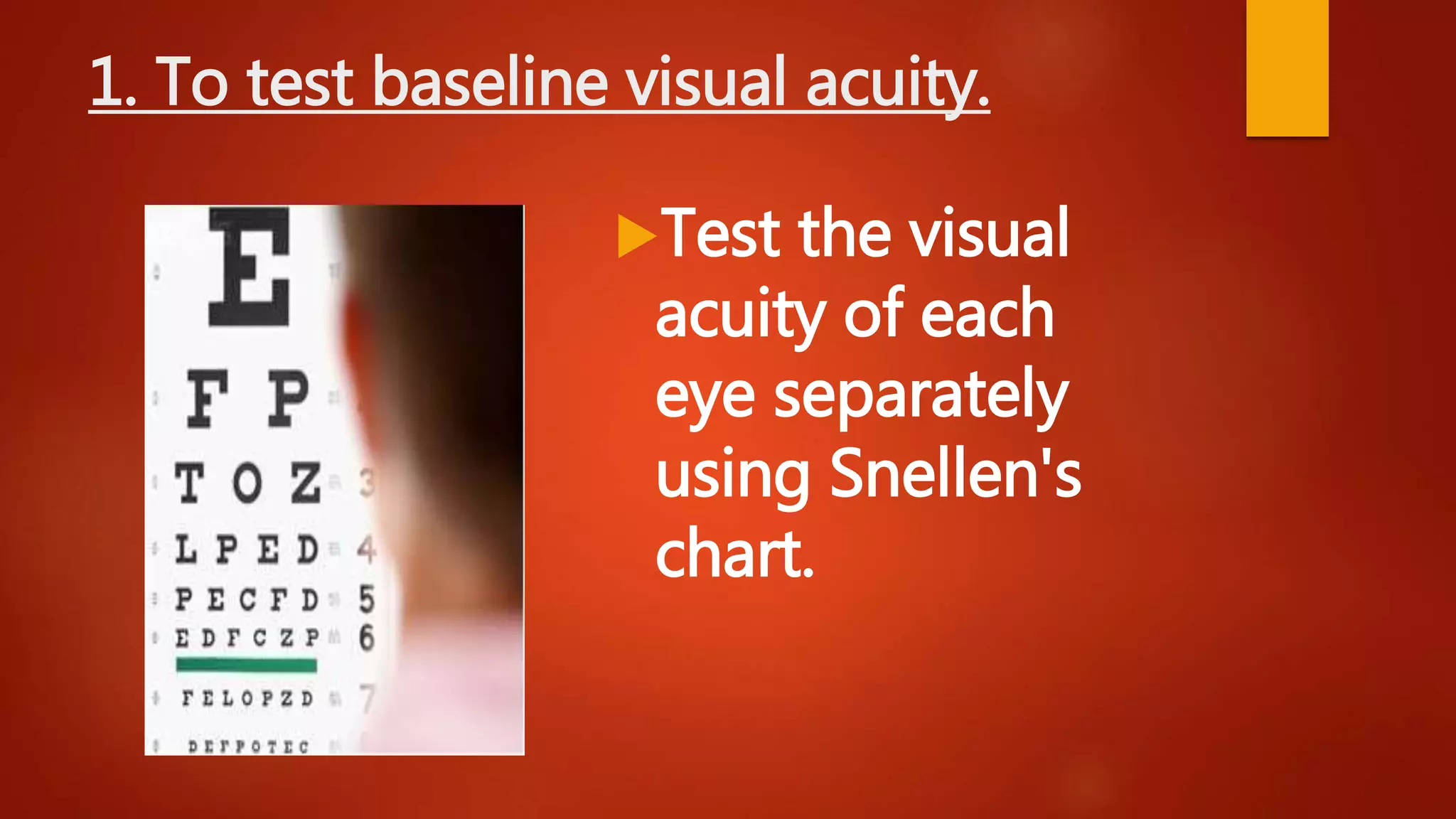
1. To test baseline visual acuity.
Test the visual
acuity of each
eye separately
using Snellen's
chart.
2. Establishing spherical power.
Start from one line above the visual acuity line.
Occlude one eye.
“Fog” the eye with a plus lens.
Start decreasing the power by 0.25D each time and
ask the patient which is better.
Stop when the patient no longer feels any
improvement.
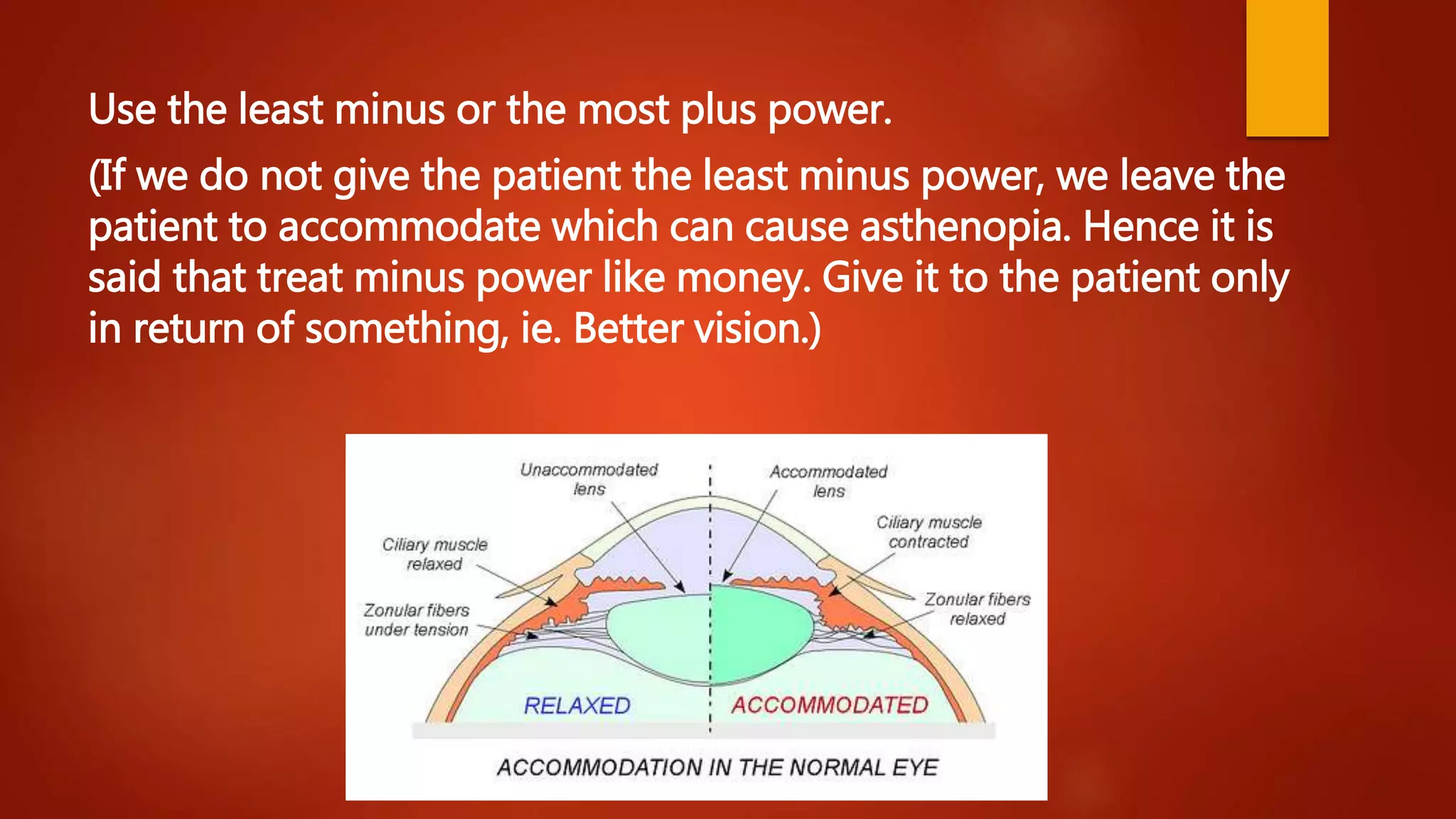
Use the least minus or the most plus power.
(If we do not give the patient the least minus power, we leave the
patient to accommodate which can cause asthenopia. Hence it is
said that treat minus power like money. Give it to the patient only
in return of something, ie. Better vision.)
FOGGING:
Fogging means to make the eye artificially myopic.
Because in a state off hyperopia, the patient tends to
accommodate.
Hence we put enough plus lenses in front of the eye such
that accommodation is relaxed and the refractive error is
stabilised.
3. Cylindrical axis refinement.
Two methods:
1. Jackson cross cylinder (JCC)
2. Astigmatic fan test.
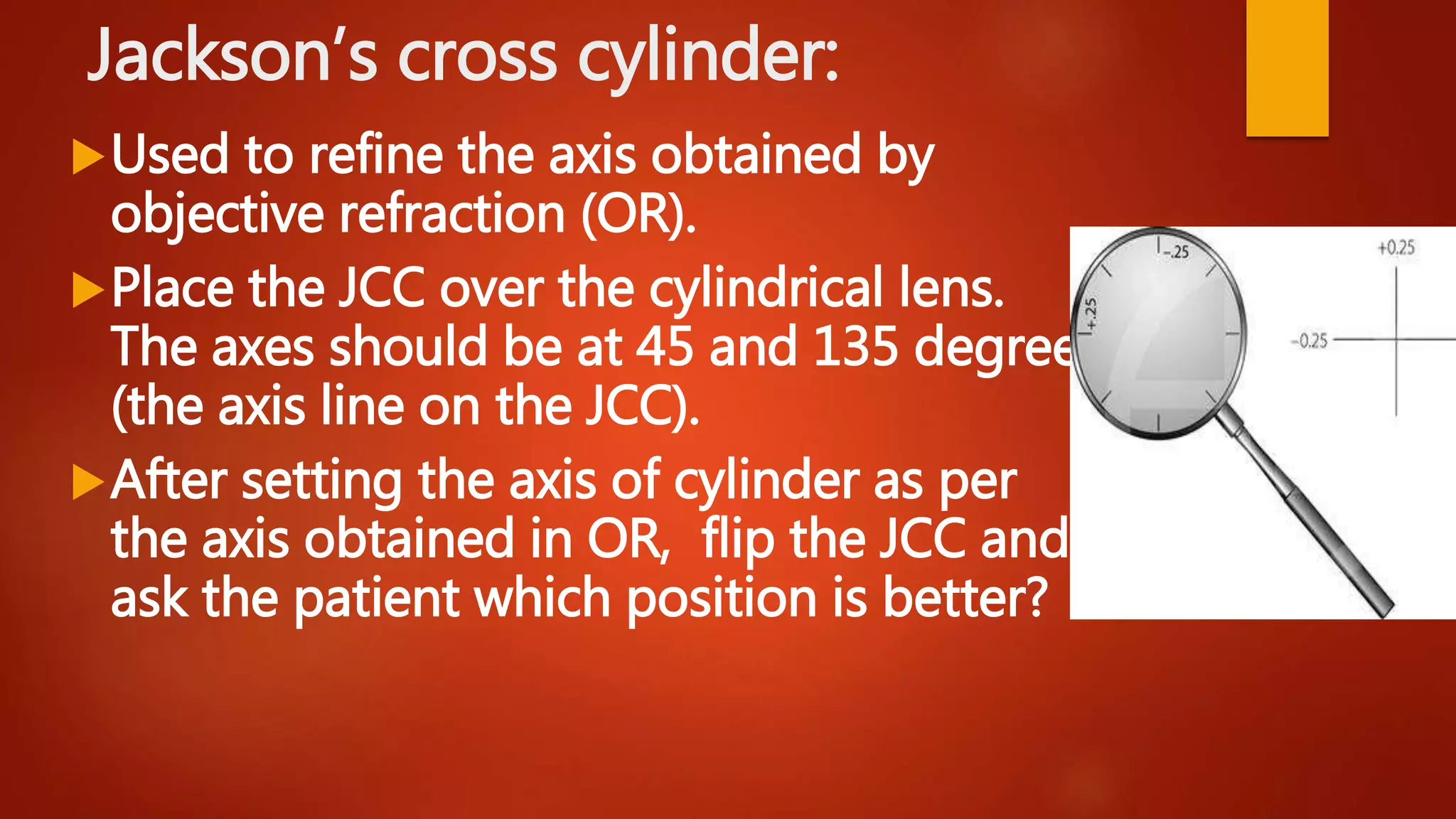
Jackson’s cross cylinder:
Used to refine the axis obtained by
objective refraction (OR).
Place the JCC over the cylindrical lens.
The axes should be at 45 and 135 degrees
(the axis line on the JCC).
After setting the axis of cylinder as per
the axis obtained in OR, flip the JCC and
ask the patient which position is better?
 In minus cylinder,
chase the red line.
 In plus cylinder
chase the white line.
Continue this for every 15 degrees in one direction
till direction changes.
And then fine tune it for 5 degrees in the other
direction.
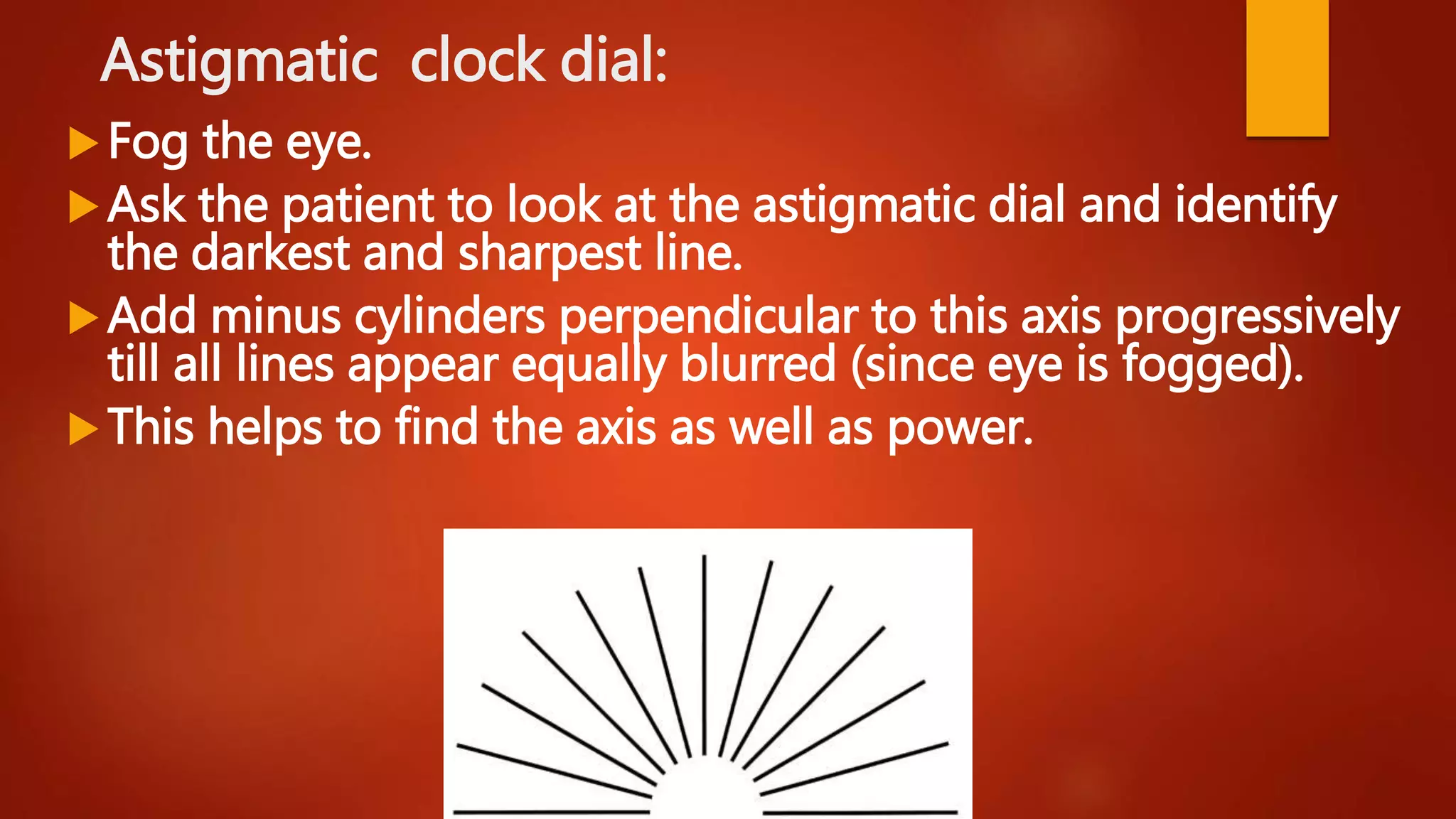
Astigmatic clock dial:
Fog the eye.
Ask the patient to look at the astigmatic dial and identify
the darkest and sharpest line.
Add minus cylinders perpendicular to this axis progressively
till all lines appear equally blurred (since eye is fogged).
This helps to find the axis as well as power.
4. Cylindrical power refinement.
After finding the axis, place the JCC in the power axes.
On flipping the JCC ask the patient which is better?
If white- add plus power.
If red- add minus power.
Continue till both appear equally blurred.
For every 1D cylindrical power added or reduced 0.5D
of spherical should be added or reduced respectively.
5. Spherical power refinement:
After the astigmatism axis and power is
refined the sphere power is refined.
This is done once again by fogging method.
This is then confirmed by:
Duochrome test.
Pinhole test.
DUOCHROME TEST::
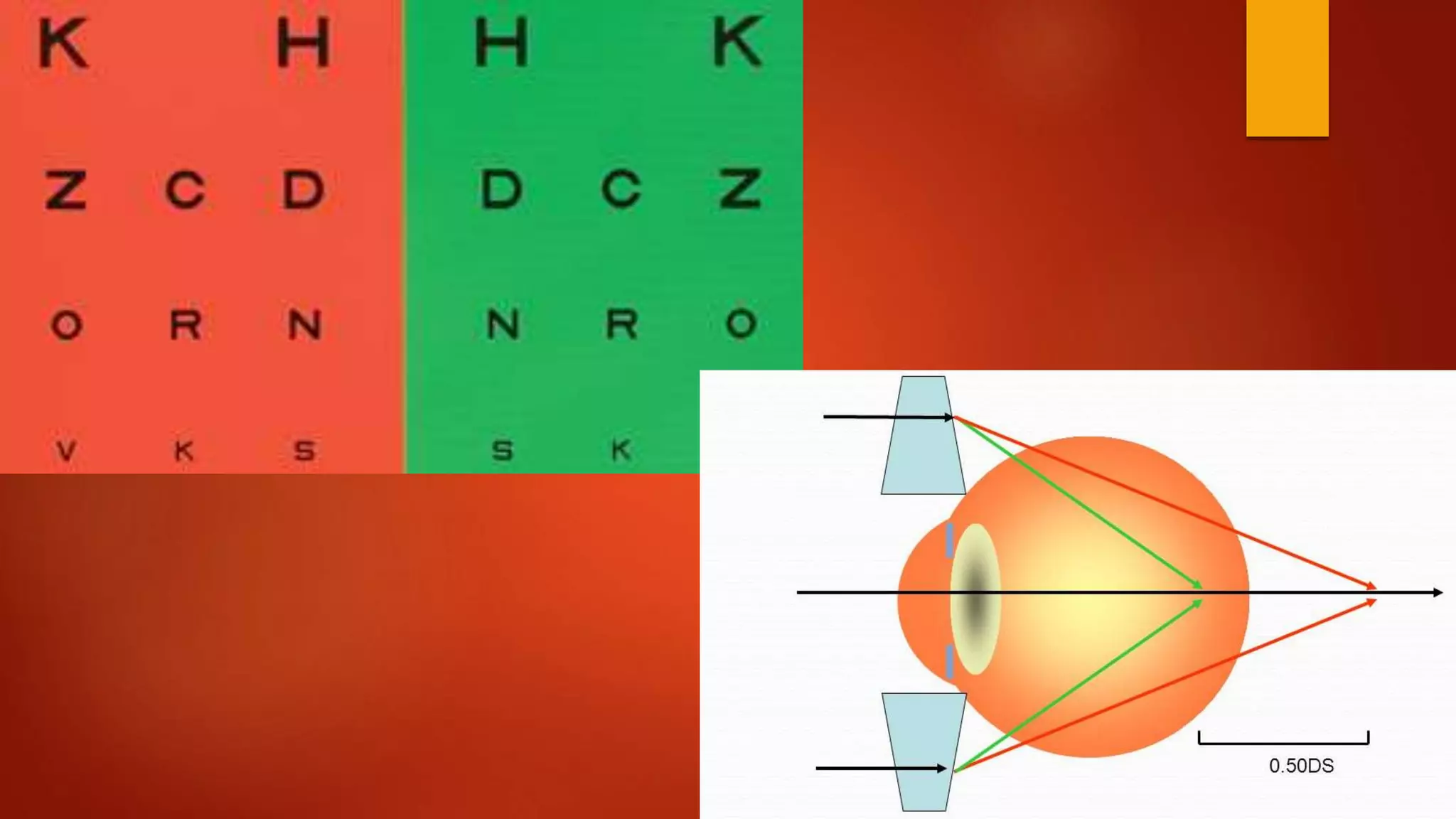
It is based on principle of chromatic aberration.
Due to difference in wavelengths, in emmetropes
yellow light focusses on the retina while red behind
and green in front.
Hence to an emmetrope both the sides appear
equally clear.
If red is clearer- under corrected myopia or over
corrected hyperopia.
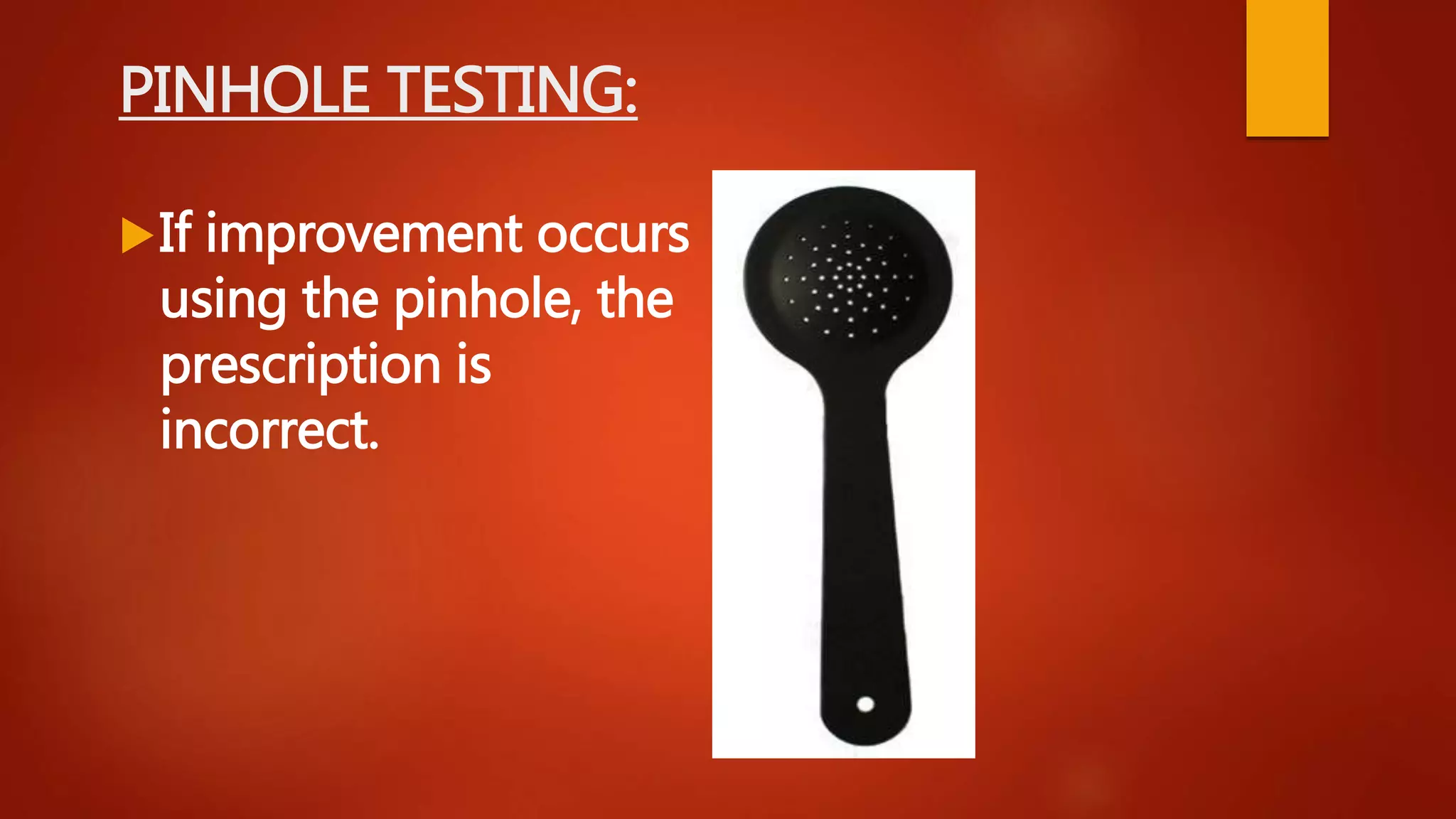
PINHOLE TESTING:
If improvement occurs
using the pinhole, the
prescription is
incorrect.
6. BINOCULAR BALANCING
To equalize the accommodative effort in
both the eyes.
Fogging and alternate cover test
Duochrome test with fogging
Prism dissociation test.
Fogging and alternate cover test:
With the best accepted lenses in the frame both
eyes are fogged with a 1D lens.
A rapid alternate cover test is performed.
Patient is asked to tell which image is clearer.
If the eyes are in balance the patient will report
equal blur.
Prism dissociation test:
After fogging, a 3 or 4 PD prism is kept base
down in front of right eye and base up in front
of left eye.
A difference between the clarity of the upper
and lower lines is used to correct the error.
 THANK YOU 

Refraction using a phoropter

  • 1.
  • 2.
    A phoropter isa common name for an ophthalmic testing device, also called a refractor. It is commonly used by eye care professionals during an eye examination, and contains different lenses used for refraction, to measure an individual's refractive error and determine his or her eyeglass prescription.
  • 3.
    PARTS OF APHOROPTER
  • 4.
    PRELIMINARY STEPS OFREFRACTION: 1. Place the patient in a comfortable sitting position behind the phoropter. 2. Adjust the IPD to centre the patients eyes on the lenses 3. Level the instrument to perfectly horizontal position. 4. Adjust the back vertex distance to 12mm. 5. Starting point of refraction is determined by objective refraction in any of these ways: a. Retinoscopy b. Auto refractometer readings c. Glasses power
  • 5.
    STEPS OF SUBJECTIVEREFRACTION PROPER 1. To test baseline visual acuity. 2. Establishing spherical power. 3. Cylindrical axis refinement. 4. Cylindrical power refinement. 5. Spherical power refinement. 6. Binocular balancing.
  • 6.
    1. To testbaseline visual acuity. Test the visual acuity of each eye separately using Snellen's chart.
  • 7.
    2. Establishing sphericalpower. Start from one line above the visual acuity line. Occlude one eye. “Fog” the eye with a plus lens. Start decreasing the power by 0.25D each time and ask the patient which is better. Stop when the patient no longer feels any improvement.
  • 8.
    Use the leastminus or the most plus power. (If we do not give the patient the least minus power, we leave the patient to accommodate which can cause asthenopia. Hence it is said that treat minus power like money. Give it to the patient only in return of something, ie. Better vision.)
  • 9.
    FOGGING: Fogging means tomake the eye artificially myopic. Because in a state off hyperopia, the patient tends to accommodate. Hence we put enough plus lenses in front of the eye such that accommodation is relaxed and the refractive error is stabilised.
  • 10.
    3. Cylindrical axisrefinement. Two methods: 1. Jackson cross cylinder (JCC) 2. Astigmatic fan test.
  • 11.
    Jackson’s cross cylinder: Usedto refine the axis obtained by objective refraction (OR). Place the JCC over the cylindrical lens. The axes should be at 45 and 135 degrees (the axis line on the JCC). After setting the axis of cylinder as per the axis obtained in OR, flip the JCC and ask the patient which position is better?
  • 12.
     In minuscylinder, chase the red line.  In plus cylinder chase the white line. Continue this for every 15 degrees in one direction till direction changes. And then fine tune it for 5 degrees in the other direction.
  • 13.
    Astigmatic clock dial: Fogthe eye. Ask the patient to look at the astigmatic dial and identify the darkest and sharpest line. Add minus cylinders perpendicular to this axis progressively till all lines appear equally blurred (since eye is fogged). This helps to find the axis as well as power.
  • 14.
    4. Cylindrical powerrefinement. After finding the axis, place the JCC in the power axes. On flipping the JCC ask the patient which is better? If white- add plus power. If red- add minus power. Continue till both appear equally blurred. For every 1D cylindrical power added or reduced 0.5D of spherical should be added or reduced respectively.
  • 15.
    5. Spherical powerrefinement: After the astigmatism axis and power is refined the sphere power is refined. This is done once again by fogging method. This is then confirmed by: Duochrome test. Pinhole test.
  • 16.
    DUOCHROME TEST:: It isbased on principle of chromatic aberration. Due to difference in wavelengths, in emmetropes yellow light focusses on the retina while red behind and green in front. Hence to an emmetrope both the sides appear equally clear. If red is clearer- under corrected myopia or over corrected hyperopia.
  • 18.
    PINHOLE TESTING: If improvementoccurs using the pinhole, the prescription is incorrect.
  • 19.
    6. BINOCULAR BALANCING Toequalize the accommodative effort in both the eyes. Fogging and alternate cover test Duochrome test with fogging Prism dissociation test.
  • 20.
    Fogging and alternatecover test: With the best accepted lenses in the frame both eyes are fogged with a 1D lens. A rapid alternate cover test is performed. Patient is asked to tell which image is clearer. If the eyes are in balance the patient will report equal blur.
  • 21.
    Prism dissociation test: Afterfogging, a 3 or 4 PD prism is kept base down in front of right eye and base up in front of left eye. A difference between the clarity of the upper and lower lines is used to correct the error.
  • 22.