DEVELOPMENTAL
GLAUCOMA
Dr. Nidhi Thaker
• Primary glaucomas with associated abnormalities
• All of the primary glaucomas that have associated
ocular abnormalities to be forms of anterior
segment dysgenesis.
• Neurocristopathies
• Anterior segment dysgeneses are attributed to
defects in neural crest migration or differentiation
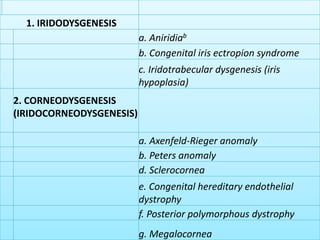
1. IRIDODYSGENESIS
a. Aniridiab
b. Congenital iris ectropion syndrome
c. Iridotrabecular dysgenesis (iris
hypoplasia)
2. CORNEODYSGENESIS
(IRIDOCORNEODYSGENESIS)
a. Axenfeld-Rieger anomaly
b. Peters anomaly
d. Sclerocornea
e. Congenital hereditary endothelial
dystrophy
f. Posterior polymorphous dystrophy
g. Megalocornea
AXENFELD-RIEGER
SYNDROME
Axenfeld-Rieger Syndrome
• Three Eponyms:
(A) Axenfeld Anomaly :
Limited to peripheral anterior segment defects
(B) Rieger Anomaly:
Peripheral abnormalities with additional
changes in the iris
(C) Rieger Syndrome:
Ocular anomalies plus systemic developmental
defects
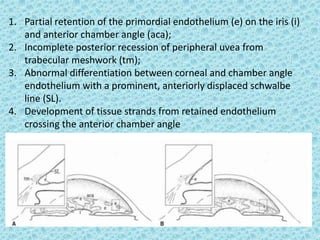
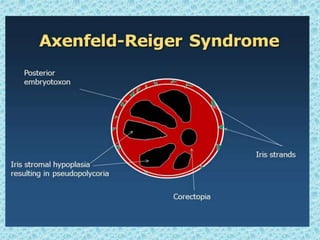
1. Partial retention of the primordial endothelium (e) on the iris (i)
and anterior chamber angle (aca);
2. Incomplete posterior recession of peripheral uvea from
trabecular meshwork (tm);
3. Abnormal differentiation between corneal and chamber angle
endothelium with a prominent, anteriorly displaced schwalbe
line (SL).
4. Development of tissue strands from retained endothelium
crossing the anterior chamber angle
• Anterior Chamber Cleavage Syndrome
• Mesodermal Dysgenesis Of The Cornea And
Iris
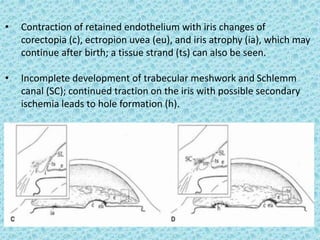
• Contraction of retained endothelium with iris changes of
corectopia (c), ectropion uvea (eu), and iris atrophy (ia), which may
continue after birth; a tissue strand (ts) can also be seen.
• Incomplete development of trabecular meshwork and Schlemm
canal (SC); continued traction on the iris with possible secondary
ischemia leads to hole formation (h).
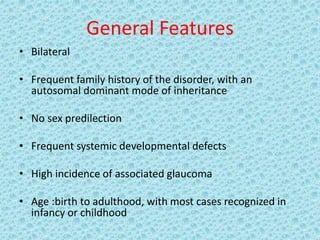
General Features
• Bilateral
• Frequent family history of the disorder, with an
autosomal dominant mode of inheritance
• No sex predilection
• Frequent systemic developmental defects
• High incidence of associated glaucoma
• Age :birth to adulthood, with most cases recognized in
infancy or childhood
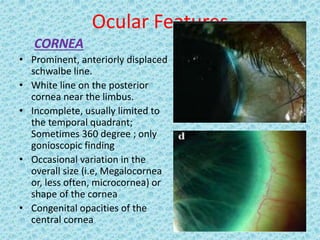
Ocular Features
CORNEA
• Prominent, anteriorly displaced
schwalbe line.
• White line on the posterior
cornea near the limbus.
• Incomplete, usually limited to
the temporal quadrant;
Sometimes 360 degree ; only
gonioscopic finding
• Occasional variation in the
overall size (i.e, Megalocornea
or, less often, microcornea) or
shape of the cornea
• Congenital opacities of the
central cornea
• Anterior Chamber Angle
• Gonioscopic examination;
1. Prominent schwalbe line
2. Iridocorneal adhesions
3. The anterior chamber angle is open and the trabecular
meshwork is visible, but the scleral spur is typically obscured
by peripheral iris, which inserts into the posterior portion of
the meshwork
•Iris
• Mild stromal thinning to
marked atrophy with hole
formation,
• Corectopia
• Ectropion uveae.
• When corectopia is present,
the pupil is usually displaced
toward a prominent
peripheral tissue strand the
atrophy and hole formation
typically occur in the
quadrant away from the
direction of the corectopia.
Other ocular abnormalities
• Strabismus
• Limbal dermoids
• Corneal pannus
• Cataracts
• Congenital ectropion uveae
• Congenital pupillary-iris-lens membrane
• Peripheral spokelike transillumination defects of the iris
• Retinal detachment
• Macular degeneration
• Chorioretinal colobomas
• Choroidal hypoplasia
• Hypoplasia of the optic nerve heads
• Glaucoma
• More than one half of the patients with the
axenfeld-rieger syndrome develop glaucoma.
• Childhood or young adulthood.
• The high insertion of peripheral iris into the
trabecular meshwork, appears to be more
pronounced in those eyes with glaucoma
• The proposed mechanism of glaucoma in
these cases relates to abnormalities of the
trabecular meshwork and schlemm canal
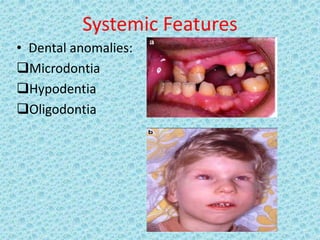
Systemic Features
• Dental anomalies:
Microdontia
Hypodentia
Oligodontia
Facial anomalies :
A receding upper lip and
prominent lower lip
Hypertelorism
Maxillary hypoplasia with
flattening of the midface
Telecanthus
A broad flat nose
Micrognathia
 mandibular prognathism
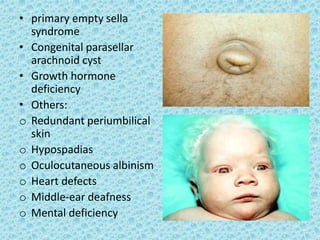
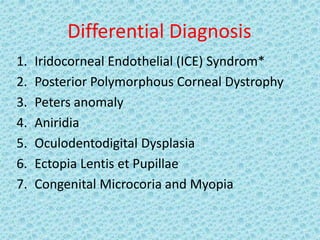
• primary empty sella
syndrome
• Congenital parasellar
arachnoid cyst
• Growth hormone
deficiency
• Others:
o Redundant periumbilical
skin
o Hypospadias
o Oculocutaneous albinism
o Heart defects
o Middle-ear deafness
o Mental deficiency
Genetic Linkage
• Chromosomes :4q25, 6p25, and 13q14.
• Type 1 :Pitx2 on 4q25
• Type 2: RIEG2 on 13q14
• Type 3: FOXC1 on 6p25
Differential Diagnosis
1. Iridocorneal Endothelial (ICE) Syndrom*
2. Posterior Polymorphous Corneal Dystrophy
3. Peters anomaly
4. Aniridia
5. Oculodentodigital Dysplasia
6. Ectopia Lentis et Pupillae
7. Congenital Microcoria and Myopia
Peters Anomaly
• Defect in the neural crest cell migration in the 6 – 8th
wk of fetal development
• Present at birth
• Usually bilateral
• Most cases are sporadic/autosomal recessive/
autosomal dominant transmission
• Defects of the ear and auditory system, orofacial
system, heart, genitourinary system, spine, and
musculoskeletal system
• Can be caused by mutation in the PAX6, PITX2,
CYP1B1, or FOXC1
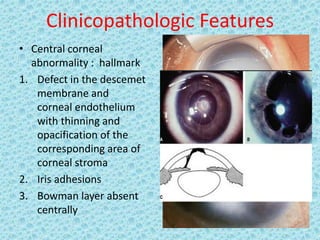
Clinicopathologic Features
• Central corneal
abnormality : hallmark
1. Defect in the descemet
membrane and
corneal endothelium
with thinning and
opacification of the
corresponding area of
corneal stroma
2. Iris adhesions
3. Bowman layer absent
centrally
I. In Peters anomaly not associated with
keratolenticular contact or cataract
II. Peters anomaly associated with
keratolenticular contact or cataract
III. Peters anomaly associated with Axenfeld-
Rieger syndrome
Glaucoma
• 50% pts
• Infantile glaucoma
• Mechanism:
o Peripheral anterior synechiae formation
o Incomplete development of trabecular
meshwork and schlemm canal
Systemic association
• Craniofacial anomalies
• CNS anomalies
• Fetal alcohol syndrome
• Chromosomal abnormaalities
• ‘peter plus’ syndrome:
o Short-limbed dwarfism
o Cleft lip/palate
o Learning difficulties
D/D
o Other Causes of Central Corneal Opacities in
Infants:
• PCG
• birth trauma
• MPS
• congenital hereditary endothelial dystrophy.
o Posterior Keratoconus
o Congenital Corneal Leukomas and Staphylomas
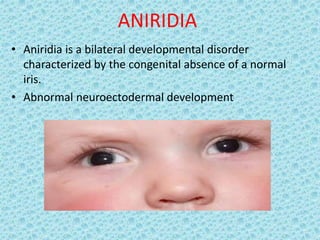
ANIRIDIA
• Aniridia is a bilateral developmental disorder
characterized by the congenital absence of a normal
iris.
• Abnormal neuroectodermal development
Classification
AD
2/3rd
No systemic
complication
genotype+=
phenotype
sporadic
1/3rd
PAX6
MUTATION
WAGAR
SYNDROME/
Miller synd
AR
1%
Gillespie
syndrome
Cerebellar
ataxia + MR
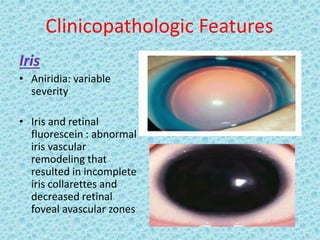
Clinicopathologic Features
Iris
• Aniridia: variable
severity
• Iris and retinal
fluorescein : abnormal
iris vascular
remodeling that
resulted in incomplete
iris collarettes and
decreased retinal
foveal avascular zones
Lids:MGD
Cornea:
• Corneal pannus and
opacity begin in the
peripheral cornea
• Microcornea ,
sclerocornea
• Iridocorneal and
keratolenticular
adhesions
• High CCT
• Epibulbar dermoid
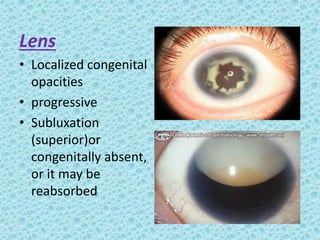
Lens
• Localized congenital
opacities
• progressive
• Subluxation
(superior)or
congenitally absent,
or it may be
reabsorbed
Fundus
• Foveal Hypoplasia, optic nerve hypoplasia, choroidal
coloboma
• Poor visual acuity and nystagmus
• Spectral-domain OCT can be used to confirm the presence of
foveal hypoplasia in eyes with aniridia, and this correlates well
with visual acuity independent of the iris rim width
Glaucoma
• 75% Pts
• late childhood and adolescence
Mechanism: synechial angle closure
secondary to the pulling of the rudimentary
iris tissue by contraction of pre exsisting
fibres
Glaucoma in aniridia usually develops after
rudimentary iris stump rotates anteriorly to
progressively cover the trabecular
meshwork
Other ocular and systemic association
• Choroidal colobomas
• Persistent pupillary membranes
• Sclerocornea
• Hallermann-streiff syndrome
• Small optic nerve heads
• Strabismus
• Ptosis
• Marfan syndrome with cervical ribs ,dental anomalies,
Tracheomalacia and delayed closure of the anterior
fontanelle
• Retinoblastoma
DEVELOPMENTAL GLAUCOMAS WITH
ASSOCIATED SYSTEMIC ANOMALIES
Sturge-Weber syndrome
Neurofibromatosis
Marfan Syndrome
Weill-Marchesani syndrome
STURGE WEBER SYNDROME
• Ancephalotrigeminal angiomatosis
• Unilateral
• Ipsilateral cavernous hemangioma/ facial cutaneous
hemangioma/ leptomeningeal angioma
• 30- 70%- Glaucoma
• Elevated episcleral venous presssure
• CNS symptoms
NEUROFIBROMATOSIS
• Most common phakomatosis
I. NF 1- von Recklinghausen or peripheral NF
– Most common
– 1: 3000- 5000
– AD, ch 17
• Ectropion uvea
• Lisch nodules
• Optic nerve glioma
• Eyelid neurofibroma
• Café au lait
• Axillary/inguinal freckling
• Cutaneous neurofibromas
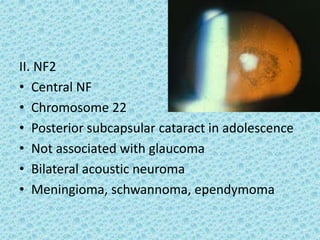
II. NF2
• Central NF
• Chromosome 22
• Posterior subcapsular cataract in adolescence
• Not associated with glaucoma
• Bilateral acoustic neuroma
• Meningioma, schwannoma, ependymoma
OTHER SYNDROMES WITH
ASSOCIATED GLAUCOMA
Chromosomal Anomalies
• Trisomy 21
• Trisomy 13
• Trisomy 18
• Turner Syndrome
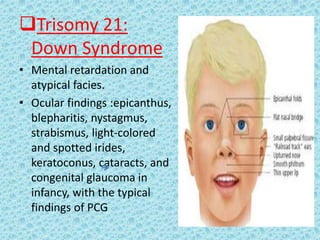
Trisomy 21:
Down Syndrome
• Mental retardation and
atypical facies.
• Ocular findings :epicanthus,
blepharitis, nystagmus,
strabismus, light-colored
and spotted irides,
keratoconus, cataracts, and
congenital glaucoma in
infancy, with the typical
findings of PCG
Trisomy 13-15: Trisomy D
Syndrome
• Mental retardation, deafness, heart disease,
and motor seizures
• Ocular findings: microphthalmia, coloboma
with cartilage, congenital cataracts, retinal
dysplasia, persistent fetal vasculature, and
dysembryogenesis of the anterior chamber
angle Glaucoma
Trisomy 18: Edwards Syndrome
• Anterior position of the iris obstructing the
anterior chamber angle
XO: Turner Syndrome
• short stature,
• postadolescent females with sexual
infantilism and multiple systemic anomalies.
• Ocular findings:
ptosis, epicanthus, cataract, strabismus, blue
sclera, corneal nebulae, and color blindness
Developmental glaucoma is rarely associated
GLAUCOMA ASSOCIATED WITH SYSTEMIC
CONGENITAL DISORDERS
 Lowe (Oculocerebrorenal) syndrome
 Stickler Syndrome
 Zellweger syndrome
 Hallermann-Streiff syndrome
 Rubinstein-Taybi (broad thumb) syndrome
 Oculodentodigital dysplasia
 Cockayne syndrome
 Fetal alcohol syndrome
Cystinosis
• Autosomal recessive metabolic disorder
• Characterized by widespread accumulation of
cystine crystals in ocular and nonocular tissues
• Mutation in the gene encoding cystinosin
(CTNS: 17p13)
• Pupillary block glaucoma caused by the
cystine accumulation in the iris stroma
Hepatocerebrorenal Syndrome:
Zellweger Syndrome
Multisystem congenital disorder characterized by
• central nervous system abnormalities
• Hepatic interstitial fibrosis
• Renal cysts
 Ocular findings :
• Nystagmus
• Corneal clouding
• Cataracts
• Retinal vascular and pigmentary abnormalities,
• Optic nerve head lesion
• Congenital glaucoma :iridocorneal adhesions may be the
mechanism of the glaucoma
Hallermann-streiff syndrome
• Micrognathia and dwarfism
• Ocular findings:
• Cataracts
• Microphthalmos.
• Glaucoma may also occur because of absorption of lens
material or associated aniridia or after cataract surgery
Kniest dysplasia
• Metatropic dwarfism
• Autosomal dominant inheritance
• Mutations in the COL2A1 gene
• Congenital glaucoma
Lowe syndrome
• Oculocerebrorenal syndrome
• Autosomal recessive/x-linked disorder
• Mental retardation, renal rickets, aminoaciduria,
hypotonia, acidemia,irritability.
• Cataract
• Glaucoma :secondary to removal of concurrent
congenital cataracts. Anterior insertion of the iris,
narrowing of the ciliary body band, and decreased
visibility of the scleral spur
• Microphthalmia, strabismus, nystagmus, miosis, and
iris atrophy.
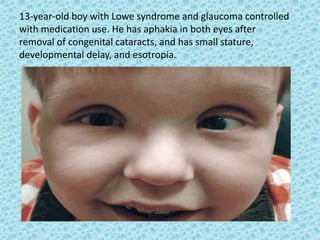
13-year-old boy with Lowe syndrome and glaucoma controlled
with medication use. He has aphakia in both eyes after
removal of congenital cataracts, and has small stature,
developmental delay, and esotropia.
Mucopolysaccharidoses
• The MPS constitute a group of inherited disorders
caused by deficiency of specific lysosomal enzymes
needed for the degradation of glycosaminoglycans,
or mucopolysaccharides
• The accumulation of partially degraded
glycosaminoglycans causes interference with cell,
tissue, and organ function.
• Hurler syndrome
• autosomal recessive disease with central nervous
system, skeletal, and visceral abnormalities
• ocular finding :
1. corneal clouding
2. Glaucoma has also been reported in Hurler
syndrome and was thought to result from
mucopolysaccharide-containing cells in the
aqueous outflow system
3. open-angle glaucoma
4. IOP returned to normal after bone marrow
transplantation
• Patients with mucopolysaccharidosis type
VI, the Maroteaux-Lamy syndrome
• Acute or chronic angleclosure glaucoma,
due to increased thickness of the peripheral
cornea than with pupillary block
Nail-Patella Syndrome
• dysplasia of the nails and absent or hypoplastic
patella as cardinal features, has been associated with
open-angle glaucoma.
Oculodentodigital Dysplasia
• hypoplastic dental enamel, microdontia, bilateral
syndactyly, and a characteristic thin nose.
• Glaucoma: mild developmental abnormalities of the
anterior chamber angle
• autosomal dominant mutation in the connexin-43
gene (CJA1, gene locus 6q21)
Prader-Willi Syndrome
• Muscular hypotonia, hypogonadism, obesity, and mental
retardation
• Abnormality of chromosome 15.
• Ocular findings: oculocutaneous albinism and congenital
ectropion uveae, which may be associated with open-angle
glaucoma
Rubinstein-Taybi Syndrome
• mental and motor retardation
• typical congenital skeletal deformities with characteristically
large, broad thumbs and first toes
• Ocular findings: bushy brows, hypertelorism, epicanthus,
antimongoloid slant of eyelids, and hyperopia,Infantile or
juvenile glaucoma(open angle)
• autosomal dominant
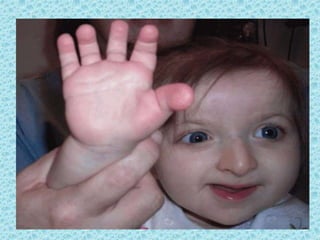
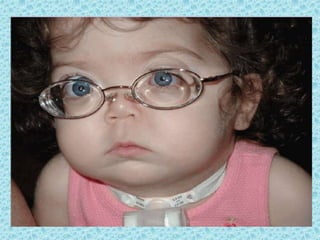
Stickler Syndrome
• Hereditary progressive arthroophthalmopathy
• An autosomal dominant connective tissue dysplasia,
• Characterized by ocular, orofacial, and generalized
skeletal abnormalities
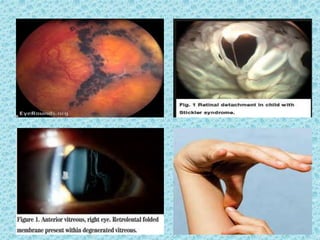
• Ocular manifestations :
o High myopia
o Open-angle glaucoma
o Cataracts
o Vitreoretinal degeneration,
o Retinal detachment
o Numerous iris processes, suggestive of a developmental
abnormality of the angle neovascular glaucoma
• Three forms of Stickler syndrome
1. Type I :mutation in the COL2A1 gene
2. Type II :mutation in the a1-polypeptide of collagen
XI (COL11A1)
3. Type III :mutations in the collagen, type XI, alpha 2
gene (COL11A2)
• Wagner syndrome :mutation in the gene
encoding chondroitin sulfate proteoglycan-2
(CSPG2) a proteoglycan found in the
vitreous
• Marshall syndrome: mutations in the
COL11A1 gene
• Weissengacher-Zweymuller syndrome :
o also called Pierre Robin syndrome
o fetal chondrodysplasia mutation in the
COL11A2 gene (as in Stickler syndrome type
III).
Waardenburg Syndrome
• autosomal dominant disorder
• lateral displacement of the medial canthi;
• hyperplasia of the medial brows;
• a prominent, broad root of the nose;
• sectorial or complete iris heterochromia;
• congenital deafness and a white forelock
• defect of neural crest-derived tissues and is caused
by a mutation in the PAX3 gene (gene map locus
2q35,
• Open-angle glaucoma
Walker-Warburg Syndrome
• Hydrocephalus (H)
• Agyria (A)
• Retinal Dysplasia (RD)
• With or without Encephalocele (±E),
• Multiple eye abnormalities have been reported, including congenital
glaucoma
Cockayne Syndrome
• Autosomal recessive disorder
• Characterized by dwarfism and birdlike facies.
• Ocular manifestations
• “salt and pepper” retinopathy
• Cataracts
• Corneal ulcers or opacities
• Nystagmus
• Hypoplastic irides
• Irregular pupils

Congenital glaucoma part2; developmental glaucoma

  • 1.
  • 2.
    • Primary glaucomaswith associated abnormalities • All of the primary glaucomas that have associated ocular abnormalities to be forms of anterior segment dysgenesis. • Neurocristopathies • Anterior segment dysgeneses are attributed to defects in neural crest migration or differentiation
  • 3.
    1. IRIDODYSGENESIS a. Aniridiab b.Congenital iris ectropion syndrome c. Iridotrabecular dysgenesis (iris hypoplasia) 2. CORNEODYSGENESIS (IRIDOCORNEODYSGENESIS) a. Axenfeld-Rieger anomaly b. Peters anomaly d. Sclerocornea e. Congenital hereditary endothelial dystrophy f. Posterior polymorphous dystrophy g. Megalocornea
  • 4.
  • 5.
    Axenfeld-Rieger Syndrome • ThreeEponyms: (A) Axenfeld Anomaly : Limited to peripheral anterior segment defects (B) Rieger Anomaly: Peripheral abnormalities with additional changes in the iris (C) Rieger Syndrome: Ocular anomalies plus systemic developmental defects
  • 6.
    1. Partial retentionof the primordial endothelium (e) on the iris (i) and anterior chamber angle (aca); 2. Incomplete posterior recession of peripheral uvea from trabecular meshwork (tm); 3. Abnormal differentiation between corneal and chamber angle endothelium with a prominent, anteriorly displaced schwalbe line (SL). 4. Development of tissue strands from retained endothelium crossing the anterior chamber angle
  • 7.
    • Anterior ChamberCleavage Syndrome • Mesodermal Dysgenesis Of The Cornea And Iris
  • 8.
    • Contraction ofretained endothelium with iris changes of corectopia (c), ectropion uvea (eu), and iris atrophy (ia), which may continue after birth; a tissue strand (ts) can also be seen. • Incomplete development of trabecular meshwork and Schlemm canal (SC); continued traction on the iris with possible secondary ischemia leads to hole formation (h).
  • 9.
    General Features • Bilateral •Frequent family history of the disorder, with an autosomal dominant mode of inheritance • No sex predilection • Frequent systemic developmental defects • High incidence of associated glaucoma • Age :birth to adulthood, with most cases recognized in infancy or childhood
  • 10.
    Ocular Features CORNEA • Prominent,anteriorly displaced schwalbe line. • White line on the posterior cornea near the limbus. • Incomplete, usually limited to the temporal quadrant; Sometimes 360 degree ; only gonioscopic finding • Occasional variation in the overall size (i.e, Megalocornea or, less often, microcornea) or shape of the cornea • Congenital opacities of the central cornea
  • 11.
    • Anterior ChamberAngle • Gonioscopic examination; 1. Prominent schwalbe line 2. Iridocorneal adhesions 3. The anterior chamber angle is open and the trabecular meshwork is visible, but the scleral spur is typically obscured by peripheral iris, which inserts into the posterior portion of the meshwork
  • 12.
    •Iris • Mild stromalthinning to marked atrophy with hole formation, • Corectopia • Ectropion uveae. • When corectopia is present, the pupil is usually displaced toward a prominent peripheral tissue strand the atrophy and hole formation typically occur in the quadrant away from the direction of the corectopia.
  • 14.
    Other ocular abnormalities •Strabismus • Limbal dermoids • Corneal pannus • Cataracts • Congenital ectropion uveae • Congenital pupillary-iris-lens membrane • Peripheral spokelike transillumination defects of the iris • Retinal detachment • Macular degeneration • Chorioretinal colobomas • Choroidal hypoplasia • Hypoplasia of the optic nerve heads
  • 15.
    • Glaucoma • Morethan one half of the patients with the axenfeld-rieger syndrome develop glaucoma. • Childhood or young adulthood. • The high insertion of peripheral iris into the trabecular meshwork, appears to be more pronounced in those eyes with glaucoma • The proposed mechanism of glaucoma in these cases relates to abnormalities of the trabecular meshwork and schlemm canal
  • 16.
    Systemic Features • Dentalanomalies: Microdontia Hypodentia Oligodontia
  • 17.
    Facial anomalies : Areceding upper lip and prominent lower lip Hypertelorism Maxillary hypoplasia with flattening of the midface Telecanthus A broad flat nose Micrognathia  mandibular prognathism
  • 18.
    • primary emptysella syndrome • Congenital parasellar arachnoid cyst • Growth hormone deficiency • Others: o Redundant periumbilical skin o Hypospadias o Oculocutaneous albinism o Heart defects o Middle-ear deafness o Mental deficiency
  • 19.
    Genetic Linkage • Chromosomes:4q25, 6p25, and 13q14. • Type 1 :Pitx2 on 4q25 • Type 2: RIEG2 on 13q14 • Type 3: FOXC1 on 6p25
  • 20.
    Differential Diagnosis 1. IridocornealEndothelial (ICE) Syndrom* 2. Posterior Polymorphous Corneal Dystrophy 3. Peters anomaly 4. Aniridia 5. Oculodentodigital Dysplasia 6. Ectopia Lentis et Pupillae 7. Congenital Microcoria and Myopia
  • 21.
    Peters Anomaly • Defectin the neural crest cell migration in the 6 – 8th wk of fetal development • Present at birth • Usually bilateral • Most cases are sporadic/autosomal recessive/ autosomal dominant transmission • Defects of the ear and auditory system, orofacial system, heart, genitourinary system, spine, and musculoskeletal system • Can be caused by mutation in the PAX6, PITX2, CYP1B1, or FOXC1
  • 22.
    Clinicopathologic Features • Centralcorneal abnormality : hallmark 1. Defect in the descemet membrane and corneal endothelium with thinning and opacification of the corresponding area of corneal stroma 2. Iris adhesions 3. Bowman layer absent centrally
  • 23.
    I. In Petersanomaly not associated with keratolenticular contact or cataract II. Peters anomaly associated with keratolenticular contact or cataract III. Peters anomaly associated with Axenfeld- Rieger syndrome
  • 26.
    Glaucoma • 50% pts •Infantile glaucoma • Mechanism: o Peripheral anterior synechiae formation o Incomplete development of trabecular meshwork and schlemm canal
  • 27.
    Systemic association • Craniofacialanomalies • CNS anomalies • Fetal alcohol syndrome • Chromosomal abnormaalities • ‘peter plus’ syndrome: o Short-limbed dwarfism o Cleft lip/palate o Learning difficulties
  • 28.
    D/D o Other Causesof Central Corneal Opacities in Infants: • PCG • birth trauma • MPS • congenital hereditary endothelial dystrophy. o Posterior Keratoconus o Congenital Corneal Leukomas and Staphylomas
  • 29.
    ANIRIDIA • Aniridia isa bilateral developmental disorder characterized by the congenital absence of a normal iris. • Abnormal neuroectodermal development
  • 30.
  • 31.
    Clinicopathologic Features Iris • Aniridia:variable severity • Iris and retinal fluorescein : abnormal iris vascular remodeling that resulted in incomplete iris collarettes and decreased retinal foveal avascular zones
  • 32.
    Lids:MGD Cornea: • Corneal pannusand opacity begin in the peripheral cornea • Microcornea , sclerocornea • Iridocorneal and keratolenticular adhesions • High CCT • Epibulbar dermoid
  • 33.
    Lens • Localized congenital opacities •progressive • Subluxation (superior)or congenitally absent, or it may be reabsorbed
  • 34.
    Fundus • Foveal Hypoplasia,optic nerve hypoplasia, choroidal coloboma • Poor visual acuity and nystagmus • Spectral-domain OCT can be used to confirm the presence of foveal hypoplasia in eyes with aniridia, and this correlates well with visual acuity independent of the iris rim width
  • 35.
    Glaucoma • 75% Pts •late childhood and adolescence Mechanism: synechial angle closure secondary to the pulling of the rudimentary iris tissue by contraction of pre exsisting fibres Glaucoma in aniridia usually develops after rudimentary iris stump rotates anteriorly to progressively cover the trabecular meshwork
  • 36.
    Other ocular andsystemic association • Choroidal colobomas • Persistent pupillary membranes • Sclerocornea • Hallermann-streiff syndrome • Small optic nerve heads • Strabismus • Ptosis • Marfan syndrome with cervical ribs ,dental anomalies, Tracheomalacia and delayed closure of the anterior fontanelle • Retinoblastoma
  • 37.
    DEVELOPMENTAL GLAUCOMAS WITH ASSOCIATEDSYSTEMIC ANOMALIES Sturge-Weber syndrome Neurofibromatosis Marfan Syndrome Weill-Marchesani syndrome
  • 38.
    STURGE WEBER SYNDROME •Ancephalotrigeminal angiomatosis • Unilateral • Ipsilateral cavernous hemangioma/ facial cutaneous hemangioma/ leptomeningeal angioma • 30- 70%- Glaucoma • Elevated episcleral venous presssure • CNS symptoms
  • 39.
    NEUROFIBROMATOSIS • Most commonphakomatosis I. NF 1- von Recklinghausen or peripheral NF – Most common – 1: 3000- 5000 – AD, ch 17 • Ectropion uvea • Lisch nodules • Optic nerve glioma • Eyelid neurofibroma • Café au lait • Axillary/inguinal freckling • Cutaneous neurofibromas
  • 41.
    II. NF2 • CentralNF • Chromosome 22 • Posterior subcapsular cataract in adolescence • Not associated with glaucoma • Bilateral acoustic neuroma • Meningioma, schwannoma, ependymoma
  • 42.
  • 43.
    Chromosomal Anomalies • Trisomy21 • Trisomy 13 • Trisomy 18 • Turner Syndrome
  • 44.
    Trisomy 21: Down Syndrome •Mental retardation and atypical facies. • Ocular findings :epicanthus, blepharitis, nystagmus, strabismus, light-colored and spotted irides, keratoconus, cataracts, and congenital glaucoma in infancy, with the typical findings of PCG
  • 45.
    Trisomy 13-15: TrisomyD Syndrome • Mental retardation, deafness, heart disease, and motor seizures • Ocular findings: microphthalmia, coloboma with cartilage, congenital cataracts, retinal dysplasia, persistent fetal vasculature, and dysembryogenesis of the anterior chamber angle Glaucoma Trisomy 18: Edwards Syndrome • Anterior position of the iris obstructing the anterior chamber angle
  • 46.
    XO: Turner Syndrome •short stature, • postadolescent females with sexual infantilism and multiple systemic anomalies. • Ocular findings: ptosis, epicanthus, cataract, strabismus, blue sclera, corneal nebulae, and color blindness Developmental glaucoma is rarely associated
  • 47.
    GLAUCOMA ASSOCIATED WITHSYSTEMIC CONGENITAL DISORDERS  Lowe (Oculocerebrorenal) syndrome  Stickler Syndrome  Zellweger syndrome  Hallermann-Streiff syndrome  Rubinstein-Taybi (broad thumb) syndrome  Oculodentodigital dysplasia  Cockayne syndrome  Fetal alcohol syndrome
  • 48.
    Cystinosis • Autosomal recessivemetabolic disorder • Characterized by widespread accumulation of cystine crystals in ocular and nonocular tissues • Mutation in the gene encoding cystinosin (CTNS: 17p13) • Pupillary block glaucoma caused by the cystine accumulation in the iris stroma
  • 49.
    Hepatocerebrorenal Syndrome: Zellweger Syndrome Multisystemcongenital disorder characterized by • central nervous system abnormalities • Hepatic interstitial fibrosis • Renal cysts  Ocular findings : • Nystagmus • Corneal clouding • Cataracts • Retinal vascular and pigmentary abnormalities, • Optic nerve head lesion • Congenital glaucoma :iridocorneal adhesions may be the mechanism of the glaucoma
  • 50.
    Hallermann-streiff syndrome • Micrognathiaand dwarfism • Ocular findings: • Cataracts • Microphthalmos. • Glaucoma may also occur because of absorption of lens material or associated aniridia or after cataract surgery Kniest dysplasia • Metatropic dwarfism • Autosomal dominant inheritance • Mutations in the COL2A1 gene • Congenital glaucoma
  • 51.
    Lowe syndrome • Oculocerebrorenalsyndrome • Autosomal recessive/x-linked disorder • Mental retardation, renal rickets, aminoaciduria, hypotonia, acidemia,irritability. • Cataract • Glaucoma :secondary to removal of concurrent congenital cataracts. Anterior insertion of the iris, narrowing of the ciliary body band, and decreased visibility of the scleral spur • Microphthalmia, strabismus, nystagmus, miosis, and iris atrophy.
  • 52.
    13-year-old boy withLowe syndrome and glaucoma controlled with medication use. He has aphakia in both eyes after removal of congenital cataracts, and has small stature, developmental delay, and esotropia.
  • 53.
    Mucopolysaccharidoses • The MPSconstitute a group of inherited disorders caused by deficiency of specific lysosomal enzymes needed for the degradation of glycosaminoglycans, or mucopolysaccharides • The accumulation of partially degraded glycosaminoglycans causes interference with cell, tissue, and organ function.
  • 54.
    • Hurler syndrome •autosomal recessive disease with central nervous system, skeletal, and visceral abnormalities • ocular finding : 1. corneal clouding 2. Glaucoma has also been reported in Hurler syndrome and was thought to result from mucopolysaccharide-containing cells in the aqueous outflow system 3. open-angle glaucoma 4. IOP returned to normal after bone marrow transplantation
  • 55.
    • Patients withmucopolysaccharidosis type VI, the Maroteaux-Lamy syndrome • Acute or chronic angleclosure glaucoma, due to increased thickness of the peripheral cornea than with pupillary block
  • 56.
    Nail-Patella Syndrome • dysplasiaof the nails and absent or hypoplastic patella as cardinal features, has been associated with open-angle glaucoma. Oculodentodigital Dysplasia • hypoplastic dental enamel, microdontia, bilateral syndactyly, and a characteristic thin nose. • Glaucoma: mild developmental abnormalities of the anterior chamber angle • autosomal dominant mutation in the connexin-43 gene (CJA1, gene locus 6q21)
  • 57.
    Prader-Willi Syndrome • Muscularhypotonia, hypogonadism, obesity, and mental retardation • Abnormality of chromosome 15. • Ocular findings: oculocutaneous albinism and congenital ectropion uveae, which may be associated with open-angle glaucoma Rubinstein-Taybi Syndrome • mental and motor retardation • typical congenital skeletal deformities with characteristically large, broad thumbs and first toes • Ocular findings: bushy brows, hypertelorism, epicanthus, antimongoloid slant of eyelids, and hyperopia,Infantile or juvenile glaucoma(open angle) • autosomal dominant
  • 59.
    Stickler Syndrome • Hereditaryprogressive arthroophthalmopathy • An autosomal dominant connective tissue dysplasia, • Characterized by ocular, orofacial, and generalized skeletal abnormalities • Ocular manifestations : o High myopia o Open-angle glaucoma o Cataracts o Vitreoretinal degeneration, o Retinal detachment o Numerous iris processes, suggestive of a developmental abnormality of the angle neovascular glaucoma
  • 61.
    • Three formsof Stickler syndrome 1. Type I :mutation in the COL2A1 gene 2. Type II :mutation in the a1-polypeptide of collagen XI (COL11A1) 3. Type III :mutations in the collagen, type XI, alpha 2 gene (COL11A2)
  • 62.
    • Wagner syndrome:mutation in the gene encoding chondroitin sulfate proteoglycan-2 (CSPG2) a proteoglycan found in the vitreous • Marshall syndrome: mutations in the COL11A1 gene • Weissengacher-Zweymuller syndrome : o also called Pierre Robin syndrome o fetal chondrodysplasia mutation in the COL11A2 gene (as in Stickler syndrome type III).
  • 64.
    Waardenburg Syndrome • autosomaldominant disorder • lateral displacement of the medial canthi; • hyperplasia of the medial brows; • a prominent, broad root of the nose; • sectorial or complete iris heterochromia; • congenital deafness and a white forelock • defect of neural crest-derived tissues and is caused by a mutation in the PAX3 gene (gene map locus 2q35, • Open-angle glaucoma
  • 65.
    Walker-Warburg Syndrome • Hydrocephalus(H) • Agyria (A) • Retinal Dysplasia (RD) • With or without Encephalocele (±E), • Multiple eye abnormalities have been reported, including congenital glaucoma Cockayne Syndrome • Autosomal recessive disorder • Characterized by dwarfism and birdlike facies. • Ocular manifestations • “salt and pepper” retinopathy • Cataracts • Corneal ulcers or opacities • Nystagmus • Hypoplastic irides • Irregular pupils

Editor's Notes