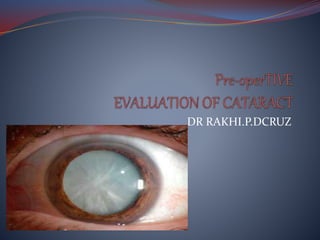
DR RAKHI.P.DCRUZ
PRE-OPERATIVE ASSESSMENT
 OCULAR HISTORY
 SYSTEMIC HISTORY
 OCULAR EXAMINATION
 OCULAR INVESTIGATIONS
 LABOROTARY INVESTIGATIONS
OCULAR HISTORY
 Ocular Symptoms Like Blurring Of Vision,coloured
Halos,diplopia,glare
 Nuclear Cataract-distant> Near
 Posterior Subcapsular-near>distant
 Duration And Progression
 H/O Of Previous Intraocular Disease
 H/O Previous Cataract Surgery
 H/O Intraocular Injuries
SYSTEMIC HISTORY
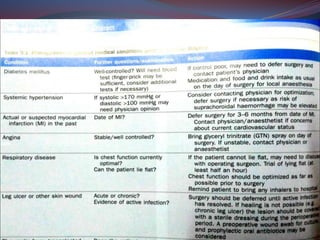
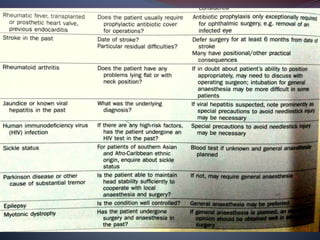
 H/o of all systemic diseases,current medications
patient is on..
 Medications relevant to eye surgery
 Systemic alpha blockers(tamsulosin)-floppy iris
syndrome
 Antiplatelets and anticoagulants
 Antihypertensives like diuretics-electrolyte imbalances
 Long term steroids-delayed healing
 Drug allergy to sulfonamides and other antibiotics
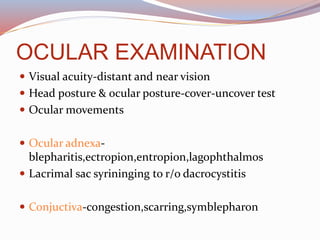
OCULAR EXAMINATION
 Visual acuity-distant and near vision
 Head posture & ocular posture-cover-uncover test
 Ocular movements
 Ocular adnexa-
blepharitis,ectropion,entropion,lagophthalmos
 Lacrimal sac syrininging to r/o dacrocystitis
 Conjuctiva-congestion,scarring,symblepharon
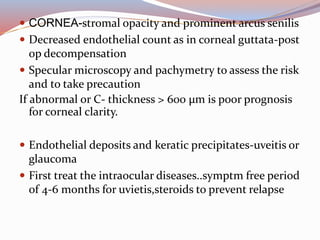
 CORNEA-stromal opacity and prominent arcus senilis
 Decreased endothelial count as in corneal guttata-post
op decompensation
 Specular microscopy and pachymetry to assess the risk
and to take precaution
If abnormal or C- thickness > 600 µm is poor prognosis
for corneal clarity.
 Endothelial deposits and keratic precipitates-uveitis or
glaucoma
 First treat the intraocular diseases..symptm free period
of 4-6 months for uvietis,steroids to prevent relapse
ANTERIOR CHAMBER-Shallow (intumescent of lens or
forward displacement by posterior pathology)
. Gonioscopy to rule out the angle abnormalities
(synechia, neovascularization).
 PUPIL-
 Reacting promptly to light-both direst and consensual
 Presence of RAPD-Implies substantial additional
pathology
 Readily dilating with mydriatics
lens
 Size of lens nucleus and grading of nuclear sclerosis-
for planning size of incision and type of surgery
 Nuclear cataract are harder and need more power with
phaco
 Black nuclear opacity-extremely dense-ECCE
 Postr polar cataract-prevent posterior capsular
dehiscence and subsequent vitreous disturbances-
avoid HYDRODISSECTION
 ZONULAR APPARATUS –examine under mydriasis.
 Pseudoexfoliation weak zonule, fragile capsule
& poor mydriasis
 SCLERA-prominent explant/encircling band for prior
RD
 OR
 Eye is particularly large/sclera is thin-peri an
retrobulbar local anesthesia should be avoided
FUNDUS EXAMINATION
A thorough fundus examination is important.
Retinal and optic nerve function must be assessed pre-
op,Because if it is defective operation becomes
valueless.
Pathology such as ARMD,RETINAL DETACHMENT Can
adversely affect visual outcome..hence a thorough
fundus evaluation is important.
In eyes with very dense opacity,when fundus cannot be
seen 5 tests are of value
 1.PROJECTION OF LIGHT
 2.2 POINT LIGHT DISCRIMINATION
 3.MADDOX ROD
 4.ENTOPIC VIEW OF RETINA
 5.USG B SCAN-r/o vitreous haemorrage,retinal
detachment,intraocular tumour & posterior
staphyloma.
 Foveal ERG
INTRAOCULAR PRESSURE
 Can be raised due to swellin of lens in INCIPIENT
STAGE/due to phacolytic glaucomain which case
extraction is indicated.
 Primary glaucoma can be pre-excistent
 If galucoma glaucome medically controlled-lens
extraction
 If NOT,perform a trabeculectomy followed by cataract
extracion/combined procedure.
REFRACTIVE ERROR
 Its critical to obtain patients pre-operative refractive
status in order to guide IOL implant selection.
 BIOMETRY facilitate calculation of lens power likely to
result in desired post op refractory outcome.
 It involves 1.Keratometry 2.A SCAN
 AXIAL LENGTH-curvature of anterior corneal surface
calculation by interferometry apparatus.
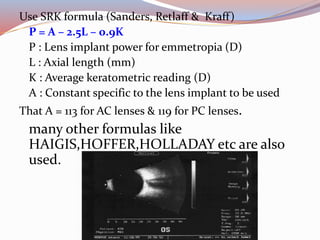
Use SRK formula (Sanders, Retlaff & Kraff)
P = A – 2.5L – 0.9K
P : Lens implant power for emmetropia (D)
L : Axial length (mm)
K : Average keratometric reading (D)
A : Constant specific to the lens implant to be used
That A = 113 for AC lenses & 119 for PC lenses.
many other formulas like
HAIGIS,HOFFER,HOLLADAY etc are also
used.
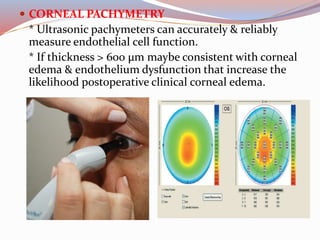
 CORNEAL PACHYMETRY
* Ultrasonic pachymeters can accurately & reliably
measure endothelial cell function.
* If thickness > 600 µm maybe consistent with corneal
edema & endothelium dysfunction that increase the
likelihood postoperative clinical corneal edema.
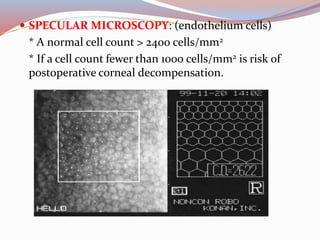
 SPECULAR MICROSCOPY: (endothelium cells)
* A normal cell count > 2400 cells/mm2
* If a cell count fewer than 1000 cells/mm2 is risk of
postoperative corneal decompensation.
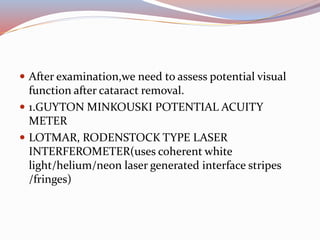
 After examination,we need to assess potential visual
function after cataract removal.
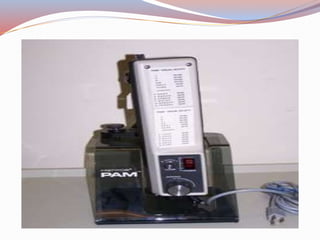
 1.GUYTON MINKOUSKI POTENTIAL ACUITY
METER
 LOTMAR, RODENSTOCK TYPE LASER
INTERFEROMETER(uses coherent white
light/helium/neon laser generated interface stripes
/fringes)
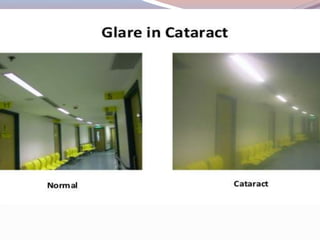
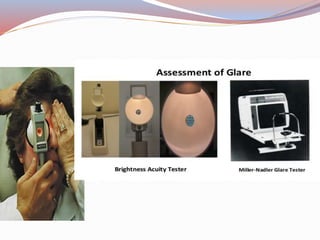
GLARE DISABILITY TESTING
 Brightness acuity tester
 or
 Miller nadler glare testing device
 Simple alternative is snellens chart kept indoor and
outdoor in sunlight or a penlight shining obliquely
towards pupil.
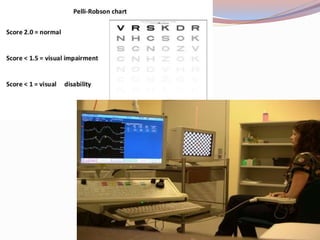
Contrast sensitivity
 Contrast sensitivity drops with cataract
 Wallmount charts for testing (PELLI ROBSON ,TERRY
CHARTS)
 VEP(VISUALY EVOKED POTENTIAL) is more specific
and it require intact macula and optic nerve besides
cortical centre.
INFORMED WRITTEN CONSENT
 Patient should give full informed written consent
before catarcat surgery.
 1 in 1000-achieves very little or no sight
 1 in 10000-lose eye completely
 Mild complications-periocular echymosis,raised
IOP,mild iridocyclitis,wound leak.
 Moderate-posterior capsular rupture,zonular
dehiscence,corneal decompensation,CME,RD(1%)
 SEVERE-
ENDOPTHALMITIS(0.1%)SUPRACHOROIDAL HGE
LAB INVESTIGATIONS
 NORMAL-RBS,ECG,SCREENING,BP,XTD
 XRAY,URINE R/E,BRE,RFT,APTT,PT INR-in patients
with individual risk factors or planned for general
aneasthesia,
 Preop-antibiotic eye drops QID-3 DAYS PRIOR TO SX.
 ANTIANXIETY DRUGS if pt apprehensive
 Preparing eye-cutting lashes
 Asked to take a normal meal,normal sleep,normal
bath,continue systemic medications .
Thank you...
Pre operative analysis for cataract surgery

Pre operative analysis for cataract surgery

  • 1.
  • 2.
    PRE-OPERATIVE ASSESSMENT  OCULARHISTORY  SYSTEMIC HISTORY  OCULAR EXAMINATION  OCULAR INVESTIGATIONS  LABOROTARY INVESTIGATIONS
  • 3.
    OCULAR HISTORY  OcularSymptoms Like Blurring Of Vision,coloured Halos,diplopia,glare  Nuclear Cataract-distant> Near  Posterior Subcapsular-near>distant  Duration And Progression  H/O Of Previous Intraocular Disease  H/O Previous Cataract Surgery  H/O Intraocular Injuries
  • 4.
    SYSTEMIC HISTORY  H/oof all systemic diseases,current medications patient is on..  Medications relevant to eye surgery  Systemic alpha blockers(tamsulosin)-floppy iris syndrome  Antiplatelets and anticoagulants  Antihypertensives like diuretics-electrolyte imbalances  Long term steroids-delayed healing  Drug allergy to sulfonamides and other antibiotics
  • 7.
    OCULAR EXAMINATION  Visualacuity-distant and near vision  Head posture & ocular posture-cover-uncover test  Ocular movements  Ocular adnexa- blepharitis,ectropion,entropion,lagophthalmos  Lacrimal sac syrininging to r/o dacrocystitis  Conjuctiva-congestion,scarring,symblepharon
  • 8.
     CORNEA-stromal opacityand prominent arcus senilis  Decreased endothelial count as in corneal guttata-post op decompensation  Specular microscopy and pachymetry to assess the risk and to take precaution If abnormal or C- thickness > 600 µm is poor prognosis for corneal clarity.  Endothelial deposits and keratic precipitates-uveitis or glaucoma  First treat the intraocular diseases..symptm free period of 4-6 months for uvietis,steroids to prevent relapse
  • 9.
    ANTERIOR CHAMBER-Shallow (intumescentof lens or forward displacement by posterior pathology) . Gonioscopy to rule out the angle abnormalities (synechia, neovascularization).  PUPIL-  Reacting promptly to light-both direst and consensual  Presence of RAPD-Implies substantial additional pathology  Readily dilating with mydriatics
  • 10.
    lens  Size oflens nucleus and grading of nuclear sclerosis- for planning size of incision and type of surgery  Nuclear cataract are harder and need more power with phaco  Black nuclear opacity-extremely dense-ECCE  Postr polar cataract-prevent posterior capsular dehiscence and subsequent vitreous disturbances- avoid HYDRODISSECTION
  • 11.
     ZONULAR APPARATUS–examine under mydriasis.  Pseudoexfoliation weak zonule, fragile capsule & poor mydriasis  SCLERA-prominent explant/encircling band for prior RD  OR  Eye is particularly large/sclera is thin-peri an retrobulbar local anesthesia should be avoided
  • 12.
    FUNDUS EXAMINATION A thoroughfundus examination is important. Retinal and optic nerve function must be assessed pre- op,Because if it is defective operation becomes valueless. Pathology such as ARMD,RETINAL DETACHMENT Can adversely affect visual outcome..hence a thorough fundus evaluation is important. In eyes with very dense opacity,when fundus cannot be seen 5 tests are of value
  • 13.
     1.PROJECTION OFLIGHT  2.2 POINT LIGHT DISCRIMINATION  3.MADDOX ROD  4.ENTOPIC VIEW OF RETINA  5.USG B SCAN-r/o vitreous haemorrage,retinal detachment,intraocular tumour & posterior staphyloma.  Foveal ERG
  • 14.
    INTRAOCULAR PRESSURE  Canbe raised due to swellin of lens in INCIPIENT STAGE/due to phacolytic glaucomain which case extraction is indicated.  Primary glaucoma can be pre-excistent  If galucoma glaucome medically controlled-lens extraction  If NOT,perform a trabeculectomy followed by cataract extracion/combined procedure.
  • 15.
    REFRACTIVE ERROR  Itscritical to obtain patients pre-operative refractive status in order to guide IOL implant selection.  BIOMETRY facilitate calculation of lens power likely to result in desired post op refractory outcome.  It involves 1.Keratometry 2.A SCAN  AXIAL LENGTH-curvature of anterior corneal surface calculation by interferometry apparatus.
  • 16.
    Use SRK formula(Sanders, Retlaff & Kraff) P = A – 2.5L – 0.9K P : Lens implant power for emmetropia (D) L : Axial length (mm) K : Average keratometric reading (D) A : Constant specific to the lens implant to be used That A = 113 for AC lenses & 119 for PC lenses. many other formulas like HAIGIS,HOFFER,HOLLADAY etc are also used.
  • 17.
     CORNEAL PACHYMETRY *Ultrasonic pachymeters can accurately & reliably measure endothelial cell function. * If thickness > 600 µm maybe consistent with corneal edema & endothelium dysfunction that increase the likelihood postoperative clinical corneal edema.
  • 18.
     SPECULAR MICROSCOPY:(endothelium cells) * A normal cell count > 2400 cells/mm2 * If a cell count fewer than 1000 cells/mm2 is risk of postoperative corneal decompensation.
  • 19.
     After examination,weneed to assess potential visual function after cataract removal.  1.GUYTON MINKOUSKI POTENTIAL ACUITY METER  LOTMAR, RODENSTOCK TYPE LASER INTERFEROMETER(uses coherent white light/helium/neon laser generated interface stripes /fringes)
  • 21.
    GLARE DISABILITY TESTING Brightness acuity tester  or  Miller nadler glare testing device  Simple alternative is snellens chart kept indoor and outdoor in sunlight or a penlight shining obliquely towards pupil.
  • 24.
    Contrast sensitivity  Contrastsensitivity drops with cataract  Wallmount charts for testing (PELLI ROBSON ,TERRY CHARTS)  VEP(VISUALY EVOKED POTENTIAL) is more specific and it require intact macula and optic nerve besides cortical centre.
  • 26.
    INFORMED WRITTEN CONSENT Patient should give full informed written consent before catarcat surgery.  1 in 1000-achieves very little or no sight  1 in 10000-lose eye completely  Mild complications-periocular echymosis,raised IOP,mild iridocyclitis,wound leak.  Moderate-posterior capsular rupture,zonular dehiscence,corneal decompensation,CME,RD(1%)  SEVERE- ENDOPTHALMITIS(0.1%)SUPRACHOROIDAL HGE
  • 27.
    LAB INVESTIGATIONS  NORMAL-RBS,ECG,SCREENING,BP,XTD XRAY,URINE R/E,BRE,RFT,APTT,PT INR-in patients with individual risk factors or planned for general aneasthesia,  Preop-antibiotic eye drops QID-3 DAYS PRIOR TO SX.  ANTIANXIETY DRUGS if pt apprehensive  Preparing eye-cutting lashes  Asked to take a normal meal,normal sleep,normal bath,continue systemic medications .
  • 28.