Pseudo-exfoliation Glaucoma Presented By: Fahad  H. Al Hulaibi King Faisal University
Introduction a systemic disorder in which a fibrillar, proteinaceous substance is produced in abnormally high concentrations within ocular tissues.   It is the most common cause of secondary glaucoma worldwide. can lead to rapid progression of optic nerve damage. Risk Factors
epidemiology In a U.S. population, the overall prevalence of pseudoexfoliation Glaucoma 12% of over all Glaucomas. more common in females than in males. Risk Factors
What is Pseudo-exfoliation syndrome   primarily ocular manifestations characterized by deposition of  whitish-gray protein  on: the lens. iris. ciliary epithelium. corneal endothelium. and trabecular meshwork. Risk Factors
The material is insoluble and floats in the aqueous humor. This accumulation  can decreases aqueous humor outflow and increases IOP. not every individual with pseudoexfoliation syndrome will develop pseudoexfoliation glaucoma. Risk Factors
Risk Factors 3 /1 in women than in men . > 50 years. living at higher altitudes or in northern latitudes. open-angle glaucoma. Risk Factors
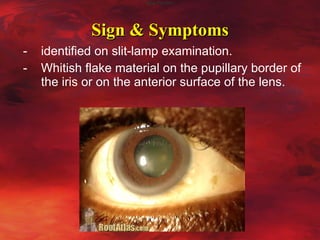
Sign & Symptoms identified on slit-lamp examination. Whitish flake material on the pupillary border of the iris or on the anterior surface of the lens. Risk Factors
Pigment granula from the pigmented layer of the iris are seen dispersed on the iris stroma and at the pupillary margin with mydriasis.
 
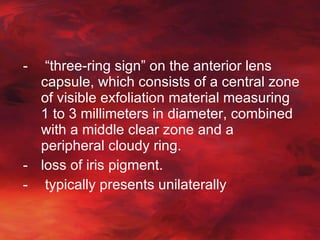
 “ three-ring sign” on the anterior lens capsule, which consists of a central zone of visible exfoliation material measuring 1 to 3 millimeters in diameter, combined with a middle clear zone and a peripheral cloudy ring. loss of iris pigment.   typically presents unilaterally
Elevated IOP leads to glaucoma . Gonioscopy reveals a discontinuous pigmentation of the trabecular meshwork. Poor pupillary response Risk Factors Pigment granula accumulate in the chamber angle.
Work up A slit-lamp exam. IOP measurement. gonioscopy : for pigment deposition. dilated fundus exam . Visual field testing : may has  peripheral visual field loss. OCT:  allows the retinal nerve fiber layer to be assessed for any changes. HRT:   is another imaging study that can provide measurements of the optic disc and retinal nerve fiber layer. Risk Factors
Differential  Diagnosis Pigmentary glaucoma. In yunger age, vertical pigment band & a radial distribution of the midperipheral iris Primary open-angle glaucoma. Amyloidosis. nonocular symptoms. Exfoliation. occurs after chronic exposure to intense heat Risk Factors
Treatment first-line therapy: beta blockers, selective alpha2-receptor agonists, topical and systemic carbonic anhydrase inhibitors, prostaglandin agonists and sympathomimetics. Risk Factors
Treatment 2.  next line of therapy: argon laser trabeculoplasty Risk Factors
Prognosis -  worse prognosis:  because the IOP is high relative to POAG. poor response to medication : leads to faster optic nerve damage increased risk of developing cataracts. Postoperative complications of cataract extraction. Retinal vein occlusion Risk Factors
References American Academic of ophthalmology, Diagnosis and Management of Pseudoexfoliation Glaucoma,  By Christopher P. Majka, MD, and Pratap Challa, MD  Edited by Ingrid U. Scott, MD, MPH, and Sharon Fekrat, MD. Medscabe , Pseudoexfoliation Glaucoma Follow-up , Author: Mauricio E Pons, MD; Chief Editor: Hampton Roy Sr, MD
Thank you

Pseudoexfoliation glaucoma

  • 1.
    Pseudo-exfoliation Glaucoma PresentedBy: Fahad H. Al Hulaibi King Faisal University
  • 2.
    Introduction a systemicdisorder in which a fibrillar, proteinaceous substance is produced in abnormally high concentrations within ocular tissues.   It is the most common cause of secondary glaucoma worldwide. can lead to rapid progression of optic nerve damage. Risk Factors
  • 3.
    epidemiology In aU.S. population, the overall prevalence of pseudoexfoliation Glaucoma 12% of over all Glaucomas. more common in females than in males. Risk Factors
  • 4.
    What is Pseudo-exfoliationsyndrome   primarily ocular manifestations characterized by deposition of whitish-gray protein on: the lens. iris. ciliary epithelium. corneal endothelium. and trabecular meshwork. Risk Factors
  • 5.
    The material isinsoluble and floats in the aqueous humor. This accumulation can decreases aqueous humor outflow and increases IOP. not every individual with pseudoexfoliation syndrome will develop pseudoexfoliation glaucoma. Risk Factors
  • 6.
    Risk Factors 3/1 in women than in men . > 50 years. living at higher altitudes or in northern latitudes. open-angle glaucoma. Risk Factors
  • 7.
    Sign & Symptomsidentified on slit-lamp examination. Whitish flake material on the pupillary border of the iris or on the anterior surface of the lens. Risk Factors
  • 8.
    Pigment granula fromthe pigmented layer of the iris are seen dispersed on the iris stroma and at the pupillary margin with mydriasis.
  • 9.
  • 10.
     “ three-ring sign”on the anterior lens capsule, which consists of a central zone of visible exfoliation material measuring 1 to 3 millimeters in diameter, combined with a middle clear zone and a peripheral cloudy ring. loss of iris pigment.   typically presents unilaterally
  • 11.
    Elevated IOP leadsto glaucoma . Gonioscopy reveals a discontinuous pigmentation of the trabecular meshwork. Poor pupillary response Risk Factors Pigment granula accumulate in the chamber angle.
  • 12.
    Work up Aslit-lamp exam. IOP measurement. gonioscopy : for pigment deposition. dilated fundus exam . Visual field testing : may has  peripheral visual field loss. OCT: allows the retinal nerve fiber layer to be assessed for any changes. HRT:  is another imaging study that can provide measurements of the optic disc and retinal nerve fiber layer. Risk Factors
  • 13.
    Differential DiagnosisPigmentary glaucoma. In yunger age, vertical pigment band & a radial distribution of the midperipheral iris Primary open-angle glaucoma. Amyloidosis. nonocular symptoms. Exfoliation. occurs after chronic exposure to intense heat Risk Factors
  • 14.
    Treatment first-line therapy:beta blockers, selective alpha2-receptor agonists, topical and systemic carbonic anhydrase inhibitors, prostaglandin agonists and sympathomimetics. Risk Factors
  • 15.
    Treatment 2.  nextline of therapy: argon laser trabeculoplasty Risk Factors
  • 16.
    Prognosis - worse prognosis: because the IOP is high relative to POAG. poor response to medication : leads to faster optic nerve damage increased risk of developing cataracts. Postoperative complications of cataract extraction. Retinal vein occlusion Risk Factors
  • 17.
    References American Academicof ophthalmology, Diagnosis and Management of Pseudoexfoliation Glaucoma,  By Christopher P. Majka, MD, and Pratap Challa, MD  Edited by Ingrid U. Scott, MD, MPH, and Sharon Fekrat, MD. Medscabe , Pseudoexfoliation Glaucoma Follow-up , Author: Mauricio E Pons, MD; Chief Editor: Hampton Roy Sr, MD
  • 18.