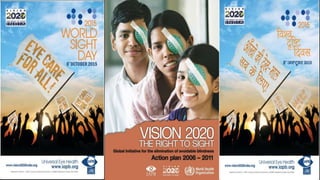
VISION 2020
SIVATEJA CHALLA
LAY OUT
 INTRODUCTION
 CAUSES FOR AVOIDABLE BLINDNESS
 VISION 2020 INDIA-VISION AND MISSION
 STRATEGY
 STRUCTURE
 SPECIFIC ACTIVITIES
INTRODUCTION
 Avoidable blindness has been defined as blindness that
could reasonably be prevented or cured within the limits
of resources
 Approximately 80% of all blindness is considered to be
avoidable.
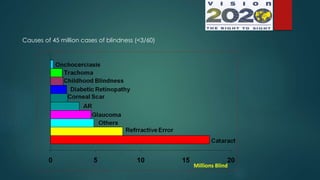
 According to WHO estimate 45 million people are blind
in the World as of 2000
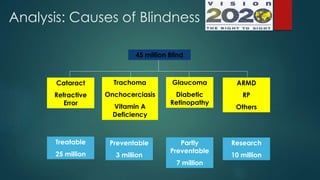
Causes of 45 million cases of blindness (<3/60)
Millions Blind
 Every year, an additional 1-2 million persons go blind.
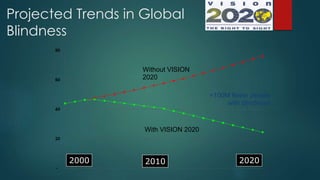
 Without proper interventions the number of blind will
increase to 75 million by 2020.
 Restoration of sight is one of the most cost-effective
interventions in health care.
Ministries
of Health
International
NGOs
February 18, 1999
Projected Trends in Global
Blindness
2000 2010 2020
Without VISION
2020
With VISION 2020
=100M fewer people
with blindness
Analysis: Causes of Blindness
45 million Blind
Cataract
Refractive
Error
Trachoma
Onchocerciasis
Vitamin A
Deficiency
Glaucoma
Diabetic
Retinopathy
ARMD
RP
Others
Treatable
25 million
Preventable
3 million
Partly
Preventable
7 million
Research
10 million
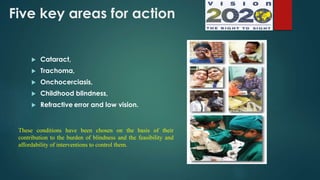
Five key areas for action
 Cataract,
 Trachoma,
 Onchocerciasis,
 Childhood blindness,
 Refractive error and low vision.
These conditions have been chosen on the basis of their
contribution to the burden of blindness and the feasibility and
affordability of interventions to control them.
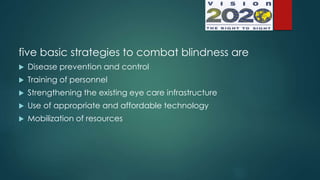
five basic strategies to combat blindness are
 Disease prevention and control
 Training of personnel
 Strengthening the existing eye care infrastructure
 Use of appropriate and affordable technology
 Mobilization of resources
IN INDIA…
 Aims to Eliminate Avoidable Blindness from India
 The National Forum (VISION 2020: The Right to Sight INDIA) is a key
driver, formed in 2004
 An India free of avoidable blindness
 Where every citizen enjoys the gift of sight
 And the visually challenged have enhanced
quality of life as a right
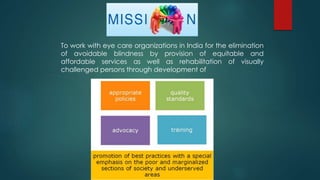
To work with eye care organizations in India for the elimination
of avoidable blindness by provision of equitable and
affordable services as well as rehabilitation of visually
challenged persons through development of
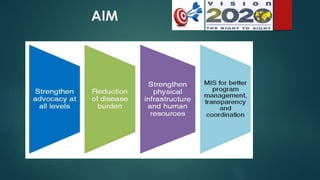
AIM
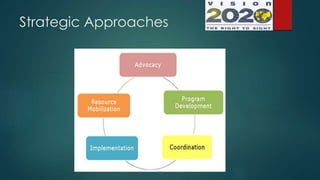
Strategic Approaches
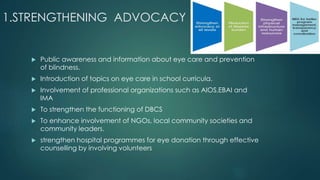
1.STRENGTHENING ADVOCACY
 Public awareness and information about eye care and prevention
of blindness.
 Introduction of topics on eye care in school curricula.
 Involvement of professional organizations such as AIOS,EBAI and
IMA
 To strengthen the functioning of DBCS
 To enhance involvement of NGOs, local community societies and
community leaders.
 strengthen hospital programmes for eye donation through effective
counselling by involving volunteers
2.REDUCTION OF DISEASE
BURDEN
Target diseases identified for intervention under
‘Vision 2020’ initiative in India include:
 Cataract
 Childhood blindness
 Refractive errors and low vision
 Corneal blindness
 Diabetic retinopathy
 Glaucoma
 Trachoma (focal)
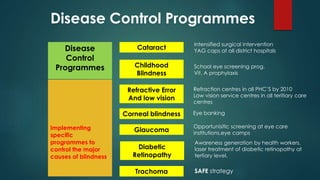
Implementing
specific
programmes to
control the major
causes of blindness.
Disease
Control
Programmes
Cataract
Refractive Error
And low vision
Diabetic
Retinopathy
Glaucoma
Trachoma
Childhood
Blindness
SAFE strategy
Intensified surgical intervention
YAG caps at all district hospitals
Disease Control Programmes
School eye screening prog.
Vit. A prophylaxis
Refraction centres in all PHC’S by 2010
Low vision service centres in all teritiary care
centres
Opportunisitic screening at eye care
institutions,eye camps
Awareness generation by health workers.
laser treatment of diabetic retinopathy at
tertiary level.
Corneal blindness Eye banking
Cataract
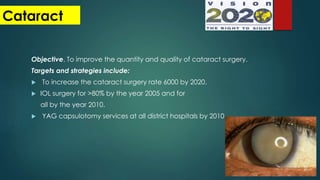
Objective. To improve the quantity and quality of cataract surgery.
Targets and strategies include:
 To increase the cataract surgery rate 6000 by 2020.
 IOL surgery for >80% by the year 2005 and for
all by the year 2010.
 YAG capsulotomy services at all district hospitals by 2010
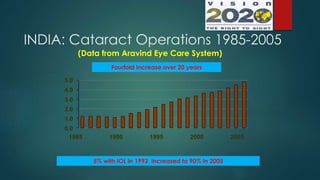
INDIA: Cataract Operations 1985-2005
(Data from Aravind Eye Care System)
0.0
1.0
2.0
3.0
4.0
5.0
5% with IOL in 1993 increased to 90% in 2005
Fourfold Increase over 20 years
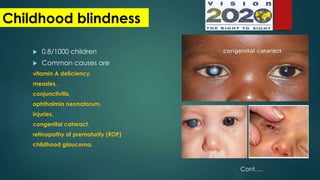
 0.8/1000 children
 Common causes are
vitamin A deficiency,
measles,
conjunctivitis,
ophthalmia neonatorum,
injuries,
congenital cataract,
retinopathy of prematurity (ROP)
childhood glaucoma.
Childhood blindness
Cont….
•To identify areas where childhood blindness from preventable disease is
common and to encourage preventive measures, for example:
(a) Measles immunization;
(b) Vitamin A supplementation;
(c) Nutrition education;
(d) Avoidance of harmful traditional practices;
(e) Monitoring of use of oxygen in newborns.
•To provide specialist training and services for the management of
surgically remediable visual loss in children from:
(a) Congenital cataract;
(b) Congenital glaucoma;
(c) Corneal scar;
(d) Retinopathy of prematurity.
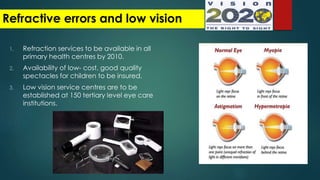
Refractive errors and low vision
1. Refraction services to be available in all
primary health centres by 2010.
2. Availability of low- cost, good quality
spectacles for children to be insured.
3. Low vision service centres are to be
established at 150 tertiary level eye care
institutions.
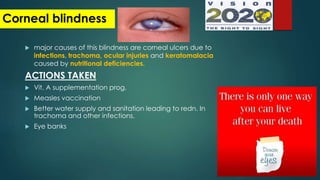
 major causes of this blindness are corneal ulcers due to
infections, trachoma, ocular injuries and keratomalacia
caused by nutritional deficiencies.
ACTIONS TAKEN
 Vit. A supplementation prog.
 Measles vaccination
 Better water supply and sanitation leading to redn. In
trachoma and other infections.
 Eye banks
Corneal blindness
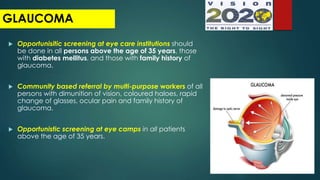
 Opportunisitic screening at eye care institutions should
be done in all persons above the age of 35 years, those
with diabetes mellitus, and those with family history of
glaucoma.
 Community based referral by multi-purpose workers of all
persons with dimunition of vision, coloured haloes, rapid
change of glasses, ocular pain and family history of
glaucoma.
 Opportunistic screening at eye camps in all patients
above the age of 35 years.
GLAUCOMA
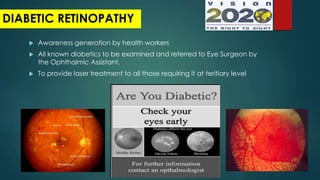
 Awareness generation by health workers
 All known diabetics to be examined and referred to Eye Surgeon by
the Ophthalmic Assistant.
 To provide laser treatment to all those requiring it at teritiary level
DIABETIC RETINOPATHY
 S surgery to correct lid deformities and prevent blindness
 A antibiotics
 F facial hygiene
 E environmental hygiene
TRACHOMA
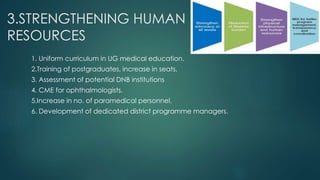
3.STRENGTHENING HUMAN
RESOURCES
1. Uniform curriculum in UG medical education.
2.Training of postgraduates, increase in seats,
3. Assessment of potential DNB institutions
4. CME for ophthalmologists.
5.Increase in no. of paramedical personnel.
6. Development of dedicated district programme managers.
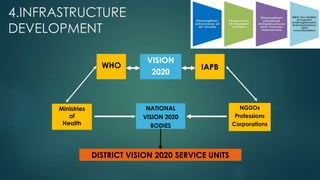
4.INFRASTRUCTURE
DEVELOPMENT
WHO
VISION
2020
NGDOs
Professions
Corporations
NATIONAL
VISION 2020
BODIES
IAPB
Ministries
of
Health
DISTRICT VISION 2020 SERVICE UNITS
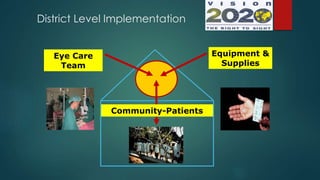
District Level Implementation
Eye Care
Team
Equipment &
Supplies
Community-Patients
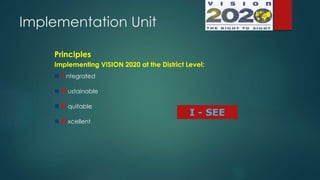
Principles
Implementing VISION 2020 at the District Level:
 I ntegrated
 S ustainable
 E quitable
 E xcellent
Implementation Unit
I - SEE
Infrastructure Development
•Development of district-level eye care services, with primary eye care
integrated into the PHC system for a population of between 0.5 and 2 million
people.
•To provide practitioners, hospitals and clinics with information on
good-quality and affordable appropriate technology.
•To provide appropriate donated equipment to countries which cannot
afford its purchase.
•To assist users to evaluate, select and purchase appropriate equipment
using methods which will help to prolong its useful life.
•To introduce new technologies such as computers and computer networks
to improve management efficiency and information exchange.
•Conduct feasibility studies on new technologies to ensure cost-
effectiveness.
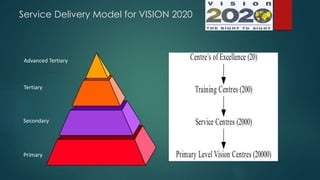
Service Delivery Model for VISION 2020
Primary
Secondary
Tertiary
Advanced Tertiary
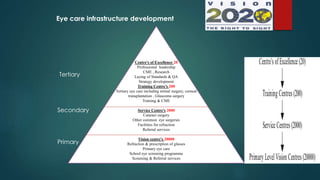
Eye care infrastructure development
Centre's of Excellence 20
Professional leadership
CME , Research
Laying of Standards & QA
Strategy development
Training Centre's 200
Tertiary eye care including retinal surgery, corneal
transplantation , Glaucoma surgery
Training & CME
Service Centre's 2000
Cataract surgery
Other common eye surgeries
Facilities for refraction
Referral services
Vision centre's 20000
Refraction & prescription of glasses
Primary eye care
School eye screening programme
Screening & Referral services
Primary
Secondary
Tertiary
Useful resources
 http://www.vision2020.org/main.cfm
 http://www.iceh.org.uk
 http://www.iapb.org/
 http://www.who.int/blindness/partnerships/vision2020/en/
 www.v2020eresource.org
 www.seeingisbelieving.org.uk
 www.worldblindunion.org
 www.sightsavers.org
 www.cbm.org
 www.icoph.org
THANK YOU!

Vision 2020

  • 1.
  • 2.
    LAY OUT  INTRODUCTION CAUSES FOR AVOIDABLE BLINDNESS  VISION 2020 INDIA-VISION AND MISSION  STRATEGY  STRUCTURE  SPECIFIC ACTIVITIES
  • 3.
    INTRODUCTION  Avoidable blindnesshas been defined as blindness that could reasonably be prevented or cured within the limits of resources  Approximately 80% of all blindness is considered to be avoidable.  According to WHO estimate 45 million people are blind in the World as of 2000
  • 4.
    Causes of 45million cases of blindness (<3/60) Millions Blind
  • 5.
     Every year,an additional 1-2 million persons go blind.  Without proper interventions the number of blind will increase to 75 million by 2020.  Restoration of sight is one of the most cost-effective interventions in health care.
  • 6.
  • 7.
    Projected Trends inGlobal Blindness 2000 2010 2020 Without VISION 2020 With VISION 2020 =100M fewer people with blindness
  • 8.
    Analysis: Causes ofBlindness 45 million Blind Cataract Refractive Error Trachoma Onchocerciasis Vitamin A Deficiency Glaucoma Diabetic Retinopathy ARMD RP Others Treatable 25 million Preventable 3 million Partly Preventable 7 million Research 10 million
  • 9.
    Five key areasfor action  Cataract,  Trachoma,  Onchocerciasis,  Childhood blindness,  Refractive error and low vision. These conditions have been chosen on the basis of their contribution to the burden of blindness and the feasibility and affordability of interventions to control them.
  • 10.
    five basic strategiesto combat blindness are  Disease prevention and control  Training of personnel  Strengthening the existing eye care infrastructure  Use of appropriate and affordable technology  Mobilization of resources
  • 11.
    IN INDIA…  Aimsto Eliminate Avoidable Blindness from India  The National Forum (VISION 2020: The Right to Sight INDIA) is a key driver, formed in 2004
  • 12.
     An Indiafree of avoidable blindness  Where every citizen enjoys the gift of sight  And the visually challenged have enhanced quality of life as a right
  • 13.
    To work witheye care organizations in India for the elimination of avoidable blindness by provision of equitable and affordable services as well as rehabilitation of visually challenged persons through development of
  • 14.
  • 15.
  • 16.
    1.STRENGTHENING ADVOCACY  Publicawareness and information about eye care and prevention of blindness.  Introduction of topics on eye care in school curricula.  Involvement of professional organizations such as AIOS,EBAI and IMA  To strengthen the functioning of DBCS  To enhance involvement of NGOs, local community societies and community leaders.  strengthen hospital programmes for eye donation through effective counselling by involving volunteers
  • 17.
    2.REDUCTION OF DISEASE BURDEN Targetdiseases identified for intervention under ‘Vision 2020’ initiative in India include:  Cataract  Childhood blindness  Refractive errors and low vision  Corneal blindness  Diabetic retinopathy  Glaucoma  Trachoma (focal)
  • 18.
    Implementing specific programmes to control themajor causes of blindness. Disease Control Programmes Cataract Refractive Error And low vision Diabetic Retinopathy Glaucoma Trachoma Childhood Blindness SAFE strategy Intensified surgical intervention YAG caps at all district hospitals Disease Control Programmes School eye screening prog. Vit. A prophylaxis Refraction centres in all PHC’S by 2010 Low vision service centres in all teritiary care centres Opportunisitic screening at eye care institutions,eye camps Awareness generation by health workers. laser treatment of diabetic retinopathy at tertiary level. Corneal blindness Eye banking
  • 19.
    Cataract Objective. To improvethe quantity and quality of cataract surgery. Targets and strategies include:  To increase the cataract surgery rate 6000 by 2020.  IOL surgery for >80% by the year 2005 and for all by the year 2010.  YAG capsulotomy services at all district hospitals by 2010
  • 20.
    INDIA: Cataract Operations1985-2005 (Data from Aravind Eye Care System) 0.0 1.0 2.0 3.0 4.0 5.0 5% with IOL in 1993 increased to 90% in 2005 Fourfold Increase over 20 years
  • 21.
     0.8/1000 children Common causes are vitamin A deficiency, measles, conjunctivitis, ophthalmia neonatorum, injuries, congenital cataract, retinopathy of prematurity (ROP) childhood glaucoma. Childhood blindness Cont….
  • 22.
    •To identify areaswhere childhood blindness from preventable disease is common and to encourage preventive measures, for example: (a) Measles immunization; (b) Vitamin A supplementation; (c) Nutrition education; (d) Avoidance of harmful traditional practices; (e) Monitoring of use of oxygen in newborns. •To provide specialist training and services for the management of surgically remediable visual loss in children from: (a) Congenital cataract; (b) Congenital glaucoma; (c) Corneal scar; (d) Retinopathy of prematurity.
  • 23.
    Refractive errors andlow vision 1. Refraction services to be available in all primary health centres by 2010. 2. Availability of low- cost, good quality spectacles for children to be insured. 3. Low vision service centres are to be established at 150 tertiary level eye care institutions.
  • 24.
     major causesof this blindness are corneal ulcers due to infections, trachoma, ocular injuries and keratomalacia caused by nutritional deficiencies. ACTIONS TAKEN  Vit. A supplementation prog.  Measles vaccination  Better water supply and sanitation leading to redn. In trachoma and other infections.  Eye banks Corneal blindness
  • 25.
     Opportunisitic screeningat eye care institutions should be done in all persons above the age of 35 years, those with diabetes mellitus, and those with family history of glaucoma.  Community based referral by multi-purpose workers of all persons with dimunition of vision, coloured haloes, rapid change of glasses, ocular pain and family history of glaucoma.  Opportunistic screening at eye camps in all patients above the age of 35 years. GLAUCOMA
  • 26.
     Awareness generationby health workers  All known diabetics to be examined and referred to Eye Surgeon by the Ophthalmic Assistant.  To provide laser treatment to all those requiring it at teritiary level DIABETIC RETINOPATHY
  • 27.
     S surgeryto correct lid deformities and prevent blindness  A antibiotics  F facial hygiene  E environmental hygiene TRACHOMA
  • 28.
    3.STRENGTHENING HUMAN RESOURCES 1. Uniformcurriculum in UG medical education. 2.Training of postgraduates, increase in seats, 3. Assessment of potential DNB institutions 4. CME for ophthalmologists. 5.Increase in no. of paramedical personnel. 6. Development of dedicated district programme managers.
  • 29.
  • 30.
    District Level Implementation EyeCare Team Equipment & Supplies Community-Patients
  • 31.
    Principles Implementing VISION 2020at the District Level:  I ntegrated  S ustainable  E quitable  E xcellent Implementation Unit I - SEE
  • 32.
    Infrastructure Development •Development ofdistrict-level eye care services, with primary eye care integrated into the PHC system for a population of between 0.5 and 2 million people. •To provide practitioners, hospitals and clinics with information on good-quality and affordable appropriate technology. •To provide appropriate donated equipment to countries which cannot afford its purchase. •To assist users to evaluate, select and purchase appropriate equipment using methods which will help to prolong its useful life. •To introduce new technologies such as computers and computer networks to improve management efficiency and information exchange. •Conduct feasibility studies on new technologies to ensure cost- effectiveness.
  • 33.
    Service Delivery Modelfor VISION 2020 Primary Secondary Tertiary Advanced Tertiary
  • 34.
    Eye care infrastructuredevelopment Centre's of Excellence 20 Professional leadership CME , Research Laying of Standards & QA Strategy development Training Centre's 200 Tertiary eye care including retinal surgery, corneal transplantation , Glaucoma surgery Training & CME Service Centre's 2000 Cataract surgery Other common eye surgeries Facilities for refraction Referral services Vision centre's 20000 Refraction & prescription of glasses Primary eye care School eye screening programme Screening & Referral services Primary Secondary Tertiary
  • 35.
    Useful resources  http://www.vision2020.org/main.cfm http://www.iceh.org.uk  http://www.iapb.org/  http://www.who.int/blindness/partnerships/vision2020/en/  www.v2020eresource.org  www.seeingisbelieving.org.uk  www.worldblindunion.org  www.sightsavers.org  www.cbm.org  www.icoph.org
  • 37.