CASE PRESENTATION
Presenter- Dr. Ajinkya Kulkarni
Moderator- Dr. Rita Dhamankar
 Age- 8 years
 Sex- Female
 Address- At post somtane Panvel
Chief complaints
First day-06/08/2013
 Informant - Mother
 (LE) Bigger than (RE) since childhood
History of presenting illness
 Apparently 8 days back she had history of fall, when
she noticed diminution of vision in left eye
 No ho pain , redness, watering.
 No ho trauma
 No ho similar complaints in the other eye.
 BIRTH HISTORY
 Full term normal delivery born out of non
consanguineous marriage
 No h/o any delayed milestones
 No h/o antenatal maternal infection
• PAST HISTORY
No history of any treatment taken in past.
• FAMILY HISTORY
Not significant
 GENERAL PHYSICAL EXAMINATION-
 Normal
 SYSTEMIC EXAMINATION-
 Normal
Ocular examination
 Head posture- Erect
 Facial symmetry- symmetrical
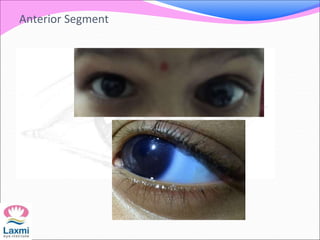
 Left eye looks bigger than the right eye.
Anterior Segment
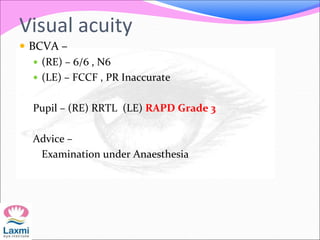
Visual acuity
 BCVA –
 (RE) – 6/6 , N6
 (LE) – FCCF , PR Inaccurate
Pupil – (RE) RRTL (LE) RAPD Grade 3
Advice –
Examination under Anaesthesia
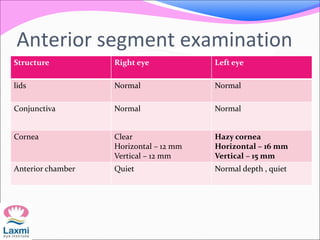
Structure Right eye Left eye
lids Normal Normal
Conjunctiva Normal Normal
Cornea Clear
Horizontal – 12 mm
Vertical – 12 mm
Hazy cornea
Horizontal – 16 mm
Vertical – 15 mm
Anterior chamber Quiet Normal depth , quiet
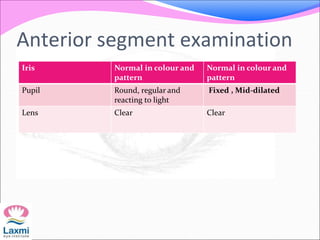
Anterior segment examination
Iris Normal in colour and
pattern
Normal in colour and
pattern
Pupil Round, regular and
reacting to light
Fixed , Mid-dilated
Lens Clear Clear
Intraocular pressure
 On Perkins tonometer-
(RE) – 14 mmhg
(LE) – 40mmhg
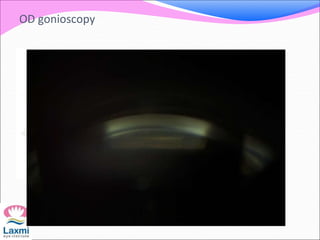
OD gonioscopy
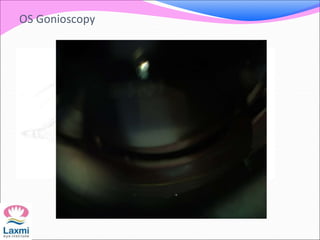
OS Gonioscopy
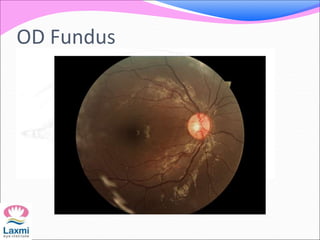
OD Fundus
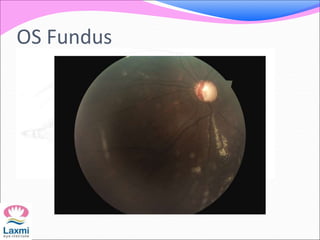
OS Fundus
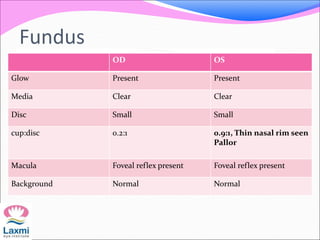
Fundus
OD OS
Glow Present Present
Media Clear Clear
Disc Small Small
cup:disc 0.2:1 0.9:1, Thin nasal rim seen
Pallor
Macula Foveal reflex present Foveal reflex present
Background Normal Normal
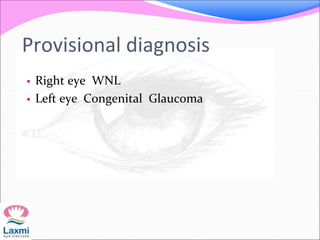
Provisional diagnosis
 Right eye WNL
 Left eye Congenital Glaucoma
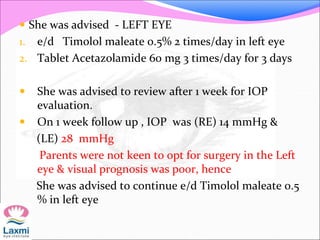
 She was advised - LEFT EYE
1. e/d Timolol maleate 0.5% 2 times/day in left eye
2. Tablet Acetazolamide 60 mg 3 times/day for 3 days
 She was advised to review after 1 week for IOP
evaluation.
 On 1 week follow up , IOP was (RE) 14 mmHg &
(LE) 28 mmHg
Parents were not keen to opt for surgery in the Left
eye & visual prognosis was poor, hence
She was advised to continue e/d Timolol maleate 0.5
% in left eye
 Subsequently patient was followed up with intervals
of 2-3 months for IOP evaluation.
 Her IOP was well controlled throughout.
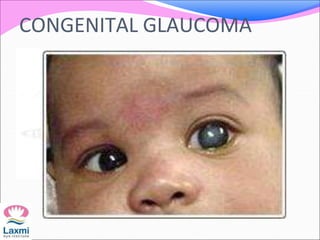
CONGENITAL GLAUCOMA
Definition
 Relating to age of onset
 Congenital glaucoma: The glaucoma exists at birth,
and usually before birth.
 Infantile glaucoma: Occurs from birth until 3 years of
life.
 Juvenile glaucoma: Occurs after the age of 3 to
teenage years
 Developmental glaucoma: Glaucoma associated with
developmental anomalies of the eye present at birth.
 Primary developmental glaucoma: Resulting from
maldevelopment of the aqueous outflow system.
 Secondary developmental glaucoma: Resulting
from damage to the aqueous outflow system due to
maldevelopment of some other portion of the eye,
e.g., angle closure due to pupillary block in a small
eye, or an eye with microspherophakia or dislocated
lens; or as a forward shift of the lens-iris diaphragm in
persistent hyperplastic primary vitreous or
retinopathy of prematurity.
Epidemiology & Demographics
 Incidence – one in 10-15,000 live birth
 75% cases bilateral,
 65% are male
 75 % present in 1st year of life
Genetics
 Most of cases are sporadic.
 Transmission pattern is autosomal recessive.
 Many cases shows polygenic transmission
 Two genetic loci GLC3A, CYP1B1 gene on it and GLC3C ,
LTBP2 gene on it have been identified
Classification
1. Primary glaucomas
A. Congenital open angle glaucoma
B. Juvenile glaucoma
C. Associated with ocular abnormalities
D. Associated with systemic abnormalities
A. Chromosomal disorders
B. Connective tissue abnormalities
C. Metabolic disease
D. Phacomatoses
E. Other
2. Secondary glaucomas
A. Traumatic glaucoma
B. Secondary to intraocular neoplasm
C. Secondary to uveitis
D. Lens – induced glaucoma
E. After surgery for congenital cataract
F. Steroid induced glaucoma
G. Secondary to rubeosis
H. Secondary angle closure glaucoma
I. Malignant glaucoma
J. Associated with raised intra ocular pressure
Shaffer-Weiss classification
1. Isolated congenital glaucoma (infantile glaucoma)
2. Glaucomas associated with congenital anomalies
1. Aniridia
2. Sturge-Weber syndrome
3. Neurofibromatosis
4. Marfan syndrome
5. Pierre Robin syndrome
6. Homocystinuria
7. Goniodysgenesis
8. Lowe’s syndrome
9. Microspherophakia , PHPV
3. Acquired glaucomas in infants
1. Retrolental fibroplasia
2. Tumors- retinoblastoma, juvenile xanthogranuloma
Hoskin’s anatomical classification
 1. Goniodysgenesis,
 2 Trabeculodysgenesis,
 3. Irido-dysgenesis and
 4. Corneodysgenesis
Development of Anterior Chamber angle –
Theories
1. Atrophy or resorption (i.e. progressive
disappearance of portions of fetal tissue)
2. Cleavage (i.e. separation of to preexisting tissue
layers due to differential growth rates)
3. Rarefaction (i.e. mechanical distention due to
growth of the anterior ocular segment)
 Anderson – at 5months of gestation, anterior surface
of iris inserts at the edge of corneal endothelium,
covering the cells which will finally form the TM –
fetal pectinate ligament
 Later the iris and ciliary body recede posteriorly and
the iris insertion and ciliary body overlap the
posterior portion of the trabecular meshwork.
Theories of abnormal development in congenital
glaucoma
 Mann (1928)- incomplete atrophy of anterior
chamber mesoderm
 Barkan(1955) - formation of membrane.
 Allen et al.(1955)- incomplete cleavage of mesoderm
in angle
 Maumenee (1959) -abnormal anterior insertion of
the ciliary musculature into TM
 Smelser and Ozanics(1971) -failure of rearrangement
of angle structures into normal trabecular meshwork
 Isolated trabeculodysgenesis is the hallmark of
primary developmental glaucoma.
 Isolated trabeculodysgenesis
 Flat iris insertion
 Anterior insertion
 Posterior insertion
 Mixed insertion
Concave (wrap-around) iris insertion
 Iridotrabeculodysgenesis
 Anterior stromal defects
 Hypoplasia
 Hyperplasia
 Anomalous iris vessels
 Persistence of tunica vasculosa lentis
 Anomalous superficial vessels
 Structural anomalies
 Holes
 Colobomata
 Aniridia
 Corneotrabeculodysgenesis
 Peripheral, e.g., Axenfeld’s anomaly
 Midperipheral, e.g., Rieger’s anomaly
 Central e.g., Peter’s anomaly, anterior
staphyloma, AC cleavage syndrome, or
posterior corneal ulcer of von Hippel
 Corneal size, e.g., microcornea or macrocornea

What Happens
Raised IOP
Rapid
enlargement
of eye
Stretching of
cornea
Breaks in
Descemet’s
membrane
Endothelial
barrier is
disturbed
Corneal
oedema and
clouding
Clinical features
 Classic Triad of symptoms
1. Epiphora
2. Photophobia
3. Blepharospasm
 Sclera – thin ,appears blue due to underlying uveal tissue.
 Lens - flat due to stretching of zonules and subluxate.
 Optic disc may show variable cupping and atrophy
especially after third year which is reversible after IOP
control.
 Axial myopia may occur because of increase in axial
length which may give rise to anisometropic ambylopia.
EUA
1. Refraction - using streak retinoscope
2. Corneal findings
3. IOP
4. Gonioscopy
5. Ophthalmoscopy
Corneal findings
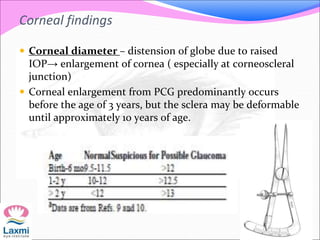
 Corneal diameter – distension of globe due to raised
IOP→ enlargement of cornea ( especially at corneoscleral
junction)
 Corneal enlargement from PCG predominantly occurs
before the age of 3 years, but the sclera may be deformable
until approximately 10 years of age.
Corneal findings
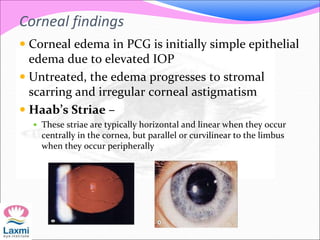
 Corneal edema in PCG is initially simple epithelial
edema due to elevated IOP
 Untreated, the edema progresses to stromal
scarring and irregular corneal astigmatism
 Haab’s Striae –
 These striae are typically horizontal and linear when they occur
centrally in the cornea, but parallel or curvilinear to the limbus
when they occur peripherally
IOP
 The type of anesthesia and the type of tonometer are
important.
 Halothane may falsely underestimate
 Ketamine may over estimate IOP.
 IOP should be checked immediately after intubation
to avoid falsely low recordings
Tonometer
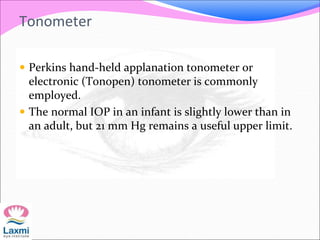
 Perkins hand-held applanation tonometer or
electronic (Tonopen) tonometer is commonly
employed.
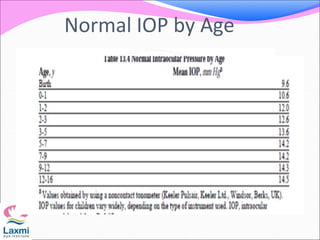
 The normal IOP in an infant is slightly lower than in
an adult, but 21 mm Hg remains a useful upper limit.
Normal IOP by Age
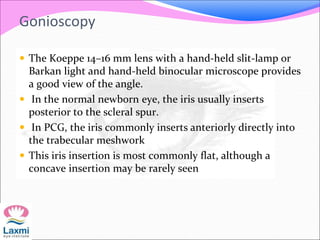
Gonioscopy
 The Koeppe 14–16 mm lens with a hand-held slit-lamp or
Barkan light and hand-held binocular microscope provides
a good view of the angle.
 In the normal newborn eye, the iris usually inserts
posterior to the scleral spur.
 In PCG, the iris commonly inserts anteriorly directly into
the trabecular meshwork
 This iris insertion is most commonly flat, although a
concave insertion may be rarely seen
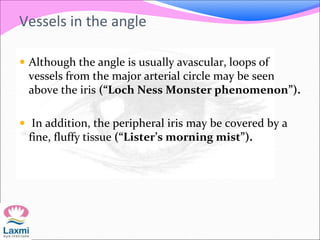
Vessels in the angle
 Although the angle is usually avascular, loops of
vessels from the major arterial circle may be seen
above the iris (“Loch Ness Monster phenomenon”).
 In addition, the peripheral iris may be covered by a
fine, fluffy tissue (“Lister’s morning mist”).
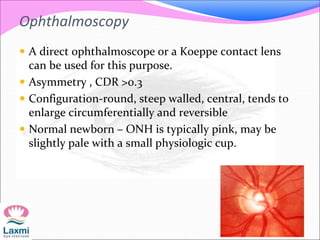
Ophthalmoscopy
 A direct ophthalmoscope or a Koeppe contact lens
can be used for this purpose.
 Asymmetry , CDR >0.3
 Configuration-round, steep walled, central, tends to
enlarge circumferentially and reversible
 Normal newborn – ONH is typically pink, may be
slightly pale with a small physiologic cup.
Interpretation of examination findings
 In most cases, after completion of EUA, the findings of
corneal enlargement, optic nerve head changes and
buphthalmos are so typical of PCG that there is little
doubt about the diagnosis and the need for surgery.
 If the IOP is normal and the other findings are present,
one can assume that the IOP is artifactually lowered under
anesthesia, and still secure the diagnosis and proceed with
surgery.
 If ocular enlargement and optic nerve cupping are not
typical or are absent, it is appropriate to postpone the
diagnosis and treatment until a repeat EUA is performed
after 3–4 weeks to confirm any progression.
Differential Diagnosis
 Disorders causing red-eye or epiphora
a) Congenital Nasolacrimal duct obstruction
b) Conjunctivitis
c) Corneal epithelial defect/abrasion
d) Keratitis
e) Inflammed anterior segment (uveitis, trauma)
 Conditions showing corneal enlargement
A. Axial myopia
B. Megalocornea
 D/d of Corneal edema/opacification
A. Forceps related birth trauma
B. Congenital anomaly
1. Sclerocornea
2. Peter’s anomaly
C. Corneal dystrophy
A. Congenital hereditary endothelial dystrophy
B. Posterior Polymorphous dystrophy
D. Keratitis
A. Herpetic
B. Rubella
E. Storage (metabolic) disorder
A. Mucopolysaccharidosis
B. Mucolipidoses
 Conditions with actual or pseudo ONH cupping
A. Physiological
B. Coloboma or pit
C. Atrophic optic nerve
Medical management
 Beta-blockers:
 The drug should be used with extreme caution in
neonates due to the possibility of apnea and other
systemic side effects.
 Cardiac abnormalities and bronchial asthma should be
specifically excluded before its use.
 Use of 0.25%, rather than 0.5%, is recommended in
children in order to reduce its side effects;
 The 0.25% formulation is not widely available. Hence,
0.5% timolol can be used with punctal occlusion.
 CAIs –
 In addition, growth suppression in children has been
associated with oral acetazolamide therapy, and infants
may experience a severe metabolic acidosis.
 Oral administration of acetazolamide suspension at a
dosage of 10 (range 5–15) mg/kg/day given in divided
doses (three times daily) is safe and well tolerated by
children, lowers IOP and may reduce corneal edema as
a prelude to surgery .
 Topical CAI’s seem to do well in children & in older
children a fixed combination of timolol with
dorzolamide is a good option for use.
 Prostaglandin analogues are not studied adequately
in children.
 Only 1/3rd of the children with Glaucoma responded
to latanoprost.
 Alpha agonists: cross the blood brain barrier easily
& result in CNS depression & respiratory depression.
 Hypotension, bradycardia, unresponsiveness,
hypotonia, & hypothermia are seen in children.
 Non recovery from anaesthesia & death have also
been recorded.
 Hence they are a NO
Surgical management
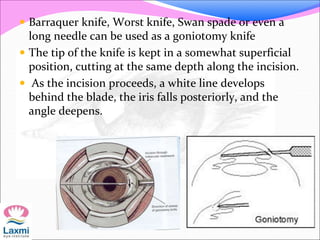
1. Goniotomy was once the treatment of choice.
 Otto Barkan (1936) -- using a specially designed glass
contact lens to visualise the angle structures while using a
knife to create an internal cleft in the trabecular tissue called
the "goniotomy"
The objective of goniotomy is to incise the obstructing
tissue that causes the retention of aqueous.
 Barraquer knife, Worst knife, Swan spade or even a
long needle can be used as a goniotomy knife
 The tip of the knife is kept in a somewhat superficial
position, cutting at the same depth along the incision.
 As the incision proceeds, a white line develops
behind the blade, the iris falls posteriorly, and the
angle deepens.
Trabeculotomy-trabeculectomy
 Combined trabeculotomy–trabeculectomy is safe
and effective in advanced primary developmental
glaucoma with corneal diameter 14 mm or more.
 Mandal et al reported 624 eyes of 360 consecutive
patients who underwent primary combined
trabeculotomy–trabeculectomy for primary
developmental glaucoma between January 1990 and
June 2004.
 They concluded that prolonged IOP control can be
achieved in patients with primary developmental
glaucoma and 42% of the patients gained normal visual
acuity.
Management of Refractory Pediatric
Glaucomas
 When the IOP is not controlled after the first surgery, the
surgical options are filtration surgery with anti-fibrosis
drugs, glaucoma drainage implants or cyclodestructive
procedures.
 Trabeculectomy with mitomycin-C as the primary surgery
is not preferred because of the potential complications of
mitomycin-C and also because of the reported higher
success rates of alternative procedures like combined
trabeculotomy–trabeculectomy.
 We may consider filtering surgery with antimetabolites, a
useful option in refractory congenital glaucoma with
previously suboptimal primary surgical results
Refractory Glaucomas
 The use of drainage devices & cyclo destructive
procedures may be resorted to, in refractory cases to
bring down the IOP.
Management of Residual Vision in
Pediatric Glaucoma
 Visual rehabilitation and low vision aids can help
these children lead a normal or near-normal life.
 telescopes (hand-held or spectacle-mounted)
 hand or pocket magnifiers (2× to 3×)
THANK YOU

Congenital glaucoma

  • 1.
    CASE PRESENTATION Presenter- Dr.Ajinkya Kulkarni Moderator- Dr. Rita Dhamankar
  • 2.
     Age- 8years  Sex- Female  Address- At post somtane Panvel
  • 3.
    Chief complaints First day-06/08/2013 Informant - Mother  (LE) Bigger than (RE) since childhood
  • 4.
    History of presentingillness  Apparently 8 days back she had history of fall, when she noticed diminution of vision in left eye
  • 5.
     No hopain , redness, watering.  No ho trauma  No ho similar complaints in the other eye.
  • 6.
     BIRTH HISTORY Full term normal delivery born out of non consanguineous marriage  No h/o any delayed milestones  No h/o antenatal maternal infection
  • 7.
    • PAST HISTORY Nohistory of any treatment taken in past. • FAMILY HISTORY Not significant
  • 8.
     GENERAL PHYSICALEXAMINATION-  Normal  SYSTEMIC EXAMINATION-  Normal
  • 9.
    Ocular examination  Headposture- Erect  Facial symmetry- symmetrical  Left eye looks bigger than the right eye.
  • 10.
  • 11.
    Visual acuity  BCVA–  (RE) – 6/6 , N6  (LE) – FCCF , PR Inaccurate Pupil – (RE) RRTL (LE) RAPD Grade 3 Advice – Examination under Anaesthesia
  • 12.
    Structure Right eyeLeft eye lids Normal Normal Conjunctiva Normal Normal Cornea Clear Horizontal – 12 mm Vertical – 12 mm Hazy cornea Horizontal – 16 mm Vertical – 15 mm Anterior chamber Quiet Normal depth , quiet Anterior segment examination
  • 13.
    Anterior segment examination IrisNormal in colour and pattern Normal in colour and pattern Pupil Round, regular and reacting to light Fixed , Mid-dilated Lens Clear Clear
  • 14.
    Intraocular pressure  OnPerkins tonometer- (RE) – 14 mmhg (LE) – 40mmhg
  • 15.
  • 16.
  • 17.
  • 18.
  • 19.
    Fundus OD OS Glow PresentPresent Media Clear Clear Disc Small Small cup:disc 0.2:1 0.9:1, Thin nasal rim seen Pallor Macula Foveal reflex present Foveal reflex present Background Normal Normal
  • 20.
    Provisional diagnosis  Righteye WNL  Left eye Congenital Glaucoma
  • 21.
     She wasadvised - LEFT EYE 1. e/d Timolol maleate 0.5% 2 times/day in left eye 2. Tablet Acetazolamide 60 mg 3 times/day for 3 days  She was advised to review after 1 week for IOP evaluation.  On 1 week follow up , IOP was (RE) 14 mmHg & (LE) 28 mmHg Parents were not keen to opt for surgery in the Left eye & visual prognosis was poor, hence She was advised to continue e/d Timolol maleate 0.5 % in left eye
  • 22.
     Subsequently patientwas followed up with intervals of 2-3 months for IOP evaluation.  Her IOP was well controlled throughout.
  • 23.
  • 24.
    Definition  Relating toage of onset  Congenital glaucoma: The glaucoma exists at birth, and usually before birth.  Infantile glaucoma: Occurs from birth until 3 years of life.  Juvenile glaucoma: Occurs after the age of 3 to teenage years
  • 25.
     Developmental glaucoma:Glaucoma associated with developmental anomalies of the eye present at birth.  Primary developmental glaucoma: Resulting from maldevelopment of the aqueous outflow system.  Secondary developmental glaucoma: Resulting from damage to the aqueous outflow system due to maldevelopment of some other portion of the eye, e.g., angle closure due to pupillary block in a small eye, or an eye with microspherophakia or dislocated lens; or as a forward shift of the lens-iris diaphragm in persistent hyperplastic primary vitreous or retinopathy of prematurity.
  • 26.
    Epidemiology & Demographics Incidence – one in 10-15,000 live birth  75% cases bilateral,  65% are male  75 % present in 1st year of life
  • 27.
    Genetics  Most ofcases are sporadic.  Transmission pattern is autosomal recessive.  Many cases shows polygenic transmission  Two genetic loci GLC3A, CYP1B1 gene on it and GLC3C , LTBP2 gene on it have been identified
  • 28.
    Classification 1. Primary glaucomas A.Congenital open angle glaucoma B. Juvenile glaucoma C. Associated with ocular abnormalities D. Associated with systemic abnormalities A. Chromosomal disorders B. Connective tissue abnormalities C. Metabolic disease D. Phacomatoses E. Other
  • 29.
    2. Secondary glaucomas A.Traumatic glaucoma B. Secondary to intraocular neoplasm C. Secondary to uveitis D. Lens – induced glaucoma E. After surgery for congenital cataract F. Steroid induced glaucoma G. Secondary to rubeosis H. Secondary angle closure glaucoma I. Malignant glaucoma J. Associated with raised intra ocular pressure
  • 30.
    Shaffer-Weiss classification 1. Isolatedcongenital glaucoma (infantile glaucoma) 2. Glaucomas associated with congenital anomalies 1. Aniridia 2. Sturge-Weber syndrome 3. Neurofibromatosis 4. Marfan syndrome 5. Pierre Robin syndrome 6. Homocystinuria 7. Goniodysgenesis 8. Lowe’s syndrome 9. Microspherophakia , PHPV 3. Acquired glaucomas in infants 1. Retrolental fibroplasia 2. Tumors- retinoblastoma, juvenile xanthogranuloma
  • 31.
    Hoskin’s anatomical classification 1. Goniodysgenesis,  2 Trabeculodysgenesis,  3. Irido-dysgenesis and  4. Corneodysgenesis
  • 32.
    Development of AnteriorChamber angle – Theories 1. Atrophy or resorption (i.e. progressive disappearance of portions of fetal tissue) 2. Cleavage (i.e. separation of to preexisting tissue layers due to differential growth rates) 3. Rarefaction (i.e. mechanical distention due to growth of the anterior ocular segment)
  • 33.
     Anderson –at 5months of gestation, anterior surface of iris inserts at the edge of corneal endothelium, covering the cells which will finally form the TM – fetal pectinate ligament  Later the iris and ciliary body recede posteriorly and the iris insertion and ciliary body overlap the posterior portion of the trabecular meshwork.
  • 34.
    Theories of abnormaldevelopment in congenital glaucoma  Mann (1928)- incomplete atrophy of anterior chamber mesoderm  Barkan(1955) - formation of membrane.  Allen et al.(1955)- incomplete cleavage of mesoderm in angle  Maumenee (1959) -abnormal anterior insertion of the ciliary musculature into TM  Smelser and Ozanics(1971) -failure of rearrangement of angle structures into normal trabecular meshwork
  • 35.
     Isolated trabeculodysgenesisis the hallmark of primary developmental glaucoma.  Isolated trabeculodysgenesis  Flat iris insertion  Anterior insertion  Posterior insertion  Mixed insertion Concave (wrap-around) iris insertion
  • 36.
     Iridotrabeculodysgenesis  Anteriorstromal defects  Hypoplasia  Hyperplasia  Anomalous iris vessels  Persistence of tunica vasculosa lentis  Anomalous superficial vessels  Structural anomalies  Holes  Colobomata  Aniridia
  • 37.
     Corneotrabeculodysgenesis  Peripheral,e.g., Axenfeld’s anomaly  Midperipheral, e.g., Rieger’s anomaly  Central e.g., Peter’s anomaly, anterior staphyloma, AC cleavage syndrome, or posterior corneal ulcer of von Hippel  Corneal size, e.g., microcornea or macrocornea 
  • 38.
    What Happens Raised IOP Rapid enlargement ofeye Stretching of cornea Breaks in Descemet’s membrane Endothelial barrier is disturbed Corneal oedema and clouding
  • 39.
    Clinical features  ClassicTriad of symptoms 1. Epiphora 2. Photophobia 3. Blepharospasm
  • 40.
     Sclera –thin ,appears blue due to underlying uveal tissue.  Lens - flat due to stretching of zonules and subluxate.  Optic disc may show variable cupping and atrophy especially after third year which is reversible after IOP control.  Axial myopia may occur because of increase in axial length which may give rise to anisometropic ambylopia.
  • 41.
    EUA 1. Refraction -using streak retinoscope 2. Corneal findings 3. IOP 4. Gonioscopy 5. Ophthalmoscopy
  • 42.
    Corneal findings  Cornealdiameter – distension of globe due to raised IOP→ enlargement of cornea ( especially at corneoscleral junction)  Corneal enlargement from PCG predominantly occurs before the age of 3 years, but the sclera may be deformable until approximately 10 years of age.
  • 43.
    Corneal findings  Cornealedema in PCG is initially simple epithelial edema due to elevated IOP  Untreated, the edema progresses to stromal scarring and irregular corneal astigmatism  Haab’s Striae –  These striae are typically horizontal and linear when they occur centrally in the cornea, but parallel or curvilinear to the limbus when they occur peripherally
  • 44.
    IOP  The typeof anesthesia and the type of tonometer are important.  Halothane may falsely underestimate  Ketamine may over estimate IOP.  IOP should be checked immediately after intubation to avoid falsely low recordings
  • 45.
    Tonometer  Perkins hand-heldapplanation tonometer or electronic (Tonopen) tonometer is commonly employed.  The normal IOP in an infant is slightly lower than in an adult, but 21 mm Hg remains a useful upper limit.
  • 46.
  • 47.
    Gonioscopy  The Koeppe14–16 mm lens with a hand-held slit-lamp or Barkan light and hand-held binocular microscope provides a good view of the angle.  In the normal newborn eye, the iris usually inserts posterior to the scleral spur.  In PCG, the iris commonly inserts anteriorly directly into the trabecular meshwork  This iris insertion is most commonly flat, although a concave insertion may be rarely seen
  • 48.
    Vessels in theangle  Although the angle is usually avascular, loops of vessels from the major arterial circle may be seen above the iris (“Loch Ness Monster phenomenon”).  In addition, the peripheral iris may be covered by a fine, fluffy tissue (“Lister’s morning mist”).
  • 49.
    Ophthalmoscopy  A directophthalmoscope or a Koeppe contact lens can be used for this purpose.  Asymmetry , CDR >0.3  Configuration-round, steep walled, central, tends to enlarge circumferentially and reversible  Normal newborn – ONH is typically pink, may be slightly pale with a small physiologic cup.
  • 50.
    Interpretation of examinationfindings  In most cases, after completion of EUA, the findings of corneal enlargement, optic nerve head changes and buphthalmos are so typical of PCG that there is little doubt about the diagnosis and the need for surgery.  If the IOP is normal and the other findings are present, one can assume that the IOP is artifactually lowered under anesthesia, and still secure the diagnosis and proceed with surgery.  If ocular enlargement and optic nerve cupping are not typical or are absent, it is appropriate to postpone the diagnosis and treatment until a repeat EUA is performed after 3–4 weeks to confirm any progression.
  • 51.
    Differential Diagnosis  Disorderscausing red-eye or epiphora a) Congenital Nasolacrimal duct obstruction b) Conjunctivitis c) Corneal epithelial defect/abrasion d) Keratitis e) Inflammed anterior segment (uveitis, trauma)  Conditions showing corneal enlargement A. Axial myopia B. Megalocornea
  • 52.
     D/d ofCorneal edema/opacification A. Forceps related birth trauma B. Congenital anomaly 1. Sclerocornea 2. Peter’s anomaly C. Corneal dystrophy A. Congenital hereditary endothelial dystrophy B. Posterior Polymorphous dystrophy D. Keratitis A. Herpetic B. Rubella E. Storage (metabolic) disorder A. Mucopolysaccharidosis B. Mucolipidoses
  • 53.
     Conditions withactual or pseudo ONH cupping A. Physiological B. Coloboma or pit C. Atrophic optic nerve
  • 54.
    Medical management  Beta-blockers: The drug should be used with extreme caution in neonates due to the possibility of apnea and other systemic side effects.  Cardiac abnormalities and bronchial asthma should be specifically excluded before its use.  Use of 0.25%, rather than 0.5%, is recommended in children in order to reduce its side effects;  The 0.25% formulation is not widely available. Hence, 0.5% timolol can be used with punctal occlusion.
  • 55.
     CAIs – In addition, growth suppression in children has been associated with oral acetazolamide therapy, and infants may experience a severe metabolic acidosis.  Oral administration of acetazolamide suspension at a dosage of 10 (range 5–15) mg/kg/day given in divided doses (three times daily) is safe and well tolerated by children, lowers IOP and may reduce corneal edema as a prelude to surgery .  Topical CAI’s seem to do well in children & in older children a fixed combination of timolol with dorzolamide is a good option for use.
  • 56.
     Prostaglandin analoguesare not studied adequately in children.  Only 1/3rd of the children with Glaucoma responded to latanoprost.  Alpha agonists: cross the blood brain barrier easily & result in CNS depression & respiratory depression.  Hypotension, bradycardia, unresponsiveness, hypotonia, & hypothermia are seen in children.  Non recovery from anaesthesia & death have also been recorded.  Hence they are a NO
  • 57.
    Surgical management 1. Goniotomywas once the treatment of choice.  Otto Barkan (1936) -- using a specially designed glass contact lens to visualise the angle structures while using a knife to create an internal cleft in the trabecular tissue called the "goniotomy" The objective of goniotomy is to incise the obstructing tissue that causes the retention of aqueous.
  • 58.
     Barraquer knife,Worst knife, Swan spade or even a long needle can be used as a goniotomy knife  The tip of the knife is kept in a somewhat superficial position, cutting at the same depth along the incision.  As the incision proceeds, a white line develops behind the blade, the iris falls posteriorly, and the angle deepens.
  • 59.
    Trabeculotomy-trabeculectomy  Combined trabeculotomy–trabeculectomyis safe and effective in advanced primary developmental glaucoma with corneal diameter 14 mm or more.  Mandal et al reported 624 eyes of 360 consecutive patients who underwent primary combined trabeculotomy–trabeculectomy for primary developmental glaucoma between January 1990 and June 2004.  They concluded that prolonged IOP control can be achieved in patients with primary developmental glaucoma and 42% of the patients gained normal visual acuity.
  • 60.
    Management of RefractoryPediatric Glaucomas  When the IOP is not controlled after the first surgery, the surgical options are filtration surgery with anti-fibrosis drugs, glaucoma drainage implants or cyclodestructive procedures.  Trabeculectomy with mitomycin-C as the primary surgery is not preferred because of the potential complications of mitomycin-C and also because of the reported higher success rates of alternative procedures like combined trabeculotomy–trabeculectomy.  We may consider filtering surgery with antimetabolites, a useful option in refractory congenital glaucoma with previously suboptimal primary surgical results
  • 61.
    Refractory Glaucomas  Theuse of drainage devices & cyclo destructive procedures may be resorted to, in refractory cases to bring down the IOP.
  • 62.
    Management of ResidualVision in Pediatric Glaucoma  Visual rehabilitation and low vision aids can help these children lead a normal or near-normal life.  telescopes (hand-held or spectacle-mounted)  hand or pocket magnifiers (2× to 3×)
  • 63.