Neovascular Glaucoma
Dr Sunil kumar
Assistant professor
Department of ophthalmology
Patna Medical college , Patna
What is NVG? Define NVG.
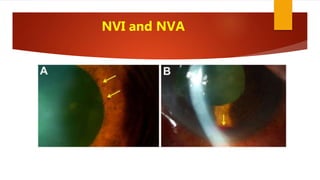
 This is a condition of new vessel development on iris (NVI) &
neovascularization on angle (NVA) ,
 Followed by fibrovascular tissue proliferation in the Angle
 ,Obstructing outflow at angle , that results rise of IOP
 That condition is principally driven by Retinal Anoxia .
A condition of New vessels development
Nomenclature history of NVG
 Rubeosis iridis was first described by Coats with CRVO in
1906.[1]
 This condition was called previously by different names such as
1. Rubeotic glaucoma
2. Diabetic hemorrhagic glaucoma
3. Congestive glaucoma
4. Thrombotic glaucoma
 In 1963 Weiss et.al named it as Neo Vascular Glaucoma
in relation NVI and rise in IOP
Conditions that causes retinal anoxia
lead to angiogenic activity in eye*.
Mainly are
 PDR
 CRVO
 Ocular ischemic syndrome (OIS)
 and other uncommon causes that causes
Retinal hypoxia
1.Diabetic retinopathy
2.Central retinal vein occlusion (CRVO)
3.Ocular ischemic syndrome (OIS)
Etiopathogenesis : common causes
1. Uveitis
2. Ocular radiation / intra ocular tumor
3. Trauma
4. Crohn’s disease ;
This is an inflammatory bowel disease (IBD) of GIT. But aloso causes
anemia and Vasculitis)
1. Bechet’s disease :
This is a rare disorder that causes Vasculitis throughout body.
Etiopathogenesis ; uncommon causes
(C) Miscellaneous retinal conditions
Coat’s disease
Eales’ disease
Frosted branch angiitis
Giant cell astrocytoma of the retina
Peripheral retinal detachment
X-linked retinoschisis (Rosenfeld et al. 1998)
Etiopathogenesis
(D) Systemic diseases
1) Cryoglobulinemia:Small vessel vasculitis
 Cryoglobulins Protein deposited in blood vessel endothelium
 Complementary pathway is activated that damage endothelium.
2) Churg-Strauss syndrome: Small vessel vasculitis –
where blood flow to organ and tissue is restricted.
3) Miscellaneous ; those condition cause retinal vascular occlusion
Etiopathogenesis
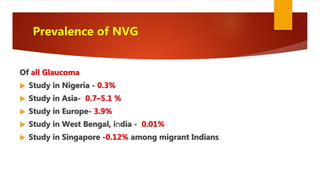
Prevalence of NVG
Of all Glaucoma
 Study in Nigeria - 0.3%
 Study in Asia- 0.7–5.1 %
 Study in Europe- 3.9%
 Study in West Bengal, india - 0.01%
 Study in Singapore -0.12% among migrant Indians
Neovascular Glaucoma
Although the Overall prevalence is low
0.01 to 5.1% of all glaucoma
but it is a dreadful condition
Which lead to blindness.
Neovascular Glaucoma
Therefore
Early detection
&
close monitoring
Is must to encounter blindness due to
NVG
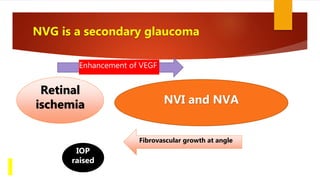
NVG is a secondary glaucoma
Retinal
ischemia NVI and NVA
Enhancement of VEGF
Fibrovascular growth at angle
IOP
raised
Etiopathogenesis
Newly formed blood vessels on Iris
move over the angle towards the CB and the SS spur
Than further move over towards the trabecular
meshwork . And obstruct outflow of aqueous.
in NVA we find that TM become Reddish .
Stages of NVG
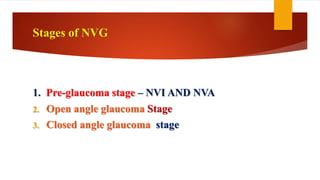
1. Pre-glaucoma stage – NVI AND NVA
2. Open angle glaucoma Stage
3. Closed angle glaucoma stage
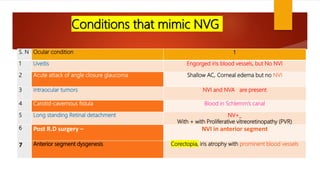
Conditions that mimic NVG
S. N Ocular condition t
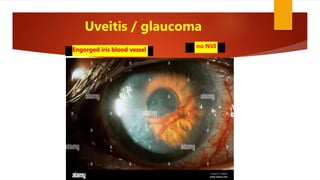
1 Uveitis Engorged iris blood vessels, but No NVI
2 Acute attack of angle closure glaucoma Shallow AC, Corneal edema but no NVI
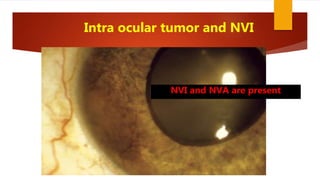
3 Intraocular tumors NVI and NVA are present
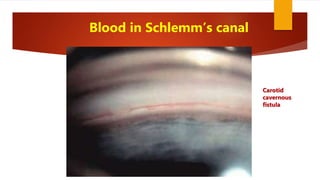
4 Carotid-cavernous fistula Blood in Schlemm’s canal
5 Long standing Retinal detachment NV+_
With + with Proliferative vitreoretinopathy (PVR)
6 Post R.D surgery – NVI in anterior segment
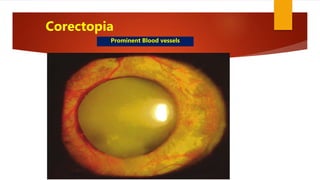
7 Anterior segment dysgenesis Corectopia, iris atrophy with prominent blood vessels
NVI and NVA
Uveitis / glaucoma
Engorged iris blood vessel
no NVI
Blood in Schlemm’s canal
Carotid
cavernous
fistula
Intra ocular tumor and NVI
NVI and NVA are present
Corectopia
Prominent Blood vessels
Conditions that mimic NVG
S. N Ocular condition t
1 Uveitis Engorged iris blood vessels, but No NVI
2 Acute attack of angle closure glaucoma Shallow AC, Corneal edema but no NVI
3 Intraocular tumors NVI and NVA are present
4 Carotid-cavernous fistula Blood in Schlemm’s canal
5 Long standing Retinal detachment NV+_
With + with Proliferative vitreoretinopathy (PVR)
6 Post R.D surgery – NVI in anterior segment
7 Anterior segment dysgenesis Corectopia, iris atrophy with prominent blood vessels
How these new vessels formed?
Angiogenesis
अब यह एक यक्ष प्रश्न है कक
 नई खून की नलियों का ननर्ााण क
ै से हुआ ?
 नई खून की नलियों का ननर्ााण कयूूँ हुआ?
 नई खून की नलियों का ननर्ााण की प्रककया कया है?
 कौन कौन से तत्व इसर्ें कारक बनते हैं/
 How the angiogenesis happens?
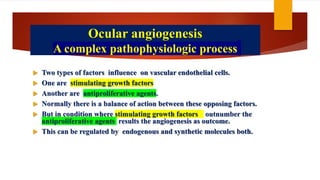
Ocular angiogenesis
A complex pathophysiologic process
 Two types of factors influence on vascular endothelial cells.
 One are stimulating growth factors
 Another are antiproliferative agents.
 Normally there is a balance of action between these opposing factors.
 But in condition where stimulating growth factors outnumber the
antiproliferative agents results the angiogenesis as outcome.
 This can be regulated by endogenous and synthetic molecules both.
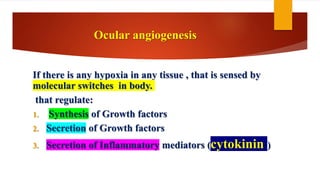
Ocular angiogenesis
If there is any hypoxia in any tissue , that is sensed by
molecular switches in body.
that regulate:
1. Synthesis of Growth factors
2. Secretion of Growth factors
3. Secretion of Inflammatory mediators (cytokinin )
Ocular angiogenesis
As a consequence, tissue microenvironment is
altered and that is facilitated by :
1. Reprogramming metabolic pathways
2. Angiogenesis
3. Vascular permeability
4. pH homeostasis
It is Transcriptional activator
which acts on such genes which encodes
those proteins which can determine
increase in Oxygen level .
And thus mediates the tissue microenvironment to adapt
in Hypoxic condition
What is Hypoxia-inducible factor-1 (HIF-1)
Its action depend on
 Amount of hypoxia
 Duration of hypoxia
It is activated in hypoxic condition and regulates the
process of adaptation in hypoxic condition
HIF action
Master regulator
Of
Cellular oxygen
Homeostasis.
What is HIF ?
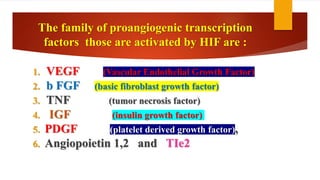
The family of proangiogenic transcription
factors those are activated by HIF are :
1. VEGF (Vascular Endothelial Growth Factor)
2. b FGF (basic fibroblast growth factor)
3. TNF (tumor necrosis factor)
4. IGF (insulin growth factor)
5. PDGF (platelet derived growth factor),
6. Angiopoietin 1,2 and TIe2
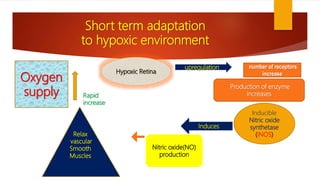
Oxygen
supply
number of receptors
increase
Production of enzyme
increases
Inducible
Nitric oxide
synthetase
(iNOS)
Hypoxic Retina
upregulation
Induces
Nitric oxide(NO)
production
Relax
vascular
Smooth
Muscles
Rapid
increase
Short term adaptation
to hypoxic environment
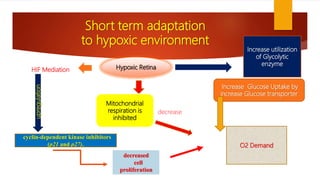
O2 Demand
Increase utilization
of Glycolytic
enzyme
Increase Glucose Uptake by
increase Glucose transporter
Hypoxic Retina
Mitochondrial
respiration is
inhibited
decrease
Short term adaptation
to hypoxic environment
HIF Mediation
cyclin-dependent kinase inhibitors
(p21 and p27).
decreased
cell
proliferation
upregulation
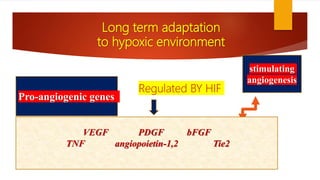
Long term adaptation
to hypoxic environment
stimulating
angiogenesis
Pro-angiogenic genes
Regulated BY HIF
VEGF PDGF bFGF
TNF angiopoietin-1,2 Tie2
Expression of
GF ( VEGF),
Cytokinin, and Pro-coagulation factors
become activated
Following chronic hypoxia
 . VEGF increases permeability of vessels via a nitric oxide
synthase/cGMP-dependent pathway
And that results production of NO and that in turn relax
vascular smooth muscle result in vasodilatation and increased
flow lead to angiogenesis.
And increase the oxygen aviability
 The intra ocular VEGF in vitreous and retinal tissue levels of
IGF -1 ( insulin like growth Factor) has been found elevated.
 This IGF -1 precedes the onset of PDR
Two main cascades of reactions have been
characterized depending on the duration of O2 def.
VEGF Function
To create new blood vessels
a) during embryonic development
b) After injury/ muscle after exercise
c) collateral circulation after blockade tribute to
disease
Action of VEGF in hypoxic
condition of Tissue
 Increases Vascular permeability as described earlier with help of NO.
 leads to increased permeability for plasmatic proteins and fibrinogen.
 Fibrinogen converts to fibrin form a temporary matrix for new b. vessels
 Organization of endothelial cells forming the “vascular bud”
 V. Bud advances from the main vessel mediated by angiogenic stimuli
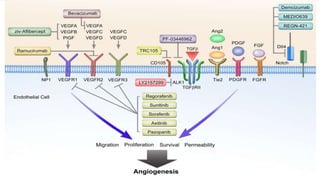
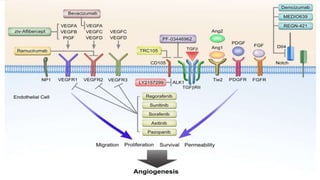
Action of VEGF
VEGF
From Vascular bud
determines the development of the
vascular lumen,
resulting in a thin capillary wall
with few pericytes,
Action of VEGF
Action of VEGF
 If VEGF is suppressed at this stage by Anti VEGF like
a) Bevacizumab
b) Ranibizumab
c) Aflibercept
d) Anti VEGF 1,2,3 drugs like i. Regorphenib ii. Sunitinib iii.
Axitinib iv. Sorafenib v. Pazopanib
The vascular growth stops and lead to the regression of the newly formed
vessel.
Action of VEGF
C/F of NVG -Symptoms
Early stage
Asymptomatic
Late stage
 chronic red, painful eye
 significant vision loss.
C/F of NVG Sign
1st Sign: could be seen on FA
leakage at pupillary margin detected on Slit lamp Exam.
 The following features are clinically seen later on
 Visible NVI- that begins at pupillary margin or iridectomy margin.
 Visible NVA -via Gonioscope – partial or complete closure of angle
could be seen.
 IOP > 50 mm of Hg with or without corneal edema
 NVG with PDR was reported to be less aggressive than ischemic CRVO
Grading of NVG stages
Neovasculari
zation
Grade 1 Grade 2 Grade 3 Grade 4
NVI
NVI at
pupillary
zone<2
quadrant
NV at
pupillary
zone>2
quadrant
NV at ciliary zone/
ectropion uveae
1-3 quadrant
NV at pupillary zone>3
quadrant
NVA
NVA cross SS
and branches
over TM< 2
quadrant
Angle vessels
cross SS and
branches
over TM> 2
quadrant
NV at TM
PAS 1-3 quadrant
NV at TM
PAS >3 quadrant
Investigation
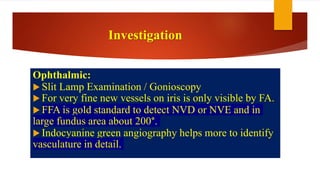
Ophthalmic:
 Slit Lamp Examination / Gonioscopy
 For very fine new vessels on iris is only visible by FA.
 FFA is gold standard to detect NVD or NVE and in
large fundus area about 200°.
 Indocyanine green angiography helps more to identify
vasculature in detail.
Investigation
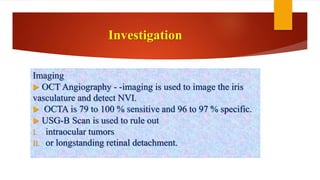
Imaging
 OCT Angiography - -imaging is used to image the iris
vasculature and detect NVI.
 OCTA is 79 to 100 % sensitive and 96 to 97 % specific.
 USG-B Scan is used to rule out
I. intraocular tumors
II. or longstanding retinal detachment.
Investigation by imaging
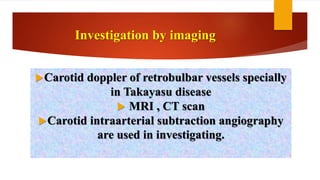
Carotid doppler of retrobulbar vessels specially
in Takayasu disease
 MRI , CT scan
Carotid intraarterial subtraction angiography
are used in investigating.
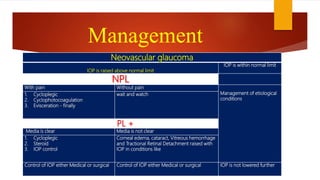
Neovascular glaucoma
IOP is raised above normal limit
IOP is within normal limit
NPL
With pain Without pain
Management of etiological
conditions
1. Cycloplegic
2. Cyclophotocoagulation
3. Evisceration - finally
wait and watch
PL +
Media is clear Media is not clear
1. Cycloplegic
2. Steroid
3. IOP control
Corneal edema, cataract, Vitreous hemorrhage
and Tractional Retinal Detachment raised with
IOP in conditions like
Control of IOP either Medical or surgical Control of IOP either Medical or surgical IOP is not lowered further
Management
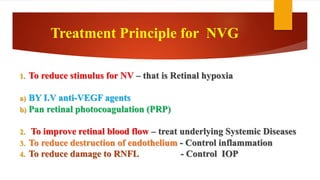
1. To reduce stimulus for NV – that is Retinal hypoxia
a) BY I.V anti-VEGF agents
b) Pan retinal photocoagulation (PRP)
2. To improve retinal blood flow – treat underlying Systemic Diseases
3. To reduce destruction of endothelium - Control inflammation
4. To reduce damage to RNFL - Control IOP
Treatment Principle for NVG
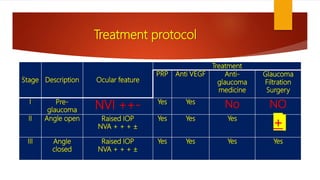
Treatment protocol
Stage Description Ocular feature
Treatment
PRP Anti VEGF Anti-
glaucoma
medicine
Glaucoma
Filtration
Surgery
I Pre-
glaucoma NVI ++- Yes Yes
No NO
II Angle open Raised IOP
NVA + + + ±
Yes Yes Yes
+
III Angle
closed
Raised IOP
NVA + + + ±
Yes Yes Yes Yes
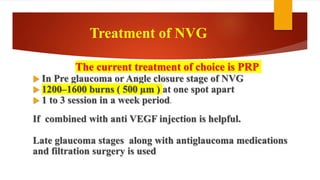
The current treatment of choice is PRP
 In Pre glaucoma or Angle closure stage of NVG
 1200–1600 burns ( 500 µm ) at one spot apart
 1 to 3 session in a week period.
If combined with anti VEGF injection is helpful.
Late glaucoma stages along with antiglaucoma medications
and filtration surgery is used
Treatment of NVG
The ARC when PRP is not feasible due to haszy media
 Anterior-retinal cryotherapy (ARC) is another management .
 In advance cases it can be combined with I .Vit. anti-VEGF injection.
 Study suggest that Combined treatment of ARC and intravitreal
bevacizumab (IVB) is associated with more rapid clearing of VH in eyes
with PDR compared with IVB alone.
 In extreme case with vitrectomy, anti-VEGF injection, PRP, and endo-
cyclo-photocoagulation is used
Treatment of NVG by ARC
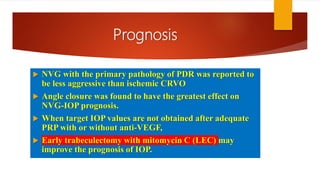
Prognosis
 NVG with the primary pathology of PDR was reported to
be less aggressive than ischemic CRVO
 Angle closure was found to have the greatest effect on
NVG-IOP prognosis.
 When target IOP values are not obtained after adequate
PRP with or without anti-VEGF,
 Early trabeculectomy with mitomycin C (LEC) may
improve the prognosis of IOP.
Take home Massage
 NVG is a dreadful condition with guarded prognosis
 Prevention of secondary factors causing retinal hypoxia
 Early detection is must to save eye
 Intense follow up by appropriate medical and surgical
managements should be undertaken on stages of NVG
based on a defined principle.
Take home Massage
 Diabetic is a principal cause of NVG and it is on global
increase.
 Increasing incidence of PDR is responsible for increasing
prevalence of disease now a days.
 Early detection of both NVI & NVA and PDR with HT,
Cardiac condition , CRVO
 In cases secondary to ocular ischemic syndrome (OIS), a
multidisciplinary approach is required.
Take home Massage
 Newer examination tools like FA and OCT can detect
the condition earlier .
 Newer treatment modalities i.e. anti-VEGF
application, PRP) can get rid of disease or deaccelerate
the progress of disease .
 Control of raised IOP) by taking care of retinal
hypoxia can avoid blindness due to NVG.
For your patience hearing

Neovascular Glaucoma .pptx

  • 1.
    Neovascular Glaucoma Dr Sunilkumar Assistant professor Department of ophthalmology Patna Medical college , Patna
  • 2.
    What is NVG?Define NVG.
  • 3.
     This isa condition of new vessel development on iris (NVI) & neovascularization on angle (NVA) ,  Followed by fibrovascular tissue proliferation in the Angle  ,Obstructing outflow at angle , that results rise of IOP  That condition is principally driven by Retinal Anoxia . A condition of New vessels development
  • 4.
    Nomenclature history ofNVG  Rubeosis iridis was first described by Coats with CRVO in 1906.[1]  This condition was called previously by different names such as 1. Rubeotic glaucoma 2. Diabetic hemorrhagic glaucoma 3. Congestive glaucoma 4. Thrombotic glaucoma  In 1963 Weiss et.al named it as Neo Vascular Glaucoma in relation NVI and rise in IOP
  • 5.
    Conditions that causesretinal anoxia lead to angiogenic activity in eye*. Mainly are  PDR  CRVO  Ocular ischemic syndrome (OIS)  and other uncommon causes that causes Retinal hypoxia
  • 6.
    1.Diabetic retinopathy 2.Central retinalvein occlusion (CRVO) 3.Ocular ischemic syndrome (OIS) Etiopathogenesis : common causes
  • 7.
    1. Uveitis 2. Ocularradiation / intra ocular tumor 3. Trauma 4. Crohn’s disease ; This is an inflammatory bowel disease (IBD) of GIT. But aloso causes anemia and Vasculitis) 1. Bechet’s disease : This is a rare disorder that causes Vasculitis throughout body. Etiopathogenesis ; uncommon causes
  • 8.
    (C) Miscellaneous retinalconditions Coat’s disease Eales’ disease Frosted branch angiitis Giant cell astrocytoma of the retina Peripheral retinal detachment X-linked retinoschisis (Rosenfeld et al. 1998) Etiopathogenesis
  • 9.
    (D) Systemic diseases 1)Cryoglobulinemia:Small vessel vasculitis  Cryoglobulins Protein deposited in blood vessel endothelium  Complementary pathway is activated that damage endothelium. 2) Churg-Strauss syndrome: Small vessel vasculitis – where blood flow to organ and tissue is restricted. 3) Miscellaneous ; those condition cause retinal vascular occlusion Etiopathogenesis
  • 10.
    Prevalence of NVG Ofall Glaucoma  Study in Nigeria - 0.3%  Study in Asia- 0.7–5.1 %  Study in Europe- 3.9%  Study in West Bengal, india - 0.01%  Study in Singapore -0.12% among migrant Indians
  • 11.
    Neovascular Glaucoma Although theOverall prevalence is low 0.01 to 5.1% of all glaucoma but it is a dreadful condition Which lead to blindness.
  • 12.
    Neovascular Glaucoma Therefore Early detection & closemonitoring Is must to encounter blindness due to NVG
  • 13.
    NVG is asecondary glaucoma Retinal ischemia NVI and NVA Enhancement of VEGF Fibrovascular growth at angle IOP raised
  • 14.
    Etiopathogenesis Newly formed bloodvessels on Iris move over the angle towards the CB and the SS spur Than further move over towards the trabecular meshwork . And obstruct outflow of aqueous. in NVA we find that TM become Reddish .
  • 15.
    Stages of NVG 1.Pre-glaucoma stage – NVI AND NVA 2. Open angle glaucoma Stage 3. Closed angle glaucoma stage
  • 16.
    Conditions that mimicNVG S. N Ocular condition t 1 Uveitis Engorged iris blood vessels, but No NVI 2 Acute attack of angle closure glaucoma Shallow AC, Corneal edema but no NVI 3 Intraocular tumors NVI and NVA are present 4 Carotid-cavernous fistula Blood in Schlemm’s canal 5 Long standing Retinal detachment NV+_ With + with Proliferative vitreoretinopathy (PVR) 6 Post R.D surgery – NVI in anterior segment 7 Anterior segment dysgenesis Corectopia, iris atrophy with prominent blood vessels
  • 17.
  • 18.
    Uveitis / glaucoma Engorgediris blood vessel no NVI
  • 19.
    Blood in Schlemm’scanal Carotid cavernous fistula
  • 20.
    Intra ocular tumorand NVI NVI and NVA are present
  • 21.
  • 22.
    Conditions that mimicNVG S. N Ocular condition t 1 Uveitis Engorged iris blood vessels, but No NVI 2 Acute attack of angle closure glaucoma Shallow AC, Corneal edema but no NVI 3 Intraocular tumors NVI and NVA are present 4 Carotid-cavernous fistula Blood in Schlemm’s canal 5 Long standing Retinal detachment NV+_ With + with Proliferative vitreoretinopathy (PVR) 6 Post R.D surgery – NVI in anterior segment 7 Anterior segment dysgenesis Corectopia, iris atrophy with prominent blood vessels
  • 23.
    How these newvessels formed? Angiogenesis अब यह एक यक्ष प्रश्न है कक  नई खून की नलियों का ननर्ााण क ै से हुआ ?  नई खून की नलियों का ननर्ााण कयूूँ हुआ?  नई खून की नलियों का ननर्ााण की प्रककया कया है?  कौन कौन से तत्व इसर्ें कारक बनते हैं/  How the angiogenesis happens?
  • 24.
    Ocular angiogenesis A complexpathophysiologic process  Two types of factors influence on vascular endothelial cells.  One are stimulating growth factors  Another are antiproliferative agents.  Normally there is a balance of action between these opposing factors.  But in condition where stimulating growth factors outnumber the antiproliferative agents results the angiogenesis as outcome.  This can be regulated by endogenous and synthetic molecules both.
  • 25.
    Ocular angiogenesis If thereis any hypoxia in any tissue , that is sensed by molecular switches in body. that regulate: 1. Synthesis of Growth factors 2. Secretion of Growth factors 3. Secretion of Inflammatory mediators (cytokinin )
  • 26.
    Ocular angiogenesis As aconsequence, tissue microenvironment is altered and that is facilitated by : 1. Reprogramming metabolic pathways 2. Angiogenesis 3. Vascular permeability 4. pH homeostasis
  • 27.
    It is Transcriptionalactivator which acts on such genes which encodes those proteins which can determine increase in Oxygen level . And thus mediates the tissue microenvironment to adapt in Hypoxic condition What is Hypoxia-inducible factor-1 (HIF-1)
  • 28.
    Its action dependon  Amount of hypoxia  Duration of hypoxia It is activated in hypoxic condition and regulates the process of adaptation in hypoxic condition HIF action
  • 29.
  • 30.
    The family ofproangiogenic transcription factors those are activated by HIF are : 1. VEGF (Vascular Endothelial Growth Factor) 2. b FGF (basic fibroblast growth factor) 3. TNF (tumor necrosis factor) 4. IGF (insulin growth factor) 5. PDGF (platelet derived growth factor), 6. Angiopoietin 1,2 and TIe2
  • 31.
    Oxygen supply number of receptors increase Productionof enzyme increases Inducible Nitric oxide synthetase (iNOS) Hypoxic Retina upregulation Induces Nitric oxide(NO) production Relax vascular Smooth Muscles Rapid increase Short term adaptation to hypoxic environment
  • 32.
    O2 Demand Increase utilization ofGlycolytic enzyme Increase Glucose Uptake by increase Glucose transporter Hypoxic Retina Mitochondrial respiration is inhibited decrease Short term adaptation to hypoxic environment HIF Mediation cyclin-dependent kinase inhibitors (p21 and p27). decreased cell proliferation upregulation
  • 33.
    Long term adaptation tohypoxic environment stimulating angiogenesis Pro-angiogenic genes Regulated BY HIF VEGF PDGF bFGF TNF angiopoietin-1,2 Tie2
  • 34.
    Expression of GF (VEGF), Cytokinin, and Pro-coagulation factors become activated Following chronic hypoxia
  • 35.
     . VEGFincreases permeability of vessels via a nitric oxide synthase/cGMP-dependent pathway And that results production of NO and that in turn relax vascular smooth muscle result in vasodilatation and increased flow lead to angiogenesis. And increase the oxygen aviability  The intra ocular VEGF in vitreous and retinal tissue levels of IGF -1 ( insulin like growth Factor) has been found elevated.  This IGF -1 precedes the onset of PDR Two main cascades of reactions have been characterized depending on the duration of O2 def.
  • 36.
    VEGF Function To createnew blood vessels a) during embryonic development b) After injury/ muscle after exercise c) collateral circulation after blockade tribute to disease
  • 37.
    Action of VEGFin hypoxic condition of Tissue  Increases Vascular permeability as described earlier with help of NO.  leads to increased permeability for plasmatic proteins and fibrinogen.  Fibrinogen converts to fibrin form a temporary matrix for new b. vessels  Organization of endothelial cells forming the “vascular bud”  V. Bud advances from the main vessel mediated by angiogenic stimuli
  • 38.
    Action of VEGF VEGF FromVascular bud determines the development of the vascular lumen, resulting in a thin capillary wall with few pericytes,
  • 39.
  • 40.
    Action of VEGF If VEGF is suppressed at this stage by Anti VEGF like a) Bevacizumab b) Ranibizumab c) Aflibercept d) Anti VEGF 1,2,3 drugs like i. Regorphenib ii. Sunitinib iii. Axitinib iv. Sorafenib v. Pazopanib The vascular growth stops and lead to the regression of the newly formed vessel.
  • 41.
  • 42.
    C/F of NVG-Symptoms Early stage Asymptomatic Late stage  chronic red, painful eye  significant vision loss.
  • 43.
    C/F of NVGSign 1st Sign: could be seen on FA leakage at pupillary margin detected on Slit lamp Exam.  The following features are clinically seen later on  Visible NVI- that begins at pupillary margin or iridectomy margin.  Visible NVA -via Gonioscope – partial or complete closure of angle could be seen.  IOP > 50 mm of Hg with or without corneal edema  NVG with PDR was reported to be less aggressive than ischemic CRVO
  • 45.
    Grading of NVGstages Neovasculari zation Grade 1 Grade 2 Grade 3 Grade 4 NVI NVI at pupillary zone<2 quadrant NV at pupillary zone>2 quadrant NV at ciliary zone/ ectropion uveae 1-3 quadrant NV at pupillary zone>3 quadrant NVA NVA cross SS and branches over TM< 2 quadrant Angle vessels cross SS and branches over TM> 2 quadrant NV at TM PAS 1-3 quadrant NV at TM PAS >3 quadrant
  • 46.
    Investigation Ophthalmic:  Slit LampExamination / Gonioscopy  For very fine new vessels on iris is only visible by FA.  FFA is gold standard to detect NVD or NVE and in large fundus area about 200°.  Indocyanine green angiography helps more to identify vasculature in detail.
  • 47.
    Investigation Imaging  OCT Angiography- -imaging is used to image the iris vasculature and detect NVI.  OCTA is 79 to 100 % sensitive and 96 to 97 % specific.  USG-B Scan is used to rule out I. intraocular tumors II. or longstanding retinal detachment.
  • 48.
    Investigation by imaging Carotiddoppler of retrobulbar vessels specially in Takayasu disease  MRI , CT scan Carotid intraarterial subtraction angiography are used in investigating.
  • 49.
    Neovascular glaucoma IOP israised above normal limit IOP is within normal limit NPL With pain Without pain Management of etiological conditions 1. Cycloplegic 2. Cyclophotocoagulation 3. Evisceration - finally wait and watch PL + Media is clear Media is not clear 1. Cycloplegic 2. Steroid 3. IOP control Corneal edema, cataract, Vitreous hemorrhage and Tractional Retinal Detachment raised with IOP in conditions like Control of IOP either Medical or surgical Control of IOP either Medical or surgical IOP is not lowered further Management
  • 50.
    1. To reducestimulus for NV – that is Retinal hypoxia a) BY I.V anti-VEGF agents b) Pan retinal photocoagulation (PRP) 2. To improve retinal blood flow – treat underlying Systemic Diseases 3. To reduce destruction of endothelium - Control inflammation 4. To reduce damage to RNFL - Control IOP Treatment Principle for NVG
  • 51.
    Treatment protocol Stage DescriptionOcular feature Treatment PRP Anti VEGF Anti- glaucoma medicine Glaucoma Filtration Surgery I Pre- glaucoma NVI ++- Yes Yes No NO II Angle open Raised IOP NVA + + + ± Yes Yes Yes + III Angle closed Raised IOP NVA + + + ± Yes Yes Yes Yes
  • 52.
    The current treatmentof choice is PRP  In Pre glaucoma or Angle closure stage of NVG  1200–1600 burns ( 500 µm ) at one spot apart  1 to 3 session in a week period. If combined with anti VEGF injection is helpful. Late glaucoma stages along with antiglaucoma medications and filtration surgery is used Treatment of NVG
  • 53.
    The ARC whenPRP is not feasible due to haszy media  Anterior-retinal cryotherapy (ARC) is another management .  In advance cases it can be combined with I .Vit. anti-VEGF injection.  Study suggest that Combined treatment of ARC and intravitreal bevacizumab (IVB) is associated with more rapid clearing of VH in eyes with PDR compared with IVB alone.  In extreme case with vitrectomy, anti-VEGF injection, PRP, and endo- cyclo-photocoagulation is used Treatment of NVG by ARC
  • 54.
    Prognosis  NVG withthe primary pathology of PDR was reported to be less aggressive than ischemic CRVO  Angle closure was found to have the greatest effect on NVG-IOP prognosis.  When target IOP values are not obtained after adequate PRP with or without anti-VEGF,  Early trabeculectomy with mitomycin C (LEC) may improve the prognosis of IOP.
  • 55.
    Take home Massage NVG is a dreadful condition with guarded prognosis  Prevention of secondary factors causing retinal hypoxia  Early detection is must to save eye  Intense follow up by appropriate medical and surgical managements should be undertaken on stages of NVG based on a defined principle.
  • 56.
    Take home Massage Diabetic is a principal cause of NVG and it is on global increase.  Increasing incidence of PDR is responsible for increasing prevalence of disease now a days.  Early detection of both NVI & NVA and PDR with HT, Cardiac condition , CRVO  In cases secondary to ocular ischemic syndrome (OIS), a multidisciplinary approach is required.
  • 57.
    Take home Massage Newer examination tools like FA and OCT can detect the condition earlier .  Newer treatment modalities i.e. anti-VEGF application, PRP) can get rid of disease or deaccelerate the progress of disease .  Control of raised IOP) by taking care of retinal hypoxia can avoid blindness due to NVG.
  • 58.

Editor's Notes

  • #14 In nut shell we can understand NVG process by this flow chart