OPTIC NEURITIS
DEFINITION
 Optic neuritis refers to
inflammation of the optic
nerve
 Occurs in about 50 % of pts
with multiple sclerosis and is
presenting feature in 20%
EPIDEMIOLOGY
 1/1,00,000
 5:1- female:male ratio
 Young age (20-40 years old)
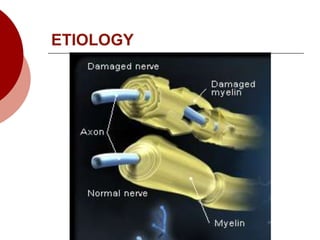
ETIOLOGY
 Idopathic
 Demyelinating disorders –
a) Multiple sclerosis
b) Devics disease
c) Schilder disease
d) acute disseminated
encephalomyelitis
 Parainfectious optic neuritis
– associated with measles ,
mumps, chicken pox or following
immunisation
 Infectious – sinus related
(ethmoiditis) , cat scratch fever ,
syphilis , lyme disease,
cryptococcal meningitis
CLINICAL TYPES
 Papillitis – involvement of optic
disc
 Neuroretinitis – involvement of
optic disc and surrounding retina in
macular area
 Retrobulbar neuritis –
involvement of optic nerve behind
the eyeball
PATHOLOGY
 Perivascular infiltrate of
inflammatory cells
 Destruction of myelin
 Removal of disintegrated myelin
by phagocytic cells
 Proliferative gliosis
CLINICAL FEATURES
 HISTORY
 A prodromal viral illness may
occur.
 Orbital pain and pain with eye
movement prior to visual
changes. The pain can be
excruciating or very mild like a
foreign body sensation.
SYMPTOMS
 Sudden profound U/L vision loss
 Pain aggravated by ocular
movements – especially upward or
downward ( due to attachment of
fibres of superior rectus to dura )
 Visual obscuration in bright light
 Impaired dark adaptation
 Reduced vividness of saturated
colours
 Movement phosphenes and sound
induced phosphenes
 Uthoff phenomenon – transient
obscuration of vision on exertion
and on exposure to heat
 Pulfrich phenomenon – altered
depth perception for moving objects
SIGNS
 Decreased visual acuity
 Decreased color vision (red
desaturation) and/or decreased
contrast/brightness sense
 RAPD unless both eyes are affected
or RAPD was present prior in
contralateral eye
 Disc edema (only 35% noted in
ONTT, thus lack of disc edema does
not rule out acute optic neuritis)
 Retinal vascular sheathing, pars
planitis (periphlebitis occurs in 5-
10% of multiple sclerosis patients)
 Any scotoma on Amsler grid and/or
confrontation visual fields or formal
visual field testing – most common
is a central or centrocecal scotoma
 VEP shows reduced amplitude and
delayed transmission time
TYPICAL OPTIC NEURITIS
 Predominantly affects females
 15-45 years
 Unilateral
 Acute , painful vision loss over
hours to days
 Retrorbital pain worse with eye
movments
 Peak visual loss within 2 weeks
after which improvement occurs
 Poor color vision , contrast
sensititivity
 Any type of visual field defect
 VEP- prolonged latency , decreased
amplitude
ATYPICAL OPTIC NEURITIS
 Painless visual loss
 Extremes of age
 Bilateral
 Disc hemorrhage , cotton wool
spots
 Progression of visual loss beyond 2
weeks
 Fails to improve with treatment
D/D
PAPILLEDEMA PAPILLITIS PSEUDO-
PAPILLITIS
LATERALITY B/L U/L U/L OR B/L
VA BLURRED
VISION
SUDDEN
PRFOUND LOSS
OF VISION
BLURRED
VISION
PAIN ON
OCULAR
MOVEMENTS
NIL YES NIL
MEDIA CLEAR VIT CELLS CLEAR
PERIPAPILLARY
EDEMA , VENOUS
ENGORGEMENT,
RETINAL HRAGE ,
EXUDATES
MARKED LESS MARKED ABSENT
FIELD
DEFECT
ENLARGED BLIND
SPOT
CENTRAL
SCOTOMA
NIL
FFA LEAKAGE OF
DYE++
MINIMAL
LEAKAGE
NIL
INVESTIGATIONS
 Routine Ix are not required in a
case of typical optic neuritis
 Required in the following conditions
A) Atypical optic neuritis
B)Recurrent optic neuritis
C)Acute optic neuritis in children
D)Presence of systemic
inflammatory disease
 CBC
 Chest x ray
 ANA , dsDNA
 FTA-ABS , VDRL
 Serology and culture for bartonella
 PCR for viral infections
 CSF tap
MRI CRITERIA FOR
DIAGNOSING MS
 Atleast 3 lesions and two of the
following should be present
 1) lesions abutting the lateral
ventricles
 2)lesions with diameters greater
than 5 mm
 3)lesions present in the posterior
fossa
TREATMENT
 Optic neuritis treatment trial
(ONTT)
 OBJECTIVES
To evaluate efficacy
of corticosteroids in
Rx of acute optic
neuritis
To investigate
relationship b/w optic
neuritis and multiple
sclerosis
 INCLUSION CRITERIA
 Age 18-46 yrs
 Acute U/L optic neuritis for 8 days
or less
 A RAPD and a visual field defect in
the affected eye
 No previous corticosteroid
treatment for optic neuritis or MS
 No systemic disease other than MS
that might be cause of optic neuritis
Pts were randomised to one of 3
groups
ORAL PREDNISOLONE
1MG/KG FOR 14 DAYS
IVMP (250MG/6HRS) FOR 3
DAYS FOLLOWED BY ORAL
PREDNISOLONE 1MG/KG
FOR 11 DAYS
ORAL PLACEBO FOR 14
DAYS
RESULTS
 Routine Ix are of limited value in
diagnosing optic neuritis in a patient
with typical optic neuritis
 Brain MRI is a powerful predictor of
early risk of MS after optic neuritis
 Visual recovery begins within 2 weeks
and continues upto 1 yr
 Probability of recurrence of optic neuritis
in either eye within 5 yrs is 28 %
 Treatment with high dose IV
steroid followed by oral steroid
accelerated visual recovery but
provided no long term benefit to
vision
 Treatment with oral
prednisolone alone did not
improve visual outcome and was
associated with increased rates of
new attacks of optic neuritis
 Dyschromatopsia , defective
stereoacuity , RAPD , delayed
latencies on VEP , pulfrich and
uthoff phenomenon may remain as
residual deficits after an attack of
optic neuritis
 Four large scale clinical trials have
been conducted to determine
whether early treatment following
first demyelinating episode can
delay the second event
 1)CHAMPS AND CHAMPIONS
 2)ETOMS
 3)BENEFIT
 4)PRECISE
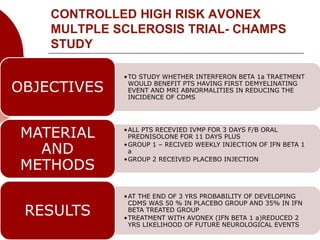
CONTROLLED HIGH RISK AVONEX
MULTPLE SCLEROSIS TRIAL- CHAMPS
STUDY
•TO STUDY WHETHER INTERFERON BETA 1a TRAETMENT
WOULD BENEFIT PTS HAVING FIRST DEMYELINATING
EVENT AND MRI ABNORMALITIES IN REDUCING THE
INCIDENCE OF CDMS
OBJECTIVES
•ALL PTS RECEVIED IVMP FOR 3 DAYS F/B ORAL
PREDNISOLONE FOR 11 DAYS PLUS
•GROUP 1 – RECIVED WEEKLY INJECTION OF IFN BETA 1
a
•GROUP 2 RECEIVED PLACEBO INJECTION
MATERIAL
AND
METHODS
•AT THE END OF 3 YRS PROBABILITY OF DEVELOPING
CDMS WAS 50 % IN PLACEBO GROUP AND 35% IN IFN
BETA TREATED GROUP
•TREATMENT WITH AVONEX (IFN BETA 1 a)REDUCED 2
YRS LIKELIHOOD OF FUTURE NEUROLOGICAL EVENTS
RESULTS
Controlled high risk avonex multiple
sclerosis prevention surveillance -
 CHAMPIONS STUDY – compared
outcomes of those who had been
given drug from start of CHAMPS
study versus those who switched
from placebo after about 30 months
 Those who were started on Rx
immediately had fewer relapses and
fewer MRI brain lesions than
delayed treatment group
 Early treatment of multiple
sclerosis study – ETOMS
 IFN B 1a treatment at an early
stage had significant positive clinical
and MRI outcomes
 Betaseron in newly emerging
multiple sclerosis for initial
teratment study – BENEFIT
 Early initiation of Rx with IFN B 1b
prevents development of disability
supporting its use after first
manifestation of relapsing remitting
MS
 PreCISe study
 Early treatment with Glatiramate
acetate is efficacious in delaying
conversion to CDMS in patients
presenting with CIS and brain
lesions detedcted by MRI
COURSE
 Typically visual acuity and color vision
is lost over 2-5 days
 Recovery starts within 2 weeks and
takes 4-6 weeks
 75-90% cases get good visual
recovery
 Reccurent attacks of retrobulbar
neuritis develop primary optic atrophy
and pts with recuurent papillitis get
postneuritic optic atrophy
Optic neuritis

Optic neuritis

  • 1.
  • 2.
    DEFINITION  Optic neuritisrefers to inflammation of the optic nerve  Occurs in about 50 % of pts with multiple sclerosis and is presenting feature in 20%
  • 3.
    EPIDEMIOLOGY  1/1,00,000  5:1-female:male ratio  Young age (20-40 years old)
  • 4.
  • 5.
     Idopathic  Demyelinatingdisorders – a) Multiple sclerosis b) Devics disease c) Schilder disease d) acute disseminated encephalomyelitis
  • 6.
     Parainfectious opticneuritis – associated with measles , mumps, chicken pox or following immunisation  Infectious – sinus related (ethmoiditis) , cat scratch fever , syphilis , lyme disease, cryptococcal meningitis
  • 7.
    CLINICAL TYPES  Papillitis– involvement of optic disc  Neuroretinitis – involvement of optic disc and surrounding retina in macular area  Retrobulbar neuritis – involvement of optic nerve behind the eyeball
  • 8.
    PATHOLOGY  Perivascular infiltrateof inflammatory cells  Destruction of myelin  Removal of disintegrated myelin by phagocytic cells  Proliferative gliosis
  • 10.
    CLINICAL FEATURES  HISTORY A prodromal viral illness may occur.  Orbital pain and pain with eye movement prior to visual changes. The pain can be excruciating or very mild like a foreign body sensation.
  • 11.
    SYMPTOMS  Sudden profoundU/L vision loss  Pain aggravated by ocular movements – especially upward or downward ( due to attachment of fibres of superior rectus to dura )  Visual obscuration in bright light  Impaired dark adaptation  Reduced vividness of saturated colours
  • 12.
     Movement phosphenesand sound induced phosphenes  Uthoff phenomenon – transient obscuration of vision on exertion and on exposure to heat  Pulfrich phenomenon – altered depth perception for moving objects
  • 13.
    SIGNS  Decreased visualacuity  Decreased color vision (red desaturation) and/or decreased contrast/brightness sense  RAPD unless both eyes are affected or RAPD was present prior in contralateral eye
  • 14.
     Disc edema(only 35% noted in ONTT, thus lack of disc edema does not rule out acute optic neuritis)  Retinal vascular sheathing, pars planitis (periphlebitis occurs in 5- 10% of multiple sclerosis patients)
  • 15.
     Any scotomaon Amsler grid and/or confrontation visual fields or formal visual field testing – most common is a central or centrocecal scotoma  VEP shows reduced amplitude and delayed transmission time
  • 16.
    TYPICAL OPTIC NEURITIS Predominantly affects females  15-45 years  Unilateral  Acute , painful vision loss over hours to days
  • 17.
     Retrorbital painworse with eye movments  Peak visual loss within 2 weeks after which improvement occurs  Poor color vision , contrast sensititivity  Any type of visual field defect  VEP- prolonged latency , decreased amplitude
  • 18.
    ATYPICAL OPTIC NEURITIS Painless visual loss  Extremes of age  Bilateral  Disc hemorrhage , cotton wool spots  Progression of visual loss beyond 2 weeks  Fails to improve with treatment
  • 19.
    D/D PAPILLEDEMA PAPILLITIS PSEUDO- PAPILLITIS LATERALITYB/L U/L U/L OR B/L VA BLURRED VISION SUDDEN PRFOUND LOSS OF VISION BLURRED VISION PAIN ON OCULAR MOVEMENTS NIL YES NIL MEDIA CLEAR VIT CELLS CLEAR
  • 20.
    PERIPAPILLARY EDEMA , VENOUS ENGORGEMENT, RETINALHRAGE , EXUDATES MARKED LESS MARKED ABSENT FIELD DEFECT ENLARGED BLIND SPOT CENTRAL SCOTOMA NIL FFA LEAKAGE OF DYE++ MINIMAL LEAKAGE NIL
  • 21.
    INVESTIGATIONS  Routine Ixare not required in a case of typical optic neuritis  Required in the following conditions A) Atypical optic neuritis B)Recurrent optic neuritis C)Acute optic neuritis in children D)Presence of systemic inflammatory disease
  • 22.
     CBC  Chestx ray  ANA , dsDNA  FTA-ABS , VDRL  Serology and culture for bartonella  PCR for viral infections  CSF tap
  • 23.
    MRI CRITERIA FOR DIAGNOSINGMS  Atleast 3 lesions and two of the following should be present  1) lesions abutting the lateral ventricles  2)lesions with diameters greater than 5 mm  3)lesions present in the posterior fossa
  • 24.
    TREATMENT  Optic neuritistreatment trial (ONTT)  OBJECTIVES To evaluate efficacy of corticosteroids in Rx of acute optic neuritis To investigate relationship b/w optic neuritis and multiple sclerosis
  • 25.
     INCLUSION CRITERIA Age 18-46 yrs  Acute U/L optic neuritis for 8 days or less  A RAPD and a visual field defect in the affected eye  No previous corticosteroid treatment for optic neuritis or MS  No systemic disease other than MS that might be cause of optic neuritis
  • 26.
    Pts were randomisedto one of 3 groups ORAL PREDNISOLONE 1MG/KG FOR 14 DAYS IVMP (250MG/6HRS) FOR 3 DAYS FOLLOWED BY ORAL PREDNISOLONE 1MG/KG FOR 11 DAYS ORAL PLACEBO FOR 14 DAYS
  • 27.
    RESULTS  Routine Ixare of limited value in diagnosing optic neuritis in a patient with typical optic neuritis  Brain MRI is a powerful predictor of early risk of MS after optic neuritis  Visual recovery begins within 2 weeks and continues upto 1 yr  Probability of recurrence of optic neuritis in either eye within 5 yrs is 28 %
  • 28.
     Treatment withhigh dose IV steroid followed by oral steroid accelerated visual recovery but provided no long term benefit to vision  Treatment with oral prednisolone alone did not improve visual outcome and was associated with increased rates of new attacks of optic neuritis
  • 29.
     Dyschromatopsia ,defective stereoacuity , RAPD , delayed latencies on VEP , pulfrich and uthoff phenomenon may remain as residual deficits after an attack of optic neuritis
  • 30.
     Four largescale clinical trials have been conducted to determine whether early treatment following first demyelinating episode can delay the second event  1)CHAMPS AND CHAMPIONS  2)ETOMS  3)BENEFIT  4)PRECISE
  • 31.
    CONTROLLED HIGH RISKAVONEX MULTPLE SCLEROSIS TRIAL- CHAMPS STUDY •TO STUDY WHETHER INTERFERON BETA 1a TRAETMENT WOULD BENEFIT PTS HAVING FIRST DEMYELINATING EVENT AND MRI ABNORMALITIES IN REDUCING THE INCIDENCE OF CDMS OBJECTIVES •ALL PTS RECEVIED IVMP FOR 3 DAYS F/B ORAL PREDNISOLONE FOR 11 DAYS PLUS •GROUP 1 – RECIVED WEEKLY INJECTION OF IFN BETA 1 a •GROUP 2 RECEIVED PLACEBO INJECTION MATERIAL AND METHODS •AT THE END OF 3 YRS PROBABILITY OF DEVELOPING CDMS WAS 50 % IN PLACEBO GROUP AND 35% IN IFN BETA TREATED GROUP •TREATMENT WITH AVONEX (IFN BETA 1 a)REDUCED 2 YRS LIKELIHOOD OF FUTURE NEUROLOGICAL EVENTS RESULTS
  • 32.
    Controlled high riskavonex multiple sclerosis prevention surveillance -  CHAMPIONS STUDY – compared outcomes of those who had been given drug from start of CHAMPS study versus those who switched from placebo after about 30 months  Those who were started on Rx immediately had fewer relapses and fewer MRI brain lesions than delayed treatment group
  • 33.
     Early treatmentof multiple sclerosis study – ETOMS  IFN B 1a treatment at an early stage had significant positive clinical and MRI outcomes
  • 34.
     Betaseron innewly emerging multiple sclerosis for initial teratment study – BENEFIT  Early initiation of Rx with IFN B 1b prevents development of disability supporting its use after first manifestation of relapsing remitting MS
  • 35.
     PreCISe study Early treatment with Glatiramate acetate is efficacious in delaying conversion to CDMS in patients presenting with CIS and brain lesions detedcted by MRI
  • 36.
    COURSE  Typically visualacuity and color vision is lost over 2-5 days  Recovery starts within 2 weeks and takes 4-6 weeks  75-90% cases get good visual recovery  Reccurent attacks of retrobulbar neuritis develop primary optic atrophy and pts with recuurent papillitis get postneuritic optic atrophy