


Motion
By Prof. Liwayway Memije-Cruz
Motion
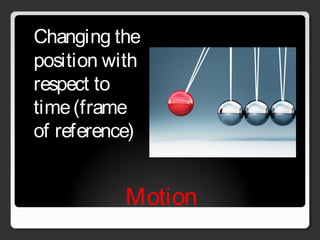
Changing the
position with
respect to
time(frame
of reference)
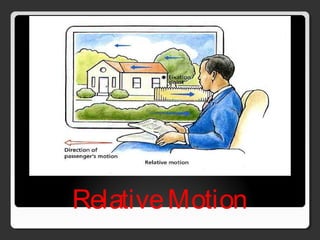
RelativeMotion
Examplesof Motion
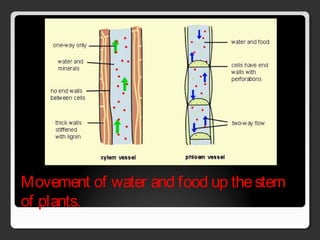
Movement of water and food up thestem
of plants.
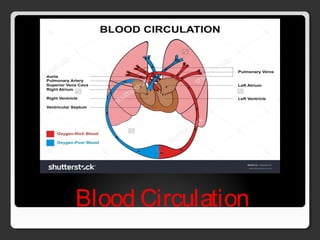
Blood Circulation
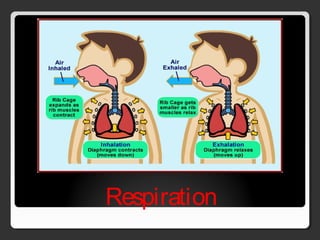
Respiration
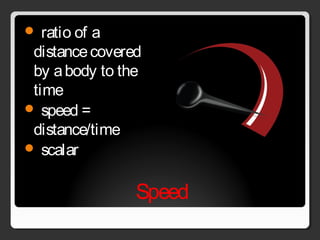
Speed
 ratio of a
distancecovered
by abody to the
time
 speed =
distance/time
 scalar
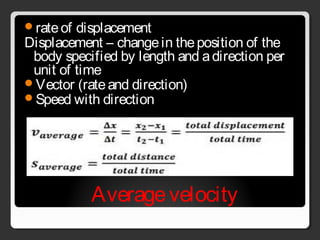
Averagevelocity
rateof displacement
Displacement – changein theposition of the
body specified by length and adirection per
unit of time
Vector (rateand direction)
Speed with direction
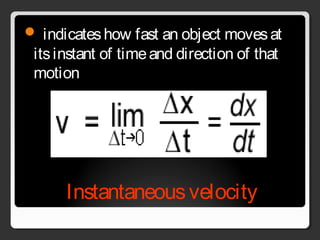
Instantaneousvelocity
 indicateshow fast an object movesat
itsinstant of timeand direction of that
motion
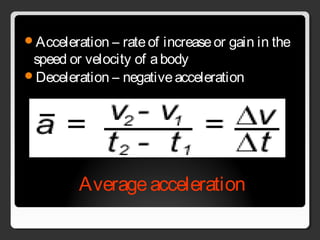
Averageacceleration
Acceleration – rateof increaseor gain in the
speed or velocity of abody
Deceleration – negativeacceleration
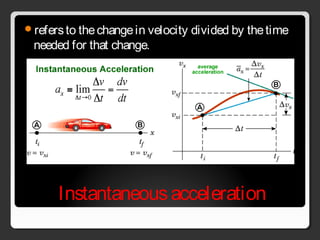
Instantaneousacceleration
refersto thechangein velocity divided by thetime
needed for that change.
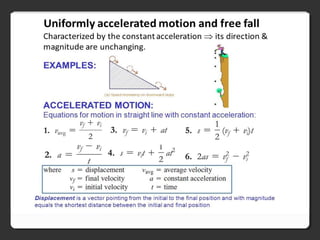
Uniformly accelerated motion
Refersto themotion in straight linein which
thedirection isalwaysthesameand the
speed changesat aconstant rate.
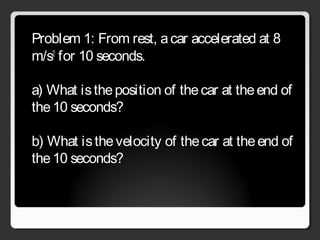
Problem 1: From rest, acar accelerated at 8
m/s2
for 10 seconds.
a) What istheposition of thecar at theend of
the10 seconds?
b) What isthevelocity of thecar at theend of
the10 seconds?
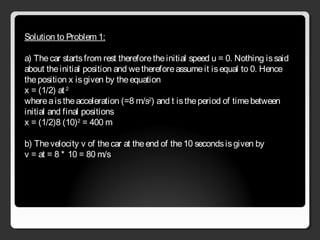
Solution to Problem 1:
a) Thecar startsfrom rest thereforetheinitial speed u = 0. Nothing issaid
about theinitial position and wethereforeassumeit isequal to 0. Hence
theposition x isgiven by theequation
x = (1/2) at 2
whereaistheacceleration (=8 m/s2
) and t istheperiod of timebetween
initial and final positions
x = (1/2)8 (10)2
= 400 m
b) Thevelocity v of thecar at theend of the10 secondsisgiven by
v = at = 8 * 10 = 80 m/s
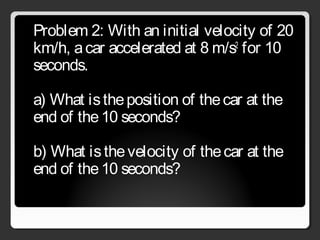
Problem 2: With an initial velocity of 20
km/h, acar accelerated at 8 m/s2
for 10
seconds.
a) What istheposition of thecar at the
end of the10 seconds?
b) What isthevelocity of thecar at the
end of the10 seconds?
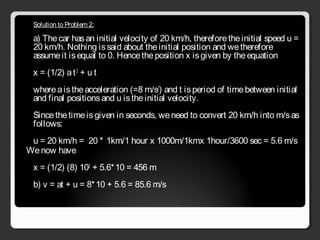
Solution to Problem 2:
a) Thecar hasan initial velocity of 20 km/h, thereforetheinitial speed u =
20 km/h. Nothing issaid about theinitial position and wetherefore
assumeit isequal to 0. Hencetheposition x isgiven by theequation
x = (1/2) at2
+ u t
whereaistheacceleration (=8 m/s2
) and t isperiod of timebetween initial
and final positionsand u istheinitial velocity.
Sincethetimeisgiven in seconds, weneed to convert 20 km/h into m/sas
follows:
u = 20 km/h =  20 * 1km/1 hour x 1000m/1kmx 1hour/3600 sec = 5.6 m/s
Wenow have
x = (1/2) (8) 102
+ 5.6*10 = 456 m
b) v = at + u = 8*10 + 5.6 = 85.6 m/s
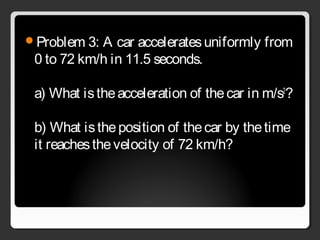
Problem 3: A car acceleratesuniformly from
0 to 72 km/h in 11.5 seconds.
a) What istheacceleration of thecar in m/s2
?
b) What istheposition of thecar by thetime
it reachesthevelocity of 72 km/h?
Freely Falling body: (dueto gravity)
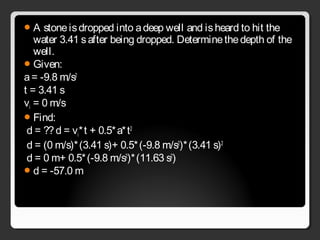
A stoneisdropped into adeep well and isheard to hit the
water 3.41 safter being dropped. Determinethedepth of the
well.
Given:
a= -9.8 m/s2
t = 3.41 s
vi = 0 m/s
Find:
d = ??d = vi*t + 0.5*a*t2
d = (0 m/s)*(3.41 s)+ 0.5*(-9.8 m/s2
)*(3.41 s)2
d = 0 m+ 0.5*(-9.8 m/s2
)*(11.63 s2
)
d = -57.0 m
Problem No. 4
Theobservation deck of tall
skyscraper 370 m abovethestreet.
Determinethetimerequired for a
penny to freefall from thedeck to
thestreet below.
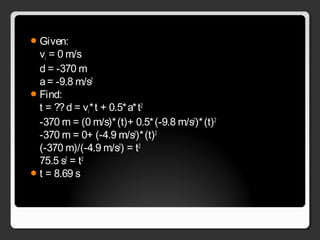
Given:
vi = 0 m/s
d = -370 m
a= -9.8 m/s2
Find:
t = ??d = vi*t + 0.5*a*t2
-370 m = (0 m/s)*(t)+ 0.5*(-9.8 m/s2
)*(t)2
-370 m = 0+ (-4.9 m/s2
)*(t)2
(-370 m)/(-4.9 m/s2
) = t2
75.5 s2
= t2
t = 8.69 s
ProjectileMotion
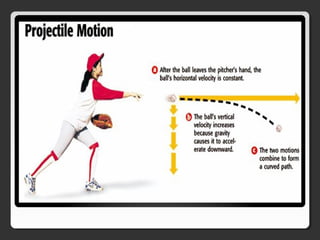
A projectileisan object upon which theonly forceis
gravity. Gravity actsto influencethevertical motion of
theprojectile, thuscausing avertical acceleration. The
horizontal motion of theprojectileistheresult of the
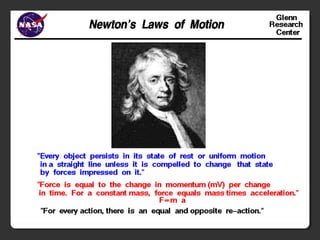
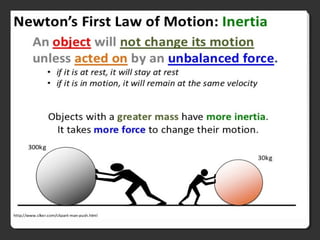
tendency of any object in motion to remain in motion at
constant velocity. Dueto theabsenceof horizontal
forces, aprojectileremainsin motion with aconstant
horizontal velocity. Horizontal forcesarenot required to
keep aprojectilemoving horizontally. Theonly force
acting upon aprojectileisgravity.
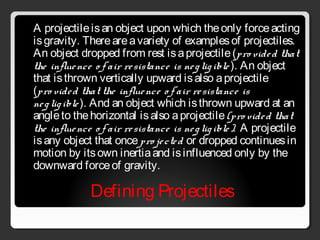
Defining Projectiles
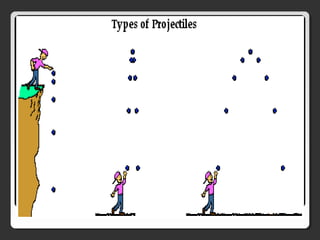
A projectileisan object upon which theonly forceacting
isgravity. Thereareavariety of examplesof projectiles.
An object dropped from rest isaprojectile(pro vided that
the influence o f air resistance is negligible ). An object
that isthrown vertically upward isalso aprojectile
(pro vided that the influence o f air resistance is
negligible). And an object which isthrown upward at an
angleto thehorizontal isalso aprojectile(pro vided that
the influence o f air resistance is negligible). A projectile
isany object that oncepro jected or dropped continuesin
motion by itsown inertiaand isinfluenced only by the
downward forceof gravity.
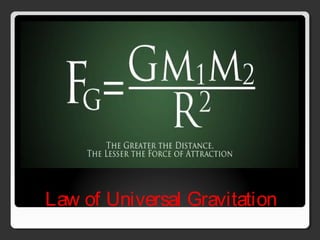
Law of Universal Gravitation
Impulseand Momentum
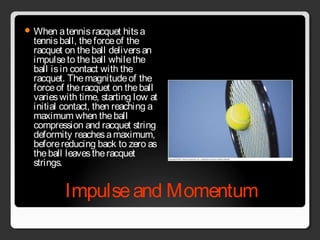
 When atennisracquet hitsa
tennisball, theforceof the
racquet on theball deliversan
impulseto theball whilethe
ball isin contact with the
racquet. Themagnitudeof the
forceof theracquet on theball
varieswith time, starting low at
initial contact, then reaching a
maximum when theball
compression and racquet string
deformity reachesamaximum,
beforereducing back to zero as
theball leavestheracquet
strings.
Conservation of Momentum
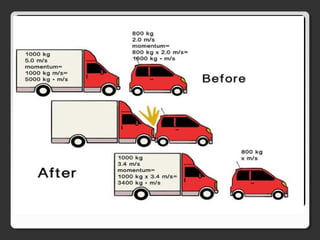
Law of Conservation of Momentum statesthat when any two
bodiesact upon another body, their total momentum remains
constant provided no external forcesareacting. That means
whenever onebody gainsmomentum, then someother body
losean equal amount of momentum, that is, momentum is
never destroyed nor created. Therefore, law of conservation
of momentum isalso known asprincipleof conservation of
momentum.
Conservation of Momentum PracticeProblems
1.Two grocery cartscollide, afull onewith amassof 35 kg
moving East at 2 m/sand an empty onewith amassof 10 kg
moving West at 3 m/s. After thecollision thefull cart is
moving East at 0.75m/s. What isthevelocity of theempty
cart?
2. Two football playershaveahead on collision and grab onto
each other’suniforms. The80 kg PennridgeRam wasmoving
at 3 m/s, whilethe70 kg Souderton player wasmoving in the
oppositedirection at 2.5 m/s. What istheir final velocity
impact?
 Two carshavea‘rear end’ collision. A
1200 kg Hondamoving at 20 m/sstrikesa
1000 kg Ford moving at 15 m/s. Their
bumpersbecomelocked and they continue
to moveasonemass. What istheir final
velocity?
 Answers
1.1.375 m/s
2.0.433 m/s
3.17.73 m/s
Coefficient of Restitution
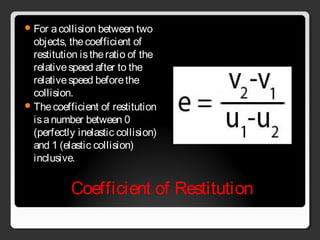
For acollision between two
objects, thecoefficient of
restitution istheratio of the
relativespeed after to the
relativespeed beforethe
collision.
Thecoefficient of restitution
isanumber between 0
(perfectly inelastic collision)
and 1 (elastic collision)
inclusive.
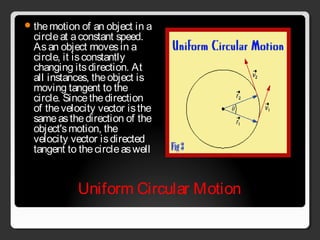
Uniform Circular Motion
themotion of an object in a
circleat aconstant speed.
Asan object movesin a
circle, it isconstantly
changing itsdirection. At
all instances, theobject is
moving tangent to the
circle. Sincethedirection
of thevelocity vector isthe
sameasthedirection of the
object'smotion, the
velocity vector isdirected
tangent to thecircleaswell
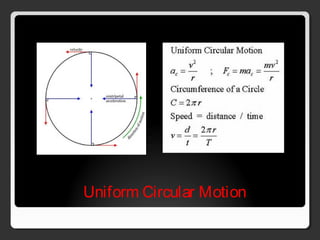
Uniform Circular Motion
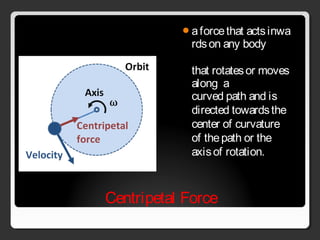
Centripetal Force
a force that acts inwa
rds on any body 
that rotates or moves
along  a
curved path and is 
directed towards the 
center of curvature 
of the path or the 
axis of rotation.
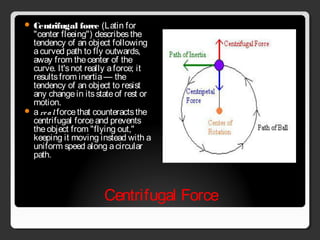
Centrifugal Force
 Centrifugal force (Latin for
"center fleeing") describesthe
tendency of an object following
acurved path to fly outwards,
away from thecenter of the
curve. It'snot really aforce; it
resultsfrom inertia— the
tendency of an object to resist
any changein itsstateof rest or
motion. 
 a real forcethat counteractsthe
centrifugal forceand prevents
theobject from "flying out,"
keeping it moving instead with a
uniform speed along acircular
path.

Motion

  • 1.
  • 2.
    Motion Changing the position with respectto time(frame of reference)
  • 3.
  • 4.
  • 5.
    Movement of waterand food up thestem of plants.
  • 6.
  • 7.
  • 8.
    Speed  ratio ofa distancecovered by abody to the time  speed = distance/time  scalar
  • 9.
    Averagevelocity rateof displacement Displacement –changein theposition of the body specified by length and adirection per unit of time Vector (rateand direction) Speed with direction
  • 10.
    Instantaneousvelocity  indicateshow fastan object movesat itsinstant of timeand direction of that motion
  • 11.
    Averageacceleration Acceleration – rateofincreaseor gain in the speed or velocity of abody Deceleration – negativeacceleration
  • 12.
    Instantaneousacceleration refersto thechangein velocitydivided by thetime needed for that change.
  • 13.
    Uniformly accelerated motion Referstothemotion in straight linein which thedirection isalwaysthesameand the speed changesat aconstant rate.
  • 15.
    Problem 1: Fromrest, acar accelerated at 8 m/s2 for 10 seconds. a) What istheposition of thecar at theend of the10 seconds? b) What isthevelocity of thecar at theend of the10 seconds?
  • 16.
    Solution to Problem1: a) Thecar startsfrom rest thereforetheinitial speed u = 0. Nothing issaid about theinitial position and wethereforeassumeit isequal to 0. Hence theposition x isgiven by theequation x = (1/2) at 2 whereaistheacceleration (=8 m/s2 ) and t istheperiod of timebetween initial and final positions x = (1/2)8 (10)2 = 400 m b) Thevelocity v of thecar at theend of the10 secondsisgiven by v = at = 8 * 10 = 80 m/s
  • 17.
    Problem 2: Withan initial velocity of 20 km/h, acar accelerated at 8 m/s2 for 10 seconds. a) What istheposition of thecar at the end of the10 seconds? b) What isthevelocity of thecar at the end of the10 seconds?
  • 18.
    Solution to Problem2: a) Thecar hasan initial velocity of 20 km/h, thereforetheinitial speed u = 20 km/h. Nothing issaid about theinitial position and wetherefore assumeit isequal to 0. Hencetheposition x isgiven by theequation x = (1/2) at2 + u t whereaistheacceleration (=8 m/s2 ) and t isperiod of timebetween initial and final positionsand u istheinitial velocity. Sincethetimeisgiven in seconds, weneed to convert 20 km/h into m/sas follows: u = 20 km/h =  20 * 1km/1 hour x 1000m/1kmx 1hour/3600 sec = 5.6 m/s Wenow have x = (1/2) (8) 102 + 5.6*10 = 456 m b) v = at + u = 8*10 + 5.6 = 85.6 m/s
  • 19.
    Problem 3: Acar acceleratesuniformly from 0 to 72 km/h in 11.5 seconds. a) What istheacceleration of thecar in m/s2 ? b) What istheposition of thecar by thetime it reachesthevelocity of 72 km/h?
  • 20.
    Freely Falling body:(dueto gravity)
  • 22.
    A stoneisdropped intoadeep well and isheard to hit the water 3.41 safter being dropped. Determinethedepth of the well. Given: a= -9.8 m/s2 t = 3.41 s vi = 0 m/s Find: d = ??d = vi*t + 0.5*a*t2 d = (0 m/s)*(3.41 s)+ 0.5*(-9.8 m/s2 )*(3.41 s)2 d = 0 m+ 0.5*(-9.8 m/s2 )*(11.63 s2 ) d = -57.0 m
  • 23.
    Problem No. 4 Theobservationdeck of tall skyscraper 370 m abovethestreet. Determinethetimerequired for a penny to freefall from thedeck to thestreet below.
  • 24.
    Given: vi = 0m/s d = -370 m a= -9.8 m/s2 Find: t = ??d = vi*t + 0.5*a*t2 -370 m = (0 m/s)*(t)+ 0.5*(-9.8 m/s2 )*(t)2 -370 m = 0+ (-4.9 m/s2 )*(t)2 (-370 m)/(-4.9 m/s2 ) = t2 75.5 s2 = t2 t = 8.69 s
  • 26.
    ProjectileMotion A projectileisan objectupon which theonly forceis gravity. Gravity actsto influencethevertical motion of theprojectile, thuscausing avertical acceleration. The horizontal motion of theprojectileistheresult of the tendency of any object in motion to remain in motion at constant velocity. Dueto theabsenceof horizontal forces, aprojectileremainsin motion with aconstant horizontal velocity. Horizontal forcesarenot required to keep aprojectilemoving horizontally. Theonly force acting upon aprojectileisgravity.
  • 27.
    Defining Projectiles A projectileisanobject upon which theonly forceacting isgravity. Thereareavariety of examplesof projectiles. An object dropped from rest isaprojectile(pro vided that the influence o f air resistance is negligible ). An object that isthrown vertically upward isalso aprojectile (pro vided that the influence o f air resistance is negligible). And an object which isthrown upward at an angleto thehorizontal isalso aprojectile(pro vided that the influence o f air resistance is negligible). A projectile isany object that oncepro jected or dropped continuesin motion by itsown inertiaand isinfluenced only by the downward forceof gravity.
  • 34.
    Law of UniversalGravitation
  • 35.
    Impulseand Momentum  Whenatennisracquet hitsa tennisball, theforceof the racquet on theball deliversan impulseto theball whilethe ball isin contact with the racquet. Themagnitudeof the forceof theracquet on theball varieswith time, starting low at initial contact, then reaching a maximum when theball compression and racquet string deformity reachesamaximum, beforereducing back to zero as theball leavestheracquet strings.
  • 36.
    Conservation of Momentum Lawof Conservation of Momentum statesthat when any two bodiesact upon another body, their total momentum remains constant provided no external forcesareacting. That means whenever onebody gainsmomentum, then someother body losean equal amount of momentum, that is, momentum is never destroyed nor created. Therefore, law of conservation of momentum isalso known asprincipleof conservation of momentum.
  • 38.
    Conservation of MomentumPracticeProblems 1.Two grocery cartscollide, afull onewith amassof 35 kg moving East at 2 m/sand an empty onewith amassof 10 kg moving West at 3 m/s. After thecollision thefull cart is moving East at 0.75m/s. What isthevelocity of theempty cart? 2. Two football playershaveahead on collision and grab onto each other’suniforms. The80 kg PennridgeRam wasmoving at 3 m/s, whilethe70 kg Souderton player wasmoving in the oppositedirection at 2.5 m/s. What istheir final velocity impact?
  • 39.
     Two carshavea‘rearend’ collision. A 1200 kg Hondamoving at 20 m/sstrikesa 1000 kg Ford moving at 15 m/s. Their bumpersbecomelocked and they continue to moveasonemass. What istheir final velocity?
  • 40.
  • 41.
    Coefficient of Restitution Foracollision between two objects, thecoefficient of restitution istheratio of the relativespeed after to the relativespeed beforethe collision. Thecoefficient of restitution isanumber between 0 (perfectly inelastic collision) and 1 (elastic collision) inclusive.
  • 42.
    Uniform Circular Motion themotionof an object in a circleat aconstant speed. Asan object movesin a circle, it isconstantly changing itsdirection. At all instances, theobject is moving tangent to the circle. Sincethedirection of thevelocity vector isthe sameasthedirection of the object'smotion, the velocity vector isdirected tangent to thecircleaswell
  • 43.
  • 44.
  • 45.
    Centrifugal Force  Centrifugalforce (Latin for "center fleeing") describesthe tendency of an object following acurved path to fly outwards, away from thecenter of the curve. It'snot really aforce; it resultsfrom inertia— the tendency of an object to resist any changein itsstateof rest or motion.   a real forcethat counteractsthe centrifugal forceand prevents theobject from "flying out," keeping it moving instead with a uniform speed along acircular path.