By Prof. Liwayway Memije-Cruz
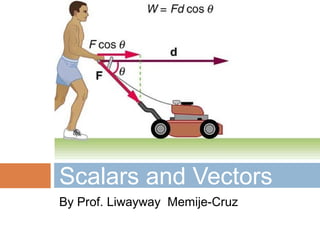
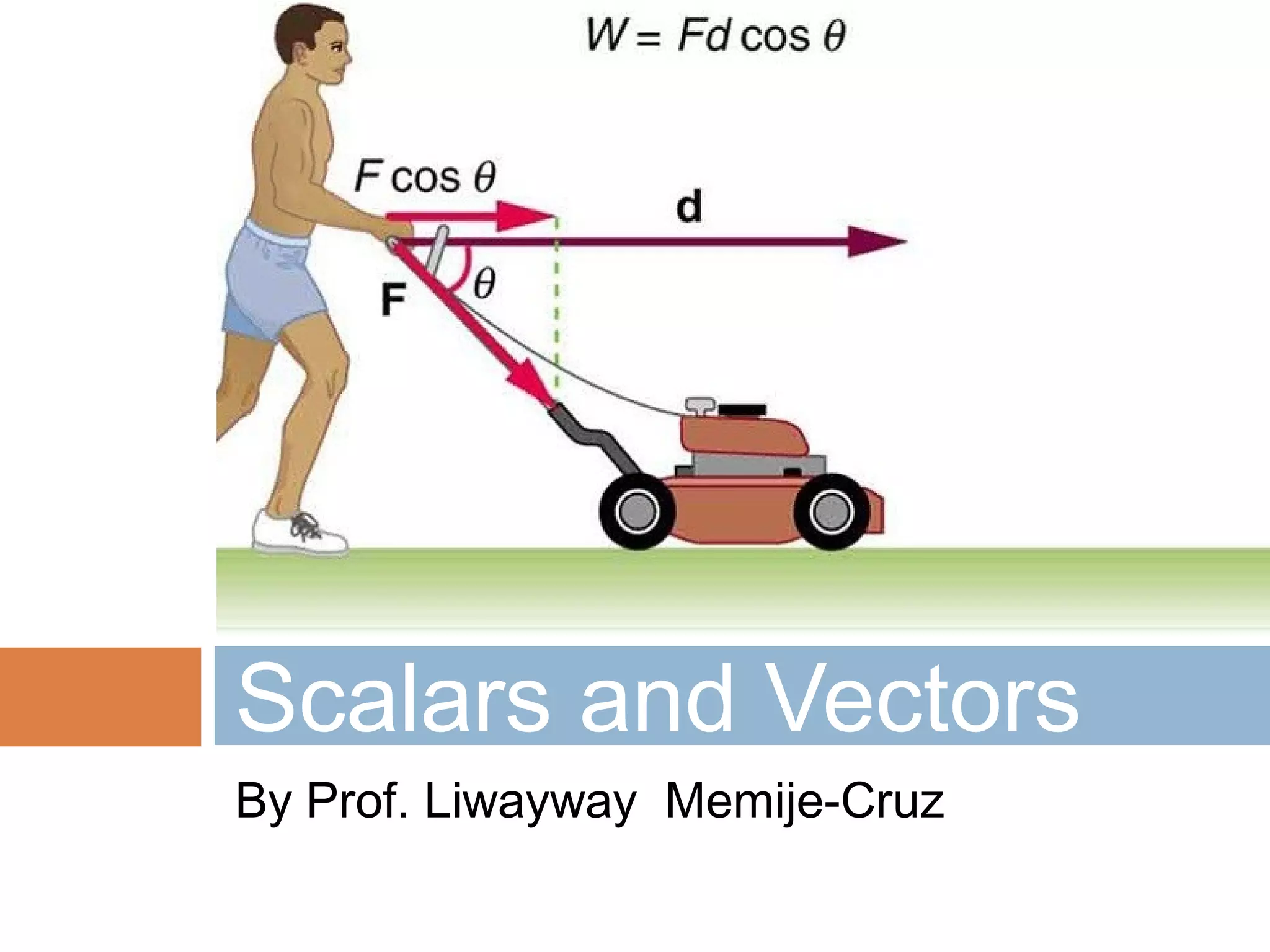
Scalars and Vectors
Introduction
 Physics is a mathematical science.
 Its concepts and principles have a
mathematical basis.
 Mo tio n o f o bje cts in physics are e xpre sse d by
distance , displace m e nt, spe e d, ve lo city, and
acce le ratio n which are asso ciate d with
mathematical quantities.
 Mathematical quantities used to describe the
motion of objects are vector and a scalar.
Mathematical Quantities
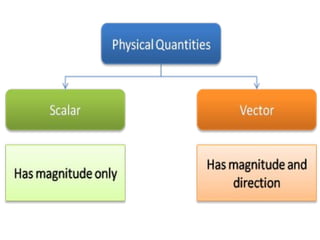
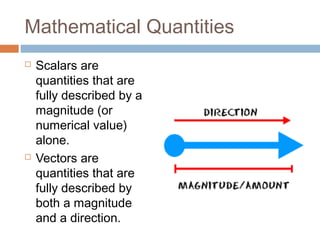
 Scalars are
quantities that are
fully described by a
magnitude (or
numerical value)
alone.
 Vectors are
quantities that are
fully described by
both a magnitude
and a direction.
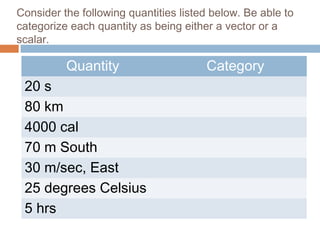
Consider the following quantities listed below. Be able to
categorize each quantity as being either a vector or a
scalar.
Quantity Category
20 s
80 km
4000 cal
70 m South
30 m/sec, East
25 degrees Celsius
5 hrs
Resultant and Equilibrant
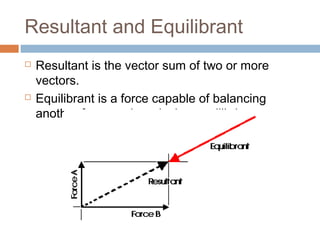
 Resultant is the vector sum of two or more
vectors.
 Equilibrant is a force capable of balancing
another force and producing equilibrium.
Methods of Finding the
Resultant
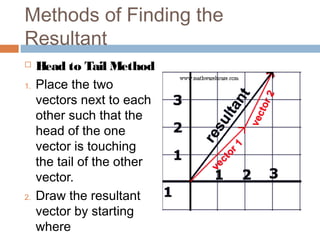
 Head to Tail Method
1. Place the two
vectors next to each
other such that the
head of the one
vector is touching
the tail of the other
vector.
2. Draw the resultant
vector by starting
where
Answer
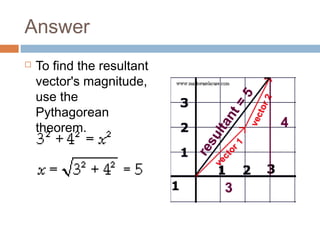
 To find the resultant
vector's magnitude,
use the
Pythagorean
theorem.
Exercise 1
1. You left your house to visit your
sister. You got in your car drove 40
miles east, then got on a highway
and went 50 miles north.
2. Draw a vector from the beginning
of your journey, your home, and the
end, your friend’s house.
Answer
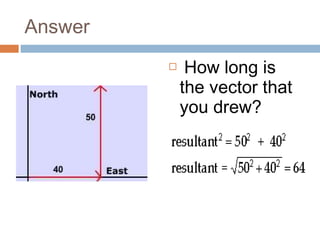
 How long is
the vector that
you drew?
Exercise 2
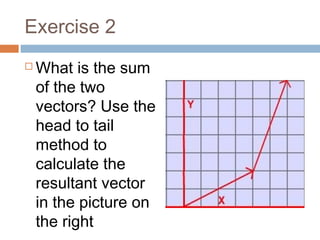
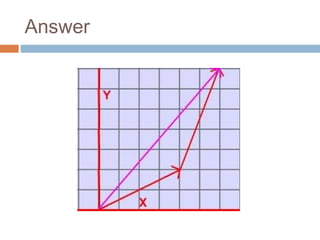
 What is the sum
of the two
vectors? Use the
head to tail
method to
calculate the
resultant vector
in the picture on
the right
Answer
Parallelogram Method
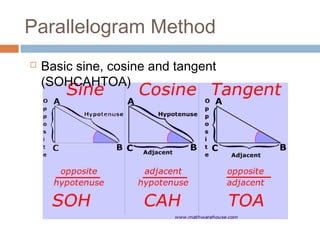
 Basic sine, cosine and tangent
(SOHCAHTOA)
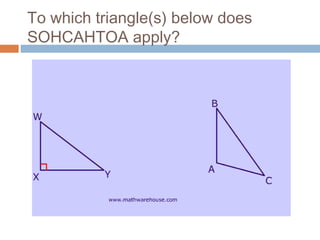
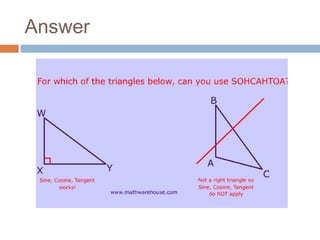
To which triangle(s) below does
SOHCAHTOA apply?
Answer
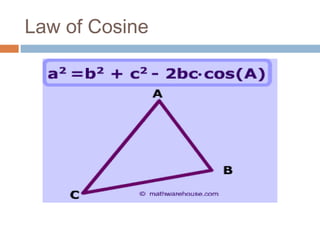
Law of Cosine
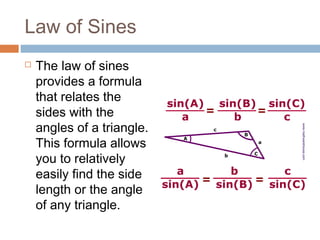
Law of Sines
 The law of sines
provides a formula
that relates the
sides with the
angles of a triangle.
This formula allows
you to relatively
easily find the side
length or the angle
of any triangle.
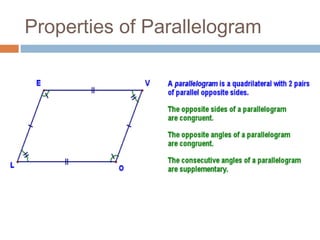
Properties of Parallelogram
Exercise 3
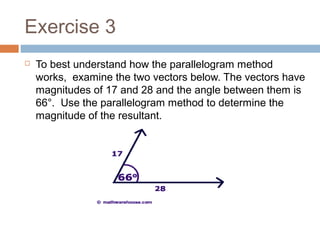
 To best understand how the parallelogram method
works, examine the two vectors below. The vectors have
magnitudes of 17 and 28 and the angle between them is
66°. Use the parallelogram method to determine the
magnitude of the resultant.
 Step 1) Draw a parallelogram based on the
two vectors that you already have. These
vectors will be two sides of the parallelogram
(not the opposite sides since they have the
angle between them)
 Step 2) We now have a parallelogram and
know two angles (opposite angles of
parallelograms are congruent). We can also
figure out the other pair of angles since the
other pair are congruent and all four angles
must add up to 360.
Step 3 Draw the
parallelograms diagonal. This
diagonal is the resultant
vector.
Step 4 Use the law of cosines
to determine the length of the
resultant
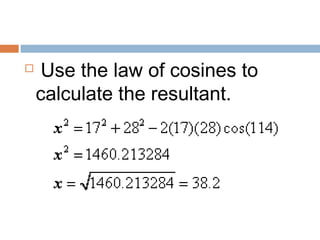
 Use the law of cosines to
calculate the resultant.
References:
 http://www.mathwarehouse.com/vectors/result
ant-vector.php#headToTailMethod
 http://www.s-cool.co.uk/a-
level/physics/vectors-and-scalars-and-linear-
motion/revise-it/resolving
 http://www.physicsclassroom.com/class/vector
s/Lesson-1/Vector-Addition
 http://www.physicsclassroom.com/class/vector
s/Lesson-1/Resultants

Scalars and Vectors

  • 1.
    By Prof. LiwaywayMemije-Cruz Scalars and Vectors
  • 2.
    Introduction  Physics isa mathematical science.  Its concepts and principles have a mathematical basis.  Mo tio n o f o bje cts in physics are e xpre sse d by distance , displace m e nt, spe e d, ve lo city, and acce le ratio n which are asso ciate d with mathematical quantities.  Mathematical quantities used to describe the motion of objects are vector and a scalar.
  • 4.
    Mathematical Quantities  Scalarsare quantities that are fully described by a magnitude (or numerical value) alone.  Vectors are quantities that are fully described by both a magnitude and a direction.
  • 5.
    Consider the followingquantities listed below. Be able to categorize each quantity as being either a vector or a scalar. Quantity Category 20 s 80 km 4000 cal 70 m South 30 m/sec, East 25 degrees Celsius 5 hrs
  • 6.
    Resultant and Equilibrant Resultant is the vector sum of two or more vectors.  Equilibrant is a force capable of balancing another force and producing equilibrium.
  • 7.
    Methods of Findingthe Resultant  Head to Tail Method 1. Place the two vectors next to each other such that the head of the one vector is touching the tail of the other vector. 2. Draw the resultant vector by starting where
  • 8.
    Answer  To findthe resultant vector's magnitude, use the Pythagorean theorem.
  • 9.
    Exercise 1 1. Youleft your house to visit your sister. You got in your car drove 40 miles east, then got on a highway and went 50 miles north. 2. Draw a vector from the beginning of your journey, your home, and the end, your friend’s house.
  • 10.
    Answer  How longis the vector that you drew?
  • 11.
    Exercise 2  Whatis the sum of the two vectors? Use the head to tail method to calculate the resultant vector in the picture on the right
  • 12.
  • 13.
    Parallelogram Method  Basicsine, cosine and tangent (SOHCAHTOA)
  • 14.
    To which triangle(s)below does SOHCAHTOA apply?
  • 15.
  • 16.
  • 17.
    Law of Sines The law of sines provides a formula that relates the sides with the angles of a triangle. This formula allows you to relatively easily find the side length or the angle of any triangle.
  • 18.
  • 19.
    Exercise 3  Tobest understand how the parallelogram method works, examine the two vectors below. The vectors have magnitudes of 17 and 28 and the angle between them is 66°. Use the parallelogram method to determine the magnitude of the resultant.
  • 20.
     Step 1)Draw a parallelogram based on the two vectors that you already have. These vectors will be two sides of the parallelogram (not the opposite sides since they have the angle between them)  Step 2) We now have a parallelogram and know two angles (opposite angles of parallelograms are congruent). We can also figure out the other pair of angles since the other pair are congruent and all four angles must add up to 360.
  • 21.
    Step 3 Drawthe parallelograms diagonal. This diagonal is the resultant vector. Step 4 Use the law of cosines to determine the length of the resultant
  • 22.
     Use thelaw of cosines to calculate the resultant.
  • 23.
    References:  http://www.mathwarehouse.com/vectors/result ant-vector.php#headToTailMethod  http://www.s-cool.co.uk/a- level/physics/vectors-and-scalars-and-linear- motion/revise-it/resolving http://www.physicsclassroom.com/class/vector s/Lesson-1/Vector-Addition  http://www.physicsclassroom.com/class/vector s/Lesson-1/Resultants