SCIENCE 9
QUARTER 4
WEEK 1
MELC 19 & 20
OPENING
PRAYER
CHECKING OF ATTENDANCE
https://docs.google.com/forms/d/e/1FAIpQLScPoML_XHnCOpa2r7Oyjm-iyZGEJqnJ9Cl9Zs6JmxUod7lKpg/viewform?usp=pp_url
WEEK 1 PROJECTILE MOTION
MELC
MELC 19: Describe the horizontal and vertical
motions of a projectile.
MELC 20: Investigate the relationship between the
angle of release and the height and range of a
projectile.
MOTION
What is motion?
Motion is the action of changing location or
position. (Physics Hypertextbook)
Motion is the change with time of the position and
orientation of a body. (Britannica.com)
VOCABULARY REVIEW
1. SPEED - is the rate at which an object is
moving along a path; scalar quantity
2. VELOCITY - is the rate and direction of
an object's movement; vector quantity.
VOCABULARY REVIEW
3. DISTANCE - how much ground an object
has covered" during its motion; scalar
quantity
4. DISPLACEMENT - how far out of place an
object is or the object's overall change in
position; vector quantity
VOCABULARY REVIEW
5. TIME - how long it took the object from
one position to another; scalar quantity
6. ACCELERATION - rate at which velocity
changes with time, in terms of both speed
and direction; vector quantity
https://youtu.be/ToymF8u6u4U
UNIFORMLY
ACCELERATED
MOTION
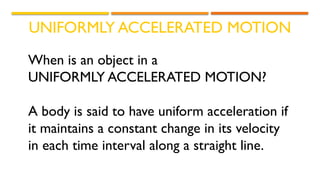
UNIFORMLY ACCELERATED MOTION
When is an object in a
UNIFORMLY ACCELERATED MOTION?
A body is said to have uniform acceleration if
it maintains a constant change in its velocity
in each time interval along a straight line.
UNIFORMLY ACCELERATED MOTION
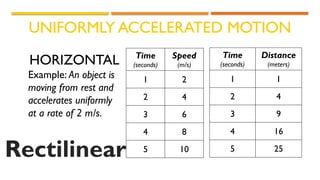
HORIZONTAL
Example: An object is
moving from rest and
accelerates uniformly
at a rate of 2 m/s.
Time
(seconds)
Speed
(m/s)
1 2
2 4
3 6
4 8
5 10
Time
(seconds)
Distance
(meters)
1 1
2 4
3 9
4 16
5 25
Rectilinear
UNIFORMLY ACCELERATED MOTION
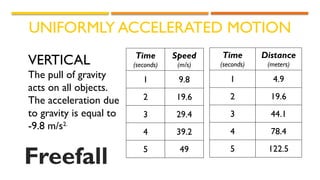
VERTICAL
The pull of gravity
acts on all objects.
The acceleration due
to gravity is equal to
-9.8 m/s2.
Time
(seconds)
Speed
(m/s)
1 9.8
2 19.6
3 29.4
4 39.2
5 49
Time
(seconds)
Distance
(meters)
1 4.9
2 19.6
3 44.1
4 78.4
5 122.5
Freefall
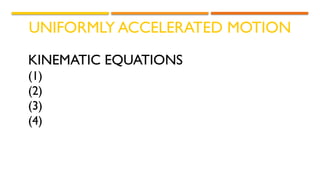
UNIFORMLY ACCELERATED MOTION
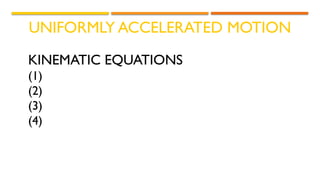
KINEMATIC EQUATIONS
(1)
(2)
(3)
(4)
UNIFORMLY ACCELERATED MOTION
KINEMATIC EQUATIONS
(1)
(2)
(3)
(4)
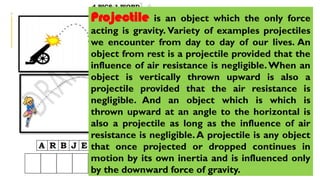
Projectile is an object which the only force
acting is gravity. Variety of examples projectiles
we encounter from day to day of our lives. An
object from rest is a projectile provided that the
influence of air resistance is negligible.When an
object is vertically thrown upward is also a
projectile provided that the air resistance is
negligible. And an object which is which is
thrown upward at an angle to the horizontal is
also a projectile as long as the influence of air
resistance is negligible.A projectile is any object
that once projected or dropped continues in
motion by its own inertia and is influenced only
by the downward force of gravity.
TRAJECTORY
PROJECTILE
MOTION
MOTION IN TWO DIMENSIONS
https://youtu.be/l_YM5PCe3B8
PROJECTILE MOTION
What is projectile motion?
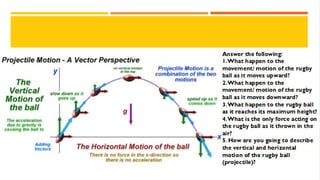
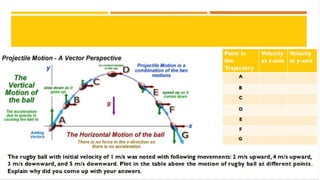
Projectile motion is a combination of uniform
motion along the horizontal and the motion of a
freely falling body along the vertical. It is an
instance of uniformly accelerated motion in two-
dimensions.
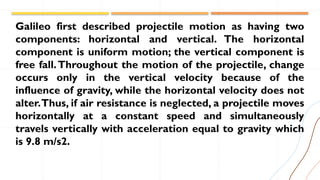
Galileo first described projectile motion as having two
components: horizontal and vertical. The horizontal
component is uniform motion; the vertical component is
free fall.Throughout the motion of the projectile, change
occurs only in the vertical velocity because of the
influence of gravity, while the horizontal velocity does not
alter.Thus, if air resistance is neglected, a projectile moves
horizontally at a constant speed and simultaneously
travels vertically with acceleration equal to gravity which
is 9.8 m/s2.
PROJECTILE MOTION
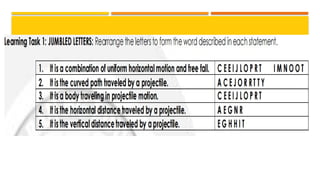
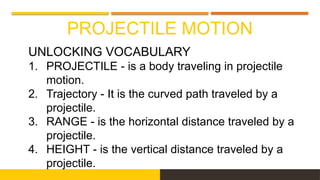
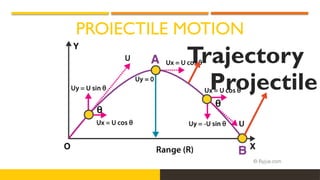
UNLOCKING VOCABULARY
1. PROJECTILE - is a body traveling in projectile
motion.
2. Trajectory - It is the curved path traveled by a
projectile.
3. RANGE - is the horizontal distance traveled by a
projectile.
4. HEIGHT - is the vertical distance traveled by a
projectile.
PROJECTILE MOTION
Trajectory
Projectile
Day 2
PROJECTILE MOTION
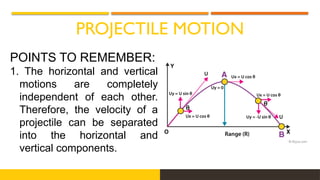
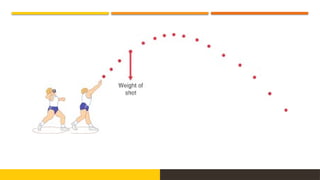
POINTS TO REMEMBER:
1. The horizontal and vertical
motions are completely
independent of each other.
Therefore, the velocity of a
projectile can be separated
into the horizontal and
vertical components.
PROJECTILE MOTION
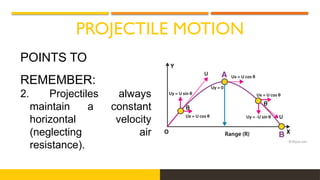
POINTS TO
REMEMBER:
2. Projectiles always
maintain a constant
horizontal velocity
(neglecting air
resistance).
PROJECTILE MOTION
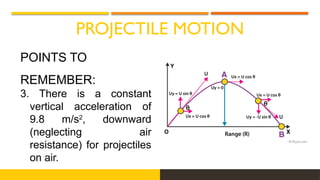
POINTS TO
REMEMBER:
3. There is a constant
vertical acceleration of
9.8 m/s2
, downward
(neglecting air
resistance) for projectiles
on air.
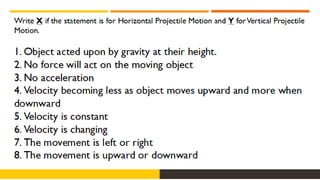
TWO TYPES OF PROJECTILE MOTION
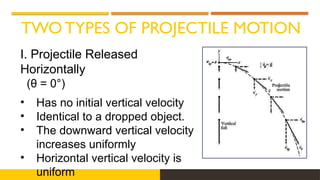
I. Projectile Released
Horizontally
(θ = 0°)
• Has no initial vertical velocity
• Identical to a dropped object.
• The downward vertical velocity
increases uniformly
• Horizontal vertical velocity is
uniform
TWO TYPES OF PROJECTILE
MOTION
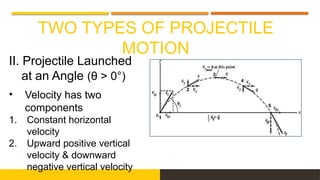
II. Projectile Launched
at an Angle (θ > 0°)
• Velocity has two
components
1. Constant horizontal
velocity
2. Upward positive vertical
velocity & downward
negative vertical velocity
TWO TYPES OF PROJECTILE
MOTION
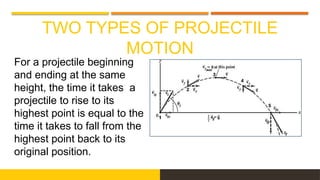
For a projectile beginning
and ending at the same
height, the time it takes a
projectile to rise to its
highest point is equal to the
time it takes to fall from the
highest point back to its
original position.
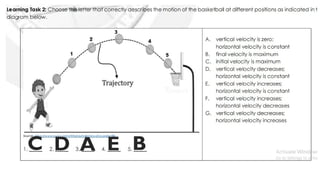
C D A E B
Day 3
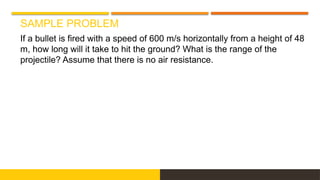
SAMPLE PROBLEM
If a bullet is fired with a speed of 600 m/s horizontally from a height of 48
m, how long will it take to hit the ground? What is the range of the
projectile? Assume that there is no air resistance.
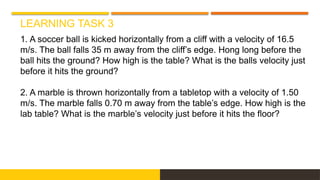
LEARNING TASK 3
1. A soccer ball is kicked horizontally from a cliff with a velocity of 16.5
m/s. The ball falls 35 m away from the cliff’s edge. Hong long before the
ball hits the ground? How high is the table? What is the balls velocity just
before it hits the ground?
2. A marble is thrown horizontally from a tabletop with a velocity of 1.50
m/s. The marble falls 0.70 m away from the table’s edge. How high is the
lab table? What is the marble’s velocity just before it hits the floor?
Day 4
PROJECTILE MOTION
The motion of a projectile may be described in
terms of the range and maximum height it
reaches.
1. RANGE - is the horizontal distance traveled
by a projectile.
2. HEIGHT - is the vertical distance traveled by
a projectile.
DAY 5
ANGLE OF RELEASE
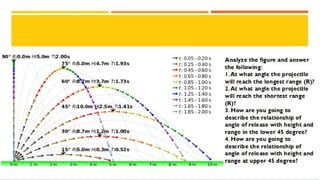
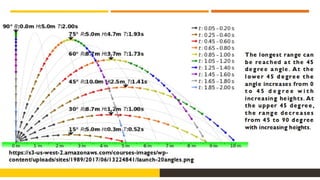
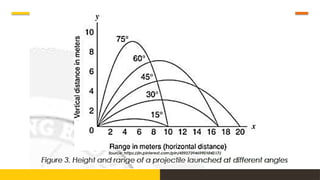
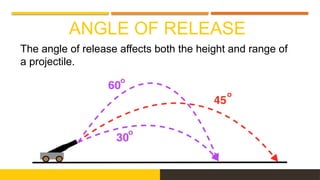
The angle of release affects both the height and range of
a projectile.
ANGLE OF RELEASE
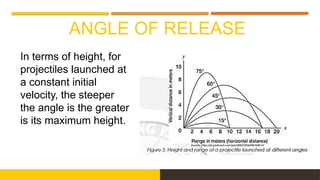
In terms of height, for
projectiles launched at
a constant initial
velocity, the steeper
the angle is the greater
is its maximum height.
ANGLE OF RELEASE
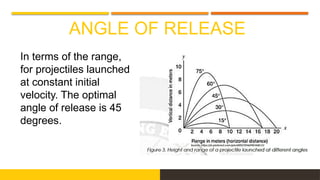
In terms of the range,
for projectiles launched
at constant initial
velocity. The optimal
angle of release is 45
degrees.
ASSIMILATION (SYNCHRONOUS)
I understand that ________________.
I realized that __________________.
I find the lesson (easy/difficult) to
learn because _____________.
SUMMATIVETEST
https://docs.google.com/forms/d/e/
1FAIpQLSdOFJ7BJGEVMsO1BZbvevIfQIl2JX2JO6AOI5WfyuDp
t0j9og/viewform?usp=sf_link

Science 9 Quarter 4 Week 1 Regular Class.pptx

  • 1.
  • 2.
  • 3.
  • 4.
    WEEK 1 PROJECTILEMOTION MELC MELC 19: Describe the horizontal and vertical motions of a projectile. MELC 20: Investigate the relationship between the angle of release and the height and range of a projectile.
  • 5.
    MOTION What is motion? Motionis the action of changing location or position. (Physics Hypertextbook) Motion is the change with time of the position and orientation of a body. (Britannica.com)
  • 6.
    VOCABULARY REVIEW 1. SPEED- is the rate at which an object is moving along a path; scalar quantity 2. VELOCITY - is the rate and direction of an object's movement; vector quantity.
  • 7.
    VOCABULARY REVIEW 3. DISTANCE- how much ground an object has covered" during its motion; scalar quantity 4. DISPLACEMENT - how far out of place an object is or the object's overall change in position; vector quantity
  • 8.
    VOCABULARY REVIEW 5. TIME- how long it took the object from one position to another; scalar quantity 6. ACCELERATION - rate at which velocity changes with time, in terms of both speed and direction; vector quantity
  • 9.
  • 10.
  • 11.
    UNIFORMLY ACCELERATED MOTION Whenis an object in a UNIFORMLY ACCELERATED MOTION? A body is said to have uniform acceleration if it maintains a constant change in its velocity in each time interval along a straight line.
  • 12.
    UNIFORMLY ACCELERATED MOTION HORIZONTAL Example:An object is moving from rest and accelerates uniformly at a rate of 2 m/s. Time (seconds) Speed (m/s) 1 2 2 4 3 6 4 8 5 10 Time (seconds) Distance (meters) 1 1 2 4 3 9 4 16 5 25 Rectilinear
  • 13.
    UNIFORMLY ACCELERATED MOTION VERTICAL Thepull of gravity acts on all objects. The acceleration due to gravity is equal to -9.8 m/s2. Time (seconds) Speed (m/s) 1 9.8 2 19.6 3 29.4 4 39.2 5 49 Time (seconds) Distance (meters) 1 4.9 2 19.6 3 44.1 4 78.4 5 122.5 Freefall
  • 14.
    UNIFORMLY ACCELERATED MOTION KINEMATICEQUATIONS (1) (2) (3) (4)
  • 15.
    UNIFORMLY ACCELERATED MOTION KINEMATICEQUATIONS (1) (2) (3) (4)
  • 16.
    Projectile is anobject which the only force acting is gravity. Variety of examples projectiles we encounter from day to day of our lives. An object from rest is a projectile provided that the influence of air resistance is negligible.When an object is vertically thrown upward is also a projectile provided that the air resistance is negligible. And an object which is which is thrown upward at an angle to the horizontal is also a projectile as long as the influence of air resistance is negligible.A projectile is any object that once projected or dropped continues in motion by its own inertia and is influenced only by the downward force of gravity.
  • 18.
  • 19.
  • 20.
  • 21.
    PROJECTILE MOTION What isprojectile motion? Projectile motion is a combination of uniform motion along the horizontal and the motion of a freely falling body along the vertical. It is an instance of uniformly accelerated motion in two- dimensions.
  • 22.
    Galileo first describedprojectile motion as having two components: horizontal and vertical. The horizontal component is uniform motion; the vertical component is free fall.Throughout the motion of the projectile, change occurs only in the vertical velocity because of the influence of gravity, while the horizontal velocity does not alter.Thus, if air resistance is neglected, a projectile moves horizontally at a constant speed and simultaneously travels vertically with acceleration equal to gravity which is 9.8 m/s2.
  • 24.
    PROJECTILE MOTION UNLOCKING VOCABULARY 1.PROJECTILE - is a body traveling in projectile motion. 2. Trajectory - It is the curved path traveled by a projectile. 3. RANGE - is the horizontal distance traveled by a projectile. 4. HEIGHT - is the vertical distance traveled by a projectile.
  • 25.
  • 26.
  • 27.
    PROJECTILE MOTION POINTS TOREMEMBER: 1. The horizontal and vertical motions are completely independent of each other. Therefore, the velocity of a projectile can be separated into the horizontal and vertical components.
  • 28.
    PROJECTILE MOTION POINTS TO REMEMBER: 2.Projectiles always maintain a constant horizontal velocity (neglecting air resistance).
  • 29.
    PROJECTILE MOTION POINTS TO REMEMBER: 3.There is a constant vertical acceleration of 9.8 m/s2 , downward (neglecting air resistance) for projectiles on air.
  • 30.
    TWO TYPES OFPROJECTILE MOTION I. Projectile Released Horizontally (θ = 0°) • Has no initial vertical velocity • Identical to a dropped object. • The downward vertical velocity increases uniformly • Horizontal vertical velocity is uniform
  • 31.
    TWO TYPES OFPROJECTILE MOTION II. Projectile Launched at an Angle (θ > 0°) • Velocity has two components 1. Constant horizontal velocity 2. Upward positive vertical velocity & downward negative vertical velocity
  • 32.
    TWO TYPES OFPROJECTILE MOTION For a projectile beginning and ending at the same height, the time it takes a projectile to rise to its highest point is equal to the time it takes to fall from the highest point back to its original position.
  • 33.
    C D AE B
  • 34.
  • 36.
    SAMPLE PROBLEM If abullet is fired with a speed of 600 m/s horizontally from a height of 48 m, how long will it take to hit the ground? What is the range of the projectile? Assume that there is no air resistance.
  • 37.
    LEARNING TASK 3 1.A soccer ball is kicked horizontally from a cliff with a velocity of 16.5 m/s. The ball falls 35 m away from the cliff’s edge. Hong long before the ball hits the ground? How high is the table? What is the balls velocity just before it hits the ground? 2. A marble is thrown horizontally from a tabletop with a velocity of 1.50 m/s. The marble falls 0.70 m away from the table’s edge. How high is the lab table? What is the marble’s velocity just before it hits the floor?

  • 38.
  • 39.
    PROJECTILE MOTION The motionof a projectile may be described in terms of the range and maximum height it reaches. 1. RANGE - is the horizontal distance traveled by a projectile. 2. HEIGHT - is the vertical distance traveled by a projectile.
  • 42.
  • 47.
    ANGLE OF RELEASE Theangle of release affects both the height and range of a projectile.
  • 48.
    ANGLE OF RELEASE Interms of height, for projectiles launched at a constant initial velocity, the steeper the angle is the greater is its maximum height.
  • 49.
    ANGLE OF RELEASE Interms of the range, for projectiles launched at constant initial velocity. The optimal angle of release is 45 degrees.
  • 53.
    ASSIMILATION (SYNCHRONOUS) I understandthat ________________. I realized that __________________. I find the lesson (easy/difficult) to learn because _____________.
  • 54.

Editor's Notes

  • #5 Mention rest
  • #13 So, when you drop something or even when you throw something up, it will go down. Things thrown upward always fall at a constant acceleration which has a magnitude of 9.8 m/s2. This means that the velocity of an object changes by 9.8 m/s every second of fall. Consider a ball thrown upward. As the ball goes up, it decelerates until it stops momentarily and changes direction. That means, it reaches its maximum height before it starts to fall back to the point where it was thrown, and its speed will be equal to the speed at which it was thrown. Note that the magnitudes of the two velocities are equal, but they have opposite directions – velocity is upward when it was thrown, but downward when it returns. Free-fall is an example of uniformly accelerated motion, with its acceleration being -9.8 m/s2, negative because it is downward. What is its velocity at the highest point? What is its velocity when it returned to the elevation from where it was thrown? What is its acceleration at the highest point? What is its acceleration just before it hits the ground? After 1 second what is the acceleration of the ball?
  • #14 V = d/t V = vf+vi/2 A= vf-vi/t
  • #15 V = d/t V = vf+vi/2 A= vf-vi/t
  • #17 Many of the games you play and sporting events you join/officiate in during PE classes involve flying objects or balls This curve is what naturally happens when an object, called a projectile, moves in two dimensions –having both horizontal and vertical motion components, acted by gravity only. In physics this is called projectile motion. Not only balls fly when in projectile motion. Have you noticed that in many sports and games, players come “flying” too? Understanding motion in two-dimensions will help you apply the physics of sports and enhance game events experiences.
  • #31 an upward positive vertical velocity component that is decreasing in magnitude until it becomes zero at the top of the trajectory (therefore it no longer goes up any further). But the gravity makes it accelerate downward at a rate of 9.8 m/s per second or 9.8 m/s2 making it descend (or go down) with an increasing negative vertical velocity until it is stopped by something.
  • #46 When the magnitude of the velocity of the projectile is increased, the horizontal and vertical components of the projection velocity both increase. As the vertical component of velocity of projectile increases, it means the maximum height attained by the projectile in its flight also increases. As the projectile attains more height than before, it takes more time to fall to the ground ie the time of flight increases. As the time of flight increases, so does the range on two counts, increased horizontal component of the velocity of projection, and increased time of flight. So increasing the velocity of projection, increase time of flight, range and the maximum height achieved during flight of the projectile.
  • #48 This is due to the fact that as we increase the angle of release, the time of flight also increases with results to higher peak.