Projectile Motion or
           2D Kinematics
       By Sandrine Colson-Inam, Ph.D


References:
Conceptual Physics, Paul G. Hewitt, 10 th edition, Addison


Wesley publisher
   http://www.glenbrook.k12.il.us/gbssci/Phys/Class/vectors/u3l
Outline
   What is a projectile
   Characteristics of a projectile's motion
   Horizontal and vertical components of
    velocity and displacement
   Initial velocity components
   Examples of problems
What is a projectile?

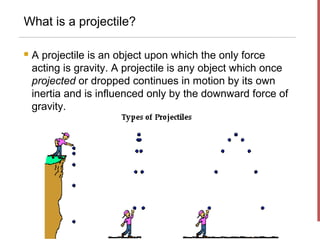
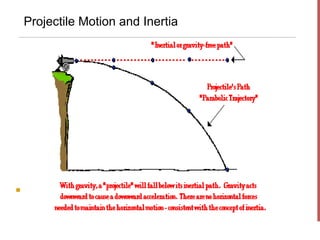
   A projectile is an object upon which the only force
    acting is gravity. A projectile is any object which once
    projected or dropped continues in motion by its own
    inertia and is influenced only by the downward force of
    gravity.
Projectile Motion and Inertia



Horizontal and Vertical Velocities


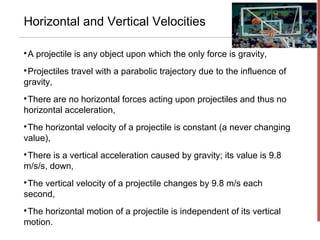
 A projectile is any object upon which the only force is gravity,

 Projectiles travel with a parabolic trajectory due to the influence of
gravity,

 There are no horizontal forces acting upon projectiles and thus no
horizontal acceleration,

 The horizontal velocity of a projectile is constant (a never changing
value),

 There is a vertical acceleration caused by gravity; its value is 9.8
m/s/s, down,

 The vertical velocity of a projectile changes by 9.8 m/s each
second,

 The horizontal motion of a projectile is independent of its vertical
motion.
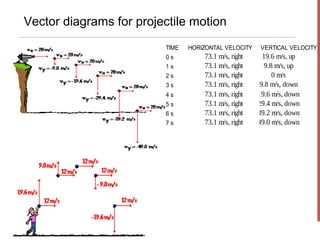
Vector diagrams for projectile motion
                         TIME   HORIZONTAL VELOCITY    VERTICAL VELOCITY
                         0s         73.1 m/s, right     19.6 m/s, up
                         1s         73.1 m/s, right      9.8 m/s, up
                         2s         73.1 m/s, right         0 m/s
                         3s         73.1 m/s, right    9.8 m/s, down
                         4s         73.1 m/s, right   19.6 m/s, down
                         5s         73.1 m/s, right   29.4 m/s, down
                         6s         73.1 m/s, right   39.2 m/s, down
                         7s         73.1 m/s, right   49.0 m/s, down
Horizontal and vertical displacement –
Horizontally Launched Projectile
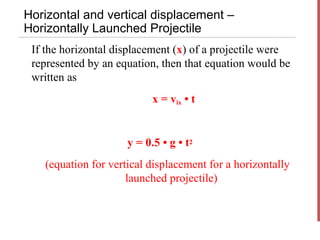
 If the horizontal displacement (x) of a projectile were
 represented by an equation, then that equation would be
 written as
                           x = vix • t


                     y = 0.5 • g • t2
   (equation for vertical displacement for a horizontally
                     launched projectile)
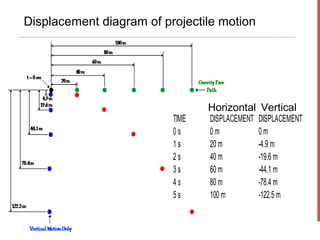
Displacement diagram of projectile motion


                                 Horizontal Vertical
                          TIME   DISPLACEMENT   DISPLACEMENT
                          0s     0m             0m
                          1s     20 m           -4.9 m
                          2s     40 m           -19.6 m
                          3s     60 m           -44.1 m
                          4s     80 m           -78.4 m
                          5s     100 m          -122.5 m
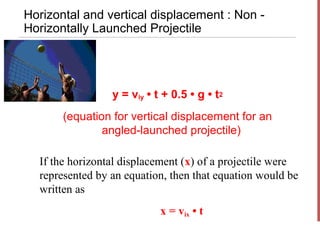
Horizontal and vertical displacement : Non -
Horizontally Launched Projectile


                 y = viy • t + 0.5 • g • t2
       (equation for vertical displacement for an
               angled-launched projectile)

  If the horizontal displacement (x) of a projectile were
  represented by an equation, then that equation would be
  written as
                            x = vix • t
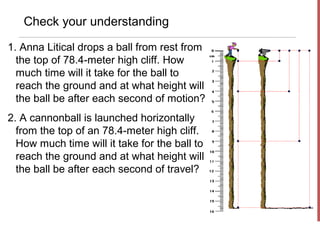
Check your understanding

1. Anna Litical drops a ball from rest from
  the top of 78.4-meter high cliff. How
  much time will it take for the ball to
  reach the ground and at what height will
  the ball be after each second of motion?
2. A cannonball is launched horizontally
  from the top of an 78.4-meter high cliff.
  How much time will it take for the ball to
  reach the ground and at what height will
  the ball be after each second of travel?
Answers
1.

    It will take 4 seconds to fall 78.4 meters

    Use the equation y = 0.5 • g • t 2 and substitute -9.8 m/s/s for g. The vertical displacement must then be
     subtracted from the initial height of 78. 4 m.

    At t = 1 s, y = 4.9 m (down) so height is 73.5 m (78.4 m - 4.9 m )

    At t = 2 s, y = 19.6 m (down) so height is 58.8 m (78.4 m - 19.6 m )

    At t = 3 s, y = 44.1 m (down) so height is 34.3 m (78.4 m - 45 m)

    At t = 4 s, y = 78.4 m (down) so height is 0 m (78.4 m - 78.4 m)

2.

    It will take 4 seconds to fall 78.4 meters

    Use the equation y = 0.5 • g • t 2 and substitute -9.8 m/s/s for g. The vertical displacement must then be
     subtracted from the initial height of 78. 4 m.

    At t = 1 s, y = 4.9 m (down) so height is 73.5 m (78.4 m - 4.9 m )

    At t = 2 s, y = 19.6 m (down) so height is 58.8 m (78.4 m - 19.6 m )

    At t = 3 s, y = 44.1 m (down) so height is 34.3 m (78.4 m - 45 m)

    At t = 4 s, y = 78.4 m (down) so height is 0 m (78.4 m - 78.4 m)
Check your understanding
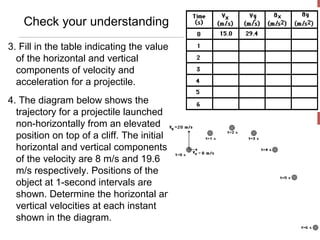
3. Fill in the table indicating the value
  of the horizontal and vertical
  components of velocity and
  acceleration for a projectile.
4. The diagram below shows the
  trajectory for a projectile launched
  non-horizontally from an elevated
  position on top of a cliff. The initial
  horizontal and vertical components
  of the velocity are 8 m/s and 19.6
  m/s respectively. Positions of the
  object at 1-second intervals are
  shown. Determine the horizontal and
  vertical velocities at each instant
  shown in the diagram.
Answers

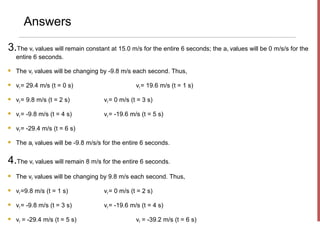
3.The v values will remain constant at 15.0 m/s for the entire 6 seconds; the a values will be 0 m/s/s for the
          x                                                                     x

    entire 6 seconds.

   The vy values will be changing by -9.8 m/s each second. Thus,

   vy = 29.4 m/s (t = 0 s)                       vy = 19.6 m/s (t = 1 s)

   vy = 9.8 m/s (t = 2 s)           vy = 0 m/s (t = 3 s)

   vy = -9.8 m/s (t = 4 s)          vy = -19.6 m/s (t = 5 s)

   vy = -29.4 m/s (t = 6 s)

   The ay values will be -9.8 m/s/s for the entire 6 seconds.


4.The v values will remain 8 m/s for the entire 6 seconds.
          x


   The vy values will be changing by 9.8 m/s each second. Thus,

   vy =9.8 m/s (t = 1 s)            vy = 0 m/s (t = 2 s)

   vy = -9.8 m/s (t = 3 s)          vy = -19.6 m/s (t = 4 s)

   vy = -29.4 m/s (t = 5 s)                      vy = -39.2 m/s (t = 6 s)
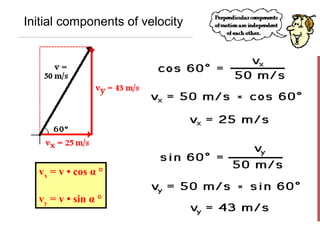
Initial components of velocity


  vx = v • cos α °

  vy = v • sin α °
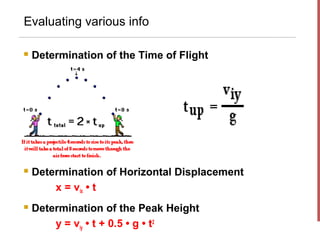
Evaluating various info

   Determination of the Time of Flight


   Determination of Horizontal Displacement
        x = vix • t
   Determination of the Peak Height
        y = viy • t + 0.5 • g • t2
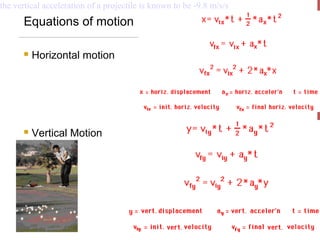
the vertical acceleration of a projectile is known to be -9.8 m/s/s
      Equations of motion

         Horizontal motion


         Vertical Motion
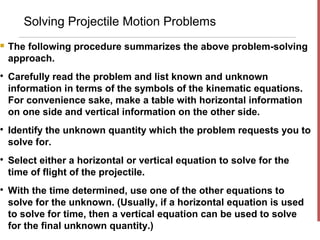
Solving Projectile Motion Problems
   The following procedure summarizes the above problem-solving
    approach.

    Carefully read the problem and list known and unknown
    information in terms of the symbols of the kinematic equations.
    For convenience sake, make a table with horizontal information
    on one side and vertical information on the other side.

    Identify the unknown quantity which the problem requests you to
    solve for.

    Select either a horizontal or vertical equation to solve for the
    time of flight of the projectile.

    With the time determined, use one of the other equations to
    solve for the unknown. (Usually, if a horizontal equation is used
    to solve for time, then a vertical equation can be used to solve
    for the final unknown quantity.)
Check your understanding

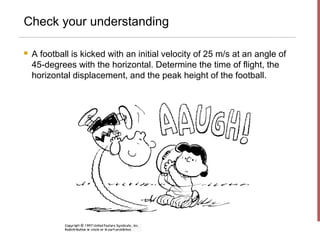
   A football is kicked with an initial velocity of 25 m/s at an angle of
    45-degrees with the horizontal. Determine the time of flight, the
    horizontal displacement, and the peak height of the football.
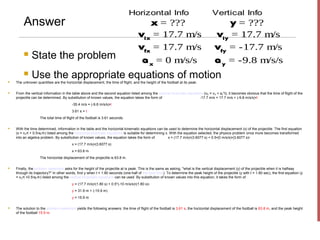
Horizontal Info                                        Vertical Info
         Answer                                                                         x = ???                                             y = ???
                                                                                     vix = 17.7 m/s                                     viy = 17.7 m/s
                                                                                     vfx = 17.7 m/s                                     vfy = -17.7 m/s
             State the problem                                                       a x = 0 m/s/s                                     a y = -9.8 m/s/s
             Use the appropriate equations of motion
   The unknown quantities are the horizontal displacement, the time of flight, and the height of the football at its peak.

   From the vertical information in the table above and the second equation listed among the vertical kinematic equations (vfy = viy + ay*t), it becomes obvious that the time of flight of the
    projectile can be determined. By substitution of known values, the equation takes the form of                       -17.7 m/s = 17.7 m/s + (-9.8 m/s/s)•t
                                         -35.4 m/s = (-9.8 m/s/s)•t
                                         3.61 s = t
                   The total time of flight of the football is 3.61 seconds.

   With the time determined, information in the table and the horizontal kinematic equations can be used to determine the horizontal displacement (x) of the projectile. The first equation
    (x = vix•t + 0.5•ax•t2) listed among the horizontal kinematic equations is suitable for determining x. With the equation selected, the physics problem once more becomes transformed
    into an algebra problem. By substitution of known values, the equation takes the form of              x = (17.7 m/s)•(3.6077 s) + 0.5•(0 m/s/s)•(3.6077 s)2
                                         x = (17.7 m/s)•(3.6077 s)
                                         x = 63.8 m
                   The horizontal displacement of the projectile is 63.8 m.

   Finally, the problem statement asks for the height of the projectile at is peak. This is the same as asking, "what is the vertical displacement (y) of the projectile when it is halfway
    through its trajectory?" In other words, find y when t = 1.80 seconds (one-half of the total time). To determine the peak height of the projectile (y with t = 1.80 sec), the first equation (y
    = viy•t +0.5•ay•t2) listed among the vertical kinematic equations can be used. By substitution of known values into this equation, it takes the form of
                                         y = (17.7 m/s)•(1.80 s) + 0.5*(-10 m/s/s)•(1.80 s)2
                                         y = 31.9 m + (-15.9 m)
                                         y = 15.9 m

   The solution to the problem statement yields the following answers: the time of flight of the football is 3.61 s, the horizontal displacement of the football is 63.8 m, and the peak height
    of the football 15.9 m.
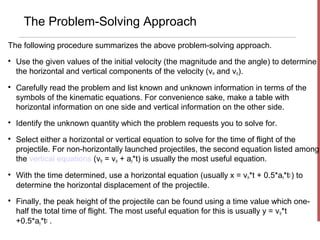
The Problem-Solving Approach
The following procedure summarizes the above problem-solving approach.

    Use the given values of the initial velocity (the magnitude and the angle) to determine
    the horizontal and vertical components of the velocity (vix and viy).

    Carefully read the problem and list known and unknown information in terms of the
    symbols of the kinematic equations. For convenience sake, make a table with
    horizontal information on one side and vertical information on the other side.

    Identify the unknown quantity which the problem requests you to solve for.

    Select either a horizontal or vertical equation to solve for the time of flight of the
    projectile. For non-horizontally launched projectiles, the second equation listed among
    the vertical equations (vfy = viy + ay*t) is usually the most useful equation.

    With the time determined, use a horizontal equation (usually x = vix*t + 0.5*ax*t2 ) to
    determine the horizontal displacement of the projectile.

    Finally, the peak height of the projectile can be found using a time value which one-
    half the total time of flight. The most useful equation for this is usually y = viy*t
    +0.5*ay*t2 .
SUMMARY: See
  Hand-outs

Projectile motion 2

  • 1.
    Projectile Motion or 2D Kinematics By Sandrine Colson-Inam, Ph.D References: Conceptual Physics, Paul G. Hewitt, 10 th edition, Addison  Wesley publisher  http://www.glenbrook.k12.il.us/gbssci/Phys/Class/vectors/u3l
  • 2.
    Outline  What is a projectile  Characteristics of a projectile's motion  Horizontal and vertical components of velocity and displacement  Initial velocity components  Examples of problems
  • 3.
    What is aprojectile?  A projectile is an object upon which the only force acting is gravity. A projectile is any object which once projected or dropped continues in motion by its own inertia and is influenced only by the downward force of gravity.
  • 4.
  • 5.
    Horizontal and VerticalVelocities  A projectile is any object upon which the only force is gravity,  Projectiles travel with a parabolic trajectory due to the influence of gravity,  There are no horizontal forces acting upon projectiles and thus no horizontal acceleration,  The horizontal velocity of a projectile is constant (a never changing value),  There is a vertical acceleration caused by gravity; its value is 9.8 m/s/s, down,  The vertical velocity of a projectile changes by 9.8 m/s each second,  The horizontal motion of a projectile is independent of its vertical motion.
  • 6.
    Vector diagrams forprojectile motion TIME HORIZONTAL VELOCITY VERTICAL VELOCITY 0s 73.1 m/s, right 19.6 m/s, up 1s 73.1 m/s, right 9.8 m/s, up 2s 73.1 m/s, right 0 m/s 3s 73.1 m/s, right 9.8 m/s, down 4s 73.1 m/s, right 19.6 m/s, down 5s 73.1 m/s, right 29.4 m/s, down 6s 73.1 m/s, right 39.2 m/s, down 7s 73.1 m/s, right 49.0 m/s, down
  • 7.
    Horizontal and verticaldisplacement – Horizontally Launched Projectile If the horizontal displacement (x) of a projectile were represented by an equation, then that equation would be written as x = vix • t y = 0.5 • g • t2 (equation for vertical displacement for a horizontally launched projectile)
  • 8.
    Displacement diagram ofprojectile motion Horizontal Vertical TIME DISPLACEMENT DISPLACEMENT 0s 0m 0m 1s 20 m -4.9 m 2s 40 m -19.6 m 3s 60 m -44.1 m 4s 80 m -78.4 m 5s 100 m -122.5 m
  • 9.
    Horizontal and verticaldisplacement : Non - Horizontally Launched Projectile y = viy • t + 0.5 • g • t2 (equation for vertical displacement for an angled-launched projectile) If the horizontal displacement (x) of a projectile were represented by an equation, then that equation would be written as x = vix • t
  • 10.
    Check your understanding 1.Anna Litical drops a ball from rest from the top of 78.4-meter high cliff. How much time will it take for the ball to reach the ground and at what height will the ball be after each second of motion? 2. A cannonball is launched horizontally from the top of an 78.4-meter high cliff. How much time will it take for the ball to reach the ground and at what height will the ball be after each second of travel?
  • 11.
    Answers 1.  It will take 4 seconds to fall 78.4 meters  Use the equation y = 0.5 • g • t 2 and substitute -9.8 m/s/s for g. The vertical displacement must then be subtracted from the initial height of 78. 4 m.  At t = 1 s, y = 4.9 m (down) so height is 73.5 m (78.4 m - 4.9 m )  At t = 2 s, y = 19.6 m (down) so height is 58.8 m (78.4 m - 19.6 m )  At t = 3 s, y = 44.1 m (down) so height is 34.3 m (78.4 m - 45 m)  At t = 4 s, y = 78.4 m (down) so height is 0 m (78.4 m - 78.4 m) 2.  It will take 4 seconds to fall 78.4 meters  Use the equation y = 0.5 • g • t 2 and substitute -9.8 m/s/s for g. The vertical displacement must then be subtracted from the initial height of 78. 4 m.  At t = 1 s, y = 4.9 m (down) so height is 73.5 m (78.4 m - 4.9 m )  At t = 2 s, y = 19.6 m (down) so height is 58.8 m (78.4 m - 19.6 m )  At t = 3 s, y = 44.1 m (down) so height is 34.3 m (78.4 m - 45 m)  At t = 4 s, y = 78.4 m (down) so height is 0 m (78.4 m - 78.4 m)
  • 12.
    Check your understanding 3.Fill in the table indicating the value of the horizontal and vertical components of velocity and acceleration for a projectile. 4. The diagram below shows the trajectory for a projectile launched non-horizontally from an elevated position on top of a cliff. The initial horizontal and vertical components of the velocity are 8 m/s and 19.6 m/s respectively. Positions of the object at 1-second intervals are shown. Determine the horizontal and vertical velocities at each instant shown in the diagram.
  • 13.
    Answers 3.The v valueswill remain constant at 15.0 m/s for the entire 6 seconds; the a values will be 0 m/s/s for the x x entire 6 seconds.  The vy values will be changing by -9.8 m/s each second. Thus,  vy = 29.4 m/s (t = 0 s) vy = 19.6 m/s (t = 1 s)  vy = 9.8 m/s (t = 2 s) vy = 0 m/s (t = 3 s)  vy = -9.8 m/s (t = 4 s) vy = -19.6 m/s (t = 5 s)  vy = -29.4 m/s (t = 6 s)  The ay values will be -9.8 m/s/s for the entire 6 seconds. 4.The v values will remain 8 m/s for the entire 6 seconds. x  The vy values will be changing by 9.8 m/s each second. Thus,  vy =9.8 m/s (t = 1 s) vy = 0 m/s (t = 2 s)  vy = -9.8 m/s (t = 3 s) vy = -19.6 m/s (t = 4 s)  vy = -29.4 m/s (t = 5 s) vy = -39.2 m/s (t = 6 s)
  • 14.
    Initial components ofvelocity vx = v • cos α ° vy = v • sin α °
  • 15.
    Evaluating various info  Determination of the Time of Flight  Determination of Horizontal Displacement x = vix • t  Determination of the Peak Height y = viy • t + 0.5 • g • t2
  • 16.
    the vertical accelerationof a projectile is known to be -9.8 m/s/s Equations of motion  Horizontal motion  Vertical Motion
  • 17.
    Solving Projectile MotionProblems  The following procedure summarizes the above problem-solving approach.  Carefully read the problem and list known and unknown information in terms of the symbols of the kinematic equations. For convenience sake, make a table with horizontal information on one side and vertical information on the other side.  Identify the unknown quantity which the problem requests you to solve for.  Select either a horizontal or vertical equation to solve for the time of flight of the projectile.  With the time determined, use one of the other equations to solve for the unknown. (Usually, if a horizontal equation is used to solve for time, then a vertical equation can be used to solve for the final unknown quantity.)
  • 18.
    Check your understanding  A football is kicked with an initial velocity of 25 m/s at an angle of 45-degrees with the horizontal. Determine the time of flight, the horizontal displacement, and the peak height of the football.
  • 19.
    Horizontal Info Vertical Info Answer x = ??? y = ??? vix = 17.7 m/s viy = 17.7 m/s vfx = 17.7 m/s vfy = -17.7 m/s  State the problem a x = 0 m/s/s a y = -9.8 m/s/s  Use the appropriate equations of motion  The unknown quantities are the horizontal displacement, the time of flight, and the height of the football at its peak.  From the vertical information in the table above and the second equation listed among the vertical kinematic equations (vfy = viy + ay*t), it becomes obvious that the time of flight of the projectile can be determined. By substitution of known values, the equation takes the form of -17.7 m/s = 17.7 m/s + (-9.8 m/s/s)•t -35.4 m/s = (-9.8 m/s/s)•t 3.61 s = t The total time of flight of the football is 3.61 seconds.  With the time determined, information in the table and the horizontal kinematic equations can be used to determine the horizontal displacement (x) of the projectile. The first equation (x = vix•t + 0.5•ax•t2) listed among the horizontal kinematic equations is suitable for determining x. With the equation selected, the physics problem once more becomes transformed into an algebra problem. By substitution of known values, the equation takes the form of x = (17.7 m/s)•(3.6077 s) + 0.5•(0 m/s/s)•(3.6077 s)2 x = (17.7 m/s)•(3.6077 s) x = 63.8 m The horizontal displacement of the projectile is 63.8 m.  Finally, the problem statement asks for the height of the projectile at is peak. This is the same as asking, "what is the vertical displacement (y) of the projectile when it is halfway through its trajectory?" In other words, find y when t = 1.80 seconds (one-half of the total time). To determine the peak height of the projectile (y with t = 1.80 sec), the first equation (y = viy•t +0.5•ay•t2) listed among the vertical kinematic equations can be used. By substitution of known values into this equation, it takes the form of y = (17.7 m/s)•(1.80 s) + 0.5*(-10 m/s/s)•(1.80 s)2 y = 31.9 m + (-15.9 m) y = 15.9 m  The solution to the problem statement yields the following answers: the time of flight of the football is 3.61 s, the horizontal displacement of the football is 63.8 m, and the peak height of the football 15.9 m.
  • 20.
    The Problem-Solving Approach Thefollowing procedure summarizes the above problem-solving approach.  Use the given values of the initial velocity (the magnitude and the angle) to determine the horizontal and vertical components of the velocity (vix and viy).  Carefully read the problem and list known and unknown information in terms of the symbols of the kinematic equations. For convenience sake, make a table with horizontal information on one side and vertical information on the other side.  Identify the unknown quantity which the problem requests you to solve for.  Select either a horizontal or vertical equation to solve for the time of flight of the projectile. For non-horizontally launched projectiles, the second equation listed among the vertical equations (vfy = viy + ay*t) is usually the most useful equation.  With the time determined, use a horizontal equation (usually x = vix*t + 0.5*ax*t2 ) to determine the horizontal displacement of the projectile.  Finally, the peak height of the projectile can be found using a time value which one- half the total time of flight. The most useful equation for this is usually y = viy*t +0.5*ay*t2 .
  • 21.
    SUMMARY: See Hand-outs