
WINDS
By Prof. Liwayway Memije-Cruz
What is a wind?
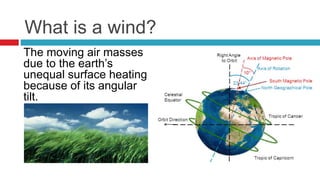
The moving air masses
due to the earth’s
unequal surface heating
because of its angular
tilt.
Types of Winds
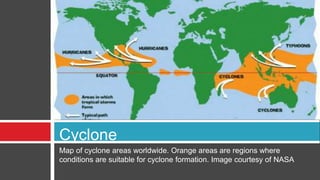
Map of cyclone areas worldwide. Orange areas are regions where
conditions are suitable for cyclone formation. Image courtesy of NASA
Cyclone
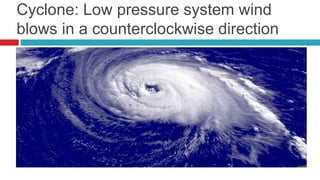
Cyclone: Low pressure system wind
blows in a counterclockwise direction
Cyclone formation.
Air swirls the area of
low-pressure before
rising upwards from the
ocean surface. Image
courtesy of Geoscience
Australia
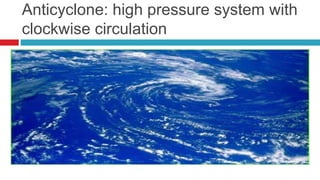
Anticyclone: high pressure system with
clockwise circulation
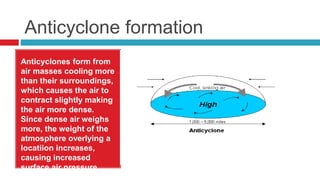
Anticyclone formation
Anticyclones form from
air masses cooling more
than their surroundings,
which causes the air to
contract slightly making
the air more dense.
Since dense air weighs
more, the weight of the
atmosphere overlying a
locatiion increases,
causing increased
surface air pressure.
Land-Sea Breeze
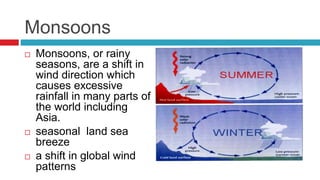
Monsoons
Monsoons
 Monsoons, or rainy
seasons, are a shift in
wind direction which
causes excessive
rainfall in many parts of
the world including
Asia.
 seasonal land sea
breeze
 a shift in global wind
patterns
Chinook winds
Chinook winds
 The chinook winds
can be a nice
warming wind
bringing instant spring
in the middle of winter
or a howling
destructive
windstorm. Chinook
winds can raise
temperatures by 25 to
35 degrees in
minutes, melt snow
completely, sandblast
cars, collapse

Wind

  • 1.
  • 2.
    What is awind? The moving air masses due to the earth’s unequal surface heating because of its angular tilt.
  • 3.
  • 4.
    Map of cycloneareas worldwide. Orange areas are regions where conditions are suitable for cyclone formation. Image courtesy of NASA Cyclone
  • 5.
    Cyclone: Low pressuresystem wind blows in a counterclockwise direction
  • 6.
    Cyclone formation. Air swirlsthe area of low-pressure before rising upwards from the ocean surface. Image courtesy of Geoscience Australia
  • 7.
    Anticyclone: high pressuresystem with clockwise circulation
  • 8.
    Anticyclone formation Anticyclones formfrom air masses cooling more than their surroundings, which causes the air to contract slightly making the air more dense. Since dense air weighs more, the weight of the atmosphere overlying a locatiion increases, causing increased surface air pressure.
  • 9.
  • 10.
  • 11.
    Monsoons  Monsoons, orrainy seasons, are a shift in wind direction which causes excessive rainfall in many parts of the world including Asia.  seasonal land sea breeze  a shift in global wind patterns
  • 12.
  • 13.
    Chinook winds  Thechinook winds can be a nice warming wind bringing instant spring in the middle of winter or a howling destructive windstorm. Chinook winds can raise temperatures by 25 to 35 degrees in minutes, melt snow completely, sandblast cars, collapse