Isomerism
By Prof. Liwayway Memije-Cruz
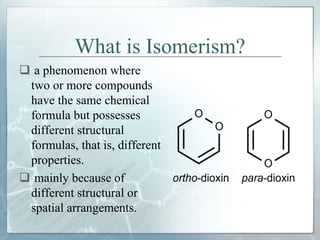
What is Isomerism?
 a phenomenon where
two or more compounds
have the same chemical
formula but possesses
different structural
formulas, that is, different
properties.
 mainly because of
different structural or
spatial arrangements.
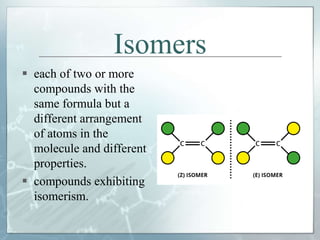
Isomers
 each of two or more
compounds with the
same formula but a
different arrangement
of atoms in the
molecule and different
properties.
 compounds exhibiting
isomerism.
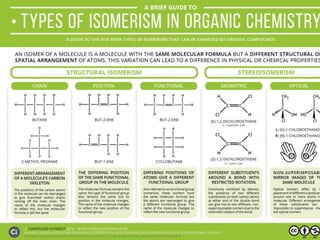
TYPES OF ISOMERISM
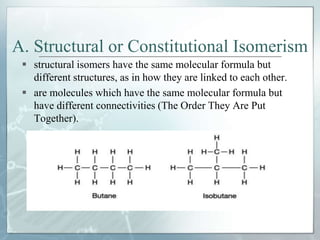
A. Structural or Constitutional Isomerism
 structural isomers have the same molecular formula but
different structures, as in how they are linked to each other.
 are molecules which have the same molecular formula but
have different connectivities (The Order They Are Put
Together).
Types of Structural Isomerism
1. Chain Isomerism
2. Position Isomerism
3. Functional Isomerism
4. Metamerism
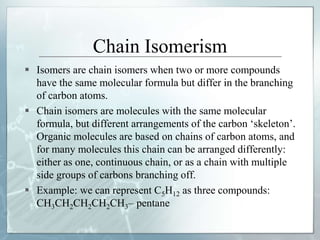
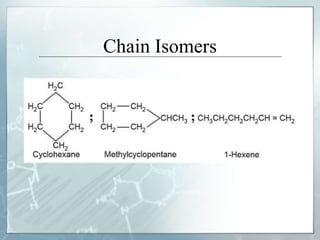
Chain Isomerism
 Isomers are chain isomers when two or more compounds
have the same molecular formula but differ in the branching
of carbon atoms.
 Chain isomers are molecules with the same molecular
formula, but different arrangements of the carbon ‘skeleton’.
Organic molecules are based on chains of carbon atoms, and
for many molecules this chain can be arranged differently:
either as one, continuous chain, or as a chain with multiple
side groups of carbons branching off.
 Example: we can represent C5H12 as three compounds:
CH3CH2CH2CH2CH3– pentane
Chain Isomers
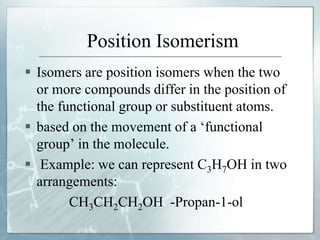
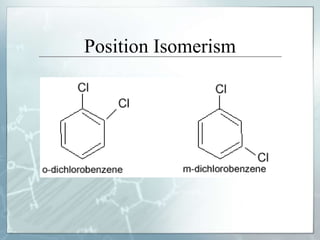
Position Isomerism
 Isomers are position isomers when the two
or more compounds differ in the position of
the functional group or substituent atoms.
 based on the movement of a ‘functional
group’ in the molecule.
 Example: we can represent C3H7OH in two
arrangements:
CH3CH2CH2OH -Propan-1-ol
Position Isomerism
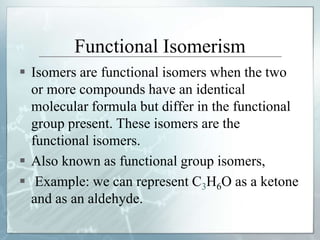
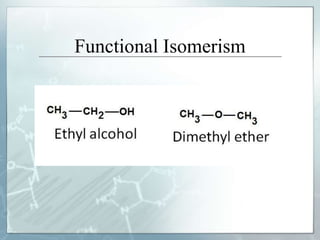
Functional Isomerism
 Isomers are functional isomers when the two
or more compounds have an identical
molecular formula but differ in the functional
group present. These isomers are the
functional isomers.
 Also known as functional group isomers,
 Example: we can represent C3H6O as a ketone
and as an aldehyde.
Functional Isomerism
Metamerism
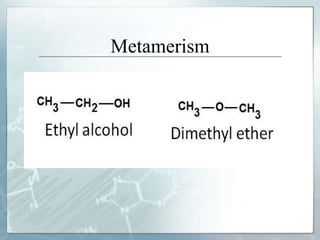
 exhibited by compounds due to the
presence of different alkyl chains on
either side of the functional group.
 Example: we can represent C4H10O
as ethoxyethane (C2H5OC2H5) and
methoxypropane (CH3OC3H7).
Metamerism
B. Stereoisomerism
 Stereoisomerism is a
phenomenon in which
compounds have the same
molecular formula but differ
in the relative positioning or
orientation of atoms in space.
 Stereoisomers are the
compounds exhibiting
stereoisomerism.
Types of
stereoisomerism:
1. Geometric
Isomerism
2. Optical Isomerism
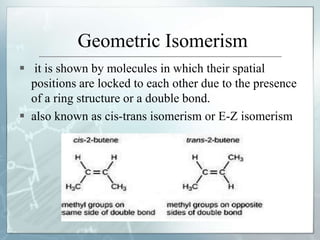
Geometric Isomerism
 it is shown by molecules in which their spatial
positions are locked to each other due to the presence
of a ring structure or a double bond.
 also known as cis-trans isomerism or E-Z isomerism
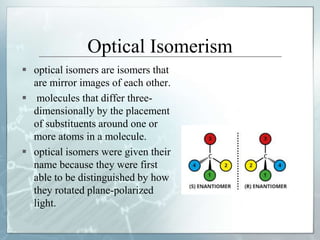
Optical Isomerism
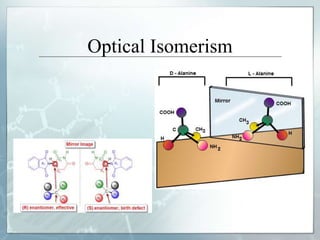
 optical isomers are isomers that
are mirror images of each other.
 molecules that differ three-
dimensionally by the placement
of substituents around one or
more atoms in a molecule.
 optical isomers were given their
name because they were first
able to be distinguished by how
they rotated plane-polarized
light.
Optical Isomerism
Bibliography
 https://www.embibe.com/study/concept-of-chain-
isomerism-concept?entity_code=KTIS78
 https://www.toppr.com/guides/chemistry/organic-
chemistry/isomerism/
 https://www.chemguide.co.uk/basicorg/isomerism/
structural.
 https://www.compoundchem.com/2014/05/22/typesof
isomerism/

Isomerism

  • 1.
  • 2.
    What is Isomerism? a phenomenon where two or more compounds have the same chemical formula but possesses different structural formulas, that is, different properties.  mainly because of different structural or spatial arrangements.
  • 3.
    Isomers  each oftwo or more compounds with the same formula but a different arrangement of atoms in the molecule and different properties.  compounds exhibiting isomerism.
  • 4.
  • 6.
    A. Structural orConstitutional Isomerism  structural isomers have the same molecular formula but different structures, as in how they are linked to each other.  are molecules which have the same molecular formula but have different connectivities (The Order They Are Put Together).
  • 7.
    Types of StructuralIsomerism 1. Chain Isomerism 2. Position Isomerism 3. Functional Isomerism 4. Metamerism
  • 8.
    Chain Isomerism  Isomersare chain isomers when two or more compounds have the same molecular formula but differ in the branching of carbon atoms.  Chain isomers are molecules with the same molecular formula, but different arrangements of the carbon ‘skeleton’. Organic molecules are based on chains of carbon atoms, and for many molecules this chain can be arranged differently: either as one, continuous chain, or as a chain with multiple side groups of carbons branching off.  Example: we can represent C5H12 as three compounds: CH3CH2CH2CH2CH3– pentane
  • 9.
  • 10.
    Position Isomerism  Isomersare position isomers when the two or more compounds differ in the position of the functional group or substituent atoms.  based on the movement of a ‘functional group’ in the molecule.  Example: we can represent C3H7OH in two arrangements: CH3CH2CH2OH -Propan-1-ol
  • 11.
  • 12.
    Functional Isomerism  Isomersare functional isomers when the two or more compounds have an identical molecular formula but differ in the functional group present. These isomers are the functional isomers.  Also known as functional group isomers,  Example: we can represent C3H6O as a ketone and as an aldehyde.
  • 13.
  • 14.
    Metamerism  exhibited bycompounds due to the presence of different alkyl chains on either side of the functional group.  Example: we can represent C4H10O as ethoxyethane (C2H5OC2H5) and methoxypropane (CH3OC3H7).
  • 15.
  • 16.
    B. Stereoisomerism  Stereoisomerismis a phenomenon in which compounds have the same molecular formula but differ in the relative positioning or orientation of atoms in space.  Stereoisomers are the compounds exhibiting stereoisomerism. Types of stereoisomerism: 1. Geometric Isomerism 2. Optical Isomerism
  • 17.
    Geometric Isomerism  itis shown by molecules in which their spatial positions are locked to each other due to the presence of a ring structure or a double bond.  also known as cis-trans isomerism or E-Z isomerism
  • 18.
    Optical Isomerism  opticalisomers are isomers that are mirror images of each other.  molecules that differ three- dimensionally by the placement of substituents around one or more atoms in a molecule.  optical isomers were given their name because they were first able to be distinguished by how they rotated plane-polarized light.
  • 19.
  • 20.
    Bibliography  https://www.embibe.com/study/concept-of-chain- isomerism-concept?entity_code=KTIS78  https://www.toppr.com/guides/chemistry/organic- chemistry/isomerism/ https://www.chemguide.co.uk/basicorg/isomerism/ structural.  https://www.compoundchem.com/2014/05/22/typesof isomerism/