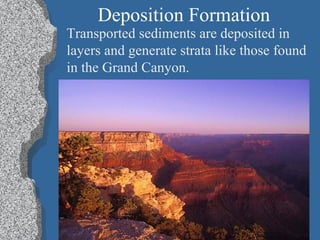
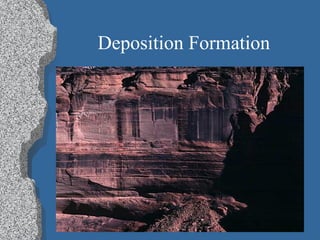
Weathering breaks down rocks and minerals near Earth's surface through mechanical and chemical processes. Mechanical weathering physically breaks rocks into smaller pieces through frost wedging, thermal expansion and contraction, exfoliation, and abrasion by wind, water, or plant growth. Chemical weathering alters the chemical composition of rocks through dissolving, oxidation, and hydrolysis. Erosion transports weathered materials from their source through agents like water, wind, ice, and gravity, depositing sediments that form new rock layers over time.
Weathering and Erosion
Weathering- processes at or
near Earth’s surface that cause
rocks and minerals to break
down
Erosion - process of removing
Earth materials from their
original sites through
weathering and transport
2.
Weathering
Mechanical Weathering -
processesthat break a rock or
mineral into smaller pieces
without altering its composition
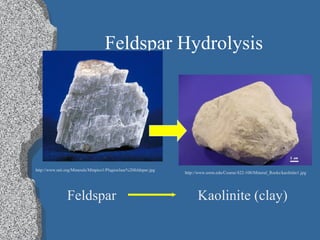
Chemical Weathering - processes
that change the chemical
composition of rocks and
minerals
3.
Mechanical Weathering Processes
Theseare actions or things that break down
Earth materials
frost wedging
thermal expansion and contraction
mechanical exfoliation
abrasion by wind, water or gravity
plant growth
4.
Processes and Agentsof Mechanical
Weathering
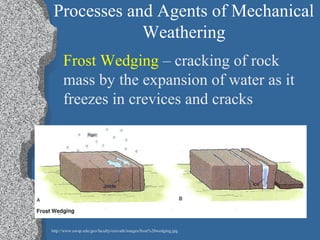
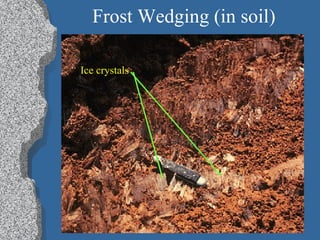
Frost Wedging – cracking of rock
mass by the expansion of water as it
freezes in crevices and cracks
http://www.uwsp.edu/geo/faculty/ozsvath/images/frost%20wedging.jpg
Processes and Agentsof Mechanical
Weathering
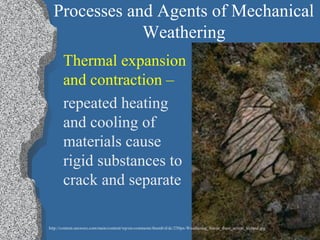
Thermal expansion
and contraction –
repeated heating
and cooling of
materials cause
rigid substances to
crack and separate
http://content.answers.com/main/content/wp/en-commons/thumb/d/dc/250px-Weathering_freeze_thaw_action_iceland.jpg
7.
Processes and Agentsof Mechanical
Weathering
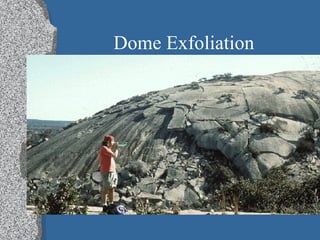
Exfoliation – as underlying rock
layers are exposed, there is less
pressure on them and they expand.
this causes the rigid layers to crack
and sections to slide off
similar to removing dead skin cells
the expanding layers often form a
dome.
Processes and Agentsof Mechanical
Weathering
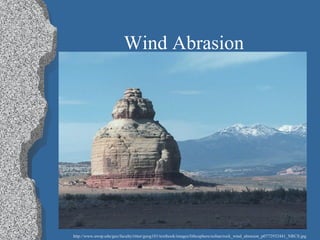
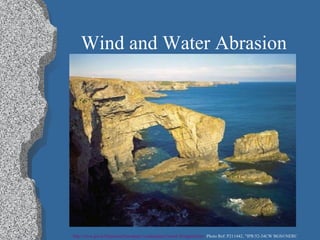
Abrasion – moving sediments or
rock sections can break off pieces
from a rock surface that they strike.
the sediments can be moved
(eroded) by wind or water and the
large rock sections by gravity.
Processes and Agentsof Mechanical
Weathering
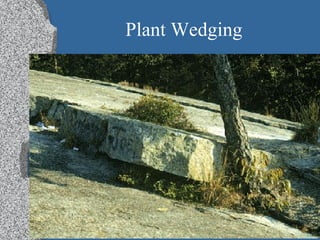
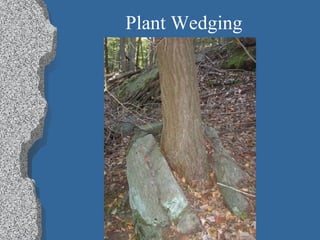
Plant Growth – as plants such as
trees send out root systems, the fine
roots find their way into cracks in
the rocks.
as the roots increase in size, they
force the rock sections apart,
increasing the separation and
weathering.
Processes of Chemical
Weathering
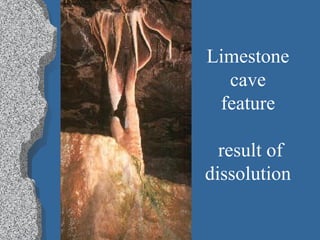
Dissolving(dissolution)
Water, often containing acid from
dissolved carbon dioxide, will dissolve
minerals from a rock body leaving
cavities in the rock. (carbonic acid)
these cavities may generate sinkholes
or cave features such as stalactites and
stalagmites.
Processes of Chemical
Weathering
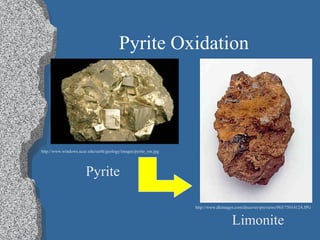
Oxidation
Mineralsmay combine with
oxygen to form new minerals that
are not as hard. (think rust)
For example, the iron-containing
mineral pyrite forms a rusty-
colored mineral called limonite.
Factors Affecting ChemicalWeathering
Climate – humid and warmth maximizes
chemical reactions
Plants and animals – living organisms
secrete substances that react with rock
Time – longer contact means greater change
Mineral composition – some minerals are
more susceptible to change than others
Surface Area- the rate of weathering
depends on the surface area exposed.
23.
Weathering and
Erosion
Weathering producesregolith (“rock
blanket”) which is composed of small
rock and mineral fragments.
When organic matter is mixed into
this material it is called soil.
24.
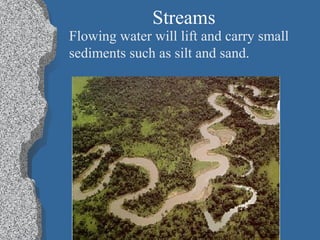
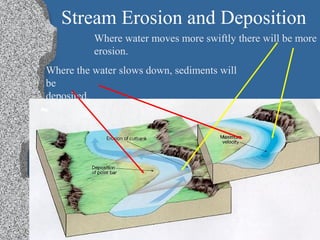
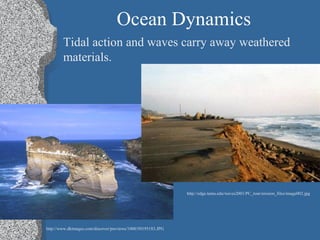
Erosion Transport Agentsor Forces
Water
rain
streams and rivers
ocean dynamics
ice in glaciers
Wind
Gravity
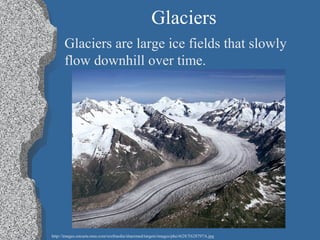
Glaciers
Glaciers are largeice fields that slowly
flow downhill over time.
http://images.encarta.msn.com/xrefmedia/sharemed/targets/images/pho/t628/T628797A.jpg
29.
Glaciers
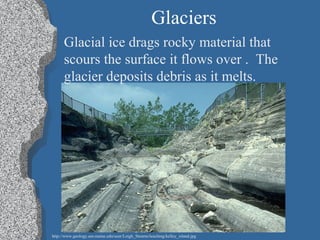
Glacial ice dragsrocky material that
scours the surface it flows over . The
glacier deposits debris as it melts.
http://www.geology.um.maine.edu/user/Leigh_Stearns/teaching/kelley_island.jpg
30.
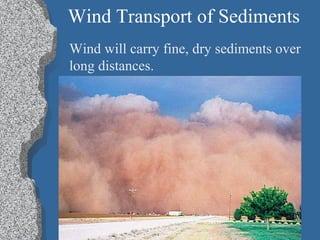
Wind Transport ofSediments
Wind will carry fine, dry sediments over
long distances.
31.
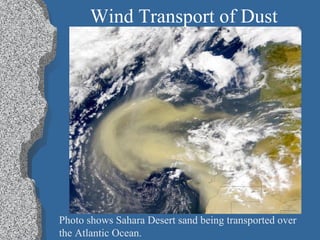
Wind Transport ofDust
Photo shows Sahara Desert sand being transported over
the Atlantic Ocean.
32.
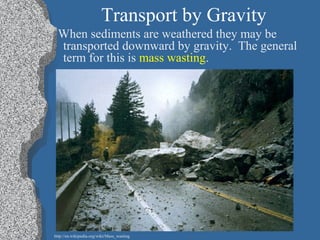
Transport by Gravity
Whensediments are weathered they may be
transported downward by gravity. The general
term for this is mass wasting.
http://en.wikipedia.org/wiki/Mass_wasting
33.
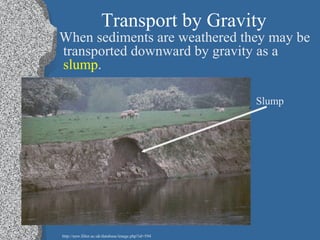
Transport by Gravity
Whensediments are weathered they may be
transported downward by gravity as a
slump.
Slump
http://new.filter.ac.uk/database/image.php?id=594
34.
Transport by Gravity
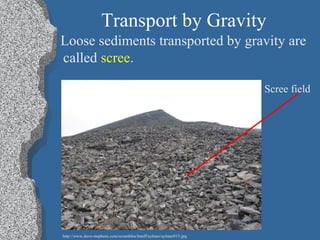
Loosesediments transported by gravity are
called scree.
Scree field
http://www.dave-stephens.com/scrambles/banff/aylmer/aylmer013.jpg