Light waves
CHALLENGE
THREE-STEP INTERVIEW
STEP 1. FORM A SMALL GROUP COMPOSE OF 3 MEMBERS
STEP 2. ASSIGN EACH MEMBER THE FOLLOWING ROLES:
INTERVIEWER, INTERVIEWEE, NOTE TAKER
STEP 3. DISCUSS OR SHARE YOUR KNOWLEDGE ABOUT
LIGHT- ITS NATURE, COMPONENTS, IMPORTANCE
Why are we able to see things?
The images we see are made up of light reflected from the
objects we look at.
WHAT IS LIGHT?
Light is a form of energy that helps us see things. It comes from sources such
as the sun, light bulbs, or flashlights. When light travels, it moves in a straight
line called a "ray." Just like a straight line you draw with a ruler, light travels in a
similar way.
Light Spectrum
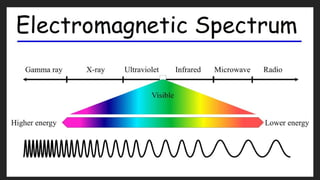
Electromagnetic radiation is a special type of energy that travels in waves through
space. It's like a wave of energy that can move without needing anything else to
carry it. There is a part of electromagnetic radiation that allows us to see things,
and it's called the visible light spectrum.
Light Spectrum
Electromagnetic radiation is a special type of energy that travels in waves through
space. It's like a wave of energy that can move without needing anything else to
carry it. There is a part of electromagnetic radiation that allows us to see things,
and it's called the visible light spectrum.
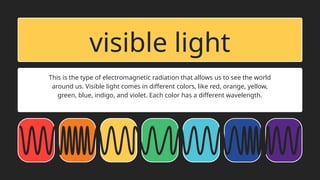
This is the type of electromagnetic radiation that allows us to see the world
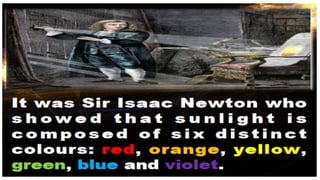
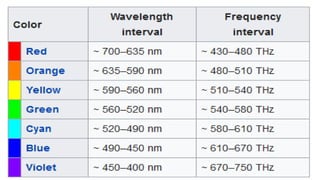
around us. Visible light comes in different colors, like red, orange, yellow,
green, blue, indigo, and violet. Each color has a different wavelength.
visible light
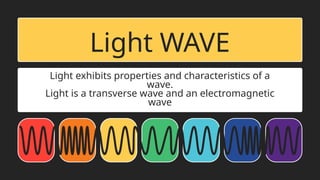
Light exhibits properties and characteristics of a
wave.
Light is a transverse wave and an electromagnetic
wave
Light WAVE
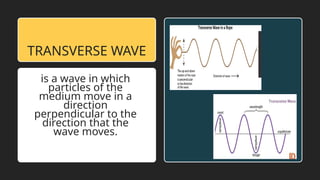
is a wave in which
particles of the
medium move in a
direction
perpendicular to the
direction that the
wave moves.
TRANSVERSE WAVE
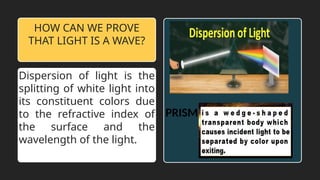
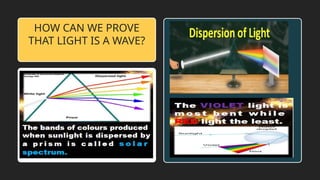
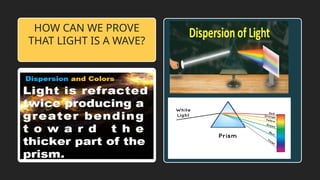
Dispersion of light is the
splitting of white light into
its constituent colors due
to the refractive index of
the surface and the
wavelength of the light.
HOW CAN WE PROVE
THAT LIGHT IS A WAVE?
PRISM
HOW CAN WE PROVE
THAT LIGHT IS A WAVE?
HOW CAN WE PROVE
THAT LIGHT IS A WAVE?
HOW CAN WE PROVE
THAT LIGHT IS A WAVE?
HOW CAN WE PROVE
THAT LIGHT IS A WAVE?
HOW CAN WE PROVE
THAT LIGHT IS A WAVE?
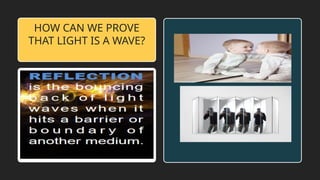
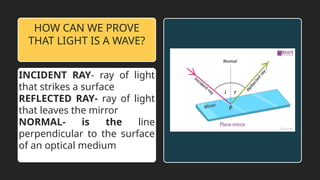
INCIDENT RAY- ray of light
that strikes a surface
REFLECTED RAY- ray of light
that leaves the mirror
NORMAL- is the line
perpendicular to the surface
of an optical medium
HOW CAN WE PROVE
THAT LIGHT IS A WAVE?
HOW CAN WE PROVE
THAT LIGHT IS A WAVE?
THE LUCKY ONES
It is both a transverse wave and an electromagnetic wave
which enables us to see things.
THE LUCKY ONES
A type of wave than can travel through space even without
the need of a medium.
THE LUCKY ONES
A type of wave in which the direction of vibration of particles
is perpendicular to the direction in which the wave is
travelling.
THE LUCKY ONES
Light behaves like p_______ and w_________ .
THE LUCKY ONES
It is the separation of white light into different colors
THE LUCKY ONES
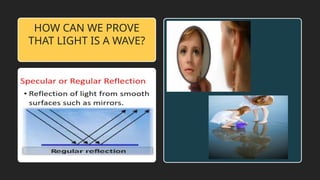
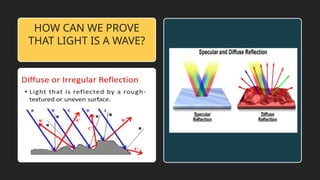
It is the bouncing back of light after hitting a barrier or
surface
THE LUCKY ONES
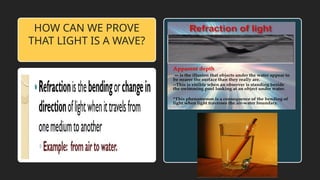
It is the bending or change of direction of light when it
travels from one medium into another (Example: from air to
water)
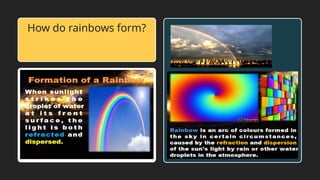
How do rainbows form?
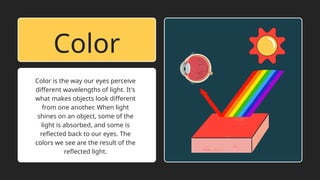
Color is the way our eyes perceive
different wavelengths of light. It's
what makes objects look different
from one another. When light
shines on an object, some of the
light is absorbed, and some is
reflected back to our eyes. The
colors we see are the result of the
reflected light.
Color
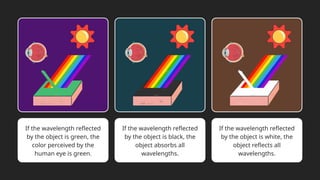
If the wavelength reflected
by the object is green, the
color perceived by the
human eye is green.
If the wavelength reflected
by the object is black, the
object absorbs all
wavelengths.
If the wavelength reflected
by the object is white, the
object reflects all
wavelengths.
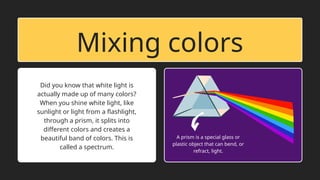
Mixing colors
Did you know that white light is
actually made up of many colors?
When you shine white light, like
sunlight or light from a flashlight,
through a prism, it splits into
different colors and creates a
beautiful band of colors. This is
called a spectrum.
A prism is a special glass or
plastic object that can bend, or
refract, light.
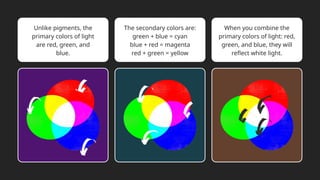
Unlike pigments, the
primary colors of light
are red, green, and
blue.
The secondary colors are:
green + blue = cyan
blue + red = magenta
red + green = yellow
When you combine the
primary colors of light: red,
green, and blue, they will
reflect white light.
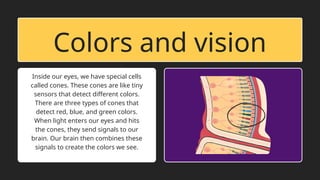
Colors and vision
Inside our eyes, we have special cells
called cones. These cones are like tiny
sensors that detect different colors.
There are three types of cones that
detect red, blue, and green colors.
When light enters our eyes and hits
the cones, they send signals to our
brain. Our brain then combines these
signals to create the colors we see.
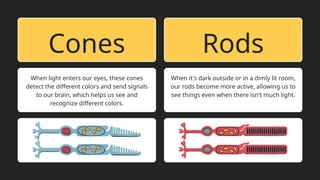
Cones Rods
When light enters our eyes, these cones
detect the different colors and send signals
to our brain, which helps us see and
recognize different colors.
When it's dark outside or in a dimly lit room,
our rods become more active, allowing us to
see things even when there isn't much light.
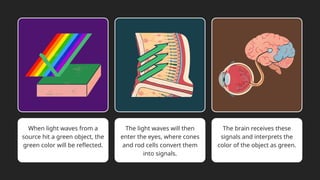
When light waves from a
source hit a green object, the
green color will be reflected.
The light waves will then
enter the eyes, where cones
and rod cells convert them
into signals.
The brain receives these
signals and interprets the
color of the object as green.
THINK ABOUT THIS!
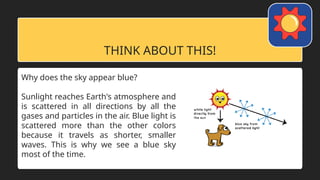
Why does the sky appear blue?
Sunlight reaches Earth's atmosphere and
is scattered in all directions by all the
gases and particles in the air. Blue light is
scattered more than the other colors
because it travels as shorter, smaller
waves. This is why we see a blue sky
most of the time.
THINK ABOUT THIS!
Why does the sky appear blue?
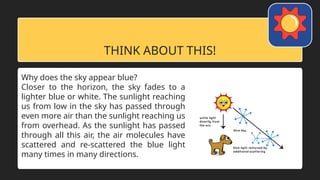
Closer to the horizon, the sky fades to a
lighter blue or white. The sunlight reaching
us from low in the sky has passed through
even more air than the sunlight reaching us
from overhead. As the sunlight has passed
through all this air, the air molecules have
scattered and re-scattered the blue light
many times in many directions.
THINK ABOUT THIS!
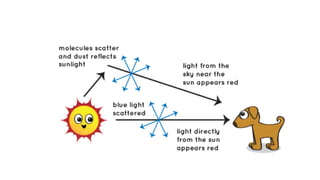
What makes a red sunset?
At sunrise and sunset, the Sun is very low in the sky, which means
that the sunlight we see has travelled through a much thicker
amount of atmosphere. Because blue light is scattered more
strongly by the atmosphere, it tends to be scattered several times
and deflected away in other directions before it gets to us. This
means that there is relatively more yellow and red light left for us
to see.
Resource Page

Lesson 4 Light Waves for Grade 8 Science

  • 1.
  • 2.
  • 3.
    THREE-STEP INTERVIEW STEP 1.FORM A SMALL GROUP COMPOSE OF 3 MEMBERS STEP 2. ASSIGN EACH MEMBER THE FOLLOWING ROLES: INTERVIEWER, INTERVIEWEE, NOTE TAKER STEP 3. DISCUSS OR SHARE YOUR KNOWLEDGE ABOUT LIGHT- ITS NATURE, COMPONENTS, IMPORTANCE
  • 4.
    Why are weable to see things? The images we see are made up of light reflected from the objects we look at.
  • 5.
    WHAT IS LIGHT? Lightis a form of energy that helps us see things. It comes from sources such as the sun, light bulbs, or flashlights. When light travels, it moves in a straight line called a "ray." Just like a straight line you draw with a ruler, light travels in a similar way.
  • 6.
    Light Spectrum Electromagnetic radiationis a special type of energy that travels in waves through space. It's like a wave of energy that can move without needing anything else to carry it. There is a part of electromagnetic radiation that allows us to see things, and it's called the visible light spectrum.
  • 7.
    Light Spectrum Electromagnetic radiationis a special type of energy that travels in waves through space. It's like a wave of energy that can move without needing anything else to carry it. There is a part of electromagnetic radiation that allows us to see things, and it's called the visible light spectrum.
  • 8.
    This is thetype of electromagnetic radiation that allows us to see the world around us. Visible light comes in different colors, like red, orange, yellow, green, blue, indigo, and violet. Each color has a different wavelength. visible light
  • 9.
    Light exhibits propertiesand characteristics of a wave. Light is a transverse wave and an electromagnetic wave Light WAVE
  • 10.
    is a wavein which particles of the medium move in a direction perpendicular to the direction that the wave moves. TRANSVERSE WAVE
  • 11.
    Dispersion of lightis the splitting of white light into its constituent colors due to the refractive index of the surface and the wavelength of the light. HOW CAN WE PROVE THAT LIGHT IS A WAVE? PRISM
  • 12.
    HOW CAN WEPROVE THAT LIGHT IS A WAVE?
  • 13.
    HOW CAN WEPROVE THAT LIGHT IS A WAVE?
  • 15.
    HOW CAN WEPROVE THAT LIGHT IS A WAVE?
  • 16.
    HOW CAN WEPROVE THAT LIGHT IS A WAVE?
  • 17.
    HOW CAN WEPROVE THAT LIGHT IS A WAVE? INCIDENT RAY- ray of light that strikes a surface REFLECTED RAY- ray of light that leaves the mirror NORMAL- is the line perpendicular to the surface of an optical medium
  • 18.
    HOW CAN WEPROVE THAT LIGHT IS A WAVE?
  • 19.
    HOW CAN WEPROVE THAT LIGHT IS A WAVE?
  • 20.
    THE LUCKY ONES Itis both a transverse wave and an electromagnetic wave which enables us to see things.
  • 21.
    THE LUCKY ONES Atype of wave than can travel through space even without the need of a medium.
  • 22.
    THE LUCKY ONES Atype of wave in which the direction of vibration of particles is perpendicular to the direction in which the wave is travelling.
  • 23.
    THE LUCKY ONES Lightbehaves like p_______ and w_________ .
  • 24.
    THE LUCKY ONES Itis the separation of white light into different colors
  • 25.
    THE LUCKY ONES Itis the bouncing back of light after hitting a barrier or surface
  • 26.
    THE LUCKY ONES Itis the bending or change of direction of light when it travels from one medium into another (Example: from air to water)
  • 27.
  • 28.
    Color is theway our eyes perceive different wavelengths of light. It's what makes objects look different from one another. When light shines on an object, some of the light is absorbed, and some is reflected back to our eyes. The colors we see are the result of the reflected light. Color
  • 29.
    If the wavelengthreflected by the object is green, the color perceived by the human eye is green. If the wavelength reflected by the object is black, the object absorbs all wavelengths. If the wavelength reflected by the object is white, the object reflects all wavelengths.
  • 30.
    Mixing colors Did youknow that white light is actually made up of many colors? When you shine white light, like sunlight or light from a flashlight, through a prism, it splits into different colors and creates a beautiful band of colors. This is called a spectrum. A prism is a special glass or plastic object that can bend, or refract, light.
  • 31.
    Unlike pigments, the primarycolors of light are red, green, and blue. The secondary colors are: green + blue = cyan blue + red = magenta red + green = yellow When you combine the primary colors of light: red, green, and blue, they will reflect white light.
  • 32.
    Colors and vision Insideour eyes, we have special cells called cones. These cones are like tiny sensors that detect different colors. There are three types of cones that detect red, blue, and green colors. When light enters our eyes and hits the cones, they send signals to our brain. Our brain then combines these signals to create the colors we see.
  • 33.
    Cones Rods When lightenters our eyes, these cones detect the different colors and send signals to our brain, which helps us see and recognize different colors. When it's dark outside or in a dimly lit room, our rods become more active, allowing us to see things even when there isn't much light.
  • 34.
    When light wavesfrom a source hit a green object, the green color will be reflected. The light waves will then enter the eyes, where cones and rod cells convert them into signals. The brain receives these signals and interprets the color of the object as green.
  • 35.
    THINK ABOUT THIS! Whydoes the sky appear blue? Sunlight reaches Earth's atmosphere and is scattered in all directions by all the gases and particles in the air. Blue light is scattered more than the other colors because it travels as shorter, smaller waves. This is why we see a blue sky most of the time.
  • 36.
    THINK ABOUT THIS! Whydoes the sky appear blue? Closer to the horizon, the sky fades to a lighter blue or white. The sunlight reaching us from low in the sky has passed through even more air than the sunlight reaching us from overhead. As the sunlight has passed through all this air, the air molecules have scattered and re-scattered the blue light many times in many directions.
  • 37.
    THINK ABOUT THIS! Whatmakes a red sunset? At sunrise and sunset, the Sun is very low in the sky, which means that the sunlight we see has travelled through a much thicker amount of atmosphere. Because blue light is scattered more strongly by the atmosphere, it tends to be scattered several times and deflected away in other directions before it gets to us. This means that there is relatively more yellow and red light left for us to see.
  • 40.

Editor's Notes

  • #3 We are able to see because light from an object can move through space and reach our eyes. Once light reaches our eyes, signals are sent to our brain, and our brain deciphers the information in order to detect the appearance, location and movement of the objects we are sighting at.
  • #4 We are able to see because light from an object can move through space and reach our eyes. Once light reaches our eyes, signals are sent to our brain, and our brain deciphers the information in order to detect the appearance, location and movement of the objects we are sighting at.
  • #6 electromagnetic spectrum is the range of frequencies of electromagnetic radiation and their respective wavelengths and photon energies.
  • #7 electromagnetic spectrum is the range of frequencies of electromagnetic radiation and their respective wavelengths and photon energies.
  • #20 We are able to see because light from an object can move through space and reach our eyes. Once light reaches our eyes, signals are sent to our brain, and our brain deciphers the information in order to detect the appearance, location and movement of the objects we are sighting at.
  • #21 We are able to see because light from an object can move through space and reach our eyes. Once light reaches our eyes, signals are sent to our brain, and our brain deciphers the information in order to detect the appearance, location and movement of the objects we are sighting at.
  • #22 We are able to see because light from an object can move through space and reach our eyes. Once light reaches our eyes, signals are sent to our brain, and our brain deciphers the information in order to detect the appearance, location and movement of the objects we are sighting at.
  • #23 We are able to see because light from an object can move through space and reach our eyes. Once light reaches our eyes, signals are sent to our brain, and our brain deciphers the information in order to detect the appearance, location and movement of the objects we are sighting at.
  • #24 We are able to see because light from an object can move through space and reach our eyes. Once light reaches our eyes, signals are sent to our brain, and our brain deciphers the information in order to detect the appearance, location and movement of the objects we are sighting at.
  • #25 We are able to see because light from an object can move through space and reach our eyes. Once light reaches our eyes, signals are sent to our brain, and our brain deciphers the information in order to detect the appearance, location and movement of the objects we are sighting at.
  • #26 We are able to see because light from an object can move through space and reach our eyes. Once light reaches our eyes, signals are sent to our brain, and our brain deciphers the information in order to detect the appearance, location and movement of the objects we are sighting at.
  • #37 We are able to see because light from an object can move through space and reach our eyes. Once light reaches our eyes, signals are sent to our brain, and our brain deciphers the information in order to detect the appearance, location and movement of the objects we are sighting at.