Motion and Force
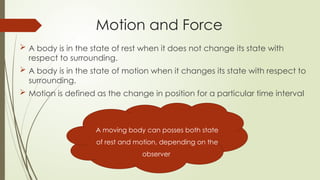
A body is in the state of rest when it does not change its state with
respect to surrounding.
A body is in the state of motion when it changes its state with respect to
surrounding.
Motion is defined as the change in position for a particular time interval
A moving body can posses both state
of rest and motion, depending on the
observer
3.
Distance and Displacement
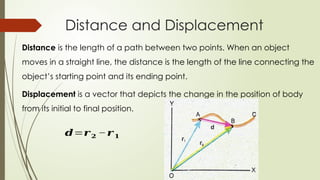
Distanceis the length of a path between two points. When an object
moves in a straight line, the distance is the length of the line connecting the
object’s starting point and its ending point.
Displacement is a vector that depicts the change in the position of body
from its initial to final position.
𝒅=𝒓𝟐 −𝒓𝟏
4.
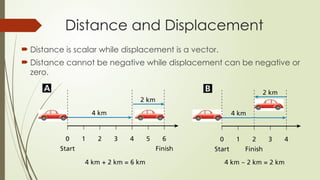
Distance isscalar while displacement is a vector.
Distance cannot be negative while displacement can be negative or
zero.
Distance and Displacement
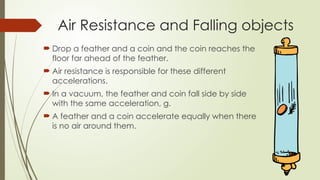
5.
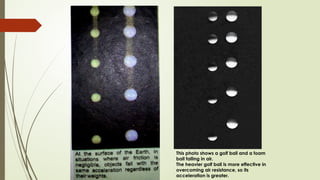
When abody moves along straight line then the displacement
coincides with the distance travelled.
Both are measured in (m).
Both have dimension [L].
Distance and Displacement
6.
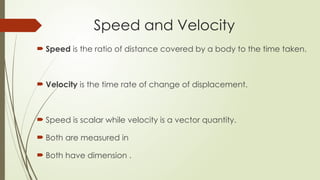
Speed isthe ratio of distance covered by a body to the time taken.
Velocity is the time rate of change of displacement.
Speed is scalar while velocity is a vector quantity.
Both are measured in
Both have dimension .
Speed and Velocity
8.
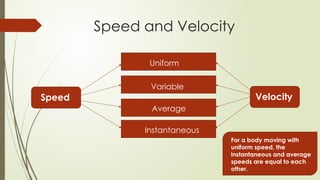
Speed and Velocity
SpeedVelocity
Uniform
Variable
Instantaneous
Average
For a body moving with
uniform speed, the
instantaneous and average
speeds are equal to each
other.
9.
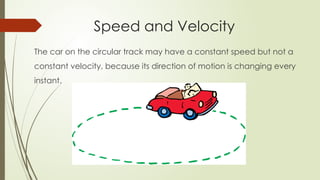
The car onthe circular track may have a constant speed but not a
constant velocity, because its direction of motion is changing every
instant.
Speed and Velocity
10.
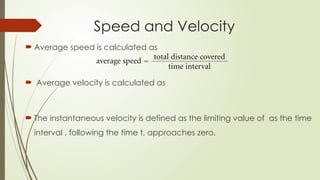
Average speedis calculated as
Average velocity is calculated as
The instantaneous velocity is defined as the limiting value of as the time
interval , following the time t, approaches zero.
Speed and Velocity
11.
The timerate of change of velocity of a body is called acceleration.
It is produced by changing velocity or direction or both.
It is a vector quantity.
It is measured in .
Its dimension is .
For a body moving with uniform acceleration, the instantaneous and
average accelerations are equal to each other.
Acceleration
12.
Types of acceleration
Uniformacceleration
Variable acceleration
Average acceleration
Instantaneous acceleration
Positive acceleration
Negative acceleration
Acceleration due to gravity
Acceleration
13.
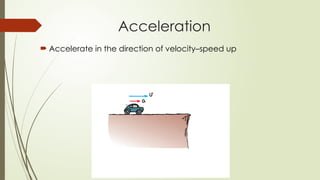
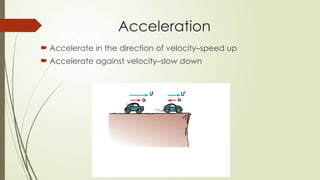
Accelerate inthe direction of velocity–speed up
Acceleration
14.
Accelerate inthe direction of velocity–speed up
Accelerate against velocity–slow down
Acceleration
15.
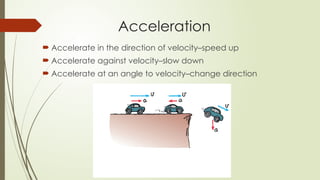
Accelerate inthe direction of velocity–speed up
Accelerate against velocity–slow down
Accelerate at an angle to velocity–change direction
Acceleration
16.
If thevelocity of body reduces but not to zero, then the
negative acceleration is called deceleration but if the
velocity reduces to zero, then the negative acceleration is
called retardation.
Acceleration
17.
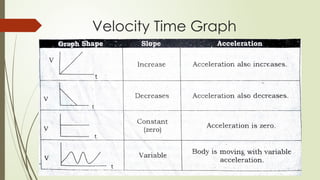
Velocity Time Graph
The shape of the velocity time graph reveals whether the object is
at rest, moving at constant speed, speeding up or slowing down.
The slope of velocity time graph gives acceleration.
The area under the velocity time graph gives the distance covered
by the object.
The equations ofmotion all apply to a body moving
1. with constant acceleration
2. in a straight line.
Equations of Motion
20.
In theabsence of air resistance, all the objects in free fall near the
surface of the Earth, moves towards the Earth with uniform
acceleration. This acceleration is known as gravitational
acceleration. Its average value is in the downward direction. Then
the equations of motion can be written as
Equations of Motion
21.
Air resistance noticeablyslows the motion of things with
large surface areas like falling feathers or pieces of paper.
But air resistance less noticeably affects the motion of more
compact objects like stones and baseballs.
Air Resistance and Falling objects
22.
Drop afeather and a coin and the coin reaches the
floor far ahead of the feather.
Air resistance is responsible for these different
accelerations.
In a vacuum, the feather and coin fall side by side
with the same acceleration, g.
A feather and a coin accelerate equally when there
is no air around them.
Air Resistance and Falling objects
23.
This photo showsa golf ball and a foam
ball falling in air.
The heavier golf ball is more effective in
overcoming air resistance, so its
acceleration is greater.
24.
How fast somethingfreely falls from rest after a certain time is
speed or velocity. The appropriate equation is v = gt .
How far that object has fallen is distance. The appropriate
equation is S = 1/2gt2
.
How fast and far object falls
25.
Sir Isaac Newton(1643-1727) an English scientist and mathematician
discovered the three laws of motion. He published them in his book
Principia in 1687. Newton’s law are adequate for speeds that are low
compared with the speed of light.
Newton’s first law of motion (law of inertia)
Newton’s second law of motion (law of acceleration)
Newton’s third law of motion (law of interaction)
Newton’s Law of Motion
26.
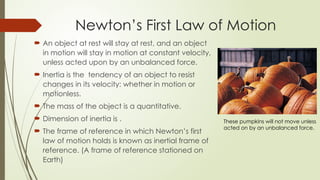
An objectat rest will stay at rest, and an object
in motion will stay in motion at constant velocity,
unless acted upon by an unbalanced force.
Inertia is the tendency of an object to resist
changes in its velocity: whether in motion or
motionless.
The mass of the object is a quantitative.
Dimension of inertia is .
The frame of reference in which Newton’s first
law of motion holds is known as inertial frame of
reference. (A frame of reference stationed on
Earth)
Newton’s First Law of Motion
These pumpkins will not move unless
acted on by an unbalanced force.
27.
Force equalsmass times acceleration.
The net force of an object is equal to the product of its mass and
acceleration.
Newton’s Second Law of Motion
28.
For everyaction, there is an equal and
opposite reaction.
Action and reaction forces never acts on
the same body.
Newton’s Third Law of Motion
29.
The productof mass and velocity is called momentum.
Momentum is defined as inertia in motion.
A moving object can have a large momentum if it has a large
mass, a high speed, or both.
It is a vector quantity and has the direction of velocity.
SI unit of momentum is .
Its dimension is .
Momentum
30.
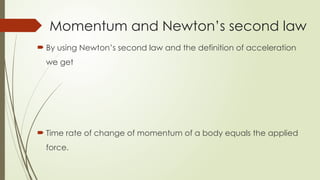
By usingNewton’s second law and the definition of acceleration
we get
Time rate of change of momentum of a body equals the applied
force.
Momentum and Newton’s second law
31.
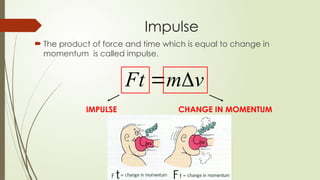
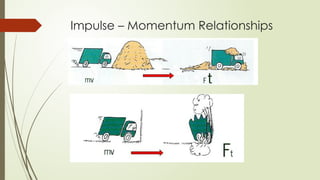
The productof force and time which is equal to change in
momentum is called impulse.
Impulse
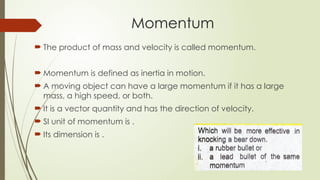
v
m
Ft
IMPULSE CHANGE IN MOMENTUM
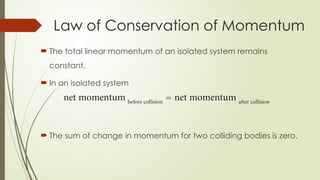
The totallinear momentum of an isolated system remains
constant.
In an isolated system
The sum of change in momentum for two colliding bodies is zero.
Law of Conservation of Momentum
Force due towater flow
Water exerts force on a wall, when impinges over it, and this force is
equal to the product of mass flow rate of water and its velocity.
The above phenomenon gives us an idea to invent turbines that uses
hydral energy.
Projectile Motion
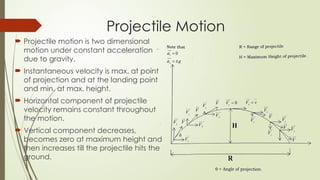
Projectilemotion is two dimensional
motion under constant acceleration
due to gravity.
Instantaneous velocity is max. at point
of projection and at the landing point
and min. at max. height.
Horizontal component of projectile
velocity remains constant throughout
the motion.
Vertical component decreases,
becomes zero at maximum height and
then increases till the projectile hits the
ground.
41.
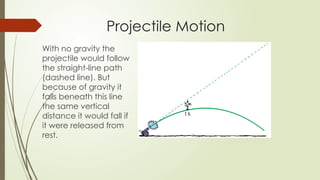
With no gravitythe
projectile would follow
the straight-line path
(dashed line). But
because of gravity it
falls beneath this line
the same vertical
distance it would fall if
it were released from
rest.
Projectile Motion
42.
With no gravitythe
projectile would follow
the straight-line path
(dashed line). But
because of gravity it
falls beneath this line
the same vertical
distance it would fall if
it were released from
rest.
Projectile Motion
43.
Projectile Motion
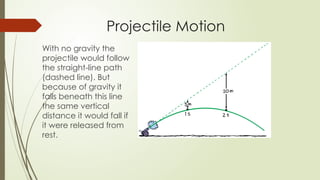
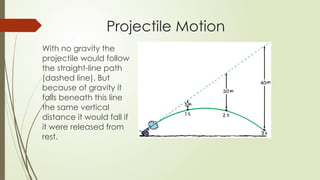
With nogravity the
projectile would follow
the straight-line path
(dashed line). But
because of gravity it
falls beneath this line
the same vertical
distance it would fall if
it were released from
rest.
44.
Projectile Motion
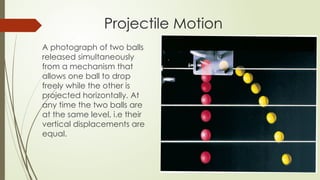
A photographof two balls
released simultaneously
from a mechanism that
allows one ball to drop
freely while the other is
projected horizontally. At
any time the two balls are
at the same level, i.e their
vertical displacements are
equal.
45.
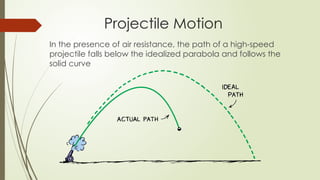
In the presenceof air resistance, the path of a high-speed
projectile falls below the idealized parabola and follows the
solid curve
Projectile Motion
46.
Height (verticalrange) is given by
The time taken by the body to cover the distance from
the place of its projection to the place where it hits the
ground at the same level is called time of flight.
Time to reach maximum height is
Total time of flight is
Projectile Motion
47.
Maximum distancewhich a projectile covers in the horizontal
direction is called the range of projectile.
It is given as
For the maximum range .
Projectile Motion
48.
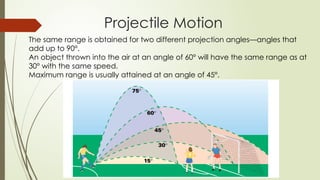
The same rangeis obtained for two different projection angles—angles that
add up to 90°.
An object thrown into the air at an angle of 60° will have the same range as at
30° with the same speed.
Maximum range is usually attained at an angle of 45°.
Projectile Motion
49.
When the angleof projection is
then the range and height of
the projectile are equal to each
other
Projectile Motion


![ When a body moves along straight line then the displacement
coincides with the distance travelled.
Both are measured in (m).
Both have dimension [L].
Distance and Displacement](https://image.slidesharecdn.com/chap3-250528174244-7ca84628/85/Chap-3-motion-and-force-MDCAT-PREPARATION-pptx-5-320.jpg)