Motion in
a Plane -
Class 11
By Dr. Umesh D. Patil
Rayat Shikshan Sanstha’s
Annasaheb Awate College,
Manchar
Motion
Introduction to Motion
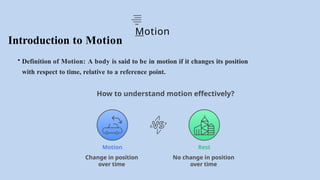
• Definition of Motion: A body is said to be in motion if it changes its position
with respect to time, relative to a reference point.
Motion
Change in position
over time
How to understand motion effectively?
Rest
No change in position
over time
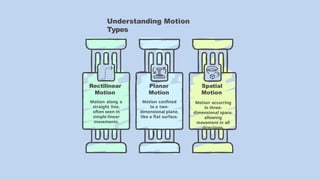
Planar
Motion
Motion confined
to a two-
dimensional plane,
like a flat surface.
Spatial
Motion
Motion occurring
in three-
dimensional space,
allowing
movement in all
directions.
Rectilinear
Motion
Motion along a
straight line,
often seen in
simple linear
movements.
Understanding Motion
Types
Acceleration
Vectors represent the
rate of change in
velocity.
Importance of Vectors in
Motion
Velocity
Vectors indicate the
speed and direction of
movement.
Displacement
Vectors show the
change in position of
an object.
2. Rectilinear Motion
(Revision)
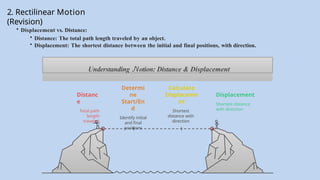
• Displacement vs. Distance:
• Distance: The total path length traveled by an object.
• Displacement: The shortest distance between the initial and final positions, with direction.
Calculate
Displaceme
nt
Shortest
distance with
direction
Determi
ne
Start/En
d
Identify initial
and final
positions
Displacement
Shortest distance
with direction
Distanc
e
Total path
length
traveled
Understanding otion:
𝒩 Distance & Displacement
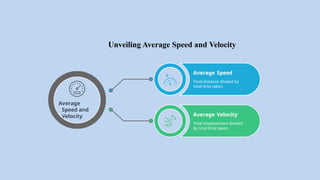
Average
Speed and
Velocity
Average Speed
Total distance divided by
total time taken.
Average Velocity
Total displacement divided
by total time taken.
Unveiling Average Speed and Velocity
Instantaneous
Velocity
Velocity at a
specific instant,
limit of average
velocity.
Instantaneous
Speed
Magnitude of
the
instantaneous
velocity, a scalar
quantity.
Instantaneous Velocity and
Speed
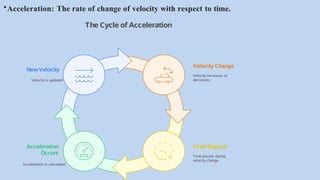
•Acceleration: The rate of change of velocity with respect to time.
Acceleration is calculated
The Cycle of Acceleration
NewVelocity
Velocity Change
Velocity is updated
Velocity increases or
decreases
Acceleration
Occurs
Time Elapsed
Time passes during
velocity change
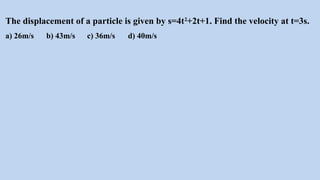
The displacement of a particle is given by s=4t2
+2t+1. Find the velocity at t=3s.
a) 26m/s b) 43m/s c) 36m/s d) 40m/s
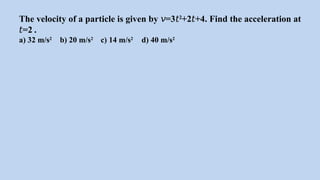
The velocity of a particle is given by =3
𝑣 𝑡2
+2 +4. Find the acceleration at
𝑡
=2 .
𝑡
a) 32 m/s2
b) 20 m/s2
c) 14 m/s2
d) 40 m/s2
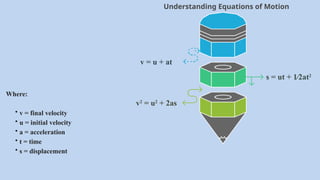
v = u + at
v2
= u2
+ 2as
Understanding Equations of Motion
s = ut + 1⁄2at2
Where:
• v = final velocity
• u = initial velocity
• a = acceleration
• t = time
• s = displacement
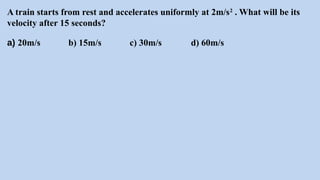
A train starts from rest and accelerates uniformly at 2m/s2
. What will be its
velocity after 15 seconds?
a) 20m/s b) 15m/s c) 30m/s d) 60m/s
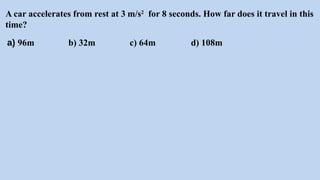
A car accelerates from rest at 3 m/s2
for 8 seconds. How far does it travel in this
time?
a) 96m b) 32m c) 64m d) 108m
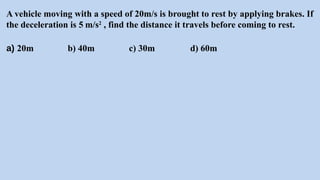
A vehicle moving with a speed of 20m/s is brought to rest by applying brakes. If
the deceleration is 5 m/s2
, find the distance it travels before coming to rest.
a) 20m b) 40m c) 30m d) 60m
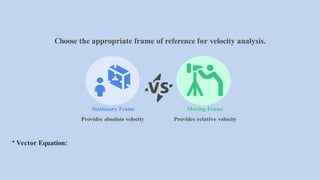
Choose the appropriate frame of reference for velocity analysis.
Moving Frame
Provides relative velocity
Stationary Frame
Provides absolute velocity
• Vector Equation:
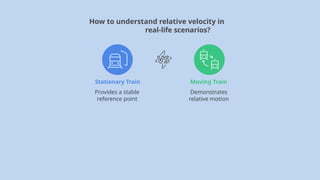
Moving Train
Demonstrates
relative motion
How to understand relative velocity in
real-life scenarios?
Stationary Train
Provides a stable
reference point
4. Motion in Two Dimensions (Vector
Form)
Instantaneous Velocity
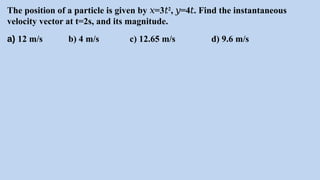
The position of a particle is given by =3
𝑥 𝑡2
, =4 . Find the instantaneous
𝑦 𝑡
velocity vector at t=2s, and its magnitude.
a) 12 m/s b) 4 m/s c) 12.65 m/s d) 9.6 m/s
Instantaneous Acceleration
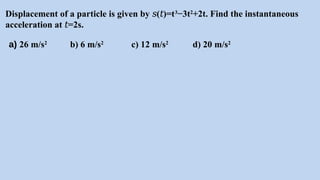
Displacement of a particle is given by ( )=t
𝑠 𝑡 3
−3t2
+2t. Find the instantaneous
acceleration at =2s.
𝑡
a) 26 m/s2
b) 6 m/s2
c) 12 m/s2
d) 20 m/s2
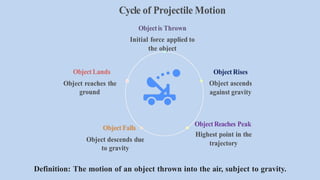
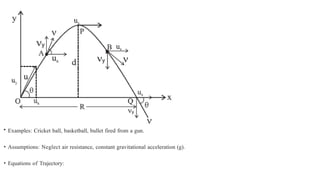
Definition: The motion of an object thrown into the air, subject to gravity.
• Examples: Cricket ball, basketball, bullet fired from a gun.
• Assumptions: Neglect air resistance, constant gravitational acceleration (g).
• Equations of Trajectory:
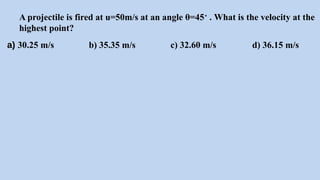
A projectile is fired at u=50m/s at an angle θ=45∘
. What is the velocity at the
highest point?
a) 30.25 m/s b) 35.35 m/s c) 32.60 m/s d) 36.15 m/s
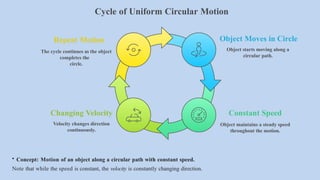
Constant Speed
Object maintains a steady speed
throughout the motion.
Cycle of Uniform Circular Motion
Object Moves in Circle
Object starts moving along a
circular path.
Repeat Motion
The cycle continues as the object
completes the
circle.
Changing Velocity
Velocity changes direction
continuously.
• Concept: Motion of an object along a circular path with constant speed.
Note that while the speed is constant, the velocity is constantly changing direction.
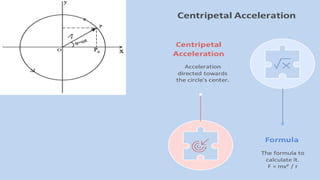
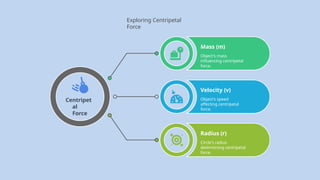
Centripet
al
Force
Radius (r)
Circle's radius
determining centripetal
force.
Exploring Centripetal
Force
Mass (m)
Object's mass
influencing centripetal
force.
Velocity (v)
Object's speed
affecting centripetal
force.
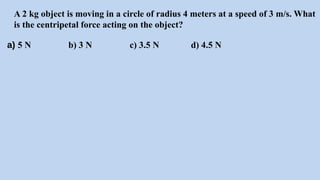
A 2 kg object is moving in a circle of radius 4 meters at a speed of 3 m/s. What
is the centripetal force acting on the object?
a) 5 N b) 3 N c) 3.5 N d) 4.5 N
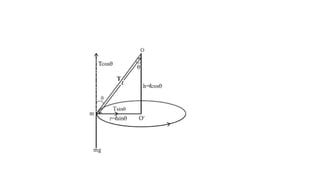
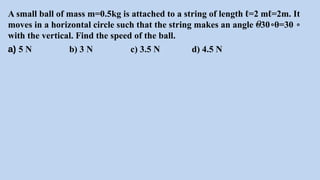
A small ball of mass m=0.5kg is attached to a string of length ℓ=2 mℓ=2m. It
moves in a horizontal circle such that the string makes an angle =30 θ=30
𝜃 ∘ ∘
with the vertical. Find the speed of the ball.
a) 5 N b) 3 N c) 3.5 N d) 4.5 N

Motion in a Plane Final cet neet jee.pptx

  • 1.
    Motion in a Plane- Class 11 By Dr. Umesh D. Patil Rayat Shikshan Sanstha’s Annasaheb Awate College, Manchar
  • 2.
    Motion Introduction to Motion •Definition of Motion: A body is said to be in motion if it changes its position with respect to time, relative to a reference point. Motion Change in position over time How to understand motion effectively? Rest No change in position over time
  • 3.
    Planar Motion Motion confined to atwo- dimensional plane, like a flat surface. Spatial Motion Motion occurring in three- dimensional space, allowing movement in all directions. Rectilinear Motion Motion along a straight line, often seen in simple linear movements. Understanding Motion Types
  • 4.
    Acceleration Vectors represent the rateof change in velocity. Importance of Vectors in Motion Velocity Vectors indicate the speed and direction of movement. Displacement Vectors show the change in position of an object.
  • 5.
    2. Rectilinear Motion (Revision) •Displacement vs. Distance: • Distance: The total path length traveled by an object. • Displacement: The shortest distance between the initial and final positions, with direction. Calculate Displaceme nt Shortest distance with direction Determi ne Start/En d Identify initial and final positions Displacement Shortest distance with direction Distanc e Total path length traveled Understanding otion: 𝒩 Distance & Displacement
  • 6.
    Average Speed and Velocity Average Speed Totaldistance divided by total time taken. Average Velocity Total displacement divided by total time taken. Unveiling Average Speed and Velocity
  • 7.
    Instantaneous Velocity Velocity at a specificinstant, limit of average velocity. Instantaneous Speed Magnitude of the instantaneous velocity, a scalar quantity. Instantaneous Velocity and Speed
  • 8.
    •Acceleration: The rateof change of velocity with respect to time. Acceleration is calculated The Cycle of Acceleration NewVelocity Velocity Change Velocity is updated Velocity increases or decreases Acceleration Occurs Time Elapsed Time passes during velocity change
  • 9.
    The displacement ofa particle is given by s=4t2 +2t+1. Find the velocity at t=3s. a) 26m/s b) 43m/s c) 36m/s d) 40m/s
  • 10.
    The velocity ofa particle is given by =3 𝑣 𝑡2 +2 +4. Find the acceleration at 𝑡 =2 . 𝑡 a) 32 m/s2 b) 20 m/s2 c) 14 m/s2 d) 40 m/s2
  • 13.
    v = u+ at v2 = u2 + 2as Understanding Equations of Motion s = ut + 1⁄2at2 Where: • v = final velocity • u = initial velocity • a = acceleration • t = time • s = displacement
  • 14.
    A train startsfrom rest and accelerates uniformly at 2m/s2 . What will be its velocity after 15 seconds? a) 20m/s b) 15m/s c) 30m/s d) 60m/s
  • 15.
    A car acceleratesfrom rest at 3 m/s2 for 8 seconds. How far does it travel in this time? a) 96m b) 32m c) 64m d) 108m
  • 16.
    A vehicle movingwith a speed of 20m/s is brought to rest by applying brakes. If the deceleration is 5 m/s2 , find the distance it travels before coming to rest. a) 20m b) 40m c) 30m d) 60m
  • 17.
    Choose the appropriateframe of reference for velocity analysis. Moving Frame Provides relative velocity Stationary Frame Provides absolute velocity • Vector Equation:
  • 18.
    Moving Train Demonstrates relative motion Howto understand relative velocity in real-life scenarios? Stationary Train Provides a stable reference point
  • 19.
    4. Motion inTwo Dimensions (Vector Form) Instantaneous Velocity
  • 20.
    The position ofa particle is given by =3 𝑥 𝑡2 , =4 . Find the instantaneous 𝑦 𝑡 velocity vector at t=2s, and its magnitude. a) 12 m/s b) 4 m/s c) 12.65 m/s d) 9.6 m/s
  • 21.
  • 22.
    Displacement of aparticle is given by ( )=t 𝑠 𝑡 3 −3t2 +2t. Find the instantaneous acceleration at =2s. 𝑡 a) 26 m/s2 b) 6 m/s2 c) 12 m/s2 d) 20 m/s2
  • 23.
    Definition: The motionof an object thrown into the air, subject to gravity.
  • 24.
    • Examples: Cricketball, basketball, bullet fired from a gun. • Assumptions: Neglect air resistance, constant gravitational acceleration (g). • Equations of Trajectory:
  • 25.
    A projectile isfired at u=50m/s at an angle θ=45∘ . What is the velocity at the highest point? a) 30.25 m/s b) 35.35 m/s c) 32.60 m/s d) 36.15 m/s
  • 26.
    Constant Speed Object maintainsa steady speed throughout the motion. Cycle of Uniform Circular Motion Object Moves in Circle Object starts moving along a circular path. Repeat Motion The cycle continues as the object completes the circle. Changing Velocity Velocity changes direction continuously. • Concept: Motion of an object along a circular path with constant speed. Note that while the speed is constant, the velocity is constantly changing direction.
  • 28.
    Centripet al Force Radius (r) Circle's radius determiningcentripetal force. Exploring Centripetal Force Mass (m) Object's mass influencing centripetal force. Velocity (v) Object's speed affecting centripetal force.
  • 29.
    A 2 kgobject is moving in a circle of radius 4 meters at a speed of 3 m/s. What is the centripetal force acting on the object? a) 5 N b) 3 N c) 3.5 N d) 4.5 N
  • 31.
    A small ballof mass m=0.5kg is attached to a string of length ℓ=2 mℓ=2m. It moves in a horizontal circle such that the string makes an angle =30 θ=30 𝜃 ∘ ∘ with the vertical. Find the speed of the ball. a) 5 N b) 3 N c) 3.5 N d) 4.5 N