Pratibha College of Education
B. Ed 105: Project
Advanced Evaluation Procedure in learning
Name of student teachers
Mrs. Leena Mahajan
Guided by: Prof Mr.WAGHMARE SIR
COMPUTER AIDED INSTRUCTION
Coordinator :
Prof. Mrs. Vidap Madam
Motivator :
Dr. K. R. Patekar Sir
 MOTION
a) Uniform Motion.
b) Non Uniform Motion.
c) Difference between uniform and non-
uniform motion.
 Speed
a) Average speed.
 Distance, Displacement
a) Difference between distance and displacement.
 Velocity, Acceleration.
a) uniform Velocity and non uniform velocity
b) difference between uniform acceleration & non uniform
acceleration.
 Laws of Motion.
a) Newton’s first law of motion.
b) Newton’s second law of motion.
c) Newton’s third law of motion.
1) Motion and how is it determined
2) Speed and how to calculate average speed
3) Difference between Distance and displacement
4) Definition of velocity , difference between uniform
velocity & non uniform velocity.
5) Definition of acceleration , difference between
uniform and non uniform acceleration.
6) Newton’s laws of motions with examples.
7) Problems based on speed ,distance, acceleration .
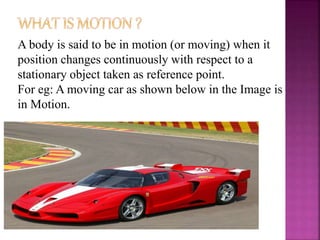
A body is said to be in motion (or moving) when it
position changes continuously with respect to a
stationary object taken as reference point.
For eg: A moving car as shown below in the Image is
in Motion.
A Body has a
uniform motion if
it travel equal
distance in equal
interval of Time.
The Distance Time
Graph for a body
Having uniform
Motion in a
Straight line.
A Body has a non-
uniform motion if it
Travels unequal
distance in equal
interval of time.
For eg: a car running at a
constant speed of 10m p/s .it
means car covering distance a
distance 10m p/s. so, Its
motion will be in uniform
motion.
For eg:the motion of a
free falling body is an
example of non-
uniform motion.
 Uniform motion
 Travel equal distance in
equal interval of time.
 The distance-time graph
for a body having
uniform motion is a
straight line.
 Non-uniform motion
 Travel unequal distance in
equal interval of time.
 The distance-time graph
for a body having non-
uniform motion is a
curved line.
1) Which of the following statement is not
correct for an object moving along a
straight path in an accelerated motion?
(a) Its speed keeps changing
(b) Its velocity always changes
(c) It always goes away from the earth
(d) A force is always acting on it
A body has a uniform motion if
(a)It travels equal distance in equal interval of
time
(b)It travels equal distance in unequal interval of
time
(c)It travel unequal distance in equal interval of
time
(d)It travel unequal distance in unequal interval
of time
Speed of a body is the
distance travelled by it in
per unit time. Thtespeed of
a body can be calculated by
Dividing the ‘Distance
Travelled’ by the ‘Time
Taken’ to travel this
Distance. So, the formula
can be written as :
SPEED=Distance Travelled
______________
Time Taken
 The average speed of a body is the total distance
travelled divided by the total time taken to cover
the Distance.
 For eg : A car which travels a distance of 100km
in 4hours, the average speed is 100/4 =25km per
hour. Although the average speed of car is 25 km
per hour, it does not mean that car is moving at this
speed all the time. When the road is Straight,or free
the speed may be much more than 25km per hour.
But on Bends (curved road), hills or in a crowded
area, the speed may fall well bellow this average
value.
 Average Speed = Total Distance Travelled
Total Time Taken
Calculate the average speed of a car that
travels a distance of 180km in 3 hrs.
(a) 80km/hr
(b) 60km/hr
(c) 60m/s
(d) 100km/hr
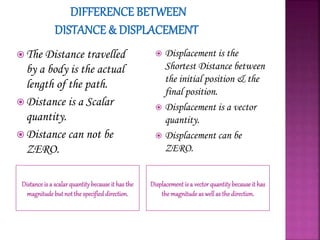
The Distance travelled by a body is the
actual length of the path covered by a
moving body irrespective of the
direction in which the body travels.
Distance is a scalar quantity(Because it
has magnitude only, it has no specified
direction).
Distance can not be ZERO. But if the
object or body travels from initial
position to final position. Then we can
say that Distance is ZERO.
When a body moves from one position
to another the Shortest (straight line)
distance between the initial position &
the final position of the body, along with
direction, is Known as Displacement.
 Displacement is a vector quantity (because it
has magnitude as well as direction).
 The distance travelled by a moving body
cannot be zero but the final displacement of a
moving body can be ZERO.
Distance is a scalarquantitybecause it has the
magnitude butnot the specifieddirection.
Displacement is a vector quantitybecause it has
the magnitude as wellas the direction.
 The Distance travelled
by a body is the actual
length of the path.
 Distance is a Scalar
quantity.
 Distance can not be
ZERO.
 Displacement is the
Shortest Distance between
the initial position & the
final position.
 Displacement is a vector
quantity.
 Displacement can be
ZERO.
The displacement of a body moving along a
circular path and completing
Its full rotation is
(a) Equal to the circumference of the path
(b) Positive
(c) Negative
(d) zero
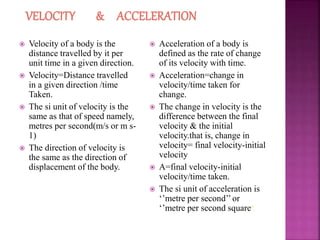
 Velocity of a body is the
distance travelled by it per
unit time in a given direction.
 Velocity=Distance travelled
in a given direction /time
Taken.
 The si unit of velocity is the
same as that of speed namely,
metres per second(m/s or m s-
1)
 The direction of velocity is
the same as the direction of
displacement of the body.
 Acceleration of a body is
defined as the rate of change
of its velocity with time.
 Acceleration=change in
velocity/time taken for
change.
 The change in velocity is the
difference between the final
velocity & the initial
velocity.that is, change in
velocity= final velocity-initial
velocity
 A=final velocity-initial
velocity/time taken.
 The si unit of acceleration is
‘’metre per second’’ or
‘’metre per second square’’.
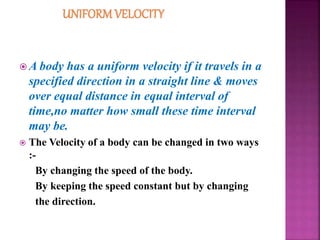
 A body has a uniform velocity if it travels in a
specified direction in a straight line & moves
over equal distance in equal interval of
time,no matter how small these time interval
may be.
 The Velocity of a body can be changed in two ways
:-
By changing the speed of the body.
By keeping the speed constant but by changing
the direction.
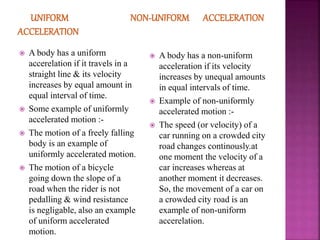
 A body has a uniform
accerelation if it travels in a
straight line & its velocity
increases by equal amount in
equal interval of time.
 Some example of uniformly
accelerated motion :-
 The motion of a freely falling
body is an example of
uniformly accelerated motion.
 The motion of a bicycle
going down the slope of a
road when the rider is not
pedalling & wind resistance
is negligable, also an example
of uniform accelerated
motion.
 A body has a non-uniform
acceleration if its velocity
increases by unequal amounts
in equal intervals of time.
 Example of non-uniformly
accelerated motion :-
 The speed (or velocity) of a
car running on a crowded city
road changes continously.at
one moment the velocity of a
car increases whereas at
another moment it decreases.
So, the movement of a car on
a crowded city road is an
example of non-uniform
accerelation.
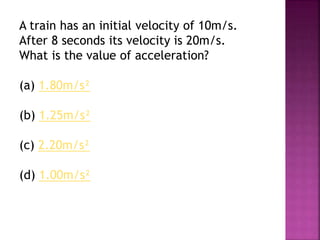
A train has an initial velocity of 10m/s.
After 8 seconds its velocity is 20m/s.
What is the value of acceleration?
(a) 1.80m/s²
(b) 1.25m/s²
(c) 2.20m/s²
(d) 1.00m/s²
A car starts from rest and is accelerated at the
rate of 2m/s for 9 seconds.Find the velocity of
car at the end of 9 seconds.
(a) 24m/s
(b) 4.5m/s
(c) 18m/s
(d) 1.8m/s
Newton has given three laws to describe the motion of
bodies. These laws are known as Newton’s law of motion. The
Newton’s law of motion give a precise definition of force &
established a relationship between the force applied on a body
and the state of motion acquired by it.
Some of the bodies(or object)around us are at rest,
that is, they are stationary, whereas others are in
motion. Newton’s first law describes the behaviour of
such bodies which are in state of rest or of uniform
motion in a straight line.
According to Newton’s first law of motion : A
body at rest will remain at rest, and a body in
motion will continue in motion in a straight
line with a uniform speed, unless it is
compelled by an external force to change its
states.
 Let us take an example to understand first law of
motion more clear .
 Suppose we have a book which is lying on the table. It
is at rest. The book will not move by itself that is, it
cannot change its position of rest by itself. It can
change its state of rest only when compelled by the
force of our hands, that is, when we lift the book from
the table. Thus, the position of rest of the book has
been changed by the external force of our hands. And
this observation supports the first part of the first law
of motion.
 The tendency of a body to remain at
rest(stationary) or, if moving to continue
moving in a straight line is called Interia.
Newton’s first Law recognizes that every body
has some Interia.
INTERIA is that property of a body due to
which it resists a change in its state of rest
or of uniform motion..
 Greater the INTERIA of a body, greater will be
the force required to bring a change in its state
of rest or uniform motion. In fact mass is a
measure of the interia of a body. If a body has
more mass, it has more interia. That is, heavier
object have more interia than lighter object.
The inertia of an object tends to cause the
object
(a) to increase its speed
(b) to decrease its speed
(c) to resist any change in its state of motion
(d) to decelerate due to friction
oWhen two bodies, a heavy one and a light one, are acted upon by
the same force for the same time, the light body attains a higher
velocity(or higher speed) than the heavy one. But the momentum
gained both the bodies is the same. The link between force &
momentum is expressed in Newton’s second law of motion.
oAccording to the Newton’s Second law of motion :
The rate of change of momentum of a body
is directly proportional to the applied force & takes place
in the direction in which the force acts. The rate of change
of momentum of a body can be obtained by dividing the
‘Change in momentum’ by ‘ Time taken’ for change. So,
Newton’s second law of Motion can be expressed as :-
Force=Changein momentum
TIME TAKEN
o Consider a body of mass m having an Initial velocity
v. The initial momentum of this body will be mv.
Suppose a force Facts on this body for time t &
causes the final velocity to become v. The final
momentum of this body will be mv. Now, the change
in momentum of this body is mv-mu & the time taken
for this change is t. So, according to Newton’s second
law of motion :
Force = mv-mu or F = m (v-u)
t t
o Thus,the force acting on a body is directly
proportional to the product of ‘mass’ of the
body & ‘acceleration’ produced in the body by
the action of the force,& it acts in the direction
of acceleration. This is another definition of
Newton’s Second Law of Motion. The relation
F=m X a can be turned into an equation by
putting in a constant K.
o Thus, Newton’s Second law of motion give us a
relationship between ‘force’ & ‘acceleration’.
o The acceleration produced in a body is directly
proportional to the force acting on it &
inversely proportional to the mass of the body.
When one body influence another body by applying force, we
say that the first body is interacting with the second body. In any
interaction between two bodies, there are always two forces that
come into play. And Newton’s third law of motion describes the
relationship between the forces that come into play when two
bodies interact with one another.
According to Newton’s third Law of Motion :
Whenever one body exerts a force on another body ,
the second body exerts an equal & opposite force on
the first body. The force exerted by the first body on
the second body is known as ‘Action’ & the force
exerted by the second body on the first body is known
as ‘Reaction’.
According to the third law of motion, action and
reaction
(a) always act on the same body
(b) always act on different bodies in opposite
directions.
(c) have same magnitude and directions
(d) act on either body at normal to each other
 Q1(MCQ/NCERT): The basic unit of speed is:
(a) km/min
(b) m/min
(c) km/h
(d) m/s
Q2(MCQ): A faster moving object covers:
(a) Less distance in more time
(b) More distance in more time
(c) Less distance in shorter time
(d) More distance in shorter time
Q3(MCQ): If the an object moving along a straight line, keeps changing its speed
then,
(a) The motion is said to be a uniform motion
(b) The motion is said to be a non uniform motion
(c) The object is said to be stationary
(d) The motion is said to be a fast motion
 Q4(MCQ/NCERT): Which of the following relations is correct?
(a) Speed = Distance × Time
(b) Speed = Distance ÷ Time
(c) Speed = Time ÷ Distance
(d) Speed = 1/(Distance × Time)
 Q5(MCQ/NCERT): A car moves with a speed of 40 km/h for 15 minutes
and then with a speed of 60 km/h for the next 15 minutes. The total
distance covered by the car is:
(a) 100 km
(b) 25 km
(c) 15 km
(d) 10 km
Q6(MCQ): 72 km/hr is same as
(a) 72 m/s
(b) 7.2 m/s
(c) 200 m/s
(d) 20 m/s
Q8(NCERT): Classify the following as motion along a straight line,
circular or oscillatory motion:
(i) Motion of your hands while running.
(ii) Motion of a horse pulling a cart on a straight road.
(iii) Motion of a child in a merry-go-round.
(iv) Motion of a child on a see-saw.
(v) Motion of the hammer of an electric bell.
(vi) Motion of a train on a straight bridge.
 Q9(MCQ): The time interval between two consecutive sunrises is
known as a
(a) Month
(b) Year
(c) Day
(d) Interval
Q10NCERT): Which of the following are not correct?
(i) The basic unit of time is second.
(ii) Every object moves with a constant speed.
(iii) Distances between two cities are measured in kilometres.
(iv) The time period of a given pendulum is not constant.
(v) The speed of a train is expressed in m/h.
(vi) A nanosecond is one billionth of a second.
(vii) The time taken by the pendulum to complete one oscillation is
called its time period.
(viii) An hourglass is used to measure the movement of the Sun to
compute time.
Q11(NCERT): The distance between two stations is 240 km. A train
takes 4 hours to cover this distance. Calculate the speed of the train.

Motion

  • 1.
    Pratibha College ofEducation B. Ed 105: Project Advanced Evaluation Procedure in learning Name of student teachers Mrs. Leena Mahajan Guided by: Prof Mr.WAGHMARE SIR COMPUTER AIDED INSTRUCTION Coordinator : Prof. Mrs. Vidap Madam Motivator : Dr. K. R. Patekar Sir
  • 3.
     MOTION a) UniformMotion. b) Non Uniform Motion. c) Difference between uniform and non- uniform motion.  Speed a) Average speed.  Distance, Displacement a) Difference between distance and displacement.  Velocity, Acceleration. a) uniform Velocity and non uniform velocity b) difference between uniform acceleration & non uniform acceleration.  Laws of Motion. a) Newton’s first law of motion. b) Newton’s second law of motion. c) Newton’s third law of motion.
  • 4.
    1) Motion andhow is it determined 2) Speed and how to calculate average speed 3) Difference between Distance and displacement 4) Definition of velocity , difference between uniform velocity & non uniform velocity. 5) Definition of acceleration , difference between uniform and non uniform acceleration. 6) Newton’s laws of motions with examples. 7) Problems based on speed ,distance, acceleration .
  • 5.
    A body issaid to be in motion (or moving) when it position changes continuously with respect to a stationary object taken as reference point. For eg: A moving car as shown below in the Image is in Motion.
  • 6.
    A Body hasa uniform motion if it travel equal distance in equal interval of Time. The Distance Time Graph for a body Having uniform Motion in a Straight line.
  • 7.
    A Body hasa non- uniform motion if it Travels unequal distance in equal interval of time.
  • 8.
    For eg: acar running at a constant speed of 10m p/s .it means car covering distance a distance 10m p/s. so, Its motion will be in uniform motion. For eg:the motion of a free falling body is an example of non- uniform motion.  Uniform motion  Travel equal distance in equal interval of time.  The distance-time graph for a body having uniform motion is a straight line.  Non-uniform motion  Travel unequal distance in equal interval of time.  The distance-time graph for a body having non- uniform motion is a curved line.
  • 9.
    1) Which ofthe following statement is not correct for an object moving along a straight path in an accelerated motion? (a) Its speed keeps changing (b) Its velocity always changes (c) It always goes away from the earth (d) A force is always acting on it
  • 10.
    A body hasa uniform motion if (a)It travels equal distance in equal interval of time (b)It travels equal distance in unequal interval of time (c)It travel unequal distance in equal interval of time (d)It travel unequal distance in unequal interval of time
  • 11.
    Speed of abody is the distance travelled by it in per unit time. Thtespeed of a body can be calculated by Dividing the ‘Distance Travelled’ by the ‘Time Taken’ to travel this Distance. So, the formula can be written as : SPEED=Distance Travelled ______________ Time Taken
  • 12.
     The averagespeed of a body is the total distance travelled divided by the total time taken to cover the Distance.  For eg : A car which travels a distance of 100km in 4hours, the average speed is 100/4 =25km per hour. Although the average speed of car is 25 km per hour, it does not mean that car is moving at this speed all the time. When the road is Straight,or free the speed may be much more than 25km per hour. But on Bends (curved road), hills or in a crowded area, the speed may fall well bellow this average value.  Average Speed = Total Distance Travelled Total Time Taken
  • 13.
    Calculate the averagespeed of a car that travels a distance of 180km in 3 hrs. (a) 80km/hr (b) 60km/hr (c) 60m/s (d) 100km/hr
  • 14.
    The Distance travelledby a body is the actual length of the path covered by a moving body irrespective of the direction in which the body travels. Distance is a scalar quantity(Because it has magnitude only, it has no specified direction). Distance can not be ZERO. But if the object or body travels from initial position to final position. Then we can say that Distance is ZERO.
  • 15.
    When a bodymoves from one position to another the Shortest (straight line) distance between the initial position & the final position of the body, along with direction, is Known as Displacement.  Displacement is a vector quantity (because it has magnitude as well as direction).  The distance travelled by a moving body cannot be zero but the final displacement of a moving body can be ZERO.
  • 16.
    Distance is ascalarquantitybecause it has the magnitude butnot the specifieddirection. Displacement is a vector quantitybecause it has the magnitude as wellas the direction.  The Distance travelled by a body is the actual length of the path.  Distance is a Scalar quantity.  Distance can not be ZERO.  Displacement is the Shortest Distance between the initial position & the final position.  Displacement is a vector quantity.  Displacement can be ZERO.
  • 17.
    The displacement ofa body moving along a circular path and completing Its full rotation is (a) Equal to the circumference of the path (b) Positive (c) Negative (d) zero
  • 18.
     Velocity ofa body is the distance travelled by it per unit time in a given direction.  Velocity=Distance travelled in a given direction /time Taken.  The si unit of velocity is the same as that of speed namely, metres per second(m/s or m s- 1)  The direction of velocity is the same as the direction of displacement of the body.  Acceleration of a body is defined as the rate of change of its velocity with time.  Acceleration=change in velocity/time taken for change.  The change in velocity is the difference between the final velocity & the initial velocity.that is, change in velocity= final velocity-initial velocity  A=final velocity-initial velocity/time taken.  The si unit of acceleration is ‘’metre per second’’ or ‘’metre per second square’’.
  • 19.
     A bodyhas a uniform velocity if it travels in a specified direction in a straight line & moves over equal distance in equal interval of time,no matter how small these time interval may be.  The Velocity of a body can be changed in two ways :- By changing the speed of the body. By keeping the speed constant but by changing the direction.
  • 20.
     A bodyhas a uniform accerelation if it travels in a straight line & its velocity increases by equal amount in equal interval of time.  Some example of uniformly accelerated motion :-  The motion of a freely falling body is an example of uniformly accelerated motion.  The motion of a bicycle going down the slope of a road when the rider is not pedalling & wind resistance is negligable, also an example of uniform accelerated motion.  A body has a non-uniform acceleration if its velocity increases by unequal amounts in equal intervals of time.  Example of non-uniformly accelerated motion :-  The speed (or velocity) of a car running on a crowded city road changes continously.at one moment the velocity of a car increases whereas at another moment it decreases. So, the movement of a car on a crowded city road is an example of non-uniform accerelation.
  • 21.
    A train hasan initial velocity of 10m/s. After 8 seconds its velocity is 20m/s. What is the value of acceleration? (a) 1.80m/s² (b) 1.25m/s² (c) 2.20m/s² (d) 1.00m/s²
  • 22.
    A car startsfrom rest and is accelerated at the rate of 2m/s for 9 seconds.Find the velocity of car at the end of 9 seconds. (a) 24m/s (b) 4.5m/s (c) 18m/s (d) 1.8m/s
  • 24.
    Newton has giventhree laws to describe the motion of bodies. These laws are known as Newton’s law of motion. The Newton’s law of motion give a precise definition of force & established a relationship between the force applied on a body and the state of motion acquired by it.
  • 25.
    Some of thebodies(or object)around us are at rest, that is, they are stationary, whereas others are in motion. Newton’s first law describes the behaviour of such bodies which are in state of rest or of uniform motion in a straight line. According to Newton’s first law of motion : A body at rest will remain at rest, and a body in motion will continue in motion in a straight line with a uniform speed, unless it is compelled by an external force to change its states.
  • 26.
     Let ustake an example to understand first law of motion more clear .  Suppose we have a book which is lying on the table. It is at rest. The book will not move by itself that is, it cannot change its position of rest by itself. It can change its state of rest only when compelled by the force of our hands, that is, when we lift the book from the table. Thus, the position of rest of the book has been changed by the external force of our hands. And this observation supports the first part of the first law of motion.
  • 27.
     The tendencyof a body to remain at rest(stationary) or, if moving to continue moving in a straight line is called Interia. Newton’s first Law recognizes that every body has some Interia. INTERIA is that property of a body due to which it resists a change in its state of rest or of uniform motion..  Greater the INTERIA of a body, greater will be the force required to bring a change in its state of rest or uniform motion. In fact mass is a measure of the interia of a body. If a body has more mass, it has more interia. That is, heavier object have more interia than lighter object.
  • 28.
    The inertia ofan object tends to cause the object (a) to increase its speed (b) to decrease its speed (c) to resist any change in its state of motion (d) to decelerate due to friction
  • 29.
    oWhen two bodies,a heavy one and a light one, are acted upon by the same force for the same time, the light body attains a higher velocity(or higher speed) than the heavy one. But the momentum gained both the bodies is the same. The link between force & momentum is expressed in Newton’s second law of motion. oAccording to the Newton’s Second law of motion : The rate of change of momentum of a body is directly proportional to the applied force & takes place in the direction in which the force acts. The rate of change of momentum of a body can be obtained by dividing the ‘Change in momentum’ by ‘ Time taken’ for change. So, Newton’s second law of Motion can be expressed as :- Force=Changein momentum TIME TAKEN
  • 30.
    o Consider abody of mass m having an Initial velocity v. The initial momentum of this body will be mv. Suppose a force Facts on this body for time t & causes the final velocity to become v. The final momentum of this body will be mv. Now, the change in momentum of this body is mv-mu & the time taken for this change is t. So, according to Newton’s second law of motion : Force = mv-mu or F = m (v-u) t t
  • 31.
    o Thus,the forceacting on a body is directly proportional to the product of ‘mass’ of the body & ‘acceleration’ produced in the body by the action of the force,& it acts in the direction of acceleration. This is another definition of Newton’s Second Law of Motion. The relation F=m X a can be turned into an equation by putting in a constant K. o Thus, Newton’s Second law of motion give us a relationship between ‘force’ & ‘acceleration’. o The acceleration produced in a body is directly proportional to the force acting on it & inversely proportional to the mass of the body.
  • 32.
    When one bodyinfluence another body by applying force, we say that the first body is interacting with the second body. In any interaction between two bodies, there are always two forces that come into play. And Newton’s third law of motion describes the relationship between the forces that come into play when two bodies interact with one another. According to Newton’s third Law of Motion : Whenever one body exerts a force on another body , the second body exerts an equal & opposite force on the first body. The force exerted by the first body on the second body is known as ‘Action’ & the force exerted by the second body on the first body is known as ‘Reaction’.
  • 33.
    According to thethird law of motion, action and reaction (a) always act on the same body (b) always act on different bodies in opposite directions. (c) have same magnitude and directions (d) act on either body at normal to each other
  • 34.
     Q1(MCQ/NCERT): Thebasic unit of speed is: (a) km/min (b) m/min (c) km/h (d) m/s Q2(MCQ): A faster moving object covers: (a) Less distance in more time (b) More distance in more time (c) Less distance in shorter time (d) More distance in shorter time Q3(MCQ): If the an object moving along a straight line, keeps changing its speed then, (a) The motion is said to be a uniform motion (b) The motion is said to be a non uniform motion (c) The object is said to be stationary (d) The motion is said to be a fast motion  Q4(MCQ/NCERT): Which of the following relations is correct? (a) Speed = Distance × Time (b) Speed = Distance ÷ Time (c) Speed = Time ÷ Distance (d) Speed = 1/(Distance × Time)
  • 35.
     Q5(MCQ/NCERT): Acar moves with a speed of 40 km/h for 15 minutes and then with a speed of 60 km/h for the next 15 minutes. The total distance covered by the car is: (a) 100 km (b) 25 km (c) 15 km (d) 10 km Q6(MCQ): 72 km/hr is same as (a) 72 m/s (b) 7.2 m/s (c) 200 m/s (d) 20 m/s Q8(NCERT): Classify the following as motion along a straight line, circular or oscillatory motion: (i) Motion of your hands while running. (ii) Motion of a horse pulling a cart on a straight road. (iii) Motion of a child in a merry-go-round. (iv) Motion of a child on a see-saw. (v) Motion of the hammer of an electric bell. (vi) Motion of a train on a straight bridge.
  • 36.
     Q9(MCQ): Thetime interval between two consecutive sunrises is known as a (a) Month (b) Year (c) Day (d) Interval Q10NCERT): Which of the following are not correct? (i) The basic unit of time is second. (ii) Every object moves with a constant speed. (iii) Distances between two cities are measured in kilometres. (iv) The time period of a given pendulum is not constant. (v) The speed of a train is expressed in m/h. (vi) A nanosecond is one billionth of a second. (vii) The time taken by the pendulum to complete one oscillation is called its time period. (viii) An hourglass is used to measure the movement of the Sun to compute time. Q11(NCERT): The distance between two stations is 240 km. A train takes 4 hours to cover this distance. Calculate the speed of the train.