

Cell and Tissues
 The cell is the basic unit of living things. All living things start
out from single cell. Series of endless cell divisions result to
the existence of specialized cells. In complex animals,
specialized body tissues cooperate in performing tasks that
help assure the survival of the whole organism.
 A tissue is a group of similar cells united in the performance of
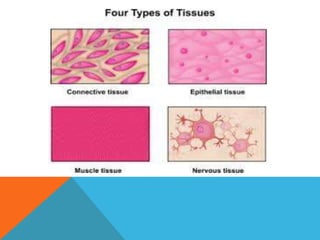
a definite function. The four primary types of tissue are
epithelium, connective tissue, nervous tissue and muscle.
 All of these body tissues are composed of somatic cells and
germ cells. Somatic cells are the cells, which make up the
tissues of the body while the germ cells are cells that give rise
to a new individual.
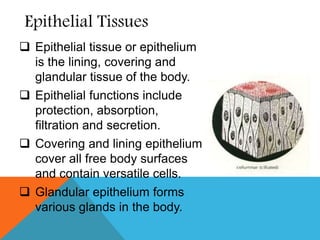
 Epithelial tissue or epithelium
is the lining, covering and
glandular tissue of the body.
 Epithelial functions include
protection, absorption,
filtration and secretion.
 Covering and lining epithelium
cover all free body surfaces
and contain versatile cells.
 Glandular epithelium forms
various glands in the body.
Epithelial Tissues
Functions of the Epithelial Tissues
 The functions of the epithelial tissues include
protection, absorption, filtration and secretion.
 The epithelium of the skin protects it from
bacterial and chemical damage.
 The linings (cilia) of the respiratory tract sweep
dust and other debris away from the lungs.
 Glandular epithelium secretes substances as
perspiration, oil, digestive enzymes and mucus.
Characteristics of epithelium tissue
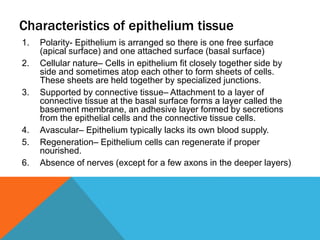
1. Polarity- Epithelium is arranged so there is one free surface
(apical surface) and one attached surface (basal surface)
2. Cellular nature– Cells in epithelium fit closely together side by
side and sometimes atop each other to form sheets of cells.
These sheets are held together by specialized junctions.
3. Supported by connective tissue– Attachment to a layer of
connective tissue at the basal surface forms a layer called the
basement membrane, an adhesive layer formed by secretions
from the epithelial cells and the connective tissue cells.
4. Avascular– Epithelium typically lacks its own blood supply.
5. Regeneration– Epithelium cells can regenerate if proper
nourished.
6. Absence of nerves (except for a few axons in the deeper layers)
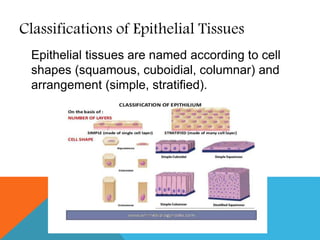
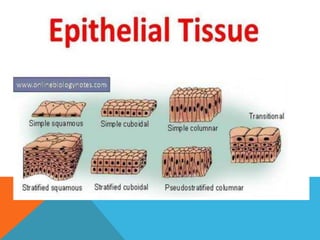
Epithelial tissues are named according to cell
shapes (squamous, cuboidial, columnar) and
arrangement (simple, stratified).
Classifications of Epithelial Tissues
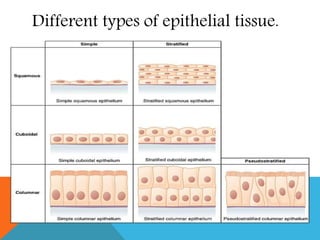
Different types of epithelial tissue.
CONNECTIVE TISSUES
 Connective tissue is the supportive,
protective, and binding tissue.
 It is characterized by the presence of
nonliving, extra cellular matrix produced and
secreted by the tissue. It varies in amount
and consistency.
 Examples of connective tissue or connective
tissue structures are fat, ligaments and
tendons, bones and cartilage.
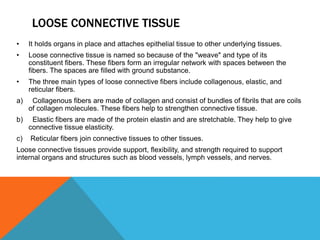
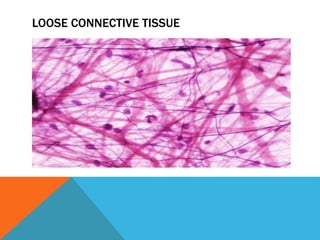
LOOSE CONNECTIVE TISSUE
• It holds organs in place and attaches epithelial tissue to other underlying tissues.
• Loose connective tissue is named so because of the "weave" and type of its
constituent fibers. These fibers form an irregular network with spaces between the
fibers. The spaces are filled with ground substance.
• The three main types of loose connective fibers include collagenous, elastic, and
reticular fibers.
a) Collagenous fibers are made of collagen and consist of bundles of fibrils that are coils
of collagen molecules. These fibers help to strengthen connective tissue.
b) Elastic fibers are made of the protein elastin and are stretchable. They help to give
connective tissue elasticity.
c) Reticular fibers join connective tissues to other tissues.
Loose connective tissues provide support, flexibility, and strength required to support
internal organs and structures such as blood vessels, lymph vessels, and nerves.
LOOSE CONNECTIVE TISSUE
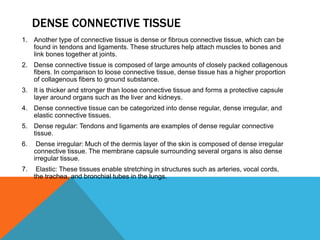
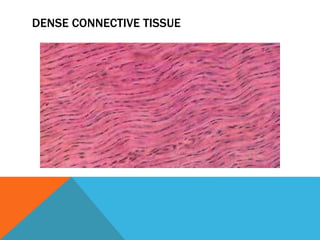
DENSE CONNECTIVE TISSUE
1. Another type of connective tissue is dense or fibrous connective tissue, which can be
found in tendons and ligaments. These structures help attach muscles to bones and
link bones together at joints.
2. Dense connective tissue is composed of large amounts of closely packed collagenous
fibers. In comparison to loose connective tissue, dense tissue has a higher proportion
of collagenous fibers to ground substance.
3. It is thicker and stronger than loose connective tissue and forms a protective capsule
layer around organs such as the liver and kidneys.
4. Dense connective tissue can be categorized into dense regular, dense irregular, and
elastic connective tissues.
5. Dense regular: Tendons and ligaments are examples of dense regular connective
tissue.
6. Dense irregular: Much of the dermis layer of the skin is composed of dense irregular
connective tissue. The membrane capsule surrounding several organs is also dense
irregular tissue.
7. Elastic: These tissues enable stretching in structures such as arteries, vocal cords,
the trachea, and bronchial tubes in the lungs.
DENSE CONNECTIVE TISSUE
SPECIALIZED CONNECTIVE TISSUES
 Specialized connective tissues include a
number of different tissues with specialized
cells and unique ground substances.
 Some of these tissues are solid and strong,
while others are fluid and flexible.
 These are adipose, cartilage, bone, blood,
and lymph.
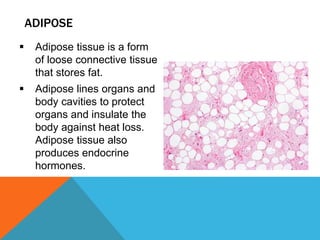
 Adipose tissue is a form
of loose connective tissue
that stores fat.
 Adipose lines organs and
body cavities to protect
organs and insulate the
body against heat loss.
Adipose tissue also
produces endocrine
hormones.
ADIPOSE
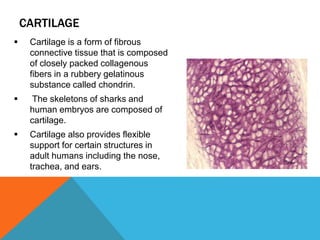
 Cartilage is a form of fibrous
connective tissue that is composed
of closely packed collagenous
fibers in a rubbery gelatinous
substance called chondrin.
 The skeletons of sharks and
human embryos are composed of
cartilage.
 Cartilage also provides flexible
support for certain structures in
adult humans including the nose,
trachea, and ears.
CARTILAGE
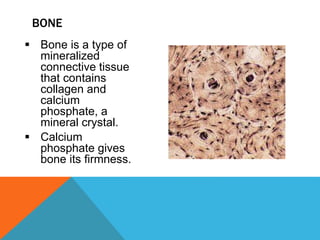
 Bone is a type of
mineralized
connective tissue
that contains
collagen and
calcium
phosphate, a
mineral crystal.
 Calcium
phosphate gives
bone its firmness.
BONE
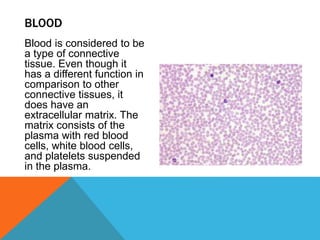
Blood is considered to be
a type of connective
tissue. Even though it
has a different function in
comparison to other
connective tissues, it
does have an
extracellular matrix. The
matrix consists of the
plasma with red blood
cells, white blood cells,
and platelets suspended
in the plasma.
BLOOD
 Lymph is another
type of fluid
connective tissue.
This clear fluid
originates from blood
plasma that exits
blood vessels at
capillary beds.
 A component of the
lymphatic system,
lymph contains
immune system cells
that protect the body
against pathogens.
LYMPH
ANIMAL TISSUE TYPES
1. Epithelial Tissue: This tissue type covers body
surfaces and lines body cavities providing
protection and allowing for the absorption and
secretion of substances.
2. Muscle Tissue: Excitable cells capable of
contraction allow muscle tissue to generate body
movement.
3. Nervous Tissue: This primary tissue of the
nervous system allows for communication
between various organs and tissues. It is
composed of neurons and glial cells.
REFERENCES:
https://courses.lumenlearning.com/boundless-
ap/chapter/epithelial-tissue/
https://biologydictionary.net/epithelial-tissue/
http://www.onlinebiologynotes.com/epithelial-
tissue-characteristics-classification-scheme-
types/
https://www.thoughtco.com/connective-tissue-
anatomy-373207

Body tissues

  • 2.
    Cell and Tissues The cell is the basic unit of living things. All living things start out from single cell. Series of endless cell divisions result to the existence of specialized cells. In complex animals, specialized body tissues cooperate in performing tasks that help assure the survival of the whole organism.  A tissue is a group of similar cells united in the performance of a definite function. The four primary types of tissue are epithelium, connective tissue, nervous tissue and muscle.  All of these body tissues are composed of somatic cells and germ cells. Somatic cells are the cells, which make up the tissues of the body while the germ cells are cells that give rise to a new individual.
  • 3.
     Epithelial tissueor epithelium is the lining, covering and glandular tissue of the body.  Epithelial functions include protection, absorption, filtration and secretion.  Covering and lining epithelium cover all free body surfaces and contain versatile cells.  Glandular epithelium forms various glands in the body. Epithelial Tissues
  • 4.
    Functions of theEpithelial Tissues  The functions of the epithelial tissues include protection, absorption, filtration and secretion.  The epithelium of the skin protects it from bacterial and chemical damage.  The linings (cilia) of the respiratory tract sweep dust and other debris away from the lungs.  Glandular epithelium secretes substances as perspiration, oil, digestive enzymes and mucus.
  • 5.
    Characteristics of epitheliumtissue 1. Polarity- Epithelium is arranged so there is one free surface (apical surface) and one attached surface (basal surface) 2. Cellular nature– Cells in epithelium fit closely together side by side and sometimes atop each other to form sheets of cells. These sheets are held together by specialized junctions. 3. Supported by connective tissue– Attachment to a layer of connective tissue at the basal surface forms a layer called the basement membrane, an adhesive layer formed by secretions from the epithelial cells and the connective tissue cells. 4. Avascular– Epithelium typically lacks its own blood supply. 5. Regeneration– Epithelium cells can regenerate if proper nourished. 6. Absence of nerves (except for a few axons in the deeper layers)
  • 6.
    Epithelial tissues arenamed according to cell shapes (squamous, cuboidial, columnar) and arrangement (simple, stratified). Classifications of Epithelial Tissues
  • 8.
    Different types ofepithelial tissue.
  • 9.
    CONNECTIVE TISSUES  Connectivetissue is the supportive, protective, and binding tissue.  It is characterized by the presence of nonliving, extra cellular matrix produced and secreted by the tissue. It varies in amount and consistency.  Examples of connective tissue or connective tissue structures are fat, ligaments and tendons, bones and cartilage.
  • 10.
    LOOSE CONNECTIVE TISSUE •It holds organs in place and attaches epithelial tissue to other underlying tissues. • Loose connective tissue is named so because of the "weave" and type of its constituent fibers. These fibers form an irregular network with spaces between the fibers. The spaces are filled with ground substance. • The three main types of loose connective fibers include collagenous, elastic, and reticular fibers. a) Collagenous fibers are made of collagen and consist of bundles of fibrils that are coils of collagen molecules. These fibers help to strengthen connective tissue. b) Elastic fibers are made of the protein elastin and are stretchable. They help to give connective tissue elasticity. c) Reticular fibers join connective tissues to other tissues. Loose connective tissues provide support, flexibility, and strength required to support internal organs and structures such as blood vessels, lymph vessels, and nerves.
  • 11.
  • 12.
    DENSE CONNECTIVE TISSUE 1.Another type of connective tissue is dense or fibrous connective tissue, which can be found in tendons and ligaments. These structures help attach muscles to bones and link bones together at joints. 2. Dense connective tissue is composed of large amounts of closely packed collagenous fibers. In comparison to loose connective tissue, dense tissue has a higher proportion of collagenous fibers to ground substance. 3. It is thicker and stronger than loose connective tissue and forms a protective capsule layer around organs such as the liver and kidneys. 4. Dense connective tissue can be categorized into dense regular, dense irregular, and elastic connective tissues. 5. Dense regular: Tendons and ligaments are examples of dense regular connective tissue. 6. Dense irregular: Much of the dermis layer of the skin is composed of dense irregular connective tissue. The membrane capsule surrounding several organs is also dense irregular tissue. 7. Elastic: These tissues enable stretching in structures such as arteries, vocal cords, the trachea, and bronchial tubes in the lungs.
  • 13.
  • 14.
    SPECIALIZED CONNECTIVE TISSUES Specialized connective tissues include a number of different tissues with specialized cells and unique ground substances.  Some of these tissues are solid and strong, while others are fluid and flexible.  These are adipose, cartilage, bone, blood, and lymph.
  • 15.
     Adipose tissueis a form of loose connective tissue that stores fat.  Adipose lines organs and body cavities to protect organs and insulate the body against heat loss. Adipose tissue also produces endocrine hormones. ADIPOSE
  • 16.
     Cartilage isa form of fibrous connective tissue that is composed of closely packed collagenous fibers in a rubbery gelatinous substance called chondrin.  The skeletons of sharks and human embryos are composed of cartilage.  Cartilage also provides flexible support for certain structures in adult humans including the nose, trachea, and ears. CARTILAGE
  • 17.
     Bone isa type of mineralized connective tissue that contains collagen and calcium phosphate, a mineral crystal.  Calcium phosphate gives bone its firmness. BONE
  • 18.
    Blood is consideredto be a type of connective tissue. Even though it has a different function in comparison to other connective tissues, it does have an extracellular matrix. The matrix consists of the plasma with red blood cells, white blood cells, and platelets suspended in the plasma. BLOOD
  • 19.
     Lymph isanother type of fluid connective tissue. This clear fluid originates from blood plasma that exits blood vessels at capillary beds.  A component of the lymphatic system, lymph contains immune system cells that protect the body against pathogens. LYMPH
  • 20.
    ANIMAL TISSUE TYPES 1.Epithelial Tissue: This tissue type covers body surfaces and lines body cavities providing protection and allowing for the absorption and secretion of substances. 2. Muscle Tissue: Excitable cells capable of contraction allow muscle tissue to generate body movement. 3. Nervous Tissue: This primary tissue of the nervous system allows for communication between various organs and tissues. It is composed of neurons and glial cells.
  • 22.