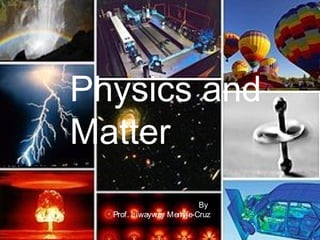
Physics and
Matter
By
Prof. Liwayway Memije-Cruz
Physics
• thestudy of
everyday
phenomenausing
thefundamental
lawsof nature.
• thestudy of matter
and energy and
their relationship.
Branchesof Physics
Classical Physics
• MECHANICS –
thestudy of
forcesacting on
bodieswhether
at rest or in
motion
Branchesof Physics
• Classical Physics – the traditional forces that
were recognized and developed before the
beginning of the20th
century
• Modern Physics – to the concepts in physics
that have surfaced since the beginning of the
20th
century.
Subdivisionsof Mechanics
1. Statics– study of
theforceson a
body or bodiesar
rest.
2. Dynamics- study
of motion and the
forcesthat affect it.
3. Kinematics- study
of motion without
regard to itscauses
Optics
• thestudy of light
• concerned not only with
visiblelight but also
with infrared and
ultraviolet radiation,
which exhibit all of the
phenomenaof visible
light except visibility,
e.g., reflection,
refraction, interference,
diffraction.
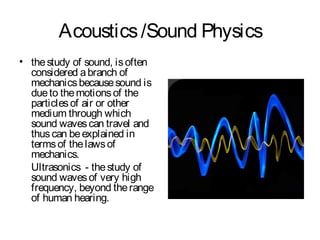
Acoustics/Sound Physics
• thestudy of sound, isoften
considered abranch of
mechanicsbecausesound is
dueto themotionsof the
particlesof air or other
medium through which
sound wavescan travel and
thuscan beexplained in
termsof thelawsof
mechanics.
Ultrasonics  - thestudy of
sound wavesof very high
frequency, beyond therange
of human hearing.
Heat
• Heat isaform of
energy, theinternal
energy possessed by
theparticlesof which
asubstanceis
composed
Thermodynamics-
dealswith the
relationshipsbetween
heat and other forms
of energy.
Electromagnetism
- the study of the
properties of electric
current and magnetism
and their relationship
a. Electrostatics – on
electric charges at
rest
b. Electrodynamics–
on moving charges
c. Magnetostatics –
on magnetic poles
at rest
Modern Physics
1. ATOMIC and NUCLEAR PHYSICS – the
study of the components, structure and
behavior of thenucleusof theatom.
2. QUANTUM PHYSICS – the study of the
discrete nature of phenomena at the atomic
and subatomic levels its focus is on the
invisible units of energy called quanta as
described by thequantum theory.
3. RELATIVISTIC PHYSICS - the study of
phenomena that take place in a forms of
reference that is in motion with respect
to an observer.
4. SOLID STATE PHYSICS – study of all
properties of solid materials including
electrical conduction in crystals of semi-
conductor and metals.
5. CONDENSED MATTER PHYSICS –study of the
properties of condensed materials (solids, and liquid
and those intermediate between them and dense gas)
with the ultimate goal and developing new material
with better properties; it is an extension of solid
statephysics.
6. PLASMA PHYSICS –the study of the fourth state of
matter; plasma
7. LOW TEMPERATURE PHYSICS – the study of the
production and maintenance of temperatures down
to almost absolute zero and the various phenomena
that occur only at such temperature.
Matter
Matteris anything that occupies
space and has mass
Classification of Matter
According to theorigin orsource, matter isclassified as organic and
inorganic matter. Organic matter comesfrom living things, while
ino rganic matter comesfrom non-living things.
Chemistshavestudied that all formsof matter may beclassified into three
general classeson thebasisof their compositions. Thesearetheelements,
compoundsand mixtures.
 Element isasubstance, which cannot bedecomposed by ordinary means.
Atom isthesmallest part of an element that can enter into combination with
other elements.
 Compound isasubstance, which can bedecomposed into two or more
simpler substancesby ordinary chemical means.
 Mixture isamaterial composed of two or moresubstanceseach of which
retainsitsown characteristic properties. a. Heterogeneousmixtureisone
which haspartspossessing different properties. b. Homogeneousmixtureis
onewhich hassimilar propertiesthroughout. Substanceisahomogeneous
material composed of oneparticular kind of matter.
Matter can ordinarily exist in three physical states –solid,
liquid, and gas. A fourth state of matter exists under
special conditions, called plasma.
The state of matterchanges as you add
more energy.
Changesin matter
Physical Properties
Specific properties arethosefeatures, which definitely distinguish one
substancefrom another. Someof thesearethefollowing:
1. Density istheweight of aunit volumeof asubstance.
2. Specific gravity istheratio of theweight of agiven volumeof a
substanceto theweight of thesamevolumeof water at thesame
temperature.
3. Hardnessistheability of thesubstanceto resist scratching.
4. Odor isthecharacteristicsodor of agiven substance.
5. Color isthecharacteristicscolor of agiven substance.
Accidental physical properties arethosefeaturesasweight,
dimensions, and volume. They havenothing to do with thenatureof
thesubstance, but they enableusto find out how much of agiven
substancewehave.
Specific and accidental
Chemical Properties
Chemical propertiesof asubstancedescribehow a
substanceactswhen it undergoeschange. They
describeitsability to form new substancesunder
given conditions.
A chemical changeor achemical reaction isachange
from onesubstanceto another. thereactionsoccur.
Someof thechemical propertiesare: combustibility,
stability, relativeactivity, responseto test reaction,
and ionization.
States of Matterand Changes of
State.
Intrinsic and Extrinsic Properties
• Intrinsic (intensive) Propertiesare
propertiesthat do not depend on thesize
of thesample. Examplesarecolor, odor,
boiling point, and electrical conductivity.
• Extrinsic (Extensive) Propertiesare
propertiesthat depend on thesizeor
amount of thesample. Examplesaremass
and volume.
Law of Conservation of Mass
• TheLaw of Conservation of Massstatethat mass
isneither created nor destroyed. An exampleis
shown in thecompletecombustion of gasoline.
Therelationship istruewithin thelimitsof one’s
ability to determinetheweightsof thereacting
substancesand theproductsof thereaction:
Gasoline+ oxygen ----> carbon dioxide+ water
vapor
Weight of reactants= weight of products
Identify whether thefollowing arephysical or
chemical changes:
• ___________________1. welding metals
• ___________________2. ripening of fruits
• ___________________3. grinding rice
• ___________________4. dissolving sugar in
water
• ___________________5. burning gas
• ___________________6. magnetizing iron nails
• ___________________7. melting of butter
• ___________________8. hair bleaching
• ___________________9. souring of milk
• ___________________10. brewing of coffee
Classify thefollowing aseither an element, a
compound, or amixture:
• ___________________1. gasoline
• ___________________2. dry ice
• ___________________3. aluminum wire
• ___________________4. diamond
• ___________________5. lead pencil
• ___________________6. toothpaste
• ___________________7. penny
• ___________________8. platinum
• ___________________9. glue
• ___________________10. rubbing alcohol
Classify thefollowing propertiesasintrinsic or
extrinsic:
• ___________________1. volume
• ___________________2. density
• ___________________3. length
• ___________________4. color
• ___________________5. freezing point
• ___________________6. electrical conductivity
• ___________________7. mass
• ___________________8. odor
• ___________________9. boiling point
• ___________________10. luster
Kinetic Molecular Theory
• showshow individual gasparticles
interact with oneanother.
Assumptionsof KMT:
• Moleculesarepoint masses(they
haveno volume)
• Gasmoleculesexert no forceon
each other unlessthey collide
• Collisionsof moleculeswith each
other or thewallsof thecontainer
do not decreasetheenergy of the
system
• Themoleculesof agasarein
constant and random motion
• Thetemperatureof agasdepends
on itsaveragekinetic
energyavg(1/2mv 2
) = 3/2kT . In
other words, theenergy of an ideal
gasisentirely kinetic.
Cohesion and Adhesion
Cohesion -
refersto the
attraction
between like
molecules.
Adhesion –
refersto the
attraction
between unlike
molecules.
Cohesion in Solids
• Tenacity – theability of
amaterial to resist being
pulled apart. Ex…steel,
tungsten, iron and
bronze
• Malleability – thestate
of being malleable, or
capableof being shaped,
asby hammering or
pressing
• Ductility - theability of
material, such assteel, to
bedrawn out into thin
wiresor flat sheetswithout
pulling apart or breaking.
Materialsthat are
extremely ductilecan be
stretched thin without
cracking and losing their
strength.
• Hardness- defined by
how well asubstancewill
resist scratching by another
substance.
Cohesion in Liquids
• Surfacetension - theproperty of the
surfaceof aliquid that allowsit to
resist an external force, dueto the
cohesivenatureof itsmolecules.
• aprinciplethat explainswhy fluids
areoften drawn up into other
substances. Thisphenomenon isalso
sometimesdescribed as“capillarity.”
A classic exampleof thisaction
involvesapaper towel and aspilled
puddleof water: when thetowel is
dipped into thewater, it sucksthe
water up. It explainsalargenumber
of eventsthat occur in nature, from
how treesmanageto get water all the
way up to their crownsto theway in
which water seemsto climb up a
straw.
Formsof Energy
• Potential Energy isany typeof stored energy. It
can bechemical, nuclear, gravitational or
mechanical. 
• Kinetic Energy isenergy in motion. An airplane
flying or ameteor plummeting each havekinetic
energy. Even thetiniest thingshavekinetic
energy, likeatomsvibrating when they arehot or
when they transmit sound waves. Electricity isthe
kinetic energy of flowing electronsbetween
atoms.
Energy – capacity to do work.
• Potential Energy is any type 
of stored energy. It can 
be chemical, nuclear, 
gravitational or mechanical. 
• Kinetic Energy is found in 
movement. An airplane flying 
or a meteor plummeting each 
have kinetic energy. Even the 
tiniest things have kinetic 
energy, like atoms vibrating 
when they are hot or when 
they transmit sound waves 
energy of flowing electrons 
between atoms.

Physics and Matter

  • 1.
  • 2.
    Physics • thestudy of everyday phenomenausing thefundamental lawsofnature. • thestudy of matter and energy and their relationship.
  • 3.
  • 4.
    Classical Physics • MECHANICS– thestudy of forcesacting on bodieswhether at rest or in motion
  • 5.
    Branchesof Physics • ClassicalPhysics – the traditional forces that were recognized and developed before the beginning of the20th century • Modern Physics – to the concepts in physics that have surfaced since the beginning of the 20th century.
  • 6.
    Subdivisionsof Mechanics 1. Statics–study of theforceson a body or bodiesar rest. 2. Dynamics- study of motion and the forcesthat affect it. 3. Kinematics- study of motion without regard to itscauses
  • 7.
    Optics • thestudy oflight • concerned not only with visiblelight but also with infrared and ultraviolet radiation, which exhibit all of the phenomenaof visible light except visibility, e.g., reflection, refraction, interference, diffraction.
  • 8.
    Acoustics/Sound Physics • thestudyof sound, isoften considered abranch of mechanicsbecausesound is dueto themotionsof the particlesof air or other medium through which sound wavescan travel and thuscan beexplained in termsof thelawsof mechanics. Ultrasonics  - thestudy of sound wavesof very high frequency, beyond therange of human hearing.
  • 9.
    Heat • Heat isaformof energy, theinternal energy possessed by theparticlesof which asubstanceis composed Thermodynamics- dealswith the relationshipsbetween heat and other forms of energy.
  • 10.
    Electromagnetism - the studyof the properties of electric current and magnetism and their relationship a. Electrostatics – on electric charges at rest b. Electrodynamics– on moving charges c. Magnetostatics – on magnetic poles at rest
  • 11.
    Modern Physics 1. ATOMICand NUCLEAR PHYSICS – the study of the components, structure and behavior of thenucleusof theatom. 2. QUANTUM PHYSICS – the study of the discrete nature of phenomena at the atomic and subatomic levels its focus is on the invisible units of energy called quanta as described by thequantum theory.
  • 12.
    3. RELATIVISTIC PHYSICS- the study of phenomena that take place in a forms of reference that is in motion with respect to an observer. 4. SOLID STATE PHYSICS – study of all properties of solid materials including electrical conduction in crystals of semi- conductor and metals.
  • 13.
    5. CONDENSED MATTERPHYSICS –study of the properties of condensed materials (solids, and liquid and those intermediate between them and dense gas) with the ultimate goal and developing new material with better properties; it is an extension of solid statephysics. 6. PLASMA PHYSICS –the study of the fourth state of matter; plasma 7. LOW TEMPERATURE PHYSICS – the study of the production and maintenance of temperatures down to almost absolute zero and the various phenomena that occur only at such temperature.
  • 14.
  • 15.
    Matteris anything thatoccupies space and has mass
  • 16.
    Classification of Matter Accordingto theorigin orsource, matter isclassified as organic and inorganic matter. Organic matter comesfrom living things, while ino rganic matter comesfrom non-living things. Chemistshavestudied that all formsof matter may beclassified into three general classeson thebasisof their compositions. Thesearetheelements, compoundsand mixtures.  Element isasubstance, which cannot bedecomposed by ordinary means. Atom isthesmallest part of an element that can enter into combination with other elements.  Compound isasubstance, which can bedecomposed into two or more simpler substancesby ordinary chemical means.  Mixture isamaterial composed of two or moresubstanceseach of which retainsitsown characteristic properties. a. Heterogeneousmixtureisone which haspartspossessing different properties. b. Homogeneousmixtureis onewhich hassimilar propertiesthroughout. Substanceisahomogeneous material composed of oneparticular kind of matter.
  • 18.
    Matter can ordinarilyexist in three physical states –solid, liquid, and gas. A fourth state of matter exists under special conditions, called plasma.
  • 19.
    The state ofmatterchanges as you add more energy.
  • 20.
  • 21.
    Physical Properties Specific propertiesarethosefeatures, which definitely distinguish one substancefrom another. Someof thesearethefollowing: 1. Density istheweight of aunit volumeof asubstance. 2. Specific gravity istheratio of theweight of agiven volumeof a substanceto theweight of thesamevolumeof water at thesame temperature. 3. Hardnessistheability of thesubstanceto resist scratching. 4. Odor isthecharacteristicsodor of agiven substance. 5. Color isthecharacteristicscolor of agiven substance. Accidental physical properties arethosefeaturesasweight, dimensions, and volume. They havenothing to do with thenatureof thesubstance, but they enableusto find out how much of agiven substancewehave. Specific and accidental
  • 22.
    Chemical Properties Chemical propertiesofasubstancedescribehow a substanceactswhen it undergoeschange. They describeitsability to form new substancesunder given conditions. A chemical changeor achemical reaction isachange from onesubstanceto another. thereactionsoccur. Someof thechemical propertiesare: combustibility, stability, relativeactivity, responseto test reaction, and ionization.
  • 23.
    States of MatterandChanges of State.
  • 24.
    Intrinsic and ExtrinsicProperties • Intrinsic (intensive) Propertiesare propertiesthat do not depend on thesize of thesample. Examplesarecolor, odor, boiling point, and electrical conductivity. • Extrinsic (Extensive) Propertiesare propertiesthat depend on thesizeor amount of thesample. Examplesaremass and volume.
  • 25.
    Law of Conservationof Mass • TheLaw of Conservation of Massstatethat mass isneither created nor destroyed. An exampleis shown in thecompletecombustion of gasoline. Therelationship istruewithin thelimitsof one’s ability to determinetheweightsof thereacting substancesand theproductsof thereaction: Gasoline+ oxygen ----> carbon dioxide+ water vapor Weight of reactants= weight of products
  • 26.
    Identify whether thefollowingarephysical or chemical changes: • ___________________1. welding metals • ___________________2. ripening of fruits • ___________________3. grinding rice • ___________________4. dissolving sugar in water • ___________________5. burning gas • ___________________6. magnetizing iron nails • ___________________7. melting of butter • ___________________8. hair bleaching • ___________________9. souring of milk • ___________________10. brewing of coffee
  • 27.
    Classify thefollowing aseitheran element, a compound, or amixture: • ___________________1. gasoline • ___________________2. dry ice • ___________________3. aluminum wire • ___________________4. diamond • ___________________5. lead pencil • ___________________6. toothpaste • ___________________7. penny • ___________________8. platinum • ___________________9. glue • ___________________10. rubbing alcohol
  • 28.
    Classify thefollowing propertiesasintrinsicor extrinsic: • ___________________1. volume • ___________________2. density • ___________________3. length • ___________________4. color • ___________________5. freezing point • ___________________6. electrical conductivity • ___________________7. mass • ___________________8. odor • ___________________9. boiling point • ___________________10. luster
  • 29.
    Kinetic Molecular Theory •showshow individual gasparticles interact with oneanother. Assumptionsof KMT: • Moleculesarepoint masses(they haveno volume) • Gasmoleculesexert no forceon each other unlessthey collide • Collisionsof moleculeswith each other or thewallsof thecontainer do not decreasetheenergy of the system • Themoleculesof agasarein constant and random motion • Thetemperatureof agasdepends on itsaveragekinetic energyavg(1/2mv 2 ) = 3/2kT . In other words, theenergy of an ideal gasisentirely kinetic.
  • 30.
    Cohesion and Adhesion Cohesion- refersto the attraction between like molecules. Adhesion – refersto the attraction between unlike molecules.
  • 31.
    Cohesion in Solids •Tenacity – theability of amaterial to resist being pulled apart. Ex…steel, tungsten, iron and bronze • Malleability – thestate of being malleable, or capableof being shaped, asby hammering or pressing
  • 32.
    • Ductility -theability of material, such assteel, to bedrawn out into thin wiresor flat sheetswithout pulling apart or breaking. Materialsthat are extremely ductilecan be stretched thin without cracking and losing their strength. • Hardness- defined by how well asubstancewill resist scratching by another substance.
  • 33.
    Cohesion in Liquids •Surfacetension - theproperty of the surfaceof aliquid that allowsit to resist an external force, dueto the cohesivenatureof itsmolecules. • aprinciplethat explainswhy fluids areoften drawn up into other substances. Thisphenomenon isalso sometimesdescribed as“capillarity.” A classic exampleof thisaction involvesapaper towel and aspilled puddleof water: when thetowel is dipped into thewater, it sucksthe water up. It explainsalargenumber of eventsthat occur in nature, from how treesmanageto get water all the way up to their crownsto theway in which water seemsto climb up a straw.
  • 34.
    Formsof Energy • PotentialEnergy isany typeof stored energy. It can bechemical, nuclear, gravitational or mechanical.  • Kinetic Energy isenergy in motion. An airplane flying or ameteor plummeting each havekinetic energy. Even thetiniest thingshavekinetic energy, likeatomsvibrating when they arehot or when they transmit sound waves. Electricity isthe kinetic energy of flowing electronsbetween atoms.
  • 35.
    Energy – capacityto do work. • Potential Energy is any type  of stored energy. It can  be chemical, nuclear,  gravitational or mechanical.  • Kinetic Energy is found in  movement. An airplane flying  or a meteor plummeting each  have kinetic energy. Even the  tiniest things have kinetic  energy, like atoms vibrating  when they are hot or when  they transmit sound waves  energy of flowing electrons  between atoms.