

By Prof. Liwayway Memije-Cruz
Introducing:
Vitamins and Nutrition
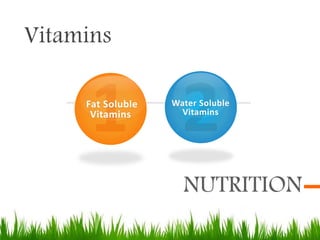
Vitamins
NUTRITION
Fat Soluble
Vitamins
Water Soluble
Vitamins
VITAMINS
What are they and what do they do?
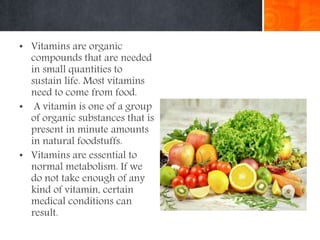
• Vitamins are organic
compounds that are needed
in small quantities to
sustain life. Most vitamins
need to come from food.
• A vitamin is one of a group
of organic substances that is
present in minute amounts
in natural foodstuffs.
• Vitamins are essential to
normal metabolism. If we
do not take enough of any
kind of vitamin, certain
medical conditions can
result.
A vitamin is both:
 an organic compound, which
means it contains carbon
 an essential nutrient that body
cannot produce enough of and
which it needs to get from food.
What are fat-soluble
vitamins?
Fat-soluble vitamins
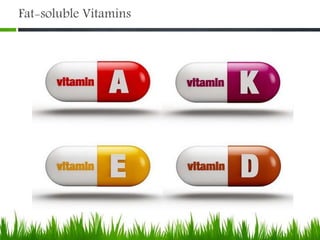
• Fat-soluble vitamins are stored in the fatty
tissues of the body and the liver. Vitamins
A, D, E, and K are fat-soluble. These are
easier to store than water-soluble
vitamins, and they can stay in the body as
reserves for days, and sometimes months.
• Fat-soluble vitamins are absorbed through
the intestinal tract with the help of fats, or
lipids.
Fat-soluble Vitamins
Vitamin A
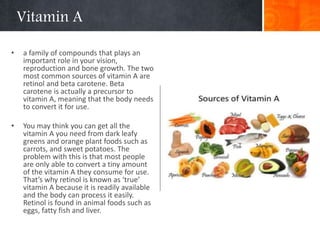
• a family of compounds that plays an
important role in your vision,
reproduction and bone growth. The two
most common sources of vitamin A are
retinol and beta carotene. Beta
carotene is actually a precursor to
vitamin A, meaning that the body needs
to convert it for use.
• You may think you can get all the
vitamin A you need from dark leafy
greens and orange plant foods such as
carrots, and sweet potatoes. The
problem with this is that most people
are only able to convert a tiny amount
of the vitamin A they consume for use.
That’s why retinol is known as ‘true’
vitamin A because it is readily available
and the body can process it easily.
Retinol is found in animal foods such as
eggs, fatty fish and liver.
Vitamin D
• The two distinct forms of
vitamin D are ergocalciferol
(vitamin D2) and
cholecalciferol (vitamin D3).
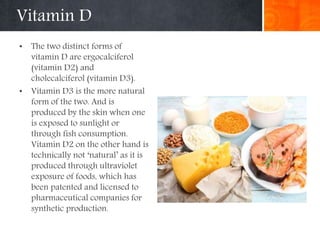
• Vitamin D3 is the more natural
form of the two. And is
produced by the skin when one
is exposed to sunlight or
through fish consumption.
Vitamin D2 on the other hand is
technically not ‘natural’ as it is
produced through ultraviolet
exposure of foods, which has
been patented and licensed to
pharmaceutical companies for
synthetic production.
Vitamin E
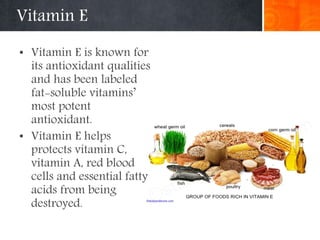
• Vitamin E is known for
its antioxidant qualities
and has been labeled
fat-soluble vitamins’
most potent
antioxidant.
• Vitamin E helps
protects vitamin C,
vitamin A, red blood
cells and essential fatty
acids from being
destroyed.
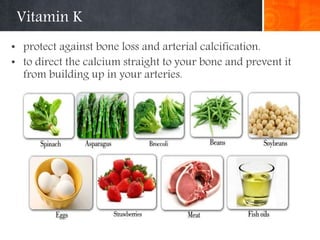
Vitamin K
• protect against bone loss and arterial calcification.
• to direct the calcium straight to your bone and prevent it
from building up in your arteries.
What are water-soluble
vitamins?
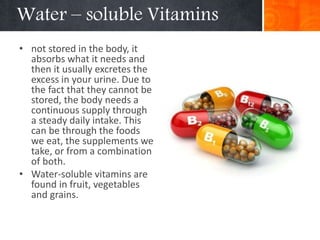
Water – soluble Vitamins
• not stored in the body, it
absorbs what it needs and
then it usually excretes the
excess in your urine. Due to
the fact that they cannot be
stored, the body needs a
continuous supply through
a steady daily intake. This
can be through the foods
we eat, the supplements we
take, or from a combination
of both.
• Water-soluble vitamins are
found in fruit, vegetables
and grains.
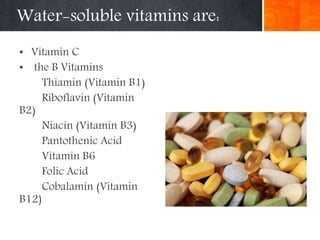
Water-soluble vitamins are:
• Vitamin C
• the B Vitamins
Thiamin (Vitamin B1)
Riboflavin (Vitamin
B2)
Niacin (Vitamin B3)
Pantothenic Acid
Vitamin B6
Folic Acid
Cobalamin (Vitamin
B12)
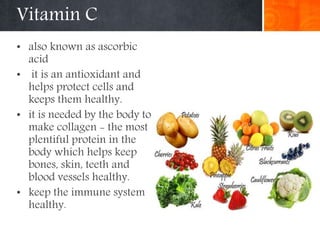
Vitamin C
• also known as ascorbic
acid
• it is an antioxidant and
helps protect cells and
keeps them healthy.
• it is needed by the body to
make collagen - the most
plentiful protein in the
body which helps keep
bones, skin, teeth and
blood vessels healthy.
• keep the immune system
healthy.
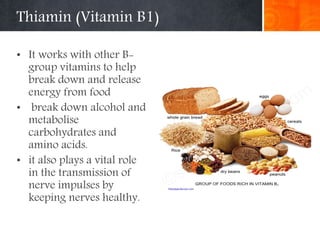
Thiamin (Vitamin B1)
• It works with other B-
group vitamins to help
break down and release
energy from food
• break down alcohol and
metabolise
carbohydrates and
amino acids.
• it also plays a vital role
in the transmission of
nerve impulses by
keeping nerves healthy.
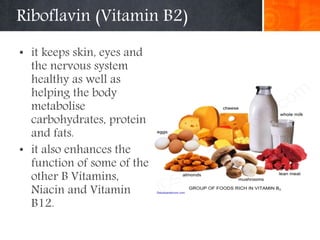
Riboflavin (Vitamin B2)
• it keeps skin, eyes and
the nervous system
healthy as well as
helping the body
metabolise
carbohydrates, protein
and fats.
• it also enhances the
function of some of the
other B Vitamins,
Niacin and Vitamin
B12.
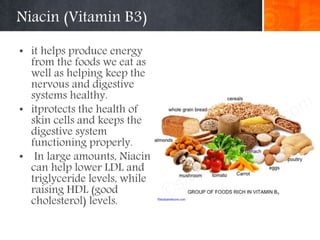
Niacin (Vitamin B3)
• it helps produce energy
from the foods we eat as
well as helping keep the
nervous and digestive
systems healthy.
• itprotects the health of
skin cells and keeps the
digestive system
functioning properly.
• In large amounts, Niacin
can help lower LDL and
triglyceride levels, while
raising HDL (good
cholesterol) levels.
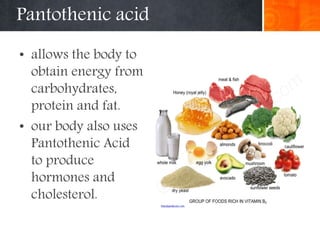
Pantothenic acid
• allows the body to
obtain energy from
carbohydrates,
protein and fat.
• our body also uses
Pantothenic Acid
to produce
hormones and
cholesterol.
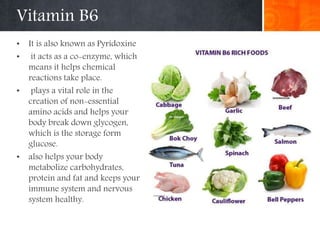
Vitamin B6
• It is also known as Pyridoxine
• it acts as a co-enzyme, which
means it helps chemical
reactions take place.
• plays a vital role in the
creation of non-essential
amino acids and helps your
body break down glycogen,
which is the storage form
glucose.
• also helps your body
metabolize carbohydrates,
protein and fat and keeps your
immune system and nervous
system healthy.
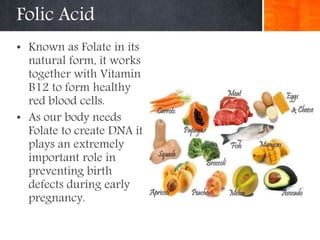
Folic Acid
• Known as Folate in its
natural form, it works
together with Vitamin
B12 to form healthy
red blood cells.
• As our body needs
Folate to create DNA it
plays an extremely
important role in
preventing birth
defects during early
pregnancy.
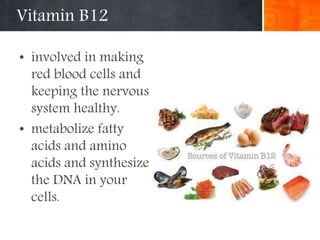
Vitamin B12
• involved in making
red blood cells and
keeping the nervous
system healthy.
• metabolize fatty
acids and amino
acids and synthesize
the DNA in your
cells.
What is it and why is it important?
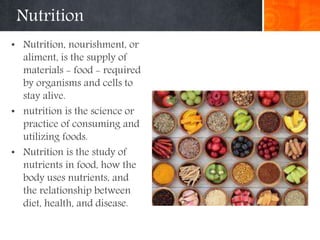
Nutrition
• Nutrition, nourishment, or
aliment, is the supply of
materials - food - required
by organisms and cells to
stay alive.
• nutrition is the science or
practice of consuming and
utilizing foods.
• Nutrition is the study of
nutrients in food, how the
body uses nutrients, and
the relationship between
diet, health, and disease.
Nutrient
A nutrient is a source of nourishment, a
component of food, for instance, protein,
carbohydrate, fat, vitamin, mineral, fiber, and
water.
A nutrient is a substance used by an organism to
survive, grow, and reproduce.
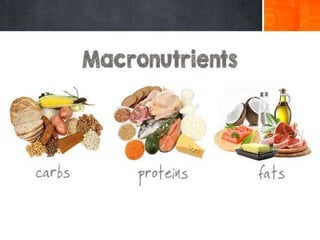
• Macronutrients are nutrients we need in
relatively large quantities.
• Micronutrients are nutrients we need in
relatively small quantities.
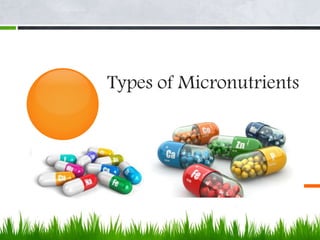
Types of Micronutrients
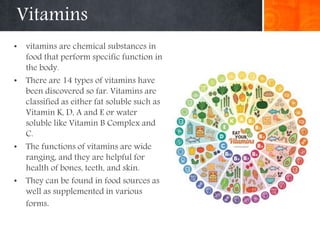
Vitamins
• vitamins are chemical substances in
food that perform specific function in
the body.
• There are 14 types of vitamins have
been discovered so far. Vitamins are
classified as either fat soluble such as
Vitamin K, D, A and E or water
soluble like Vitamin B Complex and
C.
• The functions of vitamins are wide
ranging, and they are helpful for
health of bones, teeth, and skin.
• They can be found in food sources as
well as supplemented in various
forms.
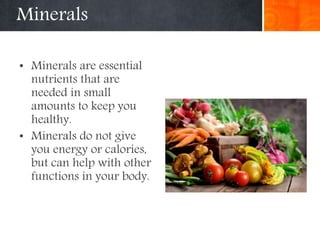
Minerals
• Minerals are essential
nutrients that are
needed in small
amounts to keep you
healthy.
• Minerals do not give
you energy or calories,
but can help with other
functions in your body.
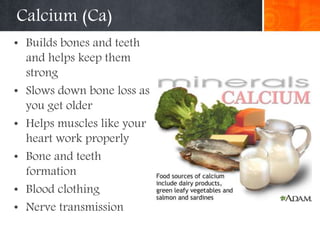
Calcium (Ca)
• Builds bones and teeth
and helps keep them
strong
• Slows down bone loss as
you get older
• Helps muscles like your
heart work properly
• Bone and teeth
formation
• Blood clothing
• Nerve transmission
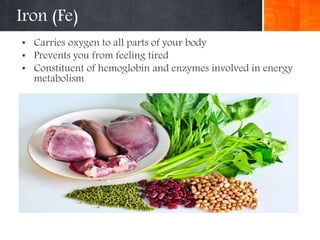
Iron (Fe)
• Carries oxygen to all parts of your body
• Prevents you from feeling tired
• Constituent of hemoglobin and enzymes involved in energy
metabolism
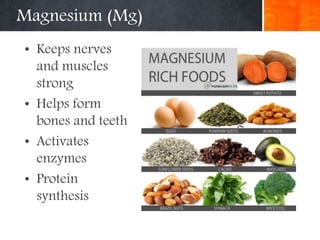
Magnesium (Mg)
• Keeps nerves
and muscles
strong
• Helps form
bones and teeth
• Activates
enzymes
• Protein
synthesis
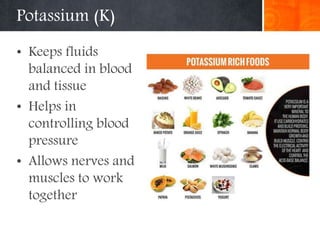
Potassium (K)
• Keeps fluids
balanced in blood
and tissue
• Helps in
controlling blood
pressure
• Allows nerves and
muscles to work
together
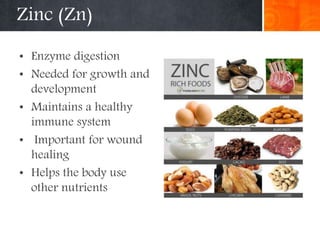
Zinc (Zn)
• Enzyme digestion
• Needed for growth and
development
• Maintains a healthy
immune system
• Important for wound
healing
• Helps the body use
other nutrients
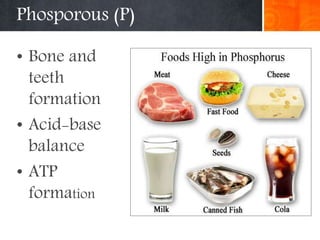
Phosporous (P)
• Bone and
teeth
formation
• Acid-base
balance
• ATP
formation
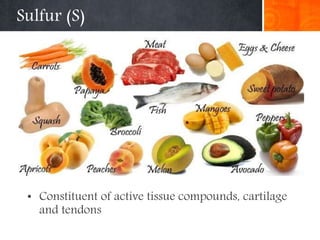
Sulfur (S)
• Constituent of active tissue compounds, cartilage
and tendons
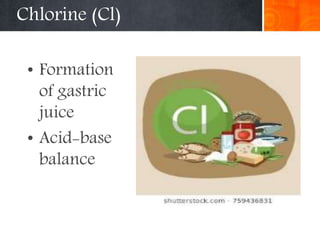
Chlorine (Cl)
• Formation
of gastric
juice
• Acid-base
balance
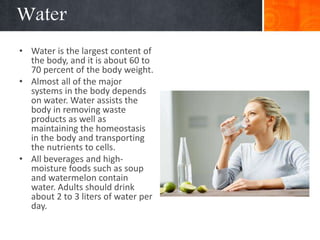
Water
• Water is the largest content of
the body, and it is about 60 to
70 percent of the body weight.
• Almost all of the major
systems in the body depends
on water. Water assists the
body in removing waste
products as well as
maintaining the homeostasis
in the body and transporting
the nutrients to cells.
• All beverages and high-
moisture foods such as soup
and watermelon contain
water. Adults should drink
about 2 to 3 liters of water per
day.
Body Mass Index
Body mass index (BMI) is a measure of
body fat based on height and weight that
applies to adult men and women. It’s not
just about the visuals, but strengthening
Body Mass Index (BMI)
• a value that depends on the weight and height of
an individual.
• defined as the body weight divided by the square
of the body height and expressed in units of
kg/m2, where weight in kilogram and height in
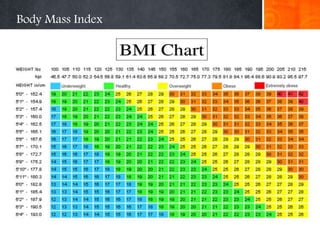
meters. BMI = Weight (kg)/Height (m)2.
• provides simple numeric measures of a person’s
thickness or thinness, allowing health
professionals to discuss weight problems with
their patients.is a value that depends on the
weight and height of an individual.
Body Mass Index
References:
• https://www.algaecal.com/expert-insights/fantastic-four-
fat-soluble-vitamins-work-together-fight-health/
• https://www.medicalnewstoday.com/articles/195878.php
• https://www.justvitamins.co.uk/blog/what-are-water-
soluble-vitamins/#.WwzKmopQjIU
• https://www.healthline.com/nutrition/water-soluble-
vitamins
• https://www.parashospitals.com/blogs/what-should-be-
ideal-bmi
• https://www.consumerhealthdigest.com/brain-
health/macronutrients-and-micronutrients-for-healthy-
brain.html
• https://

Vitamins

  • 1.
    By Prof. LiwaywayMemije-Cruz Introducing: Vitamins and Nutrition
  • 2.
  • 3.
    VITAMINS What are theyand what do they do?
  • 4.
    • Vitamins areorganic compounds that are needed in small quantities to sustain life. Most vitamins need to come from food. • A vitamin is one of a group of organic substances that is present in minute amounts in natural foodstuffs. • Vitamins are essential to normal metabolism. If we do not take enough of any kind of vitamin, certain medical conditions can result.
  • 5.
    A vitamin isboth:  an organic compound, which means it contains carbon  an essential nutrient that body cannot produce enough of and which it needs to get from food.
  • 6.
  • 7.
    Fat-soluble vitamins • Fat-solublevitamins are stored in the fatty tissues of the body and the liver. Vitamins A, D, E, and K are fat-soluble. These are easier to store than water-soluble vitamins, and they can stay in the body as reserves for days, and sometimes months. • Fat-soluble vitamins are absorbed through the intestinal tract with the help of fats, or lipids.
  • 8.
  • 9.
    Vitamin A • afamily of compounds that plays an important role in your vision, reproduction and bone growth. The two most common sources of vitamin A are retinol and beta carotene. Beta carotene is actually a precursor to vitamin A, meaning that the body needs to convert it for use. • You may think you can get all the vitamin A you need from dark leafy greens and orange plant foods such as carrots, and sweet potatoes. The problem with this is that most people are only able to convert a tiny amount of the vitamin A they consume for use. That’s why retinol is known as ‘true’ vitamin A because it is readily available and the body can process it easily. Retinol is found in animal foods such as eggs, fatty fish and liver.
  • 10.
    Vitamin D • Thetwo distinct forms of vitamin D are ergocalciferol (vitamin D2) and cholecalciferol (vitamin D3). • Vitamin D3 is the more natural form of the two. And is produced by the skin when one is exposed to sunlight or through fish consumption. Vitamin D2 on the other hand is technically not ‘natural’ as it is produced through ultraviolet exposure of foods, which has been patented and licensed to pharmaceutical companies for synthetic production.
  • 11.
    Vitamin E • VitaminE is known for its antioxidant qualities and has been labeled fat-soluble vitamins’ most potent antioxidant. • Vitamin E helps protects vitamin C, vitamin A, red blood cells and essential fatty acids from being destroyed.
  • 12.
    Vitamin K • protectagainst bone loss and arterial calcification. • to direct the calcium straight to your bone and prevent it from building up in your arteries.
  • 13.
  • 14.
    Water – solubleVitamins • not stored in the body, it absorbs what it needs and then it usually excretes the excess in your urine. Due to the fact that they cannot be stored, the body needs a continuous supply through a steady daily intake. This can be through the foods we eat, the supplements we take, or from a combination of both. • Water-soluble vitamins are found in fruit, vegetables and grains.
  • 15.
    Water-soluble vitamins are: •Vitamin C • the B Vitamins Thiamin (Vitamin B1) Riboflavin (Vitamin B2) Niacin (Vitamin B3) Pantothenic Acid Vitamin B6 Folic Acid Cobalamin (Vitamin B12)
  • 16.
    Vitamin C • alsoknown as ascorbic acid • it is an antioxidant and helps protect cells and keeps them healthy. • it is needed by the body to make collagen - the most plentiful protein in the body which helps keep bones, skin, teeth and blood vessels healthy. • keep the immune system healthy.
  • 17.
    Thiamin (Vitamin B1) •It works with other B- group vitamins to help break down and release energy from food • break down alcohol and metabolise carbohydrates and amino acids. • it also plays a vital role in the transmission of nerve impulses by keeping nerves healthy.
  • 18.
    Riboflavin (Vitamin B2) •it keeps skin, eyes and the nervous system healthy as well as helping the body metabolise carbohydrates, protein and fats. • it also enhances the function of some of the other B Vitamins, Niacin and Vitamin B12.
  • 19.
    Niacin (Vitamin B3) •it helps produce energy from the foods we eat as well as helping keep the nervous and digestive systems healthy. • itprotects the health of skin cells and keeps the digestive system functioning properly. • In large amounts, Niacin can help lower LDL and triglyceride levels, while raising HDL (good cholesterol) levels.
  • 20.
    Pantothenic acid • allowsthe body to obtain energy from carbohydrates, protein and fat. • our body also uses Pantothenic Acid to produce hormones and cholesterol.
  • 21.
    Vitamin B6 • Itis also known as Pyridoxine • it acts as a co-enzyme, which means it helps chemical reactions take place. • plays a vital role in the creation of non-essential amino acids and helps your body break down glycogen, which is the storage form glucose. • also helps your body metabolize carbohydrates, protein and fat and keeps your immune system and nervous system healthy.
  • 22.
    Folic Acid • Knownas Folate in its natural form, it works together with Vitamin B12 to form healthy red blood cells. • As our body needs Folate to create DNA it plays an extremely important role in preventing birth defects during early pregnancy.
  • 23.
    Vitamin B12 • involvedin making red blood cells and keeping the nervous system healthy. • metabolize fatty acids and amino acids and synthesize the DNA in your cells.
  • 24.
    What is itand why is it important?
  • 25.
    Nutrition • Nutrition, nourishment,or aliment, is the supply of materials - food - required by organisms and cells to stay alive. • nutrition is the science or practice of consuming and utilizing foods. • Nutrition is the study of nutrients in food, how the body uses nutrients, and the relationship between diet, health, and disease.
  • 26.
    Nutrient A nutrient isa source of nourishment, a component of food, for instance, protein, carbohydrate, fat, vitamin, mineral, fiber, and water. A nutrient is a substance used by an organism to survive, grow, and reproduce. • Macronutrients are nutrients we need in relatively large quantities. • Micronutrients are nutrients we need in relatively small quantities.
  • 29.
  • 30.
    Vitamins • vitamins arechemical substances in food that perform specific function in the body. • There are 14 types of vitamins have been discovered so far. Vitamins are classified as either fat soluble such as Vitamin K, D, A and E or water soluble like Vitamin B Complex and C. • The functions of vitamins are wide ranging, and they are helpful for health of bones, teeth, and skin. • They can be found in food sources as well as supplemented in various forms.
  • 31.
    Minerals • Minerals areessential nutrients that are needed in small amounts to keep you healthy. • Minerals do not give you energy or calories, but can help with other functions in your body.
  • 32.
    Calcium (Ca) • Buildsbones and teeth and helps keep them strong • Slows down bone loss as you get older • Helps muscles like your heart work properly • Bone and teeth formation • Blood clothing • Nerve transmission
  • 33.
    Iron (Fe) • Carriesoxygen to all parts of your body • Prevents you from feeling tired • Constituent of hemoglobin and enzymes involved in energy metabolism
  • 34.
    Magnesium (Mg) • Keepsnerves and muscles strong • Helps form bones and teeth • Activates enzymes • Protein synthesis
  • 35.
    Potassium (K) • Keepsfluids balanced in blood and tissue • Helps in controlling blood pressure • Allows nerves and muscles to work together
  • 36.
    Zinc (Zn) • Enzymedigestion • Needed for growth and development • Maintains a healthy immune system • Important for wound healing • Helps the body use other nutrients
  • 37.
    Phosporous (P) • Boneand teeth formation • Acid-base balance • ATP formation
  • 38.
    Sulfur (S) • Constituentof active tissue compounds, cartilage and tendons
  • 39.
    Chlorine (Cl) • Formation ofgastric juice • Acid-base balance
  • 40.
    Water • Water isthe largest content of the body, and it is about 60 to 70 percent of the body weight. • Almost all of the major systems in the body depends on water. Water assists the body in removing waste products as well as maintaining the homeostasis in the body and transporting the nutrients to cells. • All beverages and high- moisture foods such as soup and watermelon contain water. Adults should drink about 2 to 3 liters of water per day.
  • 41.
  • 42.
    Body mass index(BMI) is a measure of body fat based on height and weight that applies to adult men and women. It’s not just about the visuals, but strengthening
  • 43.
    Body Mass Index(BMI) • a value that depends on the weight and height of an individual. • defined as the body weight divided by the square of the body height and expressed in units of kg/m2, where weight in kilogram and height in meters. BMI = Weight (kg)/Height (m)2. • provides simple numeric measures of a person’s thickness or thinness, allowing health professionals to discuss weight problems with their patients.is a value that depends on the weight and height of an individual.
  • 44.
  • 46.
    References: • https://www.algaecal.com/expert-insights/fantastic-four- fat-soluble-vitamins-work-together-fight-health/ • https://www.medicalnewstoday.com/articles/195878.php •https://www.justvitamins.co.uk/blog/what-are-water- soluble-vitamins/#.WwzKmopQjIU • https://www.healthline.com/nutrition/water-soluble- vitamins • https://www.parashospitals.com/blogs/what-should-be- ideal-bmi • https://www.consumerhealthdigest.com/brain- health/macronutrients-and-micronutrients-for-healthy- brain.html • https://

Editor's Notes

  • #2 This presentation demonstrates the new capabilities of PowerPoint and it is best viewed in Slide Show. These slides are designed to give you great ideas for the presentations you’ll create in PowerPoint 2010! For more sample templates, click the File tab, and then on the New tab, click Sample Templates.