Describing Motion
Chapter 2: section 1
Tuesday 9/26/13
2 Goals for this lesson
1. Describe motion
2. Perform calculations to determine speed
Motion and Position
• A reference point is needed to determine the
position of an object
• Motion occurs when an object changes its
position relative to a reference point
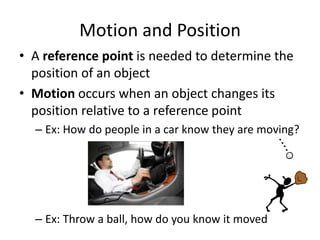
– Ex: How do people in a car know they are moving?

– Ex: Throw a ball, how do you know it moved
Distance vs Displacement
• Distance - how far an object has moved
– meter (m)
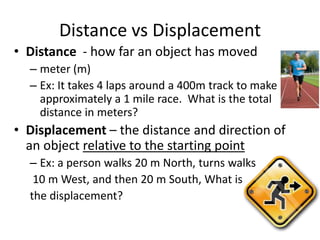
– Ex: It takes 4 laps around a 400m track to make
approximately a 1 mile race. What is the total
distance in meters?

• Displacement – the distance and direction of
an object relative to the starting point
– Ex: a person walks 20 m North, turns walks
10 m West, and then 20 m South, What is
the displacement?
Speed
•
•
•
•
•

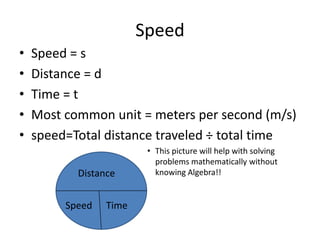
Speed = s
Distance = d
Time = t
Most common unit = meters per second (m/s)
speed=Total distance traveled ÷ total time
Distance
Speed

Time

• This picture will help with solving
problems mathematically without
knowing Algebra!!
Practice problems
1. A passenger elevator travels from the first
floor to the 60th floor, a distance of 210 m, in
35 sec. What is the elevator’s speed?
2. How far does a car travel in 0.75 hours if it is
moving at a constant speed of 88 km/hour?
3. A motorcycle is moving at a constant speed
of 40 km/h. How long does it take to travel
10 km?
Homework
Speed worksheet
Tomorrow – Motion detector lab
Monday 9/30/13
• Pick up – 9.30 Reinforcement section 1
Goals for the lesson
1. Define speed terms
2. Interpret a position time graph
3. Perform calculations to determine velocity
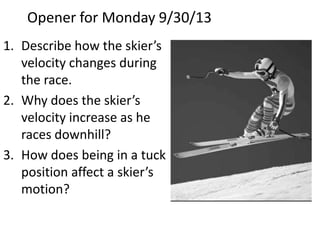
Opener for Monday 9/30/13
1. Describe how the skier’s
velocity changes during
the race.
2. Why does the skier’s
velocity increase as he
races downhill?
3. How does being in a tuck
position affect a skier’s
motion?
Speed Terms
• Constant speed – if you maintain the same
speed over a time interval
• Changing speed – speed up or slow down over
a time interval
• Average speed - describes the speed of
motion when speed is changing
• Instantaneous speed – the speed at a given
point in time
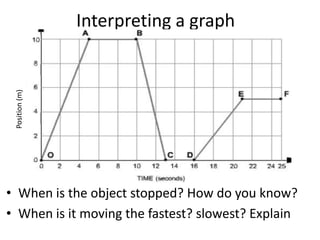
Graphing Motion
• Time is plotted on the x axis
• Distance traveled is plotted on the y axis
• Slope of a distance-time graph = velocity (speed)
– Steeper line = faster
– Horizontal line = not moving, no speed
• Connect the dots with a straight “best fit” line not
a dot-to-dot line
– Easier to extrapolate data in between points
Position (m)

Interpreting a graph

• When is the object stopped? How do you know?
• When is it moving the fastest? slowest? Explain
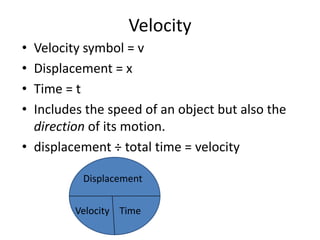
Velocity
•
•
•
•

Velocity symbol = v
Displacement = x
Time = t
Includes the speed of an object but also the
direction of its motion.
• displacement ÷ total time = velocity
Displacement
Velocity Time
Homework
• Reinforcement sec 1

• Quiz Wednesday
– speed and velocity calculations
– interpreting graphs
– describing motion

describing motion

  • 1.
    Describing Motion Chapter 2:section 1 Tuesday 9/26/13
  • 2.
    2 Goals forthis lesson 1. Describe motion 2. Perform calculations to determine speed
  • 3.
    Motion and Position •A reference point is needed to determine the position of an object • Motion occurs when an object changes its position relative to a reference point – Ex: How do people in a car know they are moving? – Ex: Throw a ball, how do you know it moved
  • 4.
    Distance vs Displacement •Distance - how far an object has moved – meter (m) – Ex: It takes 4 laps around a 400m track to make approximately a 1 mile race. What is the total distance in meters? • Displacement – the distance and direction of an object relative to the starting point – Ex: a person walks 20 m North, turns walks 10 m West, and then 20 m South, What is the displacement?
  • 5.
    Speed • • • • • Speed = s Distance= d Time = t Most common unit = meters per second (m/s) speed=Total distance traveled ÷ total time Distance Speed Time • This picture will help with solving problems mathematically without knowing Algebra!!
  • 6.
    Practice problems 1. Apassenger elevator travels from the first floor to the 60th floor, a distance of 210 m, in 35 sec. What is the elevator’s speed? 2. How far does a car travel in 0.75 hours if it is moving at a constant speed of 88 km/hour? 3. A motorcycle is moving at a constant speed of 40 km/h. How long does it take to travel 10 km?
  • 7.
  • 8.
    Monday 9/30/13 • Pickup – 9.30 Reinforcement section 1
  • 9.
    Goals for thelesson 1. Define speed terms 2. Interpret a position time graph 3. Perform calculations to determine velocity
  • 10.
    Opener for Monday9/30/13 1. Describe how the skier’s velocity changes during the race. 2. Why does the skier’s velocity increase as he races downhill? 3. How does being in a tuck position affect a skier’s motion?
  • 11.
    Speed Terms • Constantspeed – if you maintain the same speed over a time interval • Changing speed – speed up or slow down over a time interval • Average speed - describes the speed of motion when speed is changing • Instantaneous speed – the speed at a given point in time
  • 12.
    Graphing Motion • Timeis plotted on the x axis • Distance traveled is plotted on the y axis • Slope of a distance-time graph = velocity (speed) – Steeper line = faster – Horizontal line = not moving, no speed • Connect the dots with a straight “best fit” line not a dot-to-dot line – Easier to extrapolate data in between points
  • 13.
    Position (m) Interpreting agraph • When is the object stopped? How do you know? • When is it moving the fastest? slowest? Explain
  • 14.
    Velocity • • • • Velocity symbol =v Displacement = x Time = t Includes the speed of an object but also the direction of its motion. • displacement ÷ total time = velocity Displacement Velocity Time
  • 15.
    Homework • Reinforcement sec1 • Quiz Wednesday – speed and velocity calculations – interpreting graphs – describing motion