Basic Principles of Plant Pathology,
Entomology and Nematology
Dr. Nandadulal
Sannigrahi,
Associate Professor,
Department of Botany,
Nistarini college, Purulia
D.B. Road, Purulia,
INDIA (W.B)
PLANT PATHOLOGY- OVERVIEW
 Plants are essential for maintenance of life. Plants not only sustain the
man and animals, they are also the source of food for multitudes of
micro-organisms living in the ecosystem.
 Thus, while man has been able to subjugate plants and animals for his
own use, the competing micro-organisms still defy his efforts and
claim a major share of resources which man would like to use for
himself.
 It is in this context that the need for fighting the competing micro-
organisms and other agencies that lack loss of productivity has been
felt. The attack on plants by these micro-organisms changed the
appearance and productivity of the crop and this observed change was
called a disease. Plant diseases have been considered as stubborn
barriers to the rapid progress of food production.
 The branch of biology that deals with the two words “ pathos” i.e.
suffering and “logos” i.e. discourse or to speak about plants,
comprises both the art of treating the sick plant and understanding the
nature of sufferings of the diseased plants,
PLANT PATHOLOGY- OVERVIEW
 Normal cell division, differentiation and development.
 Uptake of water and nutrients from the soil.
 Synthesis of food from sunlight by photosynthesis.
 Translocation of water and food to the sites of necessity through xylem
and phloem.
 Metabolism of synthesized material
 Reproduction to give the birth of new offspring.
 A diseased plant fails to perform one or more of these functions. The
effect of a disease on functioning of an organ depends on which cells or
tissues were first attacked by the pathogen.
 For example, rotting of root tissues will affect the absorption of water
and minerals from soil and if vascular tissues have been affected, the
translocation of water and photosynthetates will be stopped or reduced.
 If leaf tissues are attacked by a pathogen, photosynthesis is affected and
plant suffers from deficiency of carbohydrates essential for supplying
energy for other activities.
PLANT PATHOLOGY- OVERVIEW
 However, J.C. Horsfall and A. Dimond (1959) have concluded that
“disease is a malfunctioning process that is caused by continuous
irritation . Of course, this process must result in some suffering . And
hence, disease is a pathological process”.
 In other words, disease is a complex phenomenon and is an
interaction among the host, the parasite and the environment. It can
also be defined as a disturbance in the rhythmical equilibrium of a
host in respect of structure or physiology or both and may lead to the
death of or the entire host or reduce the economic value of its
products.
 The disease may be classified according to symptoms like root rots,
powdery mildews etc,
 Classified to the parts of plants they affected like root diseases, stem
diseases,
 Parasitic or viral diseases may be endemic, epidemic or sporadic,
even endobiotic.
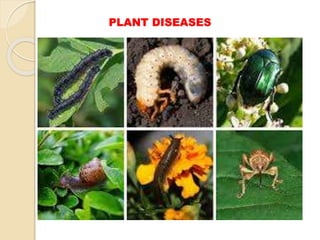
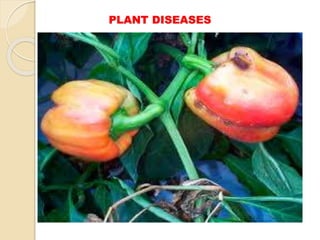
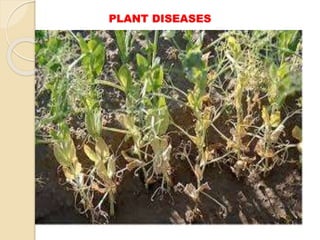
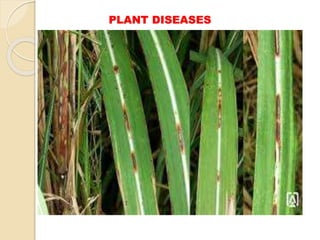
PLANT DISEASES
DISEASE DEFINITION
 Disease is a malfunctioning process that is caused by continuous irritation
which results in some suffering producing symptoms (American
Phytopathological society & British Mycological society).
 Disease is an alteration in one or more of the ordered sequential series of
physiological processes culminating in a loss of coordination of energy
utilization in a plant as a result of continuous irritation from the presence
or absence of some agent or factor.
 Disease: Any malfunctioning of host cells and tissues that result from
continuous irritation by a pathogenic agent or environmental factor and
leads to development of symptoms (G.N.Agrios, 1997).
 Pathogens bring about these irritating processes through different but
inter-related pathways
 by utilizing the host cell contents,
 by causing death of cells or by interfering with their metabolic activities
through their enzymes, toxins and growth regulators,
 by weakening of tissues due to continuous loss of nutrients, and
 by interfering with translocation of food, minerals and water.
COMMON TERMINOLOGIES IN PLANT PATHOLOGY
 Disease: Any malfunctioning of host cells and tissues that result from
continuous irritation by a pathogenic agent or environmental factor and
leads to development of symptoms (G.N.Agrios, 1997).
 Disorder: Non-infectious plant diseases due to abiotic causes such as
adverse soil and environmental conditions are termed disorders. The
common characteristic of non infectious diseases of plants is that they are
caused by the lack or excess of something (temperature, soil moisture,
soil nutrients, light, air and soil pollutants, air humidity, soil structure and
pH) that supports life. Non-infectious plant diseases occur in the absence
of pathogens, and cannot, therefore, be transmitted from diseased to
healthy plants.
 Disease development- implies the chain of events occur between time of
infection and symptoms expression of disease,
 Pathogen: An entity, usually a micro-organism that can incite disease. In
a literal sense a pathogen is any agent that causes pathos (ailment,
suffering) or damage. However, the term is generally used to denote
living organisms (Fungi, bacteria, MLO’s, nematodes etc.,) and viruses
but not nutritional deficiencies. Parasite: Organisms which derive the
materials they need for growth from living plants (host or suscept) are
called parasites.
 Pathogenecity is the ability of the pathogen to cause disease
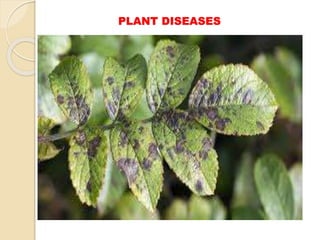
PLANT DISEASES
COMMON TERMINOLOGIES IN PLANT PATHOLOGY
 Pathogenesis is the chain of events that lead to development of disease in
the host (or) sequence of progress in disease development from the initial
contact between the pathogen and its host to the completion of the
syndrome
 Sign: The pathogen or its parts or products seen on a host plant.
Symptom: The external or internal reactions or alterations of a plant as a
result of a disease.
 Syndrome: The set of varying symptoms characterizing a disease are
collectively called a syndrome.
 Biotroph: An organism that can live and multiply only on another living
organism. They always obtain their food from living tissues on which
they complete their life cycle. Ex: Rust, smut and powdery mildew fungi.
Hemibiotroph (Facultative Saprophyte): The parasites which attack living
tissues in the same way as biotrophs but will continue to grow and
reproduce after the tissue is dead called as facultative saprophytes.
 Inoculums: It is the part of the pathogen which on contact with
susceptible host plant causes infection (or) the infective propagules which
on coming in contact with the host plant causes an infection are known as
inoculums.
PLANT DISEASES
COMMON TERMINOLOGIES IN PLANT
PATHOLOGY
 Inoculums potential: The energy of growth of a parasite available for
infection of a host at the surface of the host organ to be infected (or) The
resultant of the action of environment, the vigor of the pathogen to
establish an infection, the susceptibility of the host and the amount of
inoculums present
 Incubation period: The period of time (or time lapse) between
penetration of a host by a pathogen and the first appearance of symptoms
on the host. It varies with pathogens, hosts and environmental conditions.
 Predisposition: It is the action of set of environments, prior to
penetration and infection, which makes the plant vulnerable to attack by
the pathogen. It is related to the effect of environments on the host, not on
the pathogen, just before actual penetration occurs
 Hypersensitivity: Excessive sensitivity of plant tissues to certain
pathogens. Affected cells are killed quickly, blocking the advance of
obligate parasites. Infection is the establishment of parasitic relationship
between two organisms, following entry or penetration (or) the
establishment of a parasite within a host plant.
PLANT DISEASES
COMMON TERMINOLOGIES IN PLANT PATHOLOGY
 Epiphyte- Plant growing on other plant where no parasitic or symbiotic
relation involved,
 Endophytes - The organism contained entirely within the substrate plant,
 Exopathogen- Non-parasitic organism whose extracellular toxic metabolites
cause disease in plants,
 Differential host- A plant host that on the basis of disease symptoms serves to
distinguish between various strains or races of a given plant pathogen,
 Systemic infection: The growth of pathogen from the point of entry to varying
extents without showing adverse effect on tissues through which it passes.
 Epidemic or Epiphytotic disease: A disease usually occurs widely but
periodically in a destructive form is referred as epidemic or Epiphytotic
disease. Ex: Late blight of potato – Irish famine (1845)
 Endemic: Constantly present in a moderate to severe form and is confined to a
particular country or district. Ex: Club root of cabbage in Nilgiris Black wart of
potato – Synchytrium endobioticum Onion smut – Urocystis cepulae
 Sporadic disease: Occur at very irregular intervals and locations and in
relatively fewer instances. Ex: Udbatta disease of rice, Angular leaf spot of
cucumber – Pseudomonas lachrymans
PLANT DISEASES
BASIC PRINCIPLES OF PLANT PATHOLOGY
 Plant Pathology is the study of plant diseases including:1) causes, 2)
mechanisms by which diseases occur, 3) interactions between plants
and disease-causing agents, and 4) controlling diseases. There are a
large number of guiding principles in Plant Pathology, which are often
difficult to formulate because biology has so few absolutes.
 Here are 10 principles, which may aid in understanding, diagnosing
and controlling diseases of ornamental plants.
 Principle I - Disease is a malfunctioning of a plant, which results from
a continuous irritant by a pathogenic agent.
 Principle II - Disease results from an interaction of the virulence of the
pathogen, susceptibility of the host, and the conduciveness of the
environment
 Principle III - Conditions which favor plant growth and health
commonly favor disease.
BASIC PRINCIPLES OF PLANT PATHOLOGY
 Principle IV - Overwatering and under watering plants both
exacerbate disease.
 Principle V - The realistic way to manage plant disease is through an
integrated management strategy that includes: 1) cultural practices, 2)
epidemiology, 3) resistant varieties, 4) chemical pesticides, and 5)
biological control.
 Principle VI - A major approach to disease control is inoculums
reduction.
 Principle VII - Wood decay organisms result in wind damage and
breakage in trees.
 Principle VIII - Epidemics of introduced (invasive) species are more
severe than epidemics of endemic species.
 Principle IX - Quarantine is often the best method for combating
disease.
 Principle X - Do no harm.
NEMATODES AND PLANT DISEASE
 Study of free living and plant parasitic nematodes called Nematology
(Nema =threads, oides = like); H.C. Bastins regarded as father of
Nematology
 Nematodes belong to the kingdom Animalia. Nematodes are wormlike in
appearance but as unsegmented roundworms, they are quite distinct
taxonomically from the Annelids (true worms).
 Most of the several thousand species of nematodes live freely in fresh or
salt water or in the soil, and feed on microorganisms and microscopic
plants and animals. Numerous species of nematodes attack and parasitize
humans and animals, in which they cause various diseases.
 Several thousand species, however, are known to feed on living plants,
extracting nutrients from cells with a protrusible mouth spear or stylet and
causing a variety of plant diseases worldwide.
 The annual worldwide crop losses caused by nematodes amount to over
$157 billion annually, which includes all grains and legumes, banana,
cassava, coconut, potato, sugar beet, sugarcane, sweet potato, and yam at
about 11% losses; and most other economically important crops
(vegetables, fruits, and non-edible field crops) at about 14% losses.
NEMATODES AND PLANT DISEASE
 A number of genera and species of nematodes are highly damaging to a
great range of hosts, including foliage plants, agronomic and vegetable
crops, fruit and nut trees, turf grass, and forest trees.
 Some of the most damaging nematodes are: Root knot (Meloidogyne
spp.); Cyst (Heterodera and Globodera spp.); Root lesion (Pratylenchus
spp.); Spiral (Helicotylenchus spp.); Burrowing (Radopholus similis);
Bulb and stem (Ditylenchus dipsaci); Reniform (Rotylenchulus
reniformis); Dagger (Xiphinema spp.); Bud and leaf (Aphelenchoides
spp.); and Pine Wilt Disease (Bursaphelenchus xylophilus).
 They cause multiple symptoms- Root damage by Galls/knots or lesions,
excessive branching, stunted root systems and root rot; above- ground
symptoms by stunted growth, chlorosis, wilting, smaller leaves; stem
swellings, bud malformation, poor quality production etc.
 Crop rotation, sanitation, soil solarization, compost uses to improve soil
health, resistant varieties, chemical and biological control are some of the
effective measures to be addressed to counter nematodes in crop plants.
PLANT DISEASES AND INSECTS
 Entomology is the study of insects and their relationship to humans,
the environment, and other organisms. Entomologists make great
contributions to such diverse fields as agriculture, chemistry, biology,
human/animal health, molecular science, criminology, and forensics.
 The study of insects serves as the basis for developments in biological
and chemical pest control, food and fiber production and storage,
pharmaceuticals epidemiology, biological diversity, and a variety of
other fields of science.
 Entomology is an ancient science, dating back to the establishment of
biology as a formal field of study by Aristotle (384-322 BC). There are
even earlier references to the use of insects in daily life: such as the
growing of silkworms that began 4700 BC in China, which was an
important part of peasant life in China, as early as 4000 BC.
 More than a hundred years ago, entomologists formed a society, the
Entomological Society of America (ESA), to promote the science and
study of entomology in the United States.
PLANT DISEASES AND INSECTS
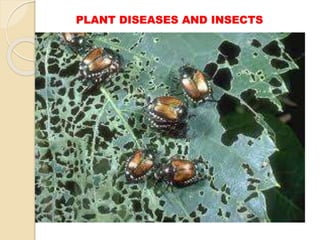
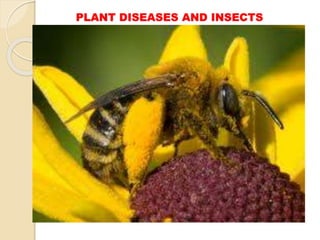
 Insects play a multiple roles in the plant diseases development,
transmission either acts as direct casual agent or to spread the diseases
by the following methods-
 Vector transmission- different types of insects like aphides,
leafhoppers, psyllids and beetles carry pathogens like virus bacteria,
fungi and infects the healthy plants along with their multiplication of
pathogens using insects as hosts,
 Direct introduction while feeding causing disease casing microbes
into plants,
 Indirect damage where the herbivore can weaken the plants, making
them more susceptible to diseases and many other processes to
expedite the infection to the different crop fields.
 The most common insect vectors belong to the order Homoptera,
which includes aphids and leaf hoppers.
 The other important vector are the white flies, the mealy bugs, the
scale insects and the tree hoppers, belong to the order, Homoptera,
 The insect vectors belong to other orders also.
PLANT DISEASES AND INSECTS
 The most important vectors such as aphids, leaf hoppers possess piercing
and sucking mouth parts,
 The other vectors have chewing mouth parts,
 All the insect vectors cannot transmit different vectors indiscriminately,
 The curly top virus of beet root is transmitted only by a leaf hopper
Eutettis tenelli and cannot be transmitted by other sucking insets found on
beetroot leaves,
 Mosaic virus of beet root is transmitted only by a “patch aphid”,
 Stunt virus of paddy is transmitted only by a leaf hopper, Nephotetix
apicalis,
 An insect which feeds on the pollens will not suck the sap and one which
feeds on the leaves will not feed on stems and other organs,
 Sometimes, the plant virus are found only in the cells of deep tissues and
can only be sucked by the insects having long proboscis,
 The transmission of virus taken as incubation period when they ware
being transferred by insects followed by certain changes,
 Certain virus multiply and grow while pass in through body of the vectors
and other pass out as such without undergoing changes.
PLANT DISEASES AND INSECTS
THANKS FOR YOUR VISIT
 ACKNOWLEDGEMENTS:
a. Google for images,
b. Different websites for enriching the course content,
c. Science Direct pages,
d. Plant Pathology- Dr. B. P. Pandey,
e. A textbook of Botany- Vol. I – Hait, Bhattacharya & Ghosh.
f. Plant diseases, insects and pests- NCBI-NH,
g. www.nature.com
h. www.spruce.com
i. www.aphis.usda.gov
j. Many more websites for references.
 This presentation has been designed to address the academic
fraternity without any financial interest. This is absolutely free to
use . The author does not claim any kind of financial benefits from
this content