EnzymesBy Prof. Liwayway Memije-Cruz
What are enzymes?
• Enzymes are
biological molecules
(typically proteins)
that significantly
speed up the rate of
virtually all of the
chemical reactions
that take place
within cells.
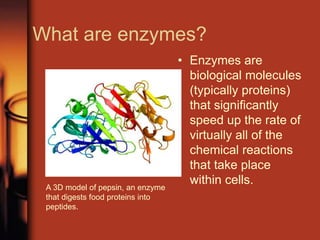
A 3D model of pepsin, an enzyme
that digests food proteins into
peptides.
Functions:
 The biological processes that occur within all living
organisms are chemical reactions, and most are regulated
by enzymes. Without enzymes, many of these reactions
would not take place at a perceptible rate.
 Enzymes catalyze all aspects of cell metabolism. This
includes the digestion of food, in which large nutrient
molecules (such as proteins, carbohydrates, and fats) are
broken down into smaller molecules; the conservation and
transformation of chemical energy; and the construction of
cellular macromolecules from smaller precursors. Many
inherited human diseases, such as albinism and
phenylketonuria, result from a deficiency of a particular
enzyme.
Enzymes play an increasingly important
role in medicine
• The enzyme thrombin is used to promote the
healing of wounds.
• Other enzymes are used to diagnose certain kinds
of disease, to cause the remission of some forms of
leukemia—a disease of the blood-forming organs—
and to counteract unfavourable reactions in people
who are allergic to penicillin.
• The enzyme lysozyme, which destroys cell walls, is
used to kill bacteria.
Enzymes and Medicine
• Enzymes have also been investigated
for their potential to prevent tooth
decay and to serve as anticoagulants
in the treatment of thrombosis, a
disease characterized by the formation
of a clot, or plug, in a blood vessel.
• Enzymes may eventually be used to
control enzyme deficiencies and
abnormalities resulting from diseases.
Enzymes are used in industrial
processes:
• preparation of certain chemical compounds and
the tanning of leather.
• analytical procedures involving the detection of
very small quantities of specific substances.
• necessary in various food-related industries,
including cheese making, the brewing of beer,
the aging of wine, and the baking of bread.
• used to clean clothes.
Classification and nomenclature
• The first enzyme name, proposed in 1833,
was diastase.
• Sixty-five years later, French microbiologist
and chemist Émile Duclaux suggested that all
enzymes be named by adding -ase to a root
indicative of the nature of the substrate of the
enzyme.
• Although enzymes are no longer named in
such a simple manner, with the exception of a
few—e.g., pepsin, trypsin, chymotrypsin,
papain—most enzyme names do end in -ase.
CLASSIFICATION OF ENZYMES
ACCORDING TO THEIR SUBSTRATES AND
THE NATURE OF THE REACTION THEY
CATALYZE.
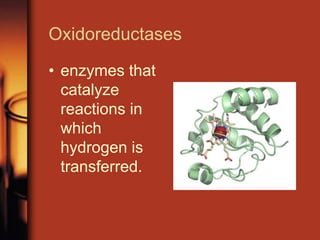
Oxidoreductases
• enzymes that
catalyze
reactions in
which
hydrogen is
transferred.
Hydrolases
• enzymes
those that
catalyze the
introduction of
the elements
of water at a
specific site in
a molecule
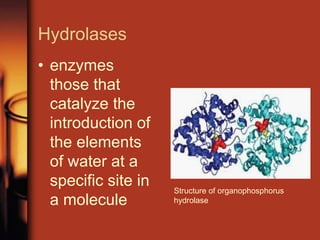
Structure of organophosphorus
hydrolase
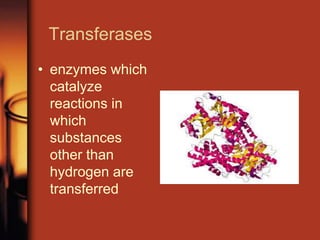
Transferases
• enzymes which
catalyze
reactions in
which
substances
other than
hydrogen are
transferred
Lyases
• enzyme that catalyzes
the breaking (an
"elimination" reaction)
of various chemical
bonds by means other
than hydrolysis (a
"substitution" reaction)
and oxidation, often
forming a new double
bond or a new ring
structure.
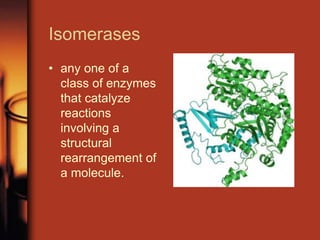
Isomerases
• any one of a
class of enzymes
that catalyze
reactions
involving a
structural
rearrangement of
a molecule.
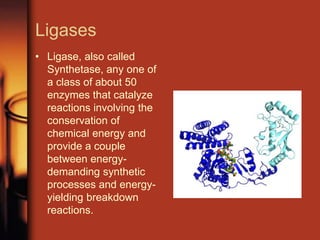
Ligases
• Ligase, also called
Synthetase, any one of
a class of about 50
enzymes that catalyze
reactions involving the
conservation of
chemical energy and
provide a couple
between energy-
demanding synthetic
processes and energy-
yielding breakdown
reactions.
Catalyst
• a substance that accelerates a chemical
reaction but is not consumed in the process.
• The amount of catalyst has no relationship to
the quantity of substance altered; very small
amounts of enzymes are very efficient
catalysts.
• Because the presence of an enzyme
accelerates the rate of conversion of a
compound to a product, it accelerates the
approach to equilibrium; it does not, however,
influence the equilibrium point attained.
What is enzyme regulation?
• process by which cells can turn off, turn on or
modulate the various activities of metabolic
pathways by regulating the activity of
enzymes.
• regulation of enzyme activity is important
to coordinate the different metabolic
processes.
• It is also important for homeostasis i.e. to
maintain the internal environment of the
• organism constant.
Regulation of enzyme activity can be
achieved by two general mechanisms:
1. Control of enzyme quantity
Enzyme quantity is affected by:
A. Altering the rate of enzyme synthesis and degradation,
B. Induction
C. Repression
2. Altering the catalytic efficiency of the enzyme by
Catalytic efficiency of enzymes is affected by:
A. Allosteric regulation
B. Feedback inhibition
C. Proenzyme (zymogen)
D. Covalent modification
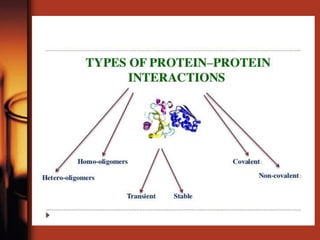
E. Protein – Protein interaction
CONTROL OF ENZYME
QUANTITY
Control of the rates of enzyme
synthesis and degradation.
• As enzymes are protein in nature, they
are synthesized from amino acids under
gene control and degraded again to
amino acids after doing its work.
• Enzyme quantity depends on the rate
of enzyme synthesis and the rate of its
• degradation.
1. Increased enzyme quantity may be due to
an increase in the rate of synthesis, a
decrease in the rate of degradation or
both.
2. Decreased enzyme quantity may be due to
a decrease in the rate of synthesis, an
increase in the rate of degradation or both.
For example, the quantity of liver arginase
enzyme increases after protein rich meal due
to an increase in the rateof its synthesis; also
it increases in starved animals due to a
decrease in the rate of its degradation.
Induction
 an increase in the rate of enzyme synthesis by
substances called inducers
 According to the response to inducers, enzymes are
classified into:
i. Constitutive enzymes, the concentration
of these enzymes does not depend on inducers.
ii. Inducible enzymes, the concentration of
these enzymes depends on the presence of inducers
For example, induction of lactase enzyme in
bacteria grown on glucose media.
Repression
• a decrease in the rate of enzyme synthesis by
substances called repressors.
• Repressors are low molecular weight substances that
decrease the rate of enzyme synthesis at the level of
gene expression.
• Repressors are usually end products of biosynthetic
reaction, so repression is sometimes called feedback
regulation.
For example, dietary cholesterol decreases the rate of
synthesis of HMG CoA reductase (β-hydroxy β -methyl
glutaryl CoA reductase), which is a key enzyme in
cholesterol biosynthesis.
CONTROL OF CATALYTIC
EFFICIENCY OF ENZYME
Allosteric Regulation
• Allosteric enzyme is formed of more than one
protein subunit. It has two sites; a catalytic
site for substrate binding and another site
(allosteric site), that is the regulatory site, to
which an effector binds.
• Allosteric means another site.
• If binding of the effector to the enzyme
increases it activity, it is called positive
effector or allosteric activator e.g. ADP is
allosteric activator for phosphofructokinase
enzyme.
Allosteric Regulation
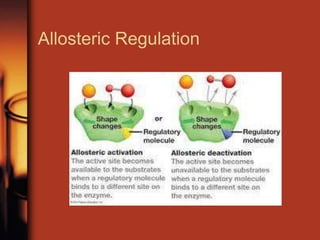
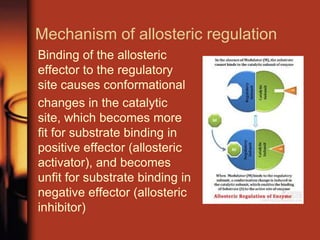
Mechanism of allosteric regulation
Binding of the allosteric
effector to the regulatory
site causes conformational
changes in the catalytic
site, which becomes more
fit for substrate binding in
positive effector (allosteric
activator), and becomes
unfit for substrate binding in
negative effector (allosteric
inhibitor)
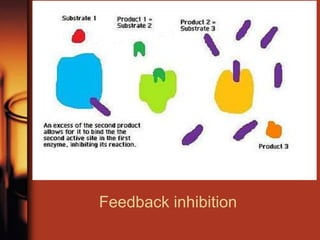
Feedback Inhibition
In biosynthetic pathways, an end
product may directly inhibit an enzyme
early in the pathway. Such enzyme
catalyzes the early functionally
irreversible step specific to a particular
biosynthetic pathway.
Feedback inhibition
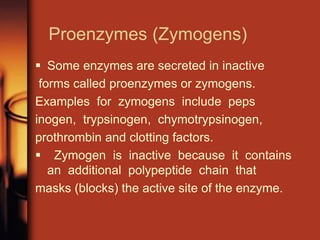
Proenzymes (Zymogens)
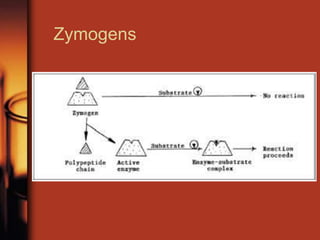
 Some enzymes are secreted in inactive
forms called proenzymes or zymogens.
Examples for zymogens include peps
inogen, trypsinogen, chymotrypsinogen,
prothrombin and clotting factors.
 Zymogen is inactive because it contains
an additional polypeptide chain that
masks (blocks) the active site of the enzyme.
Zymogens
Biological importance of zymogens
1.Some enzymes are secreted in
zymogen form to protect the tissues of
origin from auto digestion.
2. Another biological importance of
zymogens is to insure rapid mobilization
of enzyme activity at the
time of needs in response to
physiological demands.
Covalent modification
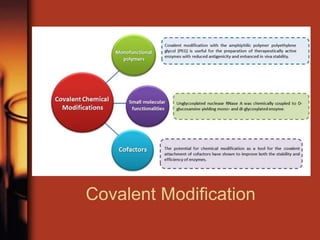
It means modification of enzyme activity of
many enzymes through formation of covalent
bonds e.g.
1. Methylation (addition of methyl
group).
2. Hydroxylation (addition of hydroxyl
group).
3. Adenylation (addition of adenylic
acid).
4. Phosphorylation (addition of
phosphate group)
Covalent Modification
Protein-protein interaction
 In enzymes that are formed from of many
protein subunits, the enzyme may be present
in an inactive form through interaction
between its protein subunits.
• The whole enzyme, formed of regulatory and
catalytic subunits, is inactive.
• Activation of the enzyme occurs by sepa
ration of the catalytic subunits from the
regulatory subunits
References:
• http://www.chem4kids.com/files/bio_enzymes.html
• http://www.rsc.org/Education/Teachers/Resources/cfb/enzymes.ht
ml
• https://www.livescience.com/45145-how-do-enzymes-work.html
• http://osp.mans.edu.eg/medbiochem_mi/cources/biochemistry/1st
_year_medicine/enzymes/files/Lecture_04.pdf
• https://www.creative-enzymes.com/service/enzyme-activity-
measurement-for-oxidoreductases-acting-on-choh-group-with-
cytochrome-as-acceptor_62.html

Enzymes

  • 1.
  • 2.
    What are enzymes? •Enzymes are biological molecules (typically proteins) that significantly speed up the rate of virtually all of the chemical reactions that take place within cells. A 3D model of pepsin, an enzyme that digests food proteins into peptides.
  • 3.
    Functions:  The biologicalprocesses that occur within all living organisms are chemical reactions, and most are regulated by enzymes. Without enzymes, many of these reactions would not take place at a perceptible rate.  Enzymes catalyze all aspects of cell metabolism. This includes the digestion of food, in which large nutrient molecules (such as proteins, carbohydrates, and fats) are broken down into smaller molecules; the conservation and transformation of chemical energy; and the construction of cellular macromolecules from smaller precursors. Many inherited human diseases, such as albinism and phenylketonuria, result from a deficiency of a particular enzyme.
  • 4.
    Enzymes play anincreasingly important role in medicine • The enzyme thrombin is used to promote the healing of wounds. • Other enzymes are used to diagnose certain kinds of disease, to cause the remission of some forms of leukemia—a disease of the blood-forming organs— and to counteract unfavourable reactions in people who are allergic to penicillin. • The enzyme lysozyme, which destroys cell walls, is used to kill bacteria.
  • 5.
    Enzymes and Medicine •Enzymes have also been investigated for their potential to prevent tooth decay and to serve as anticoagulants in the treatment of thrombosis, a disease characterized by the formation of a clot, or plug, in a blood vessel. • Enzymes may eventually be used to control enzyme deficiencies and abnormalities resulting from diseases.
  • 6.
    Enzymes are usedin industrial processes: • preparation of certain chemical compounds and the tanning of leather. • analytical procedures involving the detection of very small quantities of specific substances. • necessary in various food-related industries, including cheese making, the brewing of beer, the aging of wine, and the baking of bread. • used to clean clothes.
  • 7.
    Classification and nomenclature •The first enzyme name, proposed in 1833, was diastase. • Sixty-five years later, French microbiologist and chemist Émile Duclaux suggested that all enzymes be named by adding -ase to a root indicative of the nature of the substrate of the enzyme. • Although enzymes are no longer named in such a simple manner, with the exception of a few—e.g., pepsin, trypsin, chymotrypsin, papain—most enzyme names do end in -ase.
  • 8.
    CLASSIFICATION OF ENZYMES ACCORDINGTO THEIR SUBSTRATES AND THE NATURE OF THE REACTION THEY CATALYZE.
  • 9.
    Oxidoreductases • enzymes that catalyze reactionsin which hydrogen is transferred.
  • 10.
    Hydrolases • enzymes those that catalyzethe introduction of the elements of water at a specific site in a molecule Structure of organophosphorus hydrolase
  • 11.
    Transferases • enzymes which catalyze reactionsin which substances other than hydrogen are transferred
  • 12.
    Lyases • enzyme thatcatalyzes the breaking (an "elimination" reaction) of various chemical bonds by means other than hydrolysis (a "substitution" reaction) and oxidation, often forming a new double bond or a new ring structure.
  • 13.
    Isomerases • any oneof a class of enzymes that catalyze reactions involving a structural rearrangement of a molecule.
  • 14.
    Ligases • Ligase, alsocalled Synthetase, any one of a class of about 50 enzymes that catalyze reactions involving the conservation of chemical energy and provide a couple between energy- demanding synthetic processes and energy- yielding breakdown reactions.
  • 15.
    Catalyst • a substancethat accelerates a chemical reaction but is not consumed in the process. • The amount of catalyst has no relationship to the quantity of substance altered; very small amounts of enzymes are very efficient catalysts. • Because the presence of an enzyme accelerates the rate of conversion of a compound to a product, it accelerates the approach to equilibrium; it does not, however, influence the equilibrium point attained.
  • 16.
    What is enzymeregulation? • process by which cells can turn off, turn on or modulate the various activities of metabolic pathways by regulating the activity of enzymes. • regulation of enzyme activity is important to coordinate the different metabolic processes. • It is also important for homeostasis i.e. to maintain the internal environment of the • organism constant.
  • 17.
    Regulation of enzymeactivity can be achieved by two general mechanisms: 1. Control of enzyme quantity Enzyme quantity is affected by: A. Altering the rate of enzyme synthesis and degradation, B. Induction C. Repression 2. Altering the catalytic efficiency of the enzyme by Catalytic efficiency of enzymes is affected by: A. Allosteric regulation B. Feedback inhibition C. Proenzyme (zymogen) D. Covalent modification E. Protein – Protein interaction
  • 18.
  • 19.
    Control of therates of enzyme synthesis and degradation. • As enzymes are protein in nature, they are synthesized from amino acids under gene control and degraded again to amino acids after doing its work. • Enzyme quantity depends on the rate of enzyme synthesis and the rate of its • degradation.
  • 20.
    1. Increased enzymequantity may be due to an increase in the rate of synthesis, a decrease in the rate of degradation or both. 2. Decreased enzyme quantity may be due to a decrease in the rate of synthesis, an increase in the rate of degradation or both. For example, the quantity of liver arginase enzyme increases after protein rich meal due to an increase in the rateof its synthesis; also it increases in starved animals due to a decrease in the rate of its degradation.
  • 21.
    Induction  an increasein the rate of enzyme synthesis by substances called inducers  According to the response to inducers, enzymes are classified into: i. Constitutive enzymes, the concentration of these enzymes does not depend on inducers. ii. Inducible enzymes, the concentration of these enzymes depends on the presence of inducers For example, induction of lactase enzyme in bacteria grown on glucose media.
  • 22.
    Repression • a decreasein the rate of enzyme synthesis by substances called repressors. • Repressors are low molecular weight substances that decrease the rate of enzyme synthesis at the level of gene expression. • Repressors are usually end products of biosynthetic reaction, so repression is sometimes called feedback regulation. For example, dietary cholesterol decreases the rate of synthesis of HMG CoA reductase (β-hydroxy β -methyl glutaryl CoA reductase), which is a key enzyme in cholesterol biosynthesis.
  • 23.
  • 24.
    Allosteric Regulation • Allostericenzyme is formed of more than one protein subunit. It has two sites; a catalytic site for substrate binding and another site (allosteric site), that is the regulatory site, to which an effector binds. • Allosteric means another site. • If binding of the effector to the enzyme increases it activity, it is called positive effector or allosteric activator e.g. ADP is allosteric activator for phosphofructokinase enzyme.
  • 25.
  • 26.
    Mechanism of allostericregulation Binding of the allosteric effector to the regulatory site causes conformational changes in the catalytic site, which becomes more fit for substrate binding in positive effector (allosteric activator), and becomes unfit for substrate binding in negative effector (allosteric inhibitor)
  • 27.
    Feedback Inhibition In biosyntheticpathways, an end product may directly inhibit an enzyme early in the pathway. Such enzyme catalyzes the early functionally irreversible step specific to a particular biosynthetic pathway.
  • 28.
  • 29.
    Proenzymes (Zymogens)  Someenzymes are secreted in inactive forms called proenzymes or zymogens. Examples for zymogens include peps inogen, trypsinogen, chymotrypsinogen, prothrombin and clotting factors.  Zymogen is inactive because it contains an additional polypeptide chain that masks (blocks) the active site of the enzyme.
  • 30.
  • 31.
    Biological importance ofzymogens 1.Some enzymes are secreted in zymogen form to protect the tissues of origin from auto digestion. 2. Another biological importance of zymogens is to insure rapid mobilization of enzyme activity at the time of needs in response to physiological demands.
  • 32.
    Covalent modification It meansmodification of enzyme activity of many enzymes through formation of covalent bonds e.g. 1. Methylation (addition of methyl group). 2. Hydroxylation (addition of hydroxyl group). 3. Adenylation (addition of adenylic acid). 4. Phosphorylation (addition of phosphate group)
  • 33.
  • 34.
    Protein-protein interaction  Inenzymes that are formed from of many protein subunits, the enzyme may be present in an inactive form through interaction between its protein subunits. • The whole enzyme, formed of regulatory and catalytic subunits, is inactive. • Activation of the enzyme occurs by sepa ration of the catalytic subunits from the regulatory subunits
  • 36.
    References: • http://www.chem4kids.com/files/bio_enzymes.html • http://www.rsc.org/Education/Teachers/Resources/cfb/enzymes.ht ml •https://www.livescience.com/45145-how-do-enzymes-work.html • http://osp.mans.edu.eg/medbiochem_mi/cources/biochemistry/1st _year_medicine/enzymes/files/Lecture_04.pdf • https://www.creative-enzymes.com/service/enzyme-activity- measurement-for-oxidoreductases-acting-on-choh-group-with- cytochrome-as-acceptor_62.html