UNIFORMLY
ACCELERATED MOTION
(UAM)
QUARTER 4
MODULE 1
Most Essential Learning Competency
➢ Describe the horizontal and vertical motions of a projectile. (S9FE-lVa-34)
EXPECTATION
1. define uniformly accelerated motion operationally.
2. describe uniformly accelerated motion (horizontal and vertical)
qualitatively and quantitatively.
3. describe the horizontal and vertical motions of a projectile.
4. label a diagram illustrating projectile motion by indicating the range,
height, trajectory, initial horizontal velocity, and initial vertical velocity.
5. cite applications of projectile in everyday living.
1. Which of the following quantities changes at a constant rate in a body in
uniformly accelerated motion?
A. Time B. Speed C. Velocity D. Acceleration
2. What will happen to an object as it falls when it undergoes free fall
motion?
A. It’s speed increases
B. It’s velocity increases
C. Its acceleration remains the same
D. all of these
PRE-TEST
3. At what point in its path is the horizontal component of the velocity (vx) of
a projectile the smallest?
A. At the top
B. Halfway to the top
C. The instant it is thrown
D. It is the same throughout the path
4. A basketball is shot into the ring at an angle with the horizontal. What
can you say of the ball’s velocity at the very top of its path? At the very
top of the ball's path, its velocity is _______.
A. entirely vertical
B. entirely horizontal
C. both vertical and horizontal
D. not enough information given to know
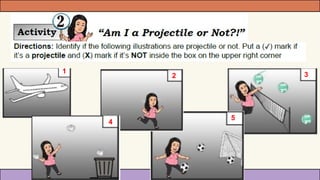
5. Which of the following does NOT exhibit a projectile motion?
A. A golf ball in flight.
B. A baseball hit by a bat.
C. A volleyball served over a net.
D. A hot air balloon floating in the sky.
GRADE 7-8 LESSON
LOOKING BACK
0
1
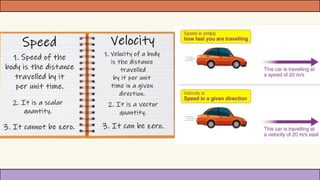
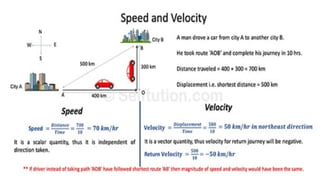
SPEED
or
VELOCITY?
VELOCITY
SPEED
VELOCITY
SPEED
SPEED
VELOCITY
SPEED
VELOCITY
SPEED
VELOCITY
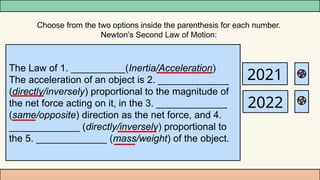
The Law of 1. __________(Inertia/Acceleration)
The acceleration of an object is 2. _____________
(directly/inversely) proportional to the magnitude of
the net force acting on it, in the 3. _____________
(same/opposite) direction as the net force, and 4.
_____________ (directly/inversely) proportional to
the 5. _____________ (mass/weight) of the object.
Choose from the two options inside the parenthesis for each number.
Newton’s Second Law of Motion:
2021
2022
Seatwork #1: Choose the letter of the correct answer.
1. What do you call the distance covered over a period of time.
a. speed b. velocity c. acceleration d. displacement
2. What is the formula in calculating speed?
a. time ÷ distance b. distance ÷ time c. time x distance d.
distance x time
3. What branch of Physics deals with sound?
a. mechanics b. thermodynamics c. acoustics d. optics
4. Which of the following is a scalar quantity?
a. distance b. displacement c. Velocity d. Acceleration
5. Which is the correct unit for acceleration?
a. m/s b. m/s2
c. m/s3
d. s/m2
INTRODUCTION
0
1
UAM
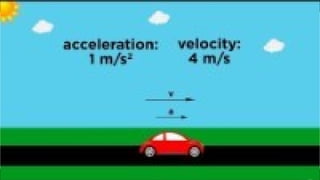
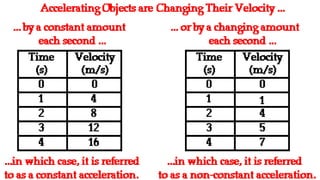
Uniformly Accelerated Motion (UAM), the
acceleration of a body is constant or does not
change. It is the velocity which changes but
the change is at a constant rate meaning the
same change in velocity at equal interval of
time. For example: A constant acceleration of
1 m/s2
means that velocity changes by 1 m/s each
second.
UAM
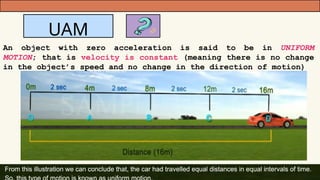
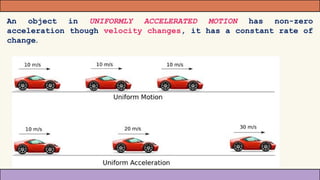
An object with zero acceleration is said to be in UNIFORM
MOTION; that is velocity is constant (meaning there is no change
in the object’s speed and no change in the direction of motion)
An object in UNIFORMLY ACCELERATED MOTION has non-zero
acceleration though velocity changes, it has a constant rate of
change.
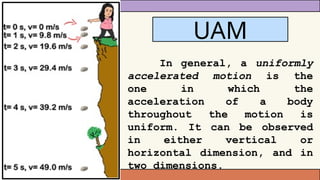
UAM
In general, a uniformly
accelerated motion is the
one in which the
acceleration of a body
throughout the motion is
uniform. It can be observed
in either vertical or
horizontal dimension, and in
two dimensions.
Free-fall
The acceleration due
to gravity neglecting
air resistance, is a
constant acceleration
for all falling bodies,
regardless of their
masses.
9.8m/s2
All objects on the earth’s
surface are being
accelerated toward the
center of the earth at a
rate of 9.8 m/s2
(can use a
negative sign to indicate
that gravity is pulling an
object downward).
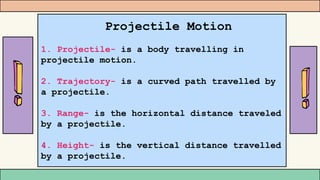
Projectile Motion
1. Projectile- is a body travelling in
projectile motion.
2. Trajectory- is a curved path travelled by
a projectile.
3. Range- is the horizontal distance traveled
by a projectile.
4. Height- is the vertical distance travelled
by a projectile.
height
range
projectile trajectory
PROJECTILE MOTION
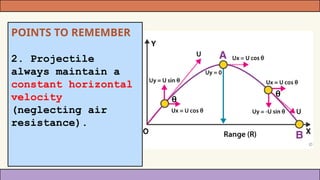
POINTS TO REMEMBER
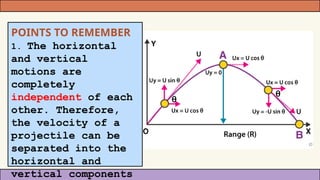
1. The horizontal
and vertical
motions are
completely
independent of each
other. Therefore,
the velocity of a
projectile can be
separated into the
horizontal and
vertical components
POINTS TO REMEMBER
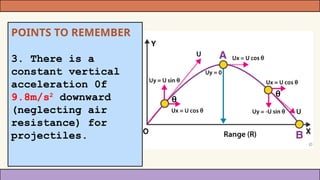
2. Projectile
always maintain a
constant horizontal
velocity
(neglecting air
resistance).
POINTS TO REMEMBER
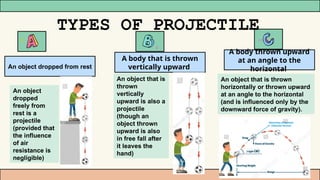
3. There is a
constant vertical
acceleration 0f
9.8m/s2
downward
(neglecting air
resistance) for
projectiles.
An object dropped from rest
A body thrown upward
at an angle to the
horizontal
A body that is thrown
vertically upward
TYPES OF PROJECTILE
An object
dropped
freely from
rest is a
projectile
(provided that
the influence
of air
resistance is
negligible)
An object that is
thrown
vertically
upward is also a
projectile
(though an
object thrown
upward is also
in free fall after
it leaves the
hand)
An object that is thrown
horizontally or thrown upward
at an angle to the horizontal
(and is influenced only by the
downward force of gravity).
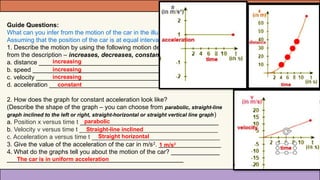
Distance - Time Velocity - Time Acceleration - Time
Guide Questions:
What can you infer from the motion of the car in the illustration above?
Assuming that the position of the car is at equal interval of time.
1. Describe the motion by using the following motion descriptors and choosing
from the description – increases, decreases, constant, uniform)
a. distance ___________________________________________________
b. speed _____________________________________________________
c. velocity ____________________________________________________
d. acceleration ________________________________________________
2. How does the graph for constant acceleration look like?
(Describe the shape of the graph – you can choose from parabolic, straight-line
graph inclined to the left or right, straight-horizontal or straight vertical line graph)
a. Position x versus time t ________________________________________
b. Velocity v versus time t ________________________________________
c. Acceleration a versus time t _____________________________________
3. Give the value of the acceleration of the car in m/s2
. __________________
4. What do the graphs tell you about the motion of the car? ______________
___________________________________________________
increasing
increasing
increasing
constant
parabolic
Straight-line inclined
Straight horizontal
1 m/s2
The car is in uniform acceleration
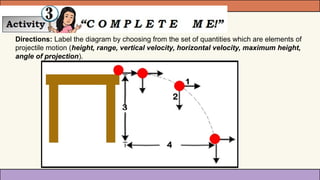
2
1 3
4
5
Directions: Label the diagram by choosing from the set of quantities which are elements of
projectile motion (height, range, vertical velocity, horizontal velocity, maximum height,
angle of projection).
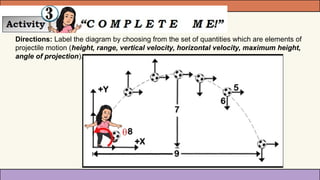
Directions: Label the diagram by choosing from the set of quantities which are elements of
projectile motion (height, range, vertical velocity, horizontal velocity, maximum height,
angle of projection).
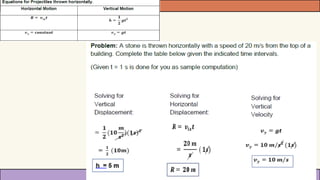
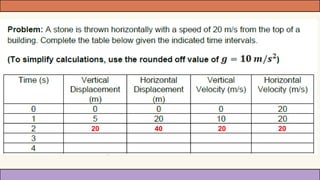
Let’s assume
that:
g= 10 m/s
20 40 20 20
CHECK-YOUR
UNDERSTANDING
0
2
TRUE
Acceleration
Constant
TRUE
9.8 m/s2
TRUE
Trajectory
TRUE
TRUE
TRUE
POST-TEST
0
2
1. The motion of an object with constant
acceleration is also known as_________________.
A. uniform motion
B. constant velocity
C. constant motion
D. uniformly accelerated motion
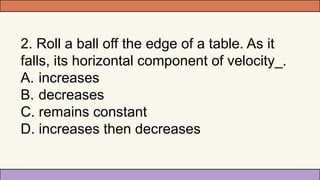
2. Roll a ball off the edge of a table. As it
falls, its horizontal component of velocity_.
A. increases
B. decreases
C. remains constant
D. increases then decreases
3. At what point in its path is the vertical
component of the velocity (vy) of a projectile
the smallest?
A. At the top
B. As it nears the top
C. Halfway to the top
D. It is the same throughout the path
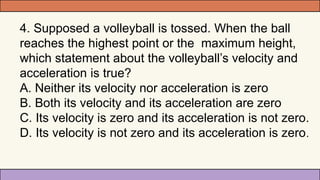
4. Supposed a volleyball is tossed. When the ball
reaches the highest point or the maximum height,
which statement about the volleyball’s velocity and
acceleration is true?
A. Neither its velocity nor acceleration is zero
B. Both its velocity and its acceleration are zero
C. Its velocity is zero and its acceleration is not zero.
D. Its velocity is not zero and its acceleration is zero.
5. Which of the following descriptions of moving
objects does NOT accurately portray a
projectile?
A. A free-falling object
B. A falling feather in a vacuum chamber
C. A falling skydiver with an open parachute
D. A falling feather in a falling vacuum chamber
— Albert
Einstein
"There is a motive force more
powerful than steam,
electricity and atomic energy:
the will."
0
4

UNIFORMLY ACCELERATED MOTION (UAM) .pptx

  • 1.
  • 2.
    Most Essential LearningCompetency ➢ Describe the horizontal and vertical motions of a projectile. (S9FE-lVa-34) EXPECTATION 1. define uniformly accelerated motion operationally. 2. describe uniformly accelerated motion (horizontal and vertical) qualitatively and quantitatively. 3. describe the horizontal and vertical motions of a projectile. 4. label a diagram illustrating projectile motion by indicating the range, height, trajectory, initial horizontal velocity, and initial vertical velocity. 5. cite applications of projectile in everyday living.
  • 3.
    1. Which ofthe following quantities changes at a constant rate in a body in uniformly accelerated motion? A. Time B. Speed C. Velocity D. Acceleration 2. What will happen to an object as it falls when it undergoes free fall motion? A. It’s speed increases B. It’s velocity increases C. Its acceleration remains the same D. all of these PRE-TEST
  • 4.
    3. At whatpoint in its path is the horizontal component of the velocity (vx) of a projectile the smallest? A. At the top B. Halfway to the top C. The instant it is thrown D. It is the same throughout the path 4. A basketball is shot into the ring at an angle with the horizontal. What can you say of the ball’s velocity at the very top of its path? At the very top of the ball's path, its velocity is _______. A. entirely vertical B. entirely horizontal C. both vertical and horizontal D. not enough information given to know
  • 5.
    5. Which ofthe following does NOT exhibit a projectile motion? A. A golf ball in flight. B. A baseball hit by a bat. C. A volleyball served over a net. D. A hot air balloon floating in the sky.
  • 6.
  • 13.
  • 17.
    The Law of1. __________(Inertia/Acceleration) The acceleration of an object is 2. _____________ (directly/inversely) proportional to the magnitude of the net force acting on it, in the 3. _____________ (same/opposite) direction as the net force, and 4. _____________ (directly/inversely) proportional to the 5. _____________ (mass/weight) of the object. Choose from the two options inside the parenthesis for each number. Newton’s Second Law of Motion: 2021 2022
  • 18.
    Seatwork #1: Choosethe letter of the correct answer. 1. What do you call the distance covered over a period of time. a. speed b. velocity c. acceleration d. displacement 2. What is the formula in calculating speed? a. time ÷ distance b. distance ÷ time c. time x distance d. distance x time 3. What branch of Physics deals with sound? a. mechanics b. thermodynamics c. acoustics d. optics 4. Which of the following is a scalar quantity? a. distance b. displacement c. Velocity d. Acceleration 5. Which is the correct unit for acceleration? a. m/s b. m/s2 c. m/s3 d. s/m2
  • 19.
  • 20.
    UAM Uniformly Accelerated Motion(UAM), the acceleration of a body is constant or does not change. It is the velocity which changes but the change is at a constant rate meaning the same change in velocity at equal interval of time. For example: A constant acceleration of 1 m/s2 means that velocity changes by 1 m/s each second.
  • 21.
    UAM An object withzero acceleration is said to be in UNIFORM MOTION; that is velocity is constant (meaning there is no change in the object’s speed and no change in the direction of motion)
  • 22.
    An object inUNIFORMLY ACCELERATED MOTION has non-zero acceleration though velocity changes, it has a constant rate of change.
  • 23.
    UAM In general, auniformly accelerated motion is the one in which the acceleration of a body throughout the motion is uniform. It can be observed in either vertical or horizontal dimension, and in two dimensions.
  • 24.
    Free-fall The acceleration due togravity neglecting air resistance, is a constant acceleration for all falling bodies, regardless of their masses. 9.8m/s2 All objects on the earth’s surface are being accelerated toward the center of the earth at a rate of 9.8 m/s2 (can use a negative sign to indicate that gravity is pulling an object downward).
  • 25.
    Projectile Motion 1. Projectile-is a body travelling in projectile motion. 2. Trajectory- is a curved path travelled by a projectile. 3. Range- is the horizontal distance traveled by a projectile. 4. Height- is the vertical distance travelled by a projectile.
  • 26.
  • 27.
    POINTS TO REMEMBER 1.The horizontal and vertical motions are completely independent of each other. Therefore, the velocity of a projectile can be separated into the horizontal and vertical components
  • 28.
    POINTS TO REMEMBER 2.Projectile always maintain a constant horizontal velocity (neglecting air resistance).
  • 29.
    POINTS TO REMEMBER 3.There is a constant vertical acceleration 0f 9.8m/s2 downward (neglecting air resistance) for projectiles.
  • 30.
    An object droppedfrom rest A body thrown upward at an angle to the horizontal A body that is thrown vertically upward TYPES OF PROJECTILE An object dropped freely from rest is a projectile (provided that the influence of air resistance is negligible) An object that is thrown vertically upward is also a projectile (though an object thrown upward is also in free fall after it leaves the hand) An object that is thrown horizontally or thrown upward at an angle to the horizontal (and is influenced only by the downward force of gravity).
  • 31.
    Distance - TimeVelocity - Time Acceleration - Time
  • 32.
    Guide Questions: What canyou infer from the motion of the car in the illustration above? Assuming that the position of the car is at equal interval of time. 1. Describe the motion by using the following motion descriptors and choosing from the description – increases, decreases, constant, uniform) a. distance ___________________________________________________ b. speed _____________________________________________________ c. velocity ____________________________________________________ d. acceleration ________________________________________________ 2. How does the graph for constant acceleration look like? (Describe the shape of the graph – you can choose from parabolic, straight-line graph inclined to the left or right, straight-horizontal or straight vertical line graph) a. Position x versus time t ________________________________________ b. Velocity v versus time t ________________________________________ c. Acceleration a versus time t _____________________________________ 3. Give the value of the acceleration of the car in m/s2 . __________________ 4. What do the graphs tell you about the motion of the car? ______________ ___________________________________________________ increasing increasing increasing constant parabolic Straight-line inclined Straight horizontal 1 m/s2 The car is in uniform acceleration
  • 33.
  • 34.
    Directions: Label thediagram by choosing from the set of quantities which are elements of projectile motion (height, range, vertical velocity, horizontal velocity, maximum height, angle of projection).
  • 35.
    Directions: Label thediagram by choosing from the set of quantities which are elements of projectile motion (height, range, vertical velocity, horizontal velocity, maximum height, angle of projection).
  • 36.
  • 38.
  • 39.
  • 40.
  • 41.
  • 42.
    1. The motionof an object with constant acceleration is also known as_________________. A. uniform motion B. constant velocity C. constant motion D. uniformly accelerated motion
  • 43.
    2. Roll aball off the edge of a table. As it falls, its horizontal component of velocity_. A. increases B. decreases C. remains constant D. increases then decreases
  • 44.
    3. At whatpoint in its path is the vertical component of the velocity (vy) of a projectile the smallest? A. At the top B. As it nears the top C. Halfway to the top D. It is the same throughout the path
  • 45.
    4. Supposed avolleyball is tossed. When the ball reaches the highest point or the maximum height, which statement about the volleyball’s velocity and acceleration is true? A. Neither its velocity nor acceleration is zero B. Both its velocity and its acceleration are zero C. Its velocity is zero and its acceleration is not zero. D. Its velocity is not zero and its acceleration is zero.
  • 46.
    5. Which ofthe following descriptions of moving objects does NOT accurately portray a projectile? A. A free-falling object B. A falling feather in a vacuum chamber C. A falling skydiver with an open parachute D. A falling feather in a falling vacuum chamber
  • 47.
    — Albert Einstein "There isa motive force more powerful than steam, electricity and atomic energy: the will."
  • 48.