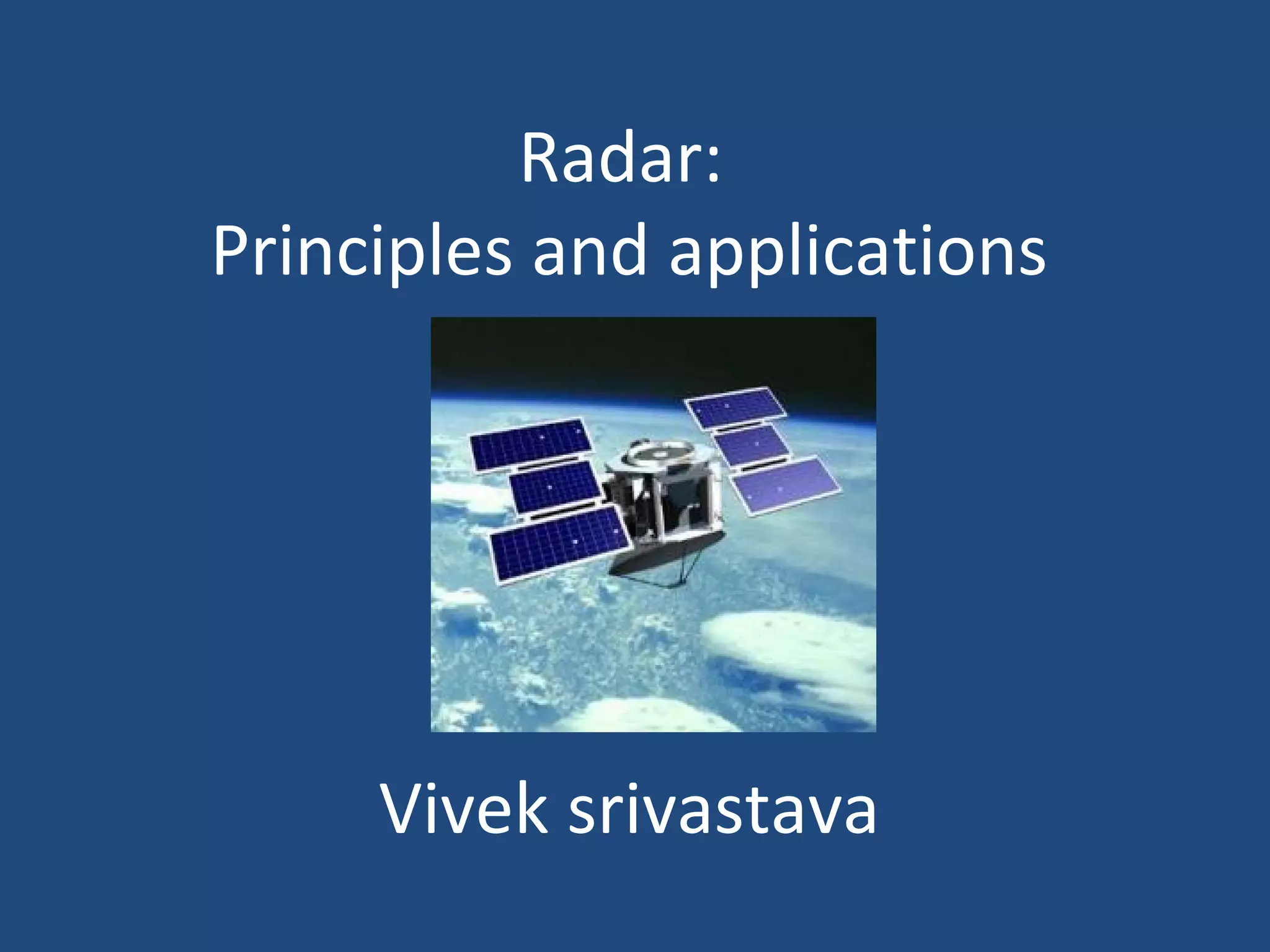
Radar:
Principles and applications
Vivek srivastava
• Radar: Radio detection and ranging
• Radio stands for microwaves and range means
distance
• Radar sensors were originally developed and
used by millitary but now they are used in civil
applications widely such as environmental
monitoring
What is Radar?
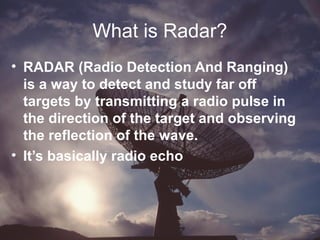
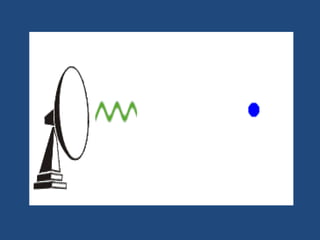
• RADAR (Radio Detection And Ranging)
is a way to detect and study far off
targets by transmitting a radio pulse in
the direction of the target and observing
the reflection of the wave.
• It’s basically radio echo
4
What is RADAR?
• A Radar system has three primary functions:
- It transmits microwave (radio) signals towards a
scene
- It receives the portion of the transmitted energy
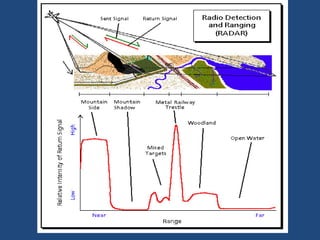
backscattered from the scene
- It observes the strength (detection) and the time
delay (ranging) of the return signals.
• Radar is an active remote sensing system & can
operate day/night
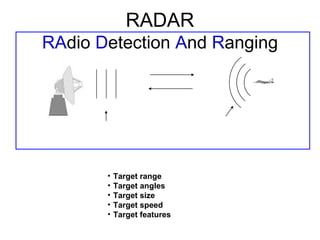
RADAR
RAdio Detection And Ranging
Radar observables:
• Target range
• Target angles
• Target size
• Target speed
• Target features
Antenna
Transmitted
Pulse
Target
Cross
Section
Propagation
Reflected
Pulse
(“echo”)
The Range
• Distance from the
radar
• Measured from time
delay between
transmitted pulse and
returned signal
received
The Range
• Remember, in general v=d/t and d=vt
• The range is just a distance
• Since radio waves travel at the speed of
light (v = c = 300,000 km/sec )
range = c•time/2
• Why divided by 2?
The Range
• The “2” is because the measured time is
for a round trip to and from the target. To
determine the range, you only want the
time to the object, so you take half!
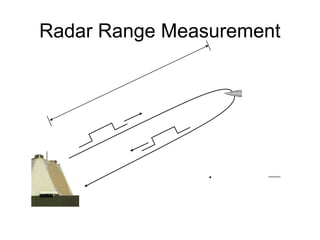
Radar Range Measurement
Transmitted
Pulse
Reflected
Pulse
Range
Target
• Target range =
cτ
2
where c = speed of light
τ = round trip time
Why microwaves
• Microwaves are electromagnetic waves with
wavelength between 1 cm to 1 m
• Used by radars because can penetrate clouds and
haze or fog
• Microwave remote sensing is considered as an
active remote sensing but passive sensors are
also used which detect naturally emitted
microwave energy
• Mainly used in meteorology, hydrology and
oceanography
• In radar, antenna transmits microwave signals
to the earth’s surface and they are
backscattered
• The part of the electromagnetic energy which
is scattered into the direction of the antenna
is detected by the sensor
• Active sensors are divided into two groups:
imaging and non imaging
• Radar is an imaging microwave sensor
• The non-imaging microwave
instruments include altimeters which
collect distance information such as
sea surface height and
scatterometers which acquire
information about object properties
such as wind speed
• Radar is an active sensor means it is having its
own energy source
• Since radar is an active sensor so data can be
acquired any time
• Another advantage of radar is that signal
characteristics (wavelength, polarization,
incidence angle etc.) can be easily controlled
Principles of imaging radar
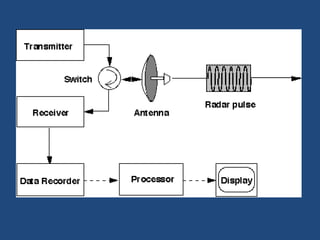
• The main systems of an imaging radar includes:
transmitter, receiver, an antenna and a recorder
• Transmitter is used to generate microwave
signals and transmit the energy to the antenna
from where it is emitted towards the earth
surface
• Antenna accepts the backscattered signals and
transfer it to the receiver which amplifies the
signals for recording purpose
• Recorder then stores the received signals
• Bistatic radar and monostatic radar
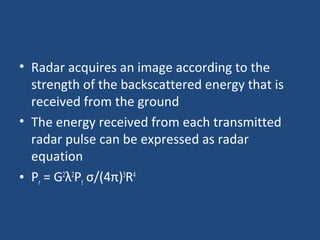
• Radar acquires an image according to the
strength of the backscattered energy that is
received from the ground
• The energy received from each transmitted
radar pulse can be expressed as radar
equation
• Pr = G2
λ2
Pt σ/(4π)3
R4
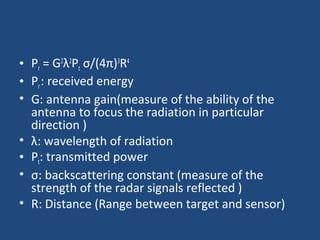
• Pr = G2
λ2
Pt σ/(4π)3
R4
• Pr: received energy
• G: antenna gain(measure of the ability of the
antenna to focus the radiation in particular
direction )
• λ: wavelength of radiation
• Pt: transmitted power
• σ: backscattering constant (measure of the
strength of the radar signals reflected )
• R: Distance (Range between target and sensor)
• Transmitting antenna: How well the antenna
converts input power into radio waves headed
in a specified direction
• Receiving antenna: How well the antenna
converts radio waves arriving from a specified
direction into electrical power
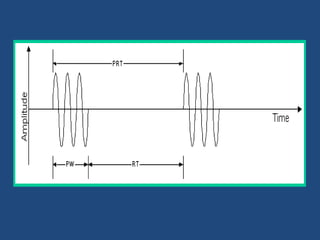
• Some radar transmitters do not transmit constant,
uninterrupted electromagnetic waves. Instead, they transmit
rhythmic pulses of EM waves with a set amount of time in
between each pulse. The pulse itself would consist of an EM
wave of several wavelengths with some dead time after it in
which there are no transmissions. The time between each
pulse is called the pulse repetition time (PRT) and the number
of pulses transmitted in one second is called the pulse
repetition frequency (PRF)
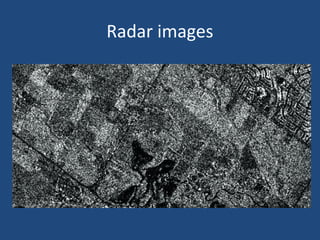
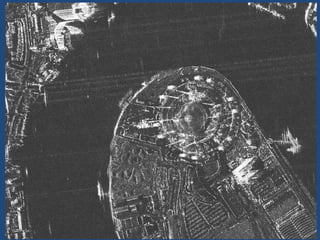
• Once the radar receives the returned signal, it
calculates useful information from it such as
the time taken for it to be received, the
strength of the returned signal, or the change
in frequency of the signal. This information is
then translated to reveal useful data: an
image, a position or the velocity of the
speeding car.
Radar images
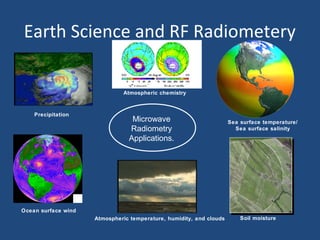
Earth Science and RF Radiometery
Microwave
Radiometry
Applications.
Ocean surface wind
Soil moisture
Sea surface temperature/
Sea surface salinity
Atmospheric temperature, humidity, and clouds
Precipitation
Atmospheric chemistry

Radar

  • 1.
  • 2.
    • Radar: Radiodetection and ranging • Radio stands for microwaves and range means distance • Radar sensors were originally developed and used by millitary but now they are used in civil applications widely such as environmental monitoring
  • 3.
    What is Radar? •RADAR (Radio Detection And Ranging) is a way to detect and study far off targets by transmitting a radio pulse in the direction of the target and observing the reflection of the wave. • It’s basically radio echo
  • 4.
    4 What is RADAR? •A Radar system has three primary functions: - It transmits microwave (radio) signals towards a scene - It receives the portion of the transmitted energy backscattered from the scene - It observes the strength (detection) and the time delay (ranging) of the return signals. • Radar is an active remote sensing system & can operate day/night
  • 5.
    RADAR RAdio Detection AndRanging Radar observables: • Target range • Target angles • Target size • Target speed • Target features Antenna Transmitted Pulse Target Cross Section Propagation Reflected Pulse (“echo”)
  • 6.
    The Range • Distancefrom the radar • Measured from time delay between transmitted pulse and returned signal received
  • 7.
    The Range • Remember,in general v=d/t and d=vt • The range is just a distance • Since radio waves travel at the speed of light (v = c = 300,000 km/sec ) range = c•time/2 • Why divided by 2?
  • 8.
    The Range • The“2” is because the measured time is for a round trip to and from the target. To determine the range, you only want the time to the object, so you take half!
  • 9.
    Radar Range Measurement Transmitted Pulse Reflected Pulse Range Target •Target range = cτ 2 where c = speed of light τ = round trip time
  • 10.
    Why microwaves • Microwavesare electromagnetic waves with wavelength between 1 cm to 1 m • Used by radars because can penetrate clouds and haze or fog • Microwave remote sensing is considered as an active remote sensing but passive sensors are also used which detect naturally emitted microwave energy • Mainly used in meteorology, hydrology and oceanography
  • 11.
    • In radar,antenna transmits microwave signals to the earth’s surface and they are backscattered • The part of the electromagnetic energy which is scattered into the direction of the antenna is detected by the sensor • Active sensors are divided into two groups: imaging and non imaging • Radar is an imaging microwave sensor
  • 12.
    • The non-imagingmicrowave instruments include altimeters which collect distance information such as sea surface height and scatterometers which acquire information about object properties such as wind speed
  • 13.
    • Radar isan active sensor means it is having its own energy source • Since radar is an active sensor so data can be acquired any time • Another advantage of radar is that signal characteristics (wavelength, polarization, incidence angle etc.) can be easily controlled
  • 14.
    Principles of imagingradar • The main systems of an imaging radar includes: transmitter, receiver, an antenna and a recorder • Transmitter is used to generate microwave signals and transmit the energy to the antenna from where it is emitted towards the earth surface • Antenna accepts the backscattered signals and transfer it to the receiver which amplifies the signals for recording purpose • Recorder then stores the received signals • Bistatic radar and monostatic radar
  • 15.
    • Radar acquiresan image according to the strength of the backscattered energy that is received from the ground • The energy received from each transmitted radar pulse can be expressed as radar equation • Pr = G2 λ2 Pt σ/(4π)3 R4
  • 16.
    • Pr =G2 λ2 Pt σ/(4π)3 R4 • Pr: received energy • G: antenna gain(measure of the ability of the antenna to focus the radiation in particular direction ) • λ: wavelength of radiation • Pt: transmitted power • σ: backscattering constant (measure of the strength of the radar signals reflected ) • R: Distance (Range between target and sensor)
  • 17.
    • Transmitting antenna:How well the antenna converts input power into radio waves headed in a specified direction • Receiving antenna: How well the antenna converts radio waves arriving from a specified direction into electrical power
  • 24.
    • Some radartransmitters do not transmit constant, uninterrupted electromagnetic waves. Instead, they transmit rhythmic pulses of EM waves with a set amount of time in between each pulse. The pulse itself would consist of an EM wave of several wavelengths with some dead time after it in which there are no transmissions. The time between each pulse is called the pulse repetition time (PRT) and the number of pulses transmitted in one second is called the pulse repetition frequency (PRF)
  • 25.
    • Once theradar receives the returned signal, it calculates useful information from it such as the time taken for it to be received, the strength of the returned signal, or the change in frequency of the signal. This information is then translated to reveal useful data: an image, a position or the velocity of the speeding car.
  • 26.
  • 28.
    Earth Science andRF Radiometery Microwave Radiometry Applications. Ocean surface wind Soil moisture Sea surface temperature/ Sea surface salinity Atmospheric temperature, humidity, and clouds Precipitation Atmospheric chemistry