Course Instructor:
Introduction to remote sensing
• Concept of Remote Sensing
• Elements Involved in Remote Sensing
• Energy Sources and Electromagnetic Radiation
• Electromagnetic Spectrum
• Classification Electromagnetic Spectrum
• Types of Remote Sensing with Respect to Wavelength
• Interactions of EM Radiation with the Atmosphere
• Interactions of EM Radiation with the Earth’s Surface
• Spectral Reflectance Curve
Concept of Remote Sensing
Remote Sensing is defined as the science (and to some
extent art) of acquiring information about the objects of
interest without actually being in contact with it.
This is done by sensing
and recording reflected
or emitted energy and
processing, analyzing
and applying that
information.
Data collection by remote sensing
1. Energy Source or
Illumination (A)
2. Radiation and the
Atmosphere (B)
3. Interaction with the
Object (C)
4. Recording of Energy
by the Sensor (D)
5. Transmission,
Reception and
Processing (E)
6. Interpretation and
Analysis (F)
7. Application (G)
Elements Involved in Remote Sensing
Energy Sources and Electromagnetic Radiation
All mater with a temperature above absolute zero (k)
radiates energy in the form of electromagnetic waves of
various wavelengths.
Electromagnetic radiation (EMR) is a carrier of
electromagnetic energy by transmitting the oscillation of
the electro-magnetic field through space or matter.
Energy Sources and Electromagnetic Radiation
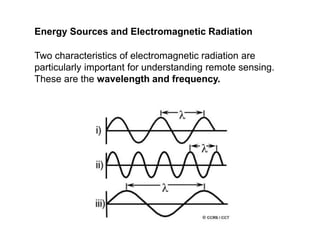
Two characteristics of electromagnetic radiation are
particularly important for understanding remote sensing.
These are the wavelength and frequency.
Energy Sources and Electromagnetic Radiation
• The wavelength is the length of one wave cycle, which
can be measured as the distance between successive
wave crests.
• Wavelength (λ) is measured in metres (m) or some
factor of metres such as micrometres (µm, 10-6
metres).
• Frequency refers to the number of cycles of a wave
passing a fixed point per unit of time.
• Frequency is normally measured in hertz (Hz),
equivalent to one cycle per second, and various
multiples of hertz.
• Electromagnetic energy can be modeled in two ways:
by wave wave motion and particle motion.
Wave Motion
EMR can be considered as a transverse wave with an
electric field and a magnetic field. The two fields are located
at right angles to each other.
c = velocity of EM energy (light) = 3  108 m/s
= wavelength [m]
= frequency [s-1 or Hz]
This equation explains that the shorter wavelength has
higher spectral frequency
Wave Motion
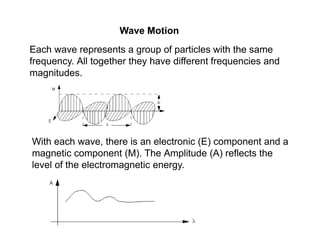
Each wave represents a group of particles with the same
frequency. All together they have different frequencies and
magnitudes.
With each wave, there is an electronic (E) component and a
magnetic component (M). The Amplitude (A) reflects the
level of the electromagnetic energy.
wavelength than in shorter wavelength.
Particle Motion (Quantum Theory)
EMR can be treated as a photon or a light quantum. The
amount of energy held by a photon of a specific wavelength
is given by
E = h  = h  c / 
where E = energy of a photon [J]
h = Plank's constant [6.6262 10-34 J s]
= frequency [Hz]
The longer the wavelength involved, the lower its energy
content
Gamma rays (wavelength is around 10-9 m) are the most
energetic and radio waves (> 1 m) the least energetic.
 It is more difficult to measure the energy emitted in longer
The total range of wavelengths is
commonly referred to as the
electromagnetic spectrum.
The electromagnetic spectrum ranges
from the shorter wavelengths (including
gamma and x-rays) to the longer
wavelengths (including microwaves and
broadcast radio waves).
The division of the spectral wavelength
is based on the devices which can be
used to observe particular types of
energy, such as thermal, shortwave
Gamma-ray
X-ray
Ultraviolet (UV)
Visible light
Infrared (IR)
Microwave
Radio wave
infrared and microwave energy.
Electromagnetic Spectrum
• Any matter with a body temperature greater than 0 K
emits electromagnetic energy. Therefore, it has a
spectrum.
• Furthermore, different chemical elements have
different spectra. They absorb and reflect spectral
energy differently.
• Different elements are combined to form compounds.
Each compound has a unique spectrum due to its
unique molecular structure.
• This is the basis for remote sensing in discriminating
one matter from the other.
• Spectrum of a material is like the finger print of
human being.
Electromagnetic spectrum used in remote sensing
Microwave:
The spectral range of near IR and short wave infrared is
sometimes called the reflective infrared (0.7-3 m) because the
range is more influenced by solar reflection rather than the emission
from the ground surface.
In the thermal infrared region, emission from the ground surface
dominates the radiant energy with little influence from solar
reflection.
Near UV(ultra-violet):
Visible light:
0.3-0.4 m
Blue: 0.4-0.5 m
Green: 0.5-0.6 m
Red: 0.6-0.7 m
Near IR: 0.7-1.3 m
Shortwave IR: 1.3-3 m
Thermal IR: 8-14 m
1 mm - 1 m
Infrared (IR):
Types of Remote Sensing with Respect to Wavelength
1. Visible and Reflective
Infrared Remote
Sensing
2. Thermal Infrared
Remote Sensing
3. Microwave Remote
Sensing
1. Remote sensing devices detect EMR
reflected from the Earth surface
2. Remote sensing device detect EMR
emitted by the Earth itself
3. Remote sensing devices generate
their own EMR, bounce it off the
Earth’s surface and measure the EMR
returned
How is EMR used in Remote Sensing
Three main ‘models’ of how EMR is used in Remote Sensing
Passive
Active
Interactions of EM Radiation with the Atmosphere
The most important source of energy is the Sun. Before the
Sun’s radiation reaches the Earth's surface it has to travel
through some distance of the Earth's atmosphere.
The composition of the atmosphere is thus of importance in
remote sensing because EMR must pass through it in order to
reach the Earth’s surface.
Interactions of EM Radiation with the Atmosphere
The atmosphere also contains
particles with a range of sizes
and sources which are of great
importance in remote sensing.
Composition of the atmosphere
Component Percentage
N2 78.08
O2 20.94
Ar 0.93
CO2 0.0314
O3 0.00000004
Interactions of EM Radiation with the Atmosphere
EMR interacts with particles and gases in the
atmosphere. Three processes serve to attenuate the
signal we are trying to detect
1.Scattering: Redirection of EMR from its original path
2.Absorption: Retention of EMR by molecules in the
atmosphere
3. Refraction: Passing of EMR through the atmosphere
Scattering occurs when particles or
large gas molecules present in the
atmosphere interact with and cause
the electromagnetic radiation to be
redirected from its original path.
Scattering depends on several factors
including the
-Wavelength of the radiation,
- Abundance of particles or gases, and
-Distance the radiation travels through the
atmosphere.
For visible wavelengths, 100 % (in case of cloud cover) to 5
% (in case of clear atmosphere) of energy received by the
sensor is directly contributed by the atmosphere.
There are three types of scattering which take place:
Rayleigh scattering
Mie scattering and
Non-selective scattering
Rayleigh scattering
Diameter of particles << wavelength of EMR (small specks
of dust or N2 and O2)
Rayleigh scattering causes shorter wavelengths of energy to
be scattered much more than longer wavelengths.
Rayleigh scattering is the dominant scattering mechanism in
the upper atmosphere.
The fact that the sky appears "blue" during the day is
because of this phenomenon.
Mie scattering
Diameter of particles = wavelength of EMR (Dust, smoke
and water vapor)
Dust, smoke and water vapour are common causes of Mie
scattering which tends to affect longer wavelengths than
those affected by Rayleigh scattering.
Mie scattering occurs mostly in the lower portions of the
atmosphere where larger particles are more abundant,
and dominates when cloud conditions are overcast.
Nonselective scattering
Diameter of particles >> wavelength of EMR (Water
droplets and large dust particles)
This occurs when the particles are much larger than the
wavelength of the radiation. Water droplets and large dust
particles can cause this type of scattering.
Nonselective scattering gets its name from the fact that all
wavelengths are scattered about equally.
Absorption is the other main mechanism when
electromagnetic radiation interacts with the atmosphere.
In contrast to scattering, this phenomenon causes
molecules in the atmosphere to absorb energy at various
wavelengths.
Three main atmospheric
constituents which absorb
radiation are-
1. Ozone (O3)
2. Carbon dioxide (CO2)
3. Water vapor (H2O)
Ozone absorbs the harmful (to most living things)
ultraviolet radiation from the sun.
Carbon dioxide absorbs radiation strongly in the far
infrared portion of the spectrum - that area associated with
thermal heating - which serves to trap this heat inside the
atmosphere.
Water vapor in the atmosphere absorbs much of the
incoming longwave infrared and shortwave microwave
radiation.
Absorption
Absorption
Parts of the EM spectrum are heavily affected by scattering
and absorption and useless for remote sensing, other parts
are less affected and useful
Atmospheric transmission expressed as percentage
Transmission
The remaining amount of energy after being absorbed and
scattered by the atmosphere is transmitted.
Atmospheric Windows
It refers to the relatively transparent wavelength regions
of the atmosphere.
The wavelengths at which EMR are partially or wholly
transmitted through the atmosphere are known as
atmospheric windows.
Atmospheric windows Wavelength (m)
Upper UV – photographic IR 0.3 – 1(approx.)
Reflected IR 1.3, 1.6, 2.2
Thermal IR 3-5, 8-14
Microwave >5000
‘Atmospheric windows’
Interactions of EM Radiation with the Earth’s Surface
Radiation that is not absorbed or scattered in the atmosphere
can reach and interact with the Earth's surface.
What will happen when the EM energy reaches the Earth
surface? The answer is that the total energy will be broken
into three parts: reflected, absorbed, and/or transmitted.
Interactions of EM Radiation with the Earth’s Surface
When electromagnetic energy is incident on any given earth
surface feature, three fundamental energy interactions are
possible. These are:
1. Absorption (A)
2. Transmission (T)
3. Reflection (R)
The proportions of each will depend on the
- wavelength of the energy,
- angle at which the radiation intersects with the surface and
- roughness of the material and condition of the feature.
Interactions of EM Radiation with the Earth’s Surface
Reflection
Two types of reflection, which represent the two extreme
ends of the way in which energy is reflected from a target are:
1. Specular reflection
2. Diffuse reflection.
Specular or mirror like reflection,
typically occurs when surface is
smooth and all (or almost all) of the
energy is directed away from the
surface in a single direction.
Interactions of EM Radiation with the Earth’s Surface
Diffuse or Lambertian reflection
occurs when the surface is
rough and the energy is reflected
almost uniformly in all directions.
Interactions of EM Radiation with the Earth’s Surface
Whether a particular target reflects specularly or diffusely, or
somewhere in between, depends on the surface roughness
of the feature in comparison to the wavelength of the
incoming radiation.
If the wavelengths are much smaller than the surface
variations or the particle sizes that make up the surface,
diffuse reflection will dominate.
For example, fine-grained sand would appear fairly smooth to
long wavelength microwaves but would appear quite rough to
the visible wavelengths
Spectral Reflectance Curve
The reflectance characteristics of earth surface
feature may be quantified by measuring the
portion of incident energy (Irradiance) that is
reflected (Radiance).
This energy is measured as a function of
wavelength and is called spectral reflectance.
It is defined as:
Reflectance 
Rs
I
Reflectance ranges from 0 to 1 or 0 to 100%. Equipment to
measure reflectance is called spectrometer
A graph of spectral reflectance as a function of wavelength is
termed as spectral reflectance curve
Vegetation: A chemical
compound in leaves called
chlorophyll strongly absorbs
radiation in the red and blue
wavelengths but reflects green
wavelengths.
The internal structure of healthy leaves act as excellent
diffuse reflectors of near-infrared wavelengths.
Spectral Reflectance of Healthy Vegetation
Spectral Reflectance of Bare Soil
The surface reflectance from bare soil depends on many
factors such as color, moisture content, presence of
carbonate and iron oxide content.
Refelectance spectra of surface samples of five mineral soils, (a) organic
dominated, (b) minimally dominated, (c) iron altered, (d) organic affected and (e)
iron dominated
Spectral Reflectance of Water
Water: Longer wavelength
visible and near infrared
radiation is absorbed more by
water than shorter visible
wavelengths.
Water typically looks blue or blue-green due to
stronger reflectance at these shorter wavelengths, and
darker if viewed at red or near infrared wavelengths.
Spectral Reflectance of Water
Typical effects of chlorophyll and sediment on water reflectance: (a) Ocean
water, (b) turbid water and (c) water with chlorophyll
Compared to vegetation and soils water has lower
reflectance.
Vegetation may reflect up to 50%, soils up to 30-40% while
water reflect at most 10% of the incoming radiation.
Beyond 1.2um, all energy is absorbed.
Blue Green Red Infrared
By measuring the energy that is
reflected (or emitted) by targets on
the Earth's surface over a variety of
different wavelengths, it is possible
to build up a spectral response for
that object.
By comparing the response patterns
of different features we may be able
to distinguish between them.
Spectral Reflectance Curve for Water and Vegetation
Spectral Reflectance of Water, Vegetation, Soil and Rock
Principles of Remote sensing
Norman Kerle, Lucas L.E. Janssen and Gerrit C. Huurneman (eds.), ITC
Educational Textbook Series, 3rd Edition, 2004, Enschede, The Netherlands.
Fundamentals of Remote Sensing
Canada Centre for Remote sensing
Remote Sensing and Image Interpretation
Thomas M. Lillesand and Ralph W. Kiefer, Forth Edition, 2000, John Wiley &
Sons, Inc., USA.
Introductory Remote Sensing: Principles and Concepts
Paul J. Gibson, 2000, Routledge, London.
Introductory Remote Sensing: Digital Image Processing and Applications
Paul J. Gibson and Clare H. Power, 2000, Routledge, London.
References on Remote Sensing

Remote sensing

  • 1.
  • 2.
    Introduction to remotesensing • Concept of Remote Sensing • Elements Involved in Remote Sensing • Energy Sources and Electromagnetic Radiation • Electromagnetic Spectrum • Classification Electromagnetic Spectrum • Types of Remote Sensing with Respect to Wavelength • Interactions of EM Radiation with the Atmosphere • Interactions of EM Radiation with the Earth’s Surface • Spectral Reflectance Curve
  • 3.
    Concept of RemoteSensing Remote Sensing is defined as the science (and to some extent art) of acquiring information about the objects of interest without actually being in contact with it. This is done by sensing and recording reflected or emitted energy and processing, analyzing and applying that information. Data collection by remote sensing
  • 4.
    1. Energy Sourceor Illumination (A) 2. Radiation and the Atmosphere (B) 3. Interaction with the Object (C) 4. Recording of Energy by the Sensor (D) 5. Transmission, Reception and Processing (E) 6. Interpretation and Analysis (F) 7. Application (G) Elements Involved in Remote Sensing
  • 5.
    Energy Sources andElectromagnetic Radiation All mater with a temperature above absolute zero (k) radiates energy in the form of electromagnetic waves of various wavelengths. Electromagnetic radiation (EMR) is a carrier of electromagnetic energy by transmitting the oscillation of the electro-magnetic field through space or matter.
  • 6.
    Energy Sources andElectromagnetic Radiation Two characteristics of electromagnetic radiation are particularly important for understanding remote sensing. These are the wavelength and frequency.
  • 7.
    Energy Sources andElectromagnetic Radiation • The wavelength is the length of one wave cycle, which can be measured as the distance between successive wave crests. • Wavelength (λ) is measured in metres (m) or some factor of metres such as micrometres (µm, 10-6 metres). • Frequency refers to the number of cycles of a wave passing a fixed point per unit of time. • Frequency is normally measured in hertz (Hz), equivalent to one cycle per second, and various multiples of hertz. • Electromagnetic energy can be modeled in two ways: by wave wave motion and particle motion.
  • 8.
    Wave Motion EMR canbe considered as a transverse wave with an electric field and a magnetic field. The two fields are located at right angles to each other. c = velocity of EM energy (light) = 3  108 m/s = wavelength [m] = frequency [s-1 or Hz] This equation explains that the shorter wavelength has higher spectral frequency
  • 9.
    Wave Motion Each waverepresents a group of particles with the same frequency. All together they have different frequencies and magnitudes. With each wave, there is an electronic (E) component and a magnetic component (M). The Amplitude (A) reflects the level of the electromagnetic energy.
  • 10.
    wavelength than inshorter wavelength. Particle Motion (Quantum Theory) EMR can be treated as a photon or a light quantum. The amount of energy held by a photon of a specific wavelength is given by E = h  = h  c /  where E = energy of a photon [J] h = Plank's constant [6.6262 10-34 J s] = frequency [Hz] The longer the wavelength involved, the lower its energy content Gamma rays (wavelength is around 10-9 m) are the most energetic and radio waves (> 1 m) the least energetic.  It is more difficult to measure the energy emitted in longer
  • 11.
    The total rangeof wavelengths is commonly referred to as the electromagnetic spectrum. The electromagnetic spectrum ranges from the shorter wavelengths (including gamma and x-rays) to the longer wavelengths (including microwaves and broadcast radio waves). The division of the spectral wavelength is based on the devices which can be used to observe particular types of energy, such as thermal, shortwave Gamma-ray X-ray Ultraviolet (UV) Visible light Infrared (IR) Microwave Radio wave infrared and microwave energy. Electromagnetic Spectrum
  • 12.
    Electromagnetic Spectrum • Anymatter with a body temperature greater than 0 K emits electromagnetic energy. Therefore, it has a spectrum. • Furthermore, different chemical elements have different spectra. They absorb and reflect spectral energy differently. • Different elements are combined to form compounds. Each compound has a unique spectrum due to its unique molecular structure. • This is the basis for remote sensing in discriminating one matter from the other. • Spectrum of a material is like the finger print of human being.
  • 14.
    Electromagnetic spectrum usedin remote sensing Microwave: The spectral range of near IR and short wave infrared is sometimes called the reflective infrared (0.7-3 m) because the range is more influenced by solar reflection rather than the emission from the ground surface. In the thermal infrared region, emission from the ground surface dominates the radiant energy with little influence from solar reflection. Near UV(ultra-violet): Visible light: 0.3-0.4 m Blue: 0.4-0.5 m Green: 0.5-0.6 m Red: 0.6-0.7 m Near IR: 0.7-1.3 m Shortwave IR: 1.3-3 m Thermal IR: 8-14 m 1 mm - 1 m Infrared (IR):
  • 16.
    Types of RemoteSensing with Respect to Wavelength 1. Visible and Reflective Infrared Remote Sensing 2. Thermal Infrared Remote Sensing 3. Microwave Remote Sensing
  • 17.
    1. Remote sensingdevices detect EMR reflected from the Earth surface 2. Remote sensing device detect EMR emitted by the Earth itself 3. Remote sensing devices generate their own EMR, bounce it off the Earth’s surface and measure the EMR returned How is EMR used in Remote Sensing Three main ‘models’ of how EMR is used in Remote Sensing Passive Active
  • 18.
    Interactions of EMRadiation with the Atmosphere The most important source of energy is the Sun. Before the Sun’s radiation reaches the Earth's surface it has to travel through some distance of the Earth's atmosphere. The composition of the atmosphere is thus of importance in remote sensing because EMR must pass through it in order to reach the Earth’s surface.
  • 19.
    Interactions of EMRadiation with the Atmosphere The atmosphere also contains particles with a range of sizes and sources which are of great importance in remote sensing. Composition of the atmosphere Component Percentage N2 78.08 O2 20.94 Ar 0.93 CO2 0.0314 O3 0.00000004
  • 20.
    Interactions of EMRadiation with the Atmosphere EMR interacts with particles and gases in the atmosphere. Three processes serve to attenuate the signal we are trying to detect 1.Scattering: Redirection of EMR from its original path 2.Absorption: Retention of EMR by molecules in the atmosphere 3. Refraction: Passing of EMR through the atmosphere
  • 21.
    Scattering occurs whenparticles or large gas molecules present in the atmosphere interact with and cause the electromagnetic radiation to be redirected from its original path. Scattering depends on several factors including the -Wavelength of the radiation, - Abundance of particles or gases, and -Distance the radiation travels through the atmosphere. For visible wavelengths, 100 % (in case of cloud cover) to 5 % (in case of clear atmosphere) of energy received by the sensor is directly contributed by the atmosphere.
  • 22.
    There are threetypes of scattering which take place: Rayleigh scattering Mie scattering and Non-selective scattering
  • 23.
    Rayleigh scattering Diameter ofparticles << wavelength of EMR (small specks of dust or N2 and O2) Rayleigh scattering causes shorter wavelengths of energy to be scattered much more than longer wavelengths. Rayleigh scattering is the dominant scattering mechanism in the upper atmosphere. The fact that the sky appears "blue" during the day is because of this phenomenon.
  • 24.
    Mie scattering Diameter ofparticles = wavelength of EMR (Dust, smoke and water vapor) Dust, smoke and water vapour are common causes of Mie scattering which tends to affect longer wavelengths than those affected by Rayleigh scattering. Mie scattering occurs mostly in the lower portions of the atmosphere where larger particles are more abundant, and dominates when cloud conditions are overcast.
  • 25.
    Nonselective scattering Diameter ofparticles >> wavelength of EMR (Water droplets and large dust particles) This occurs when the particles are much larger than the wavelength of the radiation. Water droplets and large dust particles can cause this type of scattering. Nonselective scattering gets its name from the fact that all wavelengths are scattered about equally.
  • 26.
    Absorption is theother main mechanism when electromagnetic radiation interacts with the atmosphere. In contrast to scattering, this phenomenon causes molecules in the atmosphere to absorb energy at various wavelengths. Three main atmospheric constituents which absorb radiation are- 1. Ozone (O3) 2. Carbon dioxide (CO2) 3. Water vapor (H2O)
  • 27.
    Ozone absorbs theharmful (to most living things) ultraviolet radiation from the sun. Carbon dioxide absorbs radiation strongly in the far infrared portion of the spectrum - that area associated with thermal heating - which serves to trap this heat inside the atmosphere. Water vapor in the atmosphere absorbs much of the incoming longwave infrared and shortwave microwave radiation. Absorption
  • 28.
    Absorption Parts of theEM spectrum are heavily affected by scattering and absorption and useless for remote sensing, other parts are less affected and useful
  • 29.
    Atmospheric transmission expressedas percentage Transmission The remaining amount of energy after being absorbed and scattered by the atmosphere is transmitted.
  • 30.
    Atmospheric Windows It refersto the relatively transparent wavelength regions of the atmosphere. The wavelengths at which EMR are partially or wholly transmitted through the atmosphere are known as atmospheric windows. Atmospheric windows Wavelength (m) Upper UV – photographic IR 0.3 – 1(approx.) Reflected IR 1.3, 1.6, 2.2 Thermal IR 3-5, 8-14 Microwave >5000
  • 31.
  • 32.
    Interactions of EMRadiation with the Earth’s Surface Radiation that is not absorbed or scattered in the atmosphere can reach and interact with the Earth's surface. What will happen when the EM energy reaches the Earth surface? The answer is that the total energy will be broken into three parts: reflected, absorbed, and/or transmitted.
  • 33.
    Interactions of EMRadiation with the Earth’s Surface When electromagnetic energy is incident on any given earth surface feature, three fundamental energy interactions are possible. These are: 1. Absorption (A) 2. Transmission (T) 3. Reflection (R) The proportions of each will depend on the - wavelength of the energy, - angle at which the radiation intersects with the surface and - roughness of the material and condition of the feature.
  • 34.
    Interactions of EMRadiation with the Earth’s Surface Reflection Two types of reflection, which represent the two extreme ends of the way in which energy is reflected from a target are: 1. Specular reflection 2. Diffuse reflection.
  • 35.
    Specular or mirrorlike reflection, typically occurs when surface is smooth and all (or almost all) of the energy is directed away from the surface in a single direction. Interactions of EM Radiation with the Earth’s Surface
  • 36.
    Diffuse or Lambertianreflection occurs when the surface is rough and the energy is reflected almost uniformly in all directions. Interactions of EM Radiation with the Earth’s Surface
  • 37.
    Interactions of EMRadiation with the Earth’s Surface Whether a particular target reflects specularly or diffusely, or somewhere in between, depends on the surface roughness of the feature in comparison to the wavelength of the incoming radiation. If the wavelengths are much smaller than the surface variations or the particle sizes that make up the surface, diffuse reflection will dominate. For example, fine-grained sand would appear fairly smooth to long wavelength microwaves but would appear quite rough to the visible wavelengths
  • 38.
    Spectral Reflectance Curve Thereflectance characteristics of earth surface feature may be quantified by measuring the portion of incident energy (Irradiance) that is reflected (Radiance). This energy is measured as a function of wavelength and is called spectral reflectance. It is defined as: Reflectance  Rs I Reflectance ranges from 0 to 1 or 0 to 100%. Equipment to measure reflectance is called spectrometer A graph of spectral reflectance as a function of wavelength is termed as spectral reflectance curve
  • 39.
    Vegetation: A chemical compoundin leaves called chlorophyll strongly absorbs radiation in the red and blue wavelengths but reflects green wavelengths. The internal structure of healthy leaves act as excellent diffuse reflectors of near-infrared wavelengths. Spectral Reflectance of Healthy Vegetation
  • 40.
    Spectral Reflectance ofHealthy Vegetation
  • 41.
    Spectral Reflectance ofBare Soil The surface reflectance from bare soil depends on many factors such as color, moisture content, presence of carbonate and iron oxide content. Refelectance spectra of surface samples of five mineral soils, (a) organic dominated, (b) minimally dominated, (c) iron altered, (d) organic affected and (e) iron dominated
  • 42.
    Spectral Reflectance ofWater Water: Longer wavelength visible and near infrared radiation is absorbed more by water than shorter visible wavelengths. Water typically looks blue or blue-green due to stronger reflectance at these shorter wavelengths, and darker if viewed at red or near infrared wavelengths.
  • 43.
    Spectral Reflectance ofWater Typical effects of chlorophyll and sediment on water reflectance: (a) Ocean water, (b) turbid water and (c) water with chlorophyll Compared to vegetation and soils water has lower reflectance. Vegetation may reflect up to 50%, soils up to 30-40% while water reflect at most 10% of the incoming radiation. Beyond 1.2um, all energy is absorbed.
  • 45.
    Blue Green RedInfrared By measuring the energy that is reflected (or emitted) by targets on the Earth's surface over a variety of different wavelengths, it is possible to build up a spectral response for that object. By comparing the response patterns of different features we may be able to distinguish between them. Spectral Reflectance Curve for Water and Vegetation
  • 46.
    Spectral Reflectance ofWater, Vegetation, Soil and Rock
  • 47.
    Principles of Remotesensing Norman Kerle, Lucas L.E. Janssen and Gerrit C. Huurneman (eds.), ITC Educational Textbook Series, 3rd Edition, 2004, Enschede, The Netherlands. Fundamentals of Remote Sensing Canada Centre for Remote sensing Remote Sensing and Image Interpretation Thomas M. Lillesand and Ralph W. Kiefer, Forth Edition, 2000, John Wiley & Sons, Inc., USA. Introductory Remote Sensing: Principles and Concepts Paul J. Gibson, 2000, Routledge, London. Introductory Remote Sensing: Digital Image Processing and Applications Paul J. Gibson and Clare H. Power, 2000, Routledge, London. References on Remote Sensing