SYSTEM & CONTROLVOLUME
• SYSTEM, BOUNDARY, SURROUNDINGS
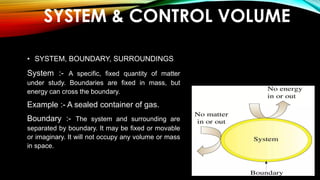
System :- A specific, fixed quantity of matter
under study. Boundaries are fixed in mass, but
energy can cross the boundary.
Example :- A sealed container of gas.
Boundary :- The system and surrounding are
separated by boundary. It may be fixed or movable
or imaginary. It will not occupy any volume or mass
in space.
3.
Surroundings :- Anythingoutside the system which affects the
behavior of the system is known as surroundings.
Control Volume (CV) :- A fixed region in space through which mass
and energy can flow. Boundaries (control surfaces) are permeable
to mass.
Example :- A turbine or a nozzle.
Control surface :- Both mass and Energy can cross the boundary of
a control volume which is called control surface.
Key Distinction :- System is mass-focused (closed); Control Volume
is volume-focused (open).
4.
TYPES OF SYSTEMS
Opensystem :-
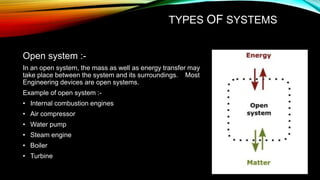
In an open system, the mass as well as energy transfer may
take place between the system and its surroundings. Most
Engineering devices are open systems.
Example of open system :-
• Internal combustion engines
• Air compressor
• Water pump
• Steam engine
• Boiler
• Turbine
5.
Closed system :-
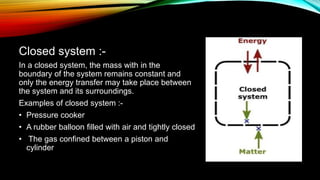
Ina closed system, the mass with in the
boundary of the system remains constant and
only the energy transfer may take place between
the system and its surroundings.
Examples of closed system :-
• Pressure cooker
• A rubber balloon filled with air and tightly closed
• The gas confined between a piston and
cylinder
6.
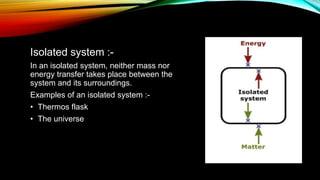
Isolated system :-
Inan isolated system, neither mass nor
energy transfer takes place between the
system and its surroundings.
Examples of an isolated system :-
• Thermos flask
• The universe
7.
COMPARISON OF SYSTEM& CONTROL VOLUME
Key Difference :- Mass vs. Region Focus
Content:
System (Closed) :- Focuses on a fixed quantity of mass.
The boundary may move (e.g., piston moving in a cylinder).
Analysis often uses the First Law for Control Mass.
Control Volume (Open) :- Focuses on a fixed region in space.
Mass flows in and out across the control surface.
Analysis often uses the First Law for Control Volume (Steady
Flow Energy Equation).