Microarray Technology
What Is A Microarray? 
“A microarray is a tool for analyzing 
gene expression that consists of a 
small membrane or glass slide 
containing samples of many genes 
arranged in a regular pattern.”
Uses 
• Analysis of gene expression 
• SNP analysis 
• MHC typing 
• Identification of pathogens 
• Identification of tumours
MICROARRAYS 
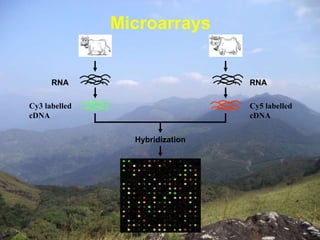
• The underlying principle of microarray technology is the ability of 
DNA to bind to itself and to RNA. 
• Analyzing gene expression involves the detection of mRNA species 
(transcriptome) present in a cell or tissue at a particular point in time.
Microarrays 
RNA RNA 
Cy3 labelled 
cDNA 
Cy5 labelled 
cDNA 
Hybridization
Evolution of Microarrays 
• One gene / one experiment 
– RT-PCR, northern blots, RNase assays 
• Macroarrays 
– Nylon membranes 
– 32P labelled samples 
• Microarrays 
– Glass slides 
– Fluorescent labelled samples 
• Affymetrix
• There are 3 main types of microarrays 
• Glass cDNA microarrays 
• Glass oligonucleotide microarrays 
• Affymetrix
Glass Microarrays 
• cDNA arrays 
– >1000 nucleotides in length 
– cDNA libraries 
• Oligonucleotide arrays 
– 70-80 nucleotides in length 
– Increased specificity
Affymetrix 
• 25 nucleotides in length 
• Mismatch pair 
– Single mismatch at centre of probe 
– Used to detect & eliminate false results 
• 11 probe pairs per gene 
• Photolithography
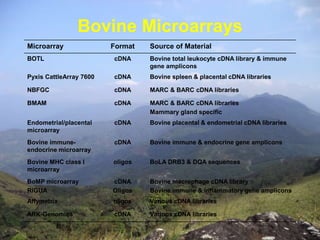
Bovine Microarrays 
Microarray Format Source of Material 
BOTL cDNA Bovine total leukocyte cDNA library & immune 
gene amplicons 
Pyxis CattleArray 7600 cDNA Bovine spleen & placental cDNA libraries 
NBFGC cDNA MARC & BARC cDNA libraries 
BMAM cDNA MARC & BARC cDNA libraries 
Mammary gland specific 
Endometrial/placental 
microarray 
cDNA Bovine placental & endometrial cDNA libraries 
Bovine immune-endocrine 
microarray 
cDNA Bovine immune & endocrine gene amplicons 
Bovine MHC class I 
microarray 
oligos BoLA DRB3 & DQA sequences 
BoMP microarray 
RIGUA 
cDNA 
Oligos 
Bovine macrophage cDNA library 
Bovine immune & inflammatory gene amplicons 
Affymetrix oligos Various cDNA libraries 
ARK-Genomics cDNA Various cDNA libraries
DNA MICROARRAYS CAN BE 
USED TO DETECT DIFFERENCES 
IN THE LEVELS GENE 
EXPRESSION IN DIFFERENT 
POPULATIONS OF CELLS ON A 
GENOME-WIDE LEVEL.
GENE EXPRESSION = A GENE’S 
ABILITY TO MAKE A GENE 
PRODUCT. 
MOST GENES CODE FOR 
PROTEINS (PROTEIN ENCODING 
GENES) THAT WHEN EXPRESSED, 
PRODUCE A GENE-SPECIFIC 
PROTEIN.
DNA MICROARRAYS 
• A small 1 square centimeter chip that’s divided into thousands 
of squares. 
• Each square contains many copies of a single gene. 
• Originally developed by Patrick Brown at the Stanford 
University School of Medicine to determine which genes are 
involved in yeast cell sporulation.
APPLICATIONS OF DNA 
MICROARRAY ANALYSIS. 
• Genes that are involved in the development of an organism. 
• Genes that are activated as a family of genes (gene expression 
profiling). 
• Genes that are involved in human cancers. 
• Earlier diagnosis of human cancers.
EXAMPLE OF A CANCER SUBTYPE 
DETERMINED VIA DNA 
MICROARRAY ANALYSIS. 
• Two subtypes of diffuse large B cell lymphoma. 
• One group of tumor cells expressed a large group of genes that 
are involved in early B cell development. 
• Another group of tumor cells expressed a large group of genes 
that are involved in late B cell development.
Microarrays have many uses. 
1. Major use is to investigate gene expression. 
2. mRNA isolated from a cell gives a snap-shot of 
the events occurring at that time.

Microarray

  • 1.
  • 2.
    What Is AMicroarray? “A microarray is a tool for analyzing gene expression that consists of a small membrane or glass slide containing samples of many genes arranged in a regular pattern.”
  • 3.
    Uses • Analysisof gene expression • SNP analysis • MHC typing • Identification of pathogens • Identification of tumours
  • 4.
    MICROARRAYS • Theunderlying principle of microarray technology is the ability of DNA to bind to itself and to RNA. • Analyzing gene expression involves the detection of mRNA species (transcriptome) present in a cell or tissue at a particular point in time.
  • 5.
    Microarrays RNA RNA Cy3 labelled cDNA Cy5 labelled cDNA Hybridization
  • 6.
    Evolution of Microarrays • One gene / one experiment – RT-PCR, northern blots, RNase assays • Macroarrays – Nylon membranes – 32P labelled samples • Microarrays – Glass slides – Fluorescent labelled samples • Affymetrix
  • 7.
    • There are3 main types of microarrays • Glass cDNA microarrays • Glass oligonucleotide microarrays • Affymetrix
  • 8.
    Glass Microarrays •cDNA arrays – >1000 nucleotides in length – cDNA libraries • Oligonucleotide arrays – 70-80 nucleotides in length – Increased specificity
  • 9.
    Affymetrix • 25nucleotides in length • Mismatch pair – Single mismatch at centre of probe – Used to detect & eliminate false results • 11 probe pairs per gene • Photolithography
  • 10.
    Bovine Microarrays MicroarrayFormat Source of Material BOTL cDNA Bovine total leukocyte cDNA library & immune gene amplicons Pyxis CattleArray 7600 cDNA Bovine spleen & placental cDNA libraries NBFGC cDNA MARC & BARC cDNA libraries BMAM cDNA MARC & BARC cDNA libraries Mammary gland specific Endometrial/placental microarray cDNA Bovine placental & endometrial cDNA libraries Bovine immune-endocrine microarray cDNA Bovine immune & endocrine gene amplicons Bovine MHC class I microarray oligos BoLA DRB3 & DQA sequences BoMP microarray RIGUA cDNA Oligos Bovine macrophage cDNA library Bovine immune & inflammatory gene amplicons Affymetrix oligos Various cDNA libraries ARK-Genomics cDNA Various cDNA libraries
  • 11.
    DNA MICROARRAYS CANBE USED TO DETECT DIFFERENCES IN THE LEVELS GENE EXPRESSION IN DIFFERENT POPULATIONS OF CELLS ON A GENOME-WIDE LEVEL.
  • 12.
    GENE EXPRESSION =A GENE’S ABILITY TO MAKE A GENE PRODUCT. MOST GENES CODE FOR PROTEINS (PROTEIN ENCODING GENES) THAT WHEN EXPRESSED, PRODUCE A GENE-SPECIFIC PROTEIN.
  • 13.
    DNA MICROARRAYS •A small 1 square centimeter chip that’s divided into thousands of squares. • Each square contains many copies of a single gene. • Originally developed by Patrick Brown at the Stanford University School of Medicine to determine which genes are involved in yeast cell sporulation.
  • 14.
    APPLICATIONS OF DNA MICROARRAY ANALYSIS. • Genes that are involved in the development of an organism. • Genes that are activated as a family of genes (gene expression profiling). • Genes that are involved in human cancers. • Earlier diagnosis of human cancers.
  • 15.
    EXAMPLE OF ACANCER SUBTYPE DETERMINED VIA DNA MICROARRAY ANALYSIS. • Two subtypes of diffuse large B cell lymphoma. • One group of tumor cells expressed a large group of genes that are involved in early B cell development. • Another group of tumor cells expressed a large group of genes that are involved in late B cell development.
  • 16.
    Microarrays have manyuses. 1. Major use is to investigate gene expression. 2. mRNA isolated from a cell gives a snap-shot of the events occurring at that time.